Lung Biopsy: Types, What to Expect, Recovery, Risks and Results

Updated: 2 days ago
Written and medically reviewed by Dr. Baraa Alnahhal, MD · Last reviewed: November 2026 · How we review
Quick Answer
A lung biopsy (pulmonary biopsy) removes a small sample of lung tissue so a pathologist can examine it. It's most often used to diagnose and stage lung cancer, and also to diagnose sarcoidosis and pulmonary fibrosis. The four main types are bronchoscopic, CT-guided needle, thoracoscopic and open biopsy. The most common risk is a collapsed lung.
What the research says
Complications are common but mostly minor: a meta-analysis of more than 12,700 CT-guided lung biopsies found overall complication rates of 38.8% for core needle biopsy and 24.0% for fine-needle aspiration, mostly minor, while major complications occurred in only 5.7% and 4.4% (Heerink WJ et al., European Radiology, 2017) [2]
The approach involves a trade-off: a meta-analysis of randomized trials found CT-guided needle biopsy diagnosed peripheral lung nodules more often than bronchoscopic biopsy with radial ultrasound, but the bronchoscopic approach carried five to eight times less risk of pneumothorax (Ho ATN et al., Lung, 2023) [3]
Key takeaways
Removes lung tissue to diagnose cancer, sarcoidosis, fibrosis and other conditions.
Four types: bronchoscopic, CT-guided needle, thoracoscopic (VATS) and open.
Needle and bronchoscopic biopsies are minimally invasive; most people go home the same day.
Main risks: collapsed lung, bleeding and infection; major complications are uncommon.
Only about 3 or 4 in 100 lung nodules turn out to be cancer.
Why is it done?
A lung biopsy is recommended when imaging, such as a CT scan or lung cancer screening scan, shows an abnormal area that can't be explained otherwise. It's used to:
Diagnose and stage lung cancer and check the tumor for markers that guide treatment.
Diagnose sarcoidosis.
Diagnose pulmonary fibrosis and other forms of interstitial lung disease.
Rarely, identify the cause of an unusual pneumonia. Sources: [1]
Most lung nodules are not cancer; many are benign lung tumors or scars. Sources: [1]
Types of lung biopsy
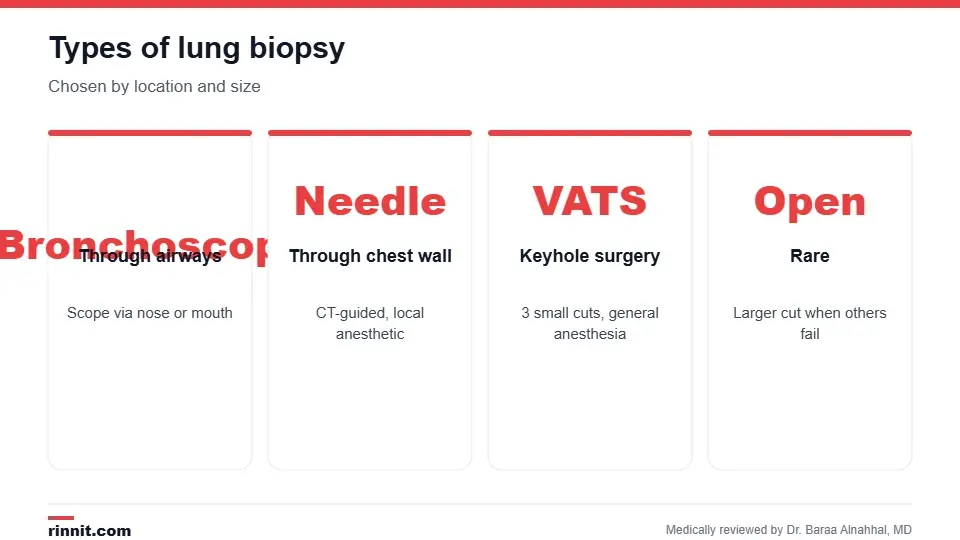
The type depends on where the abnormal area is.
Type | How it's done | Anesthesia | Typical stay |
Bronchoscopic (transbronchial) | A scope passes through the nose or mouth into the airways | General or deep sedation | Same day |
CT-guided needle | A thin needle passes between two ribs into the lung | Local, possibly sedation | Same day |
Thoracoscopic (VATS) | Camera and tools through 3 small chest cuts | General | At least 1 night |
Open (limited thoracotomy) | One larger chest cut; used rarely | General | Several days |
Bronchoscopy works best for areas near the airways, while needle biopsy suits nodules near the outer lung. Thoracoscopy and open biopsy are used when a larger sample is needed or other methods can't reach the area. Sources: [1, 3]
How do I prepare?
Review your medicines with your provider, especially blood thinners and supplements that raise bleeding risk.
Follow instructions about fasting.
Tell your provider about allergies and whether you could be pregnant.
Arrange a ride home, and help at home for a few days after an open biopsy. Sources: [1]
What happens during a needle biopsy?

A CT-guided needle biopsy is usually an outpatient procedure.
A CT scan or X-ray pinpoints the abnormal area.
The skin is cleaned and numbed with local anesthetic; you may get a sedative.
A small cut is made between two ribs.
The needle is guided into the lung, and you may be asked to hold your breath briefly while samples are taken.
The needle is removed, the site is closed and the samples go to a pathologist. Sources: [1]
Thoracoscopic and open biopsies follow a similar process under general anesthesia with a breathing tube. Sources: [1]
Recovery
Needle and bronchoscopic biopsy: a chest X-ray checks for a collapsed lung before you leave; most people go home the same day and recover in about a day, but plan for at least 2 days off work or school.
Thoracoscopic and open biopsy: a hospital stay of at least one night; walking soon after surgery lowers the risk of blood clots and pneumonia.
Call your provider if you cough up blood, have trouble breathing, severe chest pain or signs of infection. Sources: [1]
Risks
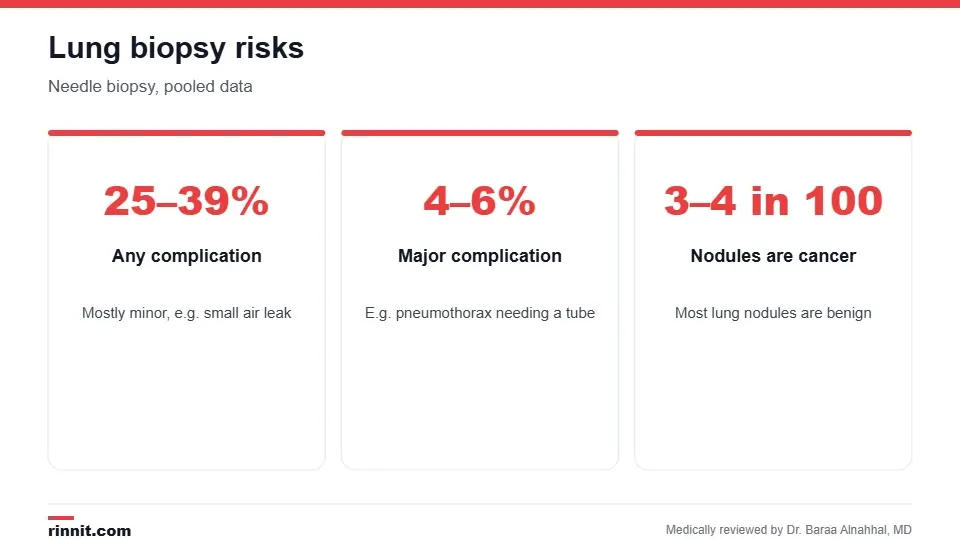
Most complications are minor.
Collapsed lung (pneumothorax): the most common; small ones often heal on their own, and some need a chest tube.
Bleeding in the lung, which may cause coughing up a little blood.
Infection.
With surgical biopsy: anesthesia problems, blood clots, slow healing and scarring. Sources: [1, 2]
Understanding your results
Results usually take a few business days and up to 10 days. If the biopsy shows cancer, you may need more tests to check whether it has spread, such as a PET scan, MRI or bone scan, plus breathing tests and tumor marker testing. If no clear diagnosis is reached, your provider may recommend another biopsy or close follow-up imaging. Sources: [1]
Conclusion
A lung biopsy gives a definite answer when imaging finds something concerning in the lungs. Minimally invasive approaches let most people go home the same day, and while minor complications are common, serious ones are uncommon. Remember that most lung nodules aren't cancer.
Keep learning: read about lung cancer and bronchoscopy.
Frequently asked questions
What is a lung biopsy?
A procedure that removes a small piece of lung tissue to examine under a microscope.
Why would I need a lung biopsy?
To diagnose a nodule, lung cancer, sarcoidosis or scarring seen on imaging.
What are the types of lung biopsy?
Bronchoscopic, CT-guided needle, thoracoscopic (VATS) and open.
Is a lung biopsy painful?
You're numbed or asleep; afterward you may feel sore.
How long does recovery take?
About a day for needle or bronchoscopic biopsy; longer for surgical biopsy.
What is the most common risk?
A collapsed lung (pneumothorax), which often heals on its own.
Will I stay in the hospital?
Usually not for needle or bronchoscopic biopsy; usually yes for surgical biopsy.
How long do results take?
A few business days, up to about 10 days.
Are most lung nodules cancer?
No. Only about 3 or 4 in 100 are cancer.
What happens if the biopsy shows cancer?
More tests check whether it has spread and guide treatment.
Related Reading
Lung Cancer: Symptoms, Causes, Diagnosis, and Treatment Explained the most common reason for a lung biopsy.
Interstitial Lung Disease: What It Is, What Causes the Scarring, and What Treatment Can Actually Do lung scarring conditions diagnosed with biopsy.
Sarcoidosis: Complete Guide to the Condition That Forms Granulomas Throughout the Body an inflammatory disease often confirmed by biopsy.
Bronchoscopy: Why It's Done, What to Expect, Recovery and Risks the airway scope used for many lung biopsies.
Pneumothorax: Understanding Collapsed Lung Causes and Care the most common biopsy complication.
References
Cleveland Clinic. Lung Biopsy: Purpose, Procedure, Risk & Recovery. Cleveland Clinic. Last updated November 10, 2025. https://my.clevelandclinic.org/health/diagnostics/lung-biopsy
Heerink WJ, de Bock GH, de Jonge GJ, et al. Complication rates of CT-guided transthoracic lung biopsy: meta-analysis. Eur Radiol. 2017;27(1):138-148. PMID 27108299. https://doi.org/10.1007/s00330-016-4357-8
Ho ATN, Gorthi R, Lee R, et al. Solitary lung nodule: CT-guided transthoracic biopsy vs transbronchial biopsy with endobronchial ultrasound and flexible bronchoscope, a meta-analysis of randomized controlled trials. Lung. 2023;201(1):85-93. PMID 36695890. https://doi.org/10.1007/s00408-023-00596-9
Medical disclaimer
This article is for general education only and does not replace advice from a qualified healthcare professional. Talk to your doctor about your own diagnosis and treatment, and seek emergency care right away for severe or sudden symptoms.



Comments