Benign Lung Tumors: The Noncancerous "Spots on the Lung" That Turn Out to Be Harmless 99% of the Time on CT Scans — and Why Most Never Need Treatment

Updated: 3 days ago
Medically reviewed by Dr. Baraa Alnahhal, MD · Last reviewed: October 15, 2026
What the research says
Most spots flagged on screening CT are not cancer. In the National Lung Screening Trial of 53,454 high-risk adults, 96.4% of positive low-dose CT results turned out to be false positives — even though screening still cut lung-cancer deaths by 20%. (Aberle et al., New England Journal of Medicine, 2011) [6]
Incidental lung nodules are found far more often than cancer. Among more than 200,000 adults in a U.S. health system, nodules were seen on 24–31% of chest CT scans; extrapolated nationally, about 1.57 million Americans had a nodule found, of whom about 63,000 were diagnosed with lung cancer within 2 years. (Gould et al., American Journal of Respiratory and Critical Care Medicine, 2015) [7]
Surgery for hamartomas, the most common benign lung tumor, is safe. In 39 patients treated over 20 years, there were no deaths after surgery, and over an average 7.3 years of follow-up only one patient had the tumor come back. (Guo et al., Journal of Experimental & Clinical Cancer Research, 2008) [8]
Quick Answer
A benign lung tumor is a noncancerous buildup of tissue in the lungs or airways that does not spread, grows slowly and is rarely life-threatening [1]. Hamartomas are the most common type, at about 55% of cases [1]. More than 90% of nodules are found by accident on imaging done for other conditions [1]. Most need no treatment beyond periodic scans [1].
What Are Benign Lung Tumors?
Hearing the word "tumor" may naturally cause fear or panic. But a tumor is simply an abnormal buildup of tissue that occurs when cells divide too quickly or don't die off as they normally should [1]. A lung tumor is a tumor that occurs in the lung tissue itself or in the airways that lead to the lungs [1].
Those airways include your nose, the inside of your nose (nasal cavity), your throat (pharynx), your voice box (larynx), your windpipe (trachea), the large tubes that carry air from your windpipe to your lungs (bronchi), and your lungs [1].
Lung tumors can either be cancerous (malignant) or noncancerous (benign) [1]. A benign lung tumor is the noncancerous kind.
How are benign lung tumors different from malignant ones?
When compared to malignant tumors, benign lung tumors are different in five important ways.
Feature | Benign lung tumors |
Spread | Aren't cancerous, so they won't spread to other parts of your body [1] |
Growth | Grow slowly or might even stop growing or shrink [1] |
Danger | Aren't usually life-threatening [1] |
Removal | Usually don't require removal [1] |
Behavior | Can expand and push against nearby tissues but won't invade, destroy, or replace other tissues [1] |
What's the difference between a nodule and a mass?
Tumors that are generally larger than 3 centimeters (1.2 inches, or about two aspirin tablets) in diameter are called masses [1]. Tumors that are 3 centimeters or fewer in diameter are nodules [1]. If a nodule forms in your lungs, it's a pulmonary nodule — "pulmonary" simply means something relates to, affects, or occurs in your lungs.
What Are the Types of Benign Lung Tumors?
There are several types of benign lung tumors. The three main types are hamartomas, bronchial adenomas, and papillomas, plus a handful of rarer kinds [1].
Type | Where it grows | What it's made of / key facts |
Hamartoma | Lung tissue | "Normal" tissues (cartilage, connective tissue, fat, muscle) in abnormal amounts; usually under 4 cm; looks like a round coin on chest X-rays — though in about 15% of cases it may look like fluffy wool or popcorn [1] |
Bronchial adenoma | Bronchi and the mucus glands or ducts of the windpipe | Another common type of benign lung nodule [1] |
Squamous papilloma | Bronchial tubes | One or more; children and adults; caused by HPV infection (the same virus behind warts and certain STIs); has the potential to become malignant [1] |
Glandular papilloma | Larger airways | Less common than squamous; all ages but mostly adults; almost always one centrally located nodule; cause unknown [1] |
Mixed squamous and glandular papilloma | Bronchial tubes | Mix of squamous and glandular tissue; only a few reported cases; can potentially become malignant because the squamous cells can change over time [1] |
Chondroma, fibroma, neurofibroma, lipoma (rare types) | Lungs or elsewhere (hands, feet, ribs, arms, thighs, below skin, along nerves) [1] | Chondromas are made of cartilage; fibromas of fibrous tissue; neurofibromas of connective tissue along nerve cells; lipomas of fatty tissue [1] |

Why are hamartomas the most common type?
Hamartomas are the most common type of benign lung nodule [1] [5]. They account for about 55% of all benign lung tumors and about 8% of all lung tumors [1]. Hamartomas usually stay within a limited area and aren't likely to press against nearby tissue [1].
How Common Are Benign Lung Tumors?
Pulmonary nodules are fairly common. Healthcare providers see them in about 1 in every 500 chest X-rays [1]. They find them in about 24% to 31% of chest CT (computed tomography) scans, according to one large U.S. study [1]. They find nodules 6 millimeters or larger in 15% to 20% of CT scans [1].
The reassuring part: at least 60% of the pulmonary nodules that providers see in chest X-rays are benign, and 99% of those in chest CT scans are benign [1]. If you're over 50 and smoke, there may be a higher chance of nodules appearing on a CT scan of your chest [1].
What Are the Symptoms of Benign Lung Tumors?
Most people don't have any symptoms of benign lung tumors [1] [3]. Healthcare providers discover more than 90% of nodules by accident while performing a chest X-ray or CT scan for some other condition [1] [3].
If you do have symptoms, they may include a mild cough that lasts for a long time, shortness of breath (dyspnea), chest discomfort, wheezing, a rattling sound in the lungs, or coughing up blood (hemoptysis) [1].
Possible symptom | Note |
Mild, long-lasting cough | Usually mild and long-lasting [1] |
Shortness of breath (dyspnea) | Feels like not getting enough air |
Chest discomfort | Vague pressure or ache |
Wheezing | Whistling sound while breathing |
Rattling sound in the lungs | Also called rhonchi [5] |
Coughing up blood (hemoptysis) | Always worth a call to your provider [1] |

What Causes Benign Lung Nodules or Masses?
Many different conditions and factors can cause benign lung nodules or masses [1]. In some cases, there are no known causes [1].
Possible cause | What it is |
Granulomas | |
Lung abscess | A pus-filled infection; bacteria usually cause abscesses [1] |
Inflammation | Diseases such as rheumatoid arthritis, sarcoidosis, or granulomatosis with polyangiitis can cause inflammation that leads to a benign lung nodule [1] |
Infection | Many types of infections can present with lung nodules [1] |
Congenital condition | Conditions present from birth, such as a lung cyst (sac of fluid), a scar, or another lung malformation [1] |
Unknown | In some cases, there are no known causes [1] |
How Are Benign Lung Nodules Diagnosed?
Healthcare providers usually discover benign lung nodules and tumors during a chest X-ray or CT scan for another condition [1] [4]. The appearance of the nodule on the CT scan is often enough for a provider to determine that it's benign [1].
If a provider can't determine the cause of a nodule from a CT scan, they may perform a bronchoscopy to take a closer look at the nodule or mass and get a tissue sample (biopsy) [1]. During a bronchoscopy, the provider slides a scope with a camera at the end down your throat and into your lungs. You'll get a sedative before the procedure, so you're unaware of what's happening [1]. The provider may get a tissue sample during the bronchoscopy, or they may get one by using a CT scan to insert a needle into the mass and extract a small amount of tissue [1] [4].
A provider will also use the following information to make a diagnosis.
Diagnostic clue | What it points to |
Nodule size | The provider may chart the growth rate. The smaller the nodule, the more likely it is to be benign. Benign nodules grow very slowly, if they grow at all. Cancerous nodules, on average, can double in size every four months or fewer [1]. |
Calcium content | Benign nodules may have calcium in them — it looks white on a CT scan — whereas malignant nodules usually don't [1]. |
Shape and surface |
How Are Benign Lung Tumors Treated?
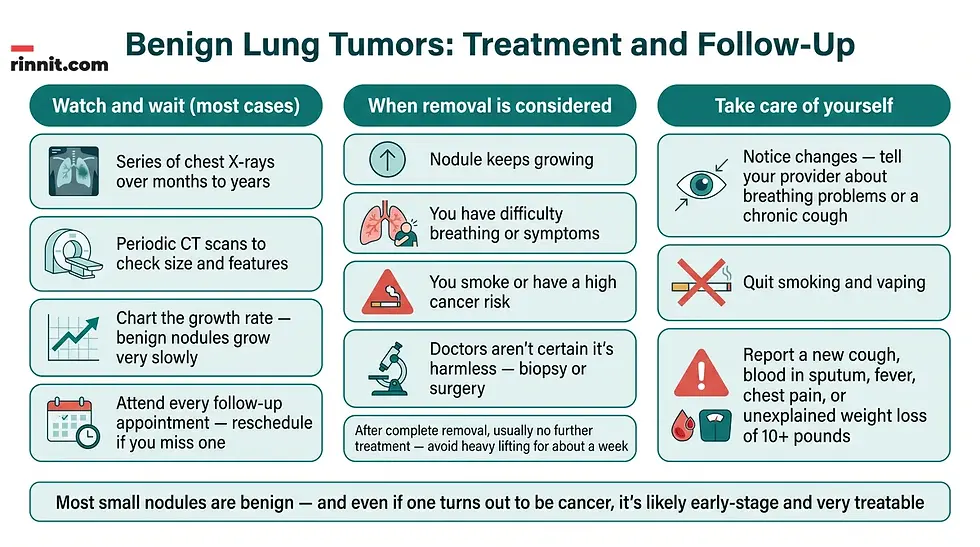
In most cases, benign lung nodules and masses don't require treatment [1]. A healthcare provider will recommend taking a series of X-rays and CT scans over a period of months to years to watch for any changes in tumor size or features [1] [4].
Does a benign lung tumor have to be removed?
No — a healthcare provider doesn't have to remove a benign tumor. They may only recommend removing a benign lung tumor if it changes [1]. A provider may recommend a biopsy or surgery to remove the tumor if they aren't certain that it's benign or harmless, or if:
How soon will I feel better after removal?
You should avoid heavy lifting and strenuous activities for about a week [1] if you have a biopsy or surgery to remove a benign lung tumor.
What's the Prognosis?
The prognosis for a benign lung tumor is usually good, as these tumors rarely cause major health problems and often need no further treatment after complete removal [1] [4].
What can I expect if I've been diagnosed with a benign lung tumor?
If you and a healthcare provider agree to simply monitor ("watch and wait") your lung tumor, it's important that you schedule regular follow-up appointments. Be sure to attend every appointment. If you have to miss one, be sure to reschedule [1].
If you have surgery to remove a benign lung tumor and a provider completely removes it, you usually don't need additional treatment [1].
Can benign lung tumors be prevented?
Benign lung tumors are usually harmless. A healthcare provider can tell you what to expect if you have an underlying condition that causes benign lung tumors to form [1].
How do I take care of myself?
Though benign lung tumors don't usually cause major health problems, the best thing you can do is be aware of changes in your body. Talk to a healthcare provider if you develop symptoms that affect your breathing or cause long-lasting (chronic) coughing. You should also schedule an appointment with a provider if you notice new lumps or bumps that appear to grow [1]. If you smoke or vape, it's a good idea to quit [1].
What's the Bottom Line?
Benign lung tumors are growths in the lungs or airways that are not cancer — they don't spread, grow slowly or stop growing, and are rarely life-threatening [1]. The good news is striking: more than 90% of these nodules are found by accident during imaging for something else, and at least 60% of X-ray nodules and 99% of CT-scan nodules turn out to be benign [1]. Most people never feel a thing, and most never need treatment — just periodic X-rays and CT scans to confirm the nodule isn't growing or changing [1]. Hamartomas are the most common type, and a biopsy or surgery is only considered when the nodule grows, causes symptoms, can't be confirmed as harmless, or cancer risk is high [1]. If your provider finds a spot on your lung, it's completely normal to feel anxious — but most small nodules are benign, and even in the worst case, a nodule that turns out to be cancer is likely at an early, very treatable stage [1] [2]. Keep your follow-up appointments, watch for breathing changes or a lasting cough, and if you smoke or vape, quitting is one of the best things you can do for your lungs [1] [2].
Frequently Asked Questions
What is a benign lung tumor?
It's an abnormal buildup of tissue in the lung tissue itself or in the airways that lead to the lungs, caused by cells dividing too quickly or not dying off as they normally should [1]. It is not cancerous [1].
Is a benign lung tumor cancer?
No. Benign lung tumors aren't cancerous and won't spread to other parts of your body [1]. They grow slowly, are rarely life-threatening, and usually don't require removal [1].
What's the difference between a nodule and a mass?
Tumors larger than 3 centimeters (1.2 inches, about two aspirin tablets) in diameter are masses; those 3 centimeters or smaller are nodules [1].
How common are benign lung nodules?
Fairly common — seen in about 1 in every 500 chest X-rays and found in about 24% to 31% of chest CT scans in one large U.S. study (15% to 20% of CT scans show nodules 6 mm or larger) [1]. At least 60% of X-ray nodules and 99% of CT-scan nodules are benign [1].
What is the most common benign lung tumor?
The hamartoma, which accounts for about 55% of all benign lung tumors and about 8% of all lung tumors [1].
Do benign lung tumors cause symptoms?
Most people have no symptoms at all — more than 90% are found by accident during imaging for another condition [1]. Possible symptoms include a long-lasting mild cough, shortness of breath, chest discomfort, wheezing, a rattling sound, or coughing up blood [1].
What causes benign lung nodules?
Granulomas from infections (like TB or fungal infections), lung abscesses, inflammation from conditions like rheumatoid arthritis or sarcoidosis, other infections, congenital conditions present from birth — and sometimes no known cause [1].
How do doctors know a nodule is benign?
Often the appearance on a CT scan is enough. Clues include small size and slow growth (cancerous nodules can double in four months or fewer), calcium inside the nodule (white on CT), and a smooth, regular shape rather than an irregular, rough one [1].
What is a bronchoscopy?
A procedure where a provider slides a scope with a camera down your throat and into your lungs — with a sedative beforehand — to look at a nodule closely and take a tissue sample (biopsy) [1].
Does a benign lung tumor need to be removed?
Usually not. Removal is considered if the provider isn't certain it's harmless, if you smoke or have high cancer risk, if you have symptoms, if tests suggest cancer may be present, or if the nodule keeps growing [1].
What does "watch and wait" mean?
Taking a series of X-rays and CT scans over months to years to watch for any changes in the tumor's size or features [1] — the standard approach for most benign nodules.
Will I feel better quickly after surgery?
If you have a biopsy or surgery to remove a benign lung tumor, you should avoid heavy lifting and strenuous activities for about a week [1].
Can I prevent benign lung tumors?
They're usually harmless, and a provider can tell you what to expect if you have an underlying condition that causes them to form [1].
What symptoms should make me call a provider?
A new or worsening cough, coughing up blood, shortness of breath, fever, chills, chest pain, or unexplained weight loss of 10 pounds or more [1] [2].
What questions should I ask my doctor?
How do you know I have a lung tumor? How do you know it's benign? What kind is it? Do I need other tests or treatment? How often should I follow up? Should I see a pulmonologist? [1]
Related Reading
Lung Cancer Screening: Who Should Get It, How Low-Dose CT Works and What Results Mean explains who qualifies for yearly low-dose CT screening, how the scan works and what the results mean.
References
Cleveland Clinic. Benign Lung Tumors. Cleveland Clinic. Last updated October 19, 2023. https://my.clevelandclinic.org/health/diseases/15023-benign-lung-tumors
Slatore CG, et al. What is a Lung Nodule? American Journal of Respiratory and Critical Care Medicine. 2016;193(7):P11-2. PMID 27035787. https://doi.org/10.1164/rccm.1937P11 (American Thoracic Society Patient Education Series; online version updated June 2020: https://www.thoracic.org/patients/patient-resources/resources/lung-nodules-online.pdf)
Velez MA. Overview of Lung Tumors. Merck Manual Consumer Version. Last updated February 2026. https://www.merckmanuals.com/home/cancer/tumors-of-the-lungs/overview-of-lung-tumors
National Library of Medicine (U.S.). Solitary pulmonary nodule. MedlinePlus Medical Encyclopedia. Reviewed July 1, 2025. https://medlineplus.gov/ency/article/000071.htm
Rajasurya V, Sharma S. Pulmonary Hamartoma. In: StatPearls [Internet]. Treasure Island (FL): StatPearls Publishing; 2026 Jan-. PMID 30969628. https://www.ncbi.nlm.nih.gov/books/NBK539806/
National Lung Screening Trial Research Team, Aberle DR, et al. Reduced lung-cancer mortality with low-dose computed tomographic screening. New England Journal of Medicine. 2011;365(5):395-409. PMID 21714641. https://doi.org/10.1056/NEJMoa1102873
Gould MK, et al. Recent Trends in the Identification of Incidental Pulmonary Nodules. American Journal of Respiratory and Critical Care Medicine. 2015;192(10):1208-14. PMID 26214244. https://doi.org/10.1164/rccm.201505-0990OC
Guo W, et al. Surgical treatment and outcome of pulmonary hamartoma: a retrospective study of 20-year experience. Journal of Experimental & Clinical Cancer Research. 2008;27(1):8. PMID 18577258. https://doi.org/10.1186/1756-9966-27-8
Medical disclaimer
The information in this article is for general informational purposes only and is not intended as professional medical advice, diagnosis, or treatment. Always seek the advice of your physician or other qualified health provider with any questions you may have regarding a medical condition. Never disregard professional medical advice or delay in seeking it because of something you have read here.



Comments