Lung Cancer Screening: Who Should Get It, How Low-Dose CT Works and What Results Mean

Updated: 2 days ago
Written and medically reviewed by Dr. Baraa Alnahhal, MD · Last reviewed: November 2026 · How we review
Quick Answer: What is lung cancer screening?
Lung cancer screening is a yearly low-dose CT scan (LDCT) of the chest that can find lung cancers while they're small and easier to treat. It's recommended if you're 50 to 80 years old, have a smoking history of at least 20 pack-years, and currently smoke or quit within the last 15 years. Any suspicious spot needs more tests. [1]
What the research says
Low-dose CT screening saves lives. In a trial of 53,454 people at high risk, three yearly low-dose CT scans led to 20% fewer lung cancer deaths than chest X-rays. Most positive scans turned out not to be cancer: 96.4% of positive low-dose CT results were false positives. (National Lung Screening Trial Research Team, New England Journal of Medicine, 2011) [2]
Screening in everyday practice finds cancer earlier, but many people miss yearly scans. Among more than 1 million people screened in the United States, 17% had a positive first scan and cancer was found in 0.56%. More than half of the cancers found were at the earliest stage, yet only 22.3% of people returned for their yearly scan. (Silvestri et al., Chest, 2023) [3]
Key takeaways
Lung cancer screening uses a yearly low-dose CT scan, not a blood test. [1]
It's for people 50 to 80 with a 20 pack-year smoking history who smoke now or quit in the last 15 years. [1]
Lung cancer rarely causes symptoms early, when it's easier to treat. [1]
Possible downsides include false positives, treatment of growths that would never cause harm and a small dose of radiation. [1]
You can stop screening at age 81, once you've been smoke-free for 15 years, or if you couldn't or wouldn't have lung surgery. [1]
What is lung cancer screening?
Lung cancer screening is a yearly low-dose CT scan that can show possibly cancerous tumors while they're still small. The scan takes pictures of the inside of your lungs. Screening means having a regular test to catch a disease before it causes symptoms. [1]
You might wonder why you'd look for cancer without symptoms. Lung cancer rarely causes symptoms in its early stages, when it's easier to treat, so it's often found later, when survival rates are lower. While anyone can get lung cancer, people who smoke or used to smoke are at higher risk. [1]
Who should get screened for lung cancer?
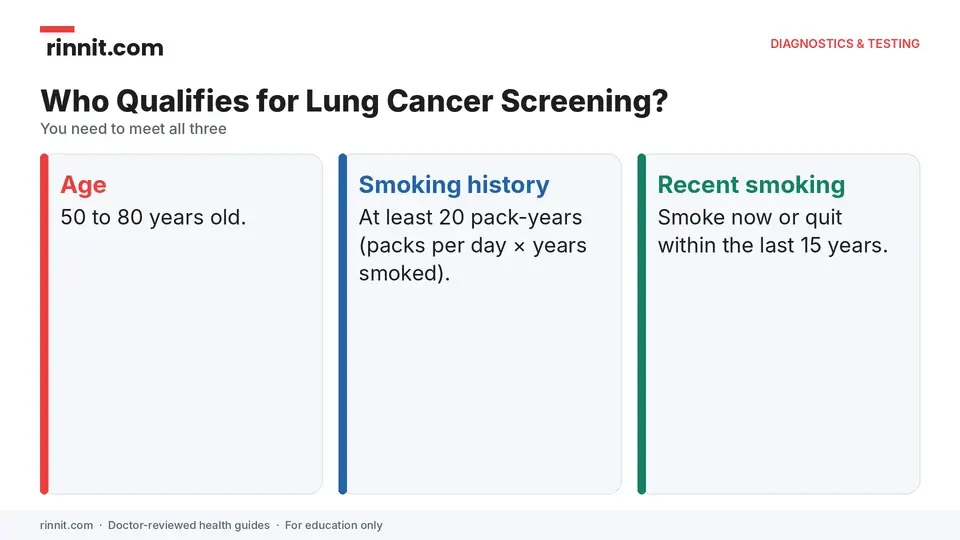
Healthcare providers recommend a low-dose CT scan every year if you meet all of the following: [1]
You're between the ages of 50 and 80.
You currently smoke or quit within the last 15 years.
You have a smoking history of at least 20 pack-years.
These guidelines come from the United States Preventive Services Task Force (USPSTF), based on the most recent lung cancer screening studies. [1]
How do you calculate pack-years?
Multiply the number of years you've smoked by the number of packs (20 cigarettes each) you smoke per day. A 20 pack-year history could mean one pack a day for 20 years or two packs a day for 10 years. Ask your provider if you're not sure how to work out your number. [1]
Packs per day | Years smoked | Pack-years |
1 | 20 | 20 |
2 | 10 | 20 |
0.5 | 40 | 20 |
1 | 30 | 30 |
Sources: [1]
How does lung cancer screening work?
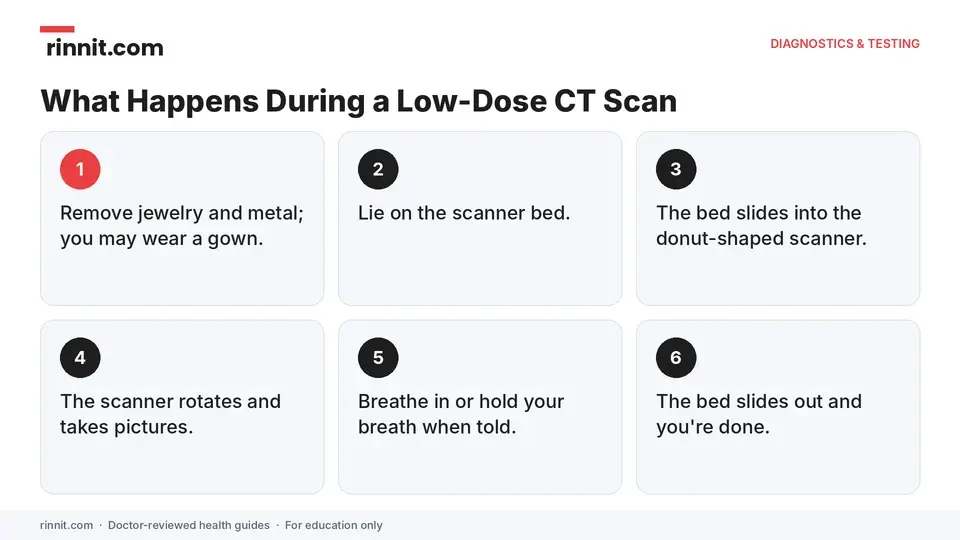
Screening takes pictures of the inside of your chest. The images don't diagnose cancer on their own, but they can show small masses that can then be tested for cancer. [1]
How do you prepare?
You usually don't need to do anything to prepare, but check with your provider. Wear clothes that are easy to change out of and little jewelry. Let the imaging center know if you're sick, especially with a respiratory illness, because they may reschedule your scan so it's as accurate as possible. [1]
What happens during the scan?
The technician asks you to remove jewelry, watches or metal items, and you may change into a gown from the waist up.
You lie on a bed that goes into the scanner.
The bed slides into a scanner shaped like a tube or a donut.
The scanner rotates around you, and the table may move forward and backward as it takes pictures.
The technician asks you to breathe in or out and hold your breath at certain points. They talk to you through a microphone from just outside the room.
When all the images are taken, the bed slides out so you can get up.
There are no special instructions to follow after the scan. [1]
Benefits and risks of lung cancer screening
Benefits | Risks |
Low-dose CT shows smaller tumors than a plain chest X-ray | False positives: something that looks like cancer but isn't, which can lead to more tests and stress |
Studies suggest X-ray screening isn't as good at catching cancer early or improving survival | Treatment of a growth that would never have caused symptoms or spread |
Low-dose CT uses less radiation than a standard CT scan | Radiation exposure: small but not zero, and repeated exposure can raise cancer risk |
Sources: [1]
Scans can also show incidental findings, conditions your provider wasn't looking for, such as COPD or a breast mass. Some need treatment, but others don't and can lead to unnecessary tests and stress. Most pulmonary nodules, small masses of lung tissue, are harmless. [1]
What do lung cancer screening results mean?

A radiologist and your provider review your scan, and you get a report. It may use these terms: [1]
Result | What it means |
Negative | Nothing on the scan looked possibly cancerous |
Benign | Nodules (growths) that don't look cancerous |
Probably benign | Nodules that don't look cancerous, but follow-up imaging is recommended to be sure |
Suspicious | Nodules that could be cancer; you'll need follow-up imaging and possibly a biopsy |
Very suspicious | Nodules that look like cancer; you'll need follow-up imaging and a biopsy, and a referral to a lung cancer specialist |
Significant or potentially significant | Something that isn't cancer but may need more imaging or testing |
Incomplete | The scan couldn't be evaluated, for example because of a lung infection; you may need another scan in a few months |
Sources: [1]
If you need urgent follow-up, you'll usually hear quickly. Otherwise, results may take from a day to several days. [1]
What happens after an abnormal result?
Your provider will discuss your results with you. Possible next steps include: [1]
Another low-dose CT scan in three to six months
A follow-up diagnostic CT scan
A visit with a cancer specialist (oncologist)
A visit with a lung specialist (pulmonologist) or another specialist for noncancerous conditions
When can you stop lung cancer screening?
You can stop yearly screening if any of these are true: [1]
You're 81 or older.
You haven't smoked in 15 years or longer. Your risk goes down as more time passes since your last cigarette.
You can't have, or wouldn't choose to have, surgery for early lung cancer because of a health condition.
Is lung cancer screening worth it?
Screening makes it more likely that, if you do develop lung cancer, it's found early when it's more treatable. Studies suggest more than half of people (about 1 in 2) diagnosed through yearly screening are diagnosed at an early stage, compared with about 28% of all people diagnosed with lung cancer. There are no blood tests that screen for or diagnose lung cancer. [1]
Conclusion
Lung cancer is serious, but yearly low-dose CT screening is a powerful way to catch it early, when treatment works best. If you're 50 to 80 and smoke or quit within the last 15 years, talk with your provider about whether you qualify.
Remember that a positive scan isn't a diagnosis. Most findings turn out to be harmless, and your care team will guide any follow-up tests.
Keep learning: Read our guide to lung cancer or our explainer on the CT scan. For more trusted, doctor-reviewed health guides, visit Rinnit.com.
FAQ
What is lung cancer screening?
A yearly low-dose CT scan that looks for lung cancer before it causes symptoms.
Who should get screened for lung cancer?
People 50 to 80 with a 20 pack-year history who smoke now or quit within 15 years.
What is a pack-year?
The number of packs smoked per day multiplied by the number of years you've smoked.
How often should I be screened?
Once a year while you still meet the screening criteria.
Do I need to prepare for a lung cancer screening?
Usually not, but wear easy clothes and tell staff if you have a respiratory illness.
Is lung cancer screening safe?
It uses a low dose of radiation, which is small but not zero.
What does a positive lung cancer screening mean?
Something needs a closer look; most findings, like many nodules, are not cancer.
What happens after an abnormal scan?
You may need a repeat scan, a diagnostic CT or PET/CT, or a specialist visit.
When can I stop lung cancer screening?
At 81, after 15 smoke-free years, or if you couldn't or wouldn't have lung surgery.
Is there a blood test for lung cancer?
No. There are no blood tests that screen for or diagnose lung cancer.
Related Reading
Lung Cancer: Symptoms, Causes, Diagnosis, and Treatment Explained explains the cancer that yearly low-dose CT screening aims to catch early.
Non-Small Cell Lung Cancer: Understanding Symptoms, Types, and Treatments covers the most common type of lung cancer and how it's treated.
Pulmonary Nodules: Symptoms, Causes, and Management explains the small lung spots screening scans often find, most of which are harmless.
Benign Lung Tumors: The Noncancerous "Spots on the Lung" That Turn Out to Be Harmless 99% of the Time on CT Scans — and Why Most Never Need Treatment describes noncancerous lung growths that can show up on a screening scan.
What Is Chronic Obstructive Pulmonary Disease (COPD)? Symptoms, Causes, Stages, and Treatment covers COPD, a lung disease that screening scans sometimes reveal.
Cancer Screening: Which Tests Are Recommended, When to Start and the Risks gives an overview of recommended cancer screening tests, starting ages and the benefits and risks.
References
Cleveland Clinic. Lung Cancer Screening: Purpose, Procedure & Results. Cleveland Clinic. Last updated August 16, 2024. https://my.clevelandclinic.org/health/diagnostics/15031-lung-cancer-screening
National Lung Screening Trial Research Team; Aberle DR, Adams AM, Berg CD, et al. Reduced lung-cancer mortality with low-dose computed tomographic screening. N Engl J Med. 2011;365(5):395-409. PMID 21714641. https://doi.org/10.1056/NEJMoa1102873
Silvestri GA, Goldman L, Tanner NT, et al. Outcomes From More Than 1 Million People Screened for Lung Cancer With Low-Dose CT Imaging. Chest. 2023;164(1):241-251. PMID 36773935. https://doi.org/10.1016/j.chest.2023.02.003
Medical disclaimer
This article is for general education only and does not replace advice from a qualified healthcare professional. Talk to your doctor about your own diagnosis and treatment, and seek emergency care right away for severe or sudden symptoms.



Comments