What Is Rumination Syndrome? A Plain-Language Guide to the Condition Behind Effortless Food Regurgitation After Meals

Updated: 2 days ago
Medically reviewed by Dr. Baraa Alnahhal, MD · Last reviewed: October 2026
Quick Answer
Rumination syndrome is a condition in which undigested or partially digested food repeatedly comes back up from the stomach without effort or intent, then is rechewed and swallowed or spit out. [1] It is not immediately life-threatening, but untreated it can cause weight loss and malnutrition. After other conditions are ruled out, it is mainly treated with habit-reversal behavior therapy. [2]
What the research says
Rumination syndrome is more common in adults than in children, and is linked to anxiety and depression. A meta-analysis of 30 community studies with 114,228 participants found a pooled prevalence of rumination syndrome (Rome IV criteria) of 3.7% in adults (95% CI 2.3 to 5.1) versus 0.4% in children (95% CI 0.2 to 0.6). In adults, rumination was associated with anxiety (odds ratio 2.3), depression (odds ratio 1.8), and female gender (odds ratio 1.4). (Haworth et al., Neurogastroenterol Motil, 2024) [3]
Breathing-based behavioral therapy sharply cuts regurgitation episodes. A 2019 review describes a randomized trial in which behavioral therapy with biofeedback led to a 74% reduction in rumination activity (from about 29 to 7 daily events) compared with a 1% change during sham treatment (P = .001), and concludes that diaphragmatic breathing, with or without biofeedback, remains the most effective treatment strategy. (Halland, Curr Opin Gastroenterol, 2019) [4]
The condition is easy to miss or mistake for something else. A 2024 review calls rumination syndrome an underdiagnosed behavioral disorder with an estimated prevalence of 3.1% to 5.8%, notes it can be misdiagnosed as GERD, gastroparesis, achalasia, or bulimia nervosa, and identifies diaphragmatic breathing — supported by biofeedback and cognitive behavioral therapy — as the mainstay of treatment. (Pomenti and Katzka, Dis Esophagus, 2024) [5]
What Is Rumination Syndrome?
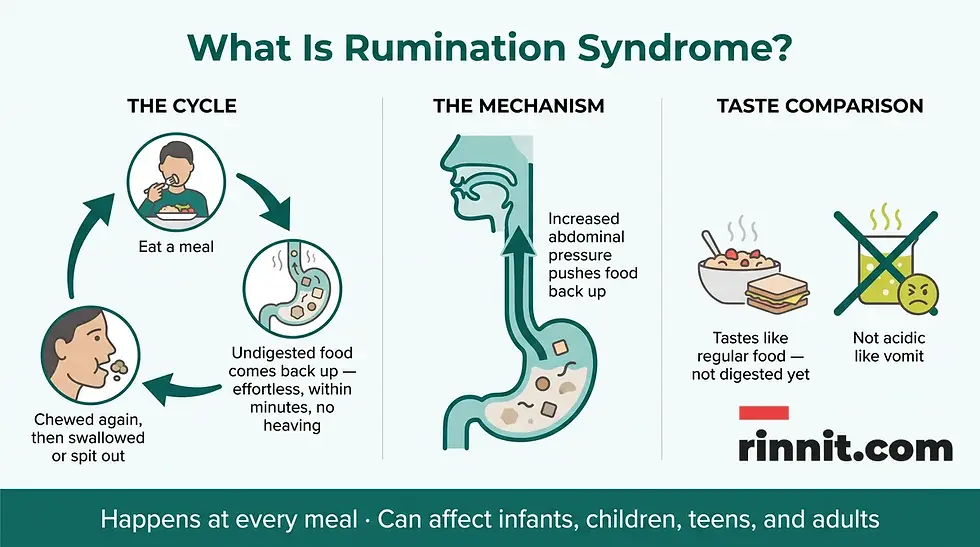
Rumination syndrome is a condition in which someone repeatedly regurgitates undigested or partially digested food from the stomach. The regurgitated food is then chewed again and swallowed or spit out. [1] People with rumination syndrome don't try to regurgitate food. It happens without any effort. [1]
Because the food hasn't yet been digested, it reportedly tastes like regular food and isn't acidic like vomit. Rumination typically happens at every meal, soon after eating. [1]
Studies suggest it affects about 3% to 4% of adults, though it is often missed. Treatment may include behavioral therapy or medicine, and behavioral therapy typically involves teaching people to breathe from the diaphragm. [1]
What Are the Symptoms of Rumination Syndrome?
Rumination syndrome symptoms include effortless regurgitation soon after eating, belly pain relieved by regurgitation, fullness, nausea and unintended weight loss. [1]
Rumination syndrome isn't usually associated with retching (the heaving motion that usually comes before vomiting). [1] That lack of heaving is one of the things that distinguishes it from vomiting.
When Should You See a Doctor?
Consult a healthcare professional if you or your child often regurgitates food. [1]
Symptom | What it looks like |
Effortless regurgitation | Typically within minutes of eating, at every meal |
Belly pain or pressure | Relieved by regurgitation |
Feeling of fullness | After or during meals |
Nausea | May accompany regurgitation |
Weight loss without trying | Can signal a problem that needs attention |
What Causes Rumination Syndrome?
The exact cause of rumination syndrome isn't clear. But it appears to be caused by an increase in abdominal pressure. [1]
Rumination syndrome is often confused with bulimia nervosa, gastroesophageal reflux disease (GERD — a condition where stomach acid backs up into the food pipe), and gastroparesis (a condition where the stomach empties too slowly). [1] Some people have rumination syndrome linked to a rectal evacuation disorder. A rectal evacuation issue involves pelvic floor muscles that don't work together correctly, which leads to ongoing constipation. [1]
The condition has long been known to happen in infants and people with developmental disabilities. It's now clear that the condition isn't related to age, as it can happen in children, teens and adults. [1] Rumination syndrome is more likely to happen in people with anxiety, depression or other psychiatric disorders. [1] [3]
Factor | Detail |
Apparent mechanism | An increase in abdominal pressure pushes food back up |
Exact cause | Not clear |
Commonly confused with | Bulimia nervosa, GERD, gastroparesis |
Sometimes linked to | A rectal evacuation disorder (pelvic floor muscles that don't coordinate, causing ongoing constipation) |
Who gets it | Infants, children, teens, and adults — it isn't age-related |
Higher likelihood | People with anxiety, depression, or other psychiatric disorders |
What Complications Can Rumination Syndrome Cause?
Rumination syndrome complications may include weight loss, malnutrition, worn teeth, bad breath, embarrassment and social isolation, and untreated it can damage the esophagus. [1]
Unhealthy weight loss.
Malnutrition.
Worn teeth.
Bad breath.
Embarrassment.
Social isolation.
Untreated, rumination syndrome can damage the tube between the mouth and stomach, called the esophagus. [1]

How Is Rumination Syndrome Diagnosed?
To diagnose rumination syndrome, a healthcare professional asks about current symptoms and takes a medical history. This first examination, combined with observing behavior, is often enough to diagnose rumination syndrome. [2]
Sometimes, tests such as high-resolution esophageal manometry and impedance measurement are used to confirm the diagnosis. This testing shows whether there is increased pressure in the abdomen. It also can provide an image of the irregular function for use in behavioral therapy. [2]
Other tests that may be used to rule out other possible causes of your or your child's symptoms include:
Upper endoscopy. This test allows a close look at the esophagus, stomach and upper part of the small intestine to rule out any obstruction. A small tissue sample called a biopsy may be removed for further study. [2]
Gastric emptying. This procedure can measure how long it takes food to empty from the stomach. Another version of this test also can measure how long it takes food to travel through the small intestine and colon. [2]
Test | What it does |
Symptoms + history + behavior observation | Often enough to diagnose on its own |
High-resolution esophageal manometry and impedance measurement | Confirms the diagnosis; shows increased abdominal pressure; images the irregular function for use in behavioral therapy |
Upper endoscopy | Looks at the esophagus, stomach, and upper small intestine to rule out obstruction; a biopsy may be taken |
Gastric emptying | Measures how long food takes to leave the stomach (a version can track travel through the small intestine and colon too) |
How Is Rumination Syndrome Treated?
Treatment for rumination syndrome takes place after ruling out other disorders and depends on age and cognitive ability. [2]
How Does Behavior Therapy Work?
Habit-reversal behavior therapy is used to treat people without developmental disabilities who have rumination syndrome. First, you learn to recognize when rumination happens. When rumination starts, you use the abdominal muscles to breathe in and out. This technique is called diaphragmatic breathing. Diaphragmatic breathing prevents abdominal contractions and regurgitation. [2] [4]
Biofeedback is part of behavior therapy for rumination syndrome. During biofeedback, imaging can help you or your child learn diaphragmatic breathing skills to counteract regurgitation. [2]
For infants, treatment usually focuses on working with parents or caregivers to change the infant's environment and behavior. [2]
What Medicines May Help?
Some people with rumination syndrome may benefit from treatment with medicine that helps relax the stomach after eating. [2]
If frequent rumination is damaging the esophagus, proton pump inhibitors such as esomeprazole (Nexium) or omeprazole (Prilosec) may be prescribed. These medicines can protect the lining of the esophagus until behavior therapy reduces the frequency and severity of regurgitation. [2]
Treatment path | What happens |
Habit-reversal behavior therapy | Learn to recognize when rumination starts, then breathe in and out using abdominal muscles (diaphragmatic breathing) to prevent abdominal contractions and regurgitation |
Biofeedback | Imaging helps you or your child learn diaphragmatic breathing skills to counteract regurgitation |
Infant care | Work with parents or caregivers to change the infant's environment and behavior |
Stomach-relaxing medicine | May help some people after eating |
Proton pump inhibitors (esomeprazole/Nexium, omeprazole/Prilosec) | Prescribed if frequent rumination is damaging the esophagus; protects the lining until behavior therapy reduces regurgitation |

How Should You Prepare for Your Appointment?
You may start by seeing your or your child's primary healthcare professional. Or you may be referred immediately to a doctor who specializes in digestive disorders, called a gastroenterologist. [2]
What Can You Do?
When you make the appointment, ask if there's anything that needs to be done in advance, such as fasting before a specific test. Make a list of symptoms (including any that seem unrelated to the reason for the appointment), key personal information (major stresses, recent life changes, family medical history), all medications, vitamins or other supplements you or your child takes (including doses), and questions to ask the healthcare professional. Take a family member or friend along, if possible, to help you remember the information you're given. [2]
For rumination syndrome, some basic questions to ask include:
What's the most likely cause of these symptoms?
Are there other possible causes?
Are any tests needed?
Is this likely temporary or long lasting?
What treatment do you recommend?
Are there any alternatives to the primary approach you're suggesting?
Are any dietary restrictions recommended?
Do you have any brochures or other printed material about this condition? What websites do you recommend?
What Will the Doctor Ask?
You'll likely be asked a few questions during the appointment, such as:
When did the symptoms begin?
Do symptoms occur with every meal?
How severe are the symptoms?
Does anything make your or your child's symptoms better?
Does anything seem to worsen the symptoms?
What Can You Do in the Meantime?
Chewing gum may help ease some rumination syndrome symptoms for some people. [2]
What is the bottom line on rumination syndrome?
Rumination syndrome is the effortless, unintended return of undigested food to the mouth within minutes of eating — at every meal. It doesn't involve heaving, the food tastes normal rather than acidic, and it can affect anyone from infants to adults. While the exact cause isn't clear, increased abdominal pressure appears to be behind it, and the condition is more likely in people with anxiety, depression, or other psychiatric disorders. Left untreated, it can wear down teeth, damage the esophagus, cause weight loss and malnutrition, and isolate people socially. The good news is that diagnosis is often possible from symptoms, history, and observation alone, and treatment usually starts with habit-reversal behavior therapy — learning to spot the pattern and using belly breathing to stop the regurgitation — with stomach-relaxing medicine or proton pump inhibitors added when needed. If you or your child often regurgitates food, the best first step is a conversation with a healthcare professional.
Take the Next Step
If you or your child often regurgitates food after meals, talk to a healthcare professional — the sooner, the better for your teeth, your nutrition, and your esophagus. Ask whether you should start with your primary care provider or go straight to a gastroenterologist, bring a written list of your symptoms and medicines, and ask about habit-reversal behavior therapy, since diaphragmatic breathing is the cornerstone of treatment. Until your appointment, chewing gum may help ease symptoms for some people, and a supportive family member or friend can help you remember what you're told.
Frequently Asked Questions
What is rumination syndrome?
Rumination syndrome is a condition in which someone repeatedly regurgitates undigested or partially digested food from the stomach. The food is then chewed again and swallowed or spit out — without any effort or intent.
Why doesn't the food taste acidic like vomit?
Because the food hasn't yet been digested, it reportedly tastes like regular food and isn't acidic like vomit.
When does it happen?
Rumination typically happens at every meal, soon after eating — usually within minutes.
Is rumination syndrome the same as vomiting?
No. Regurgitation in rumination syndrome is effortless and isn't usually associated with retching (the heaving motion that precedes vomiting).
What causes it?
The exact cause isn't clear, but it appears to be caused by an increase in abdominal pressure. It's more likely in people with anxiety, depression, or other psychiatric disorders.
Who gets rumination syndrome?
Rumination syndrome has long been known in infants and people with developmental disabilities, but it isn't age-related — it can happen in children, teens, and adults.
What complications can it cause?
Unhealthy weight loss, malnutrition, worn teeth, bad breath, embarrassment, social isolation, and — if untreated — damage to the esophagus.
How is it diagnosed?
Usually through symptoms, medical history, and observing behavior, which is often enough. Sometimes high-resolution esophageal manometry and impedance measurement confirm the diagnosis, and other tests (upper endoscopy, gastric emptying) rule out other causes.
How is it treated?
Treatment depends on age and cognitive ability and usually focuses on habit-reversal behavior therapy — recognizing when rumination happens and using diaphragmatic breathing to stop it. Some people benefit from stomach-relaxing medicine, and proton pump inhibitors may protect the esophagus if regurgitation is frequent.
Can I do anything before my appointment?
Chewing gum may help ease some symptoms for some people. When you arrive, tell the healthcare professional when symptoms began, whether they happen at every meal, how severe they are, and what makes them better or worse.
Related Reading
Esophageal Manometry: What the Test Measures, How to Prepare and What Results Mean explains the test that measures how your esophagus muscles and valves work.
References
Mayo Clinic Staff. Rumination syndrome: Symptoms and causes. Mayo Clinic. Last updated June 28, 2025. Accessed October 14, 2026. https://www.mayoclinic.org/diseases-conditions/rumination-syndrome/symptoms-causes/syc-20377330
Mayo Clinic Staff. Rumination syndrome: Diagnosis and treatment. Mayo Clinic. Last updated June 28, 2025. Accessed October 14, 2026. https://www.mayoclinic.org/diseases-conditions/rumination-syndrome/diagnosis-treatment/drc-20377333
Haworth JJ, Treadway S, Hobson AR. The prevalence of rumination syndrome and rumination disorder: a systematic review and meta-analysis. Neurogastroenterol Motil. 2024;36(7):e14793. PMID: 38563201. https://doi.org/10.1111/nmo.14793
Halland M. Rumination syndrome: when to suspect and how to treat. Curr Opin Gastroenterol. 2019;35(4):387-393. PMID: 31116102. https://doi.org/10.1097/MOG.0000000000000549
Pomenti S, Katzka DA. Current state of rumination syndrome. Dis Esophagus. 2024;37(9):doae041. PMID: 38741462. https://doi.org/10.1093/dote/doae041
Disclaimer: This guide is for general information only and is not a substitute for professional medical advice, diagnosis, or treatment. Always seek the advice of a physician or other qualified health provider with any questions about a medical condition. Never disregard professional medical advice or delay seeking it because of something you have read here.



Comments