Esophagram (Barium Swallow): Purpose, Prep, Procedure and Results

Updated: 2 days ago
Written and medically reviewed by Dr. Baraa Alnahhal, MD · Last reviewed: November 2026 · How we review
Quick Answer: What is an esophagram?
An esophagram, also called a barium swallow, is an X-ray test that shows what happens inside the esophagus as you swallow. You drink a liquid containing barium, which makes the esophagus show up clearly. It helps find problems such as trouble swallowing, achalasia, strictures, spasms and hiatal hernia. The test is painless and takes 20 to 30 minutes. [1]
What the research says
A timed barium swallow can spot achalasia-type disorders fairly accurately. In 290 adults with swallowing problems, a timed barium esophagram using barium height and tablet passage detected achalasia or a related outflow blockage with 77.8% sensitivity and 86.0% specificity. Combining several image measurements raised accuracy to 88.3%. (Fass et al., Gastroenterology, 2025) [2]
Reflux seen on a barium swallow does not confirm GERD. Among 182 people who had both a barium esophagram and reflux monitoring, reflux seen on barium predicted confirmed GERD with only 37.6% sensitivity and 71.6% specificity. A hiatal hernia seen on barium was linked to a higher acid burden. (Bhardwaj et al., Journal of Clinical Gastroenterology, 2026) [3]
A standard barium swallow is not a substitute for manometry when checking muscle function. In 46 people before anti-reflux surgery, a standard barium esophagram matched high-resolution manometry for esophageal motility in only 46% of cases, with a sensitivity of 14%. (Zambito et al., American Journal of Surgery, 2021) [4]
Key takeaways
An esophagram (barium swallow) is an X-ray test that shows how your esophagus moves and looks while you swallow. [1]
It helps diagnose conditions such as dysphagia, achalasia, esophageal spasms, strictures, hiatal hernia, diverticula and tumors. [1]
The test takes about 20 to 30 minutes, is painless and needs no sedation. [1]
Barium can cause bloating, cramps, constipation and white stool for a short time; drinking water helps. [1]
Barium findings are often combined with other tests, such as manometry or reflux monitoring, to confirm a diagnosis. [3] [4]
What is an esophagram?
An esophagram is a test that shows what happens inside your esophagus, the tube that carries food from your throat to your stomach, when you swallow. It is also called a barium swallow. [1]

You drink a liquid containing a small amount of barium. Barium makes body parts show up more clearly on X-ray. The test uses fluoroscopy, a type of X-ray that sends short bursts of beam to record your esophagus in action, like a video. [1]
Why is a barium swallow done?
Your provider may order an esophagram if they suspect a problem with your esophagus. It can help diagnose: [1]
Condition | What it means |
Difficulty swallowing (dysphagia) | Food or liquid does not pass easily from the mouth to the stomach |
Achalasia | The esophagus has trouble moving food toward the stomach |
Esophagogastric junction outflow obstruction | The lower esophageal sphincter does not relax as it should |
Esophageal spasms | Uncoordinated or painful muscle contractions in the esophagus |
Esophageal stricture or web | A narrowing or thin band of tissue inside the esophagus |
Hiatal hernia | Part of the stomach pushes up through the diaphragm |
Diverticulum, polyps, ulcers or cancer | A pouch, growth or sore in the esophagus lining |
Sources: [1]
It can also help detect esophageal atresia, a condition present at birth in which the esophagus does not form properly. [1]
What are the variations of a barium swallow?
Your provider may add extra steps to get a clearer view of certain problems. [1]
Variation | How it works | What it helps show |
Standard barium drink | You sip and swallow a flavored barium liquid while X-ray video records | How the esophagus moves and its overall shape |
Effervescent granules | Barium is mixed with baking soda crystals that make gas and gently inflate the esophagus | The lining, narrowing, strictures and hernias |
Barium tablet | You swallow a barium tablet at the end of the test | Narrowing or strictures |
Sources: [1]
How do you prepare for an esophagram?
Before the test, your provider explains the procedure and asks whether you have any allergies to barium. If you are allergic, iodine may be used as the contrast agent instead. [1]
Mention recent X-rays. Radiation exposure can add up over time.
Share if you could be pregnant. Your provider needs to know before any X-ray test.
Follow eating and drinking instructions. The radiology department may ask you to stop eating or drinking for a set time before the test.
Skip gum and hard candy. They can coat your throat and affect the images.
Wear comfortable clothing. You will move into different positions on a tilting table.
Sources: [1]
What happens during a barium swallow?
An esophagram is an outpatient test, and you do not need sedation. A provider guides you through each step. [1]
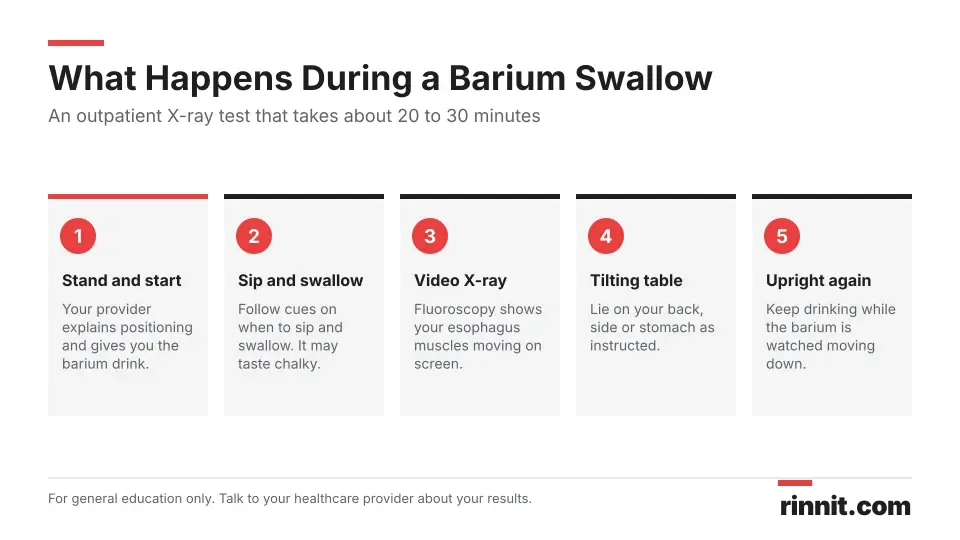
You stand for the first part while your provider explains how to position yourself, then you receive the barium drink.
You sip and swallow the barium solution. It contains sweeteners and flavoring but may taste chalky.
You follow your provider's cues on when to sip and when to swallow.
Video of your esophagus muscles moving appears on your provider's screen.
You turn in different directions as instructed.
You lie on a tilting table and change positions, lying on your back, side or stomach.
The table moves you upright so you can keep drinking the solution while your provider watches the barium move through your esophagus.
Sources: [1]
Barium swallow at a glance
Item | Typical detail |
Type of test | X-ray (fluoroscopy) with a barium contrast drink |
Setting | Outpatient; you go home the same day |
Sedation | None |
How long it takes | About 20 to 30 minutes |
Does it hurt? | No, the test is painless |
Results | Explained by your provider at a follow-up visit |
Sources: [1]
What happens after a barium swallow?
You can return to your usual routine after the test. Barium may cause some short-term side effects that usually ease as it passes out in your stool: [1]
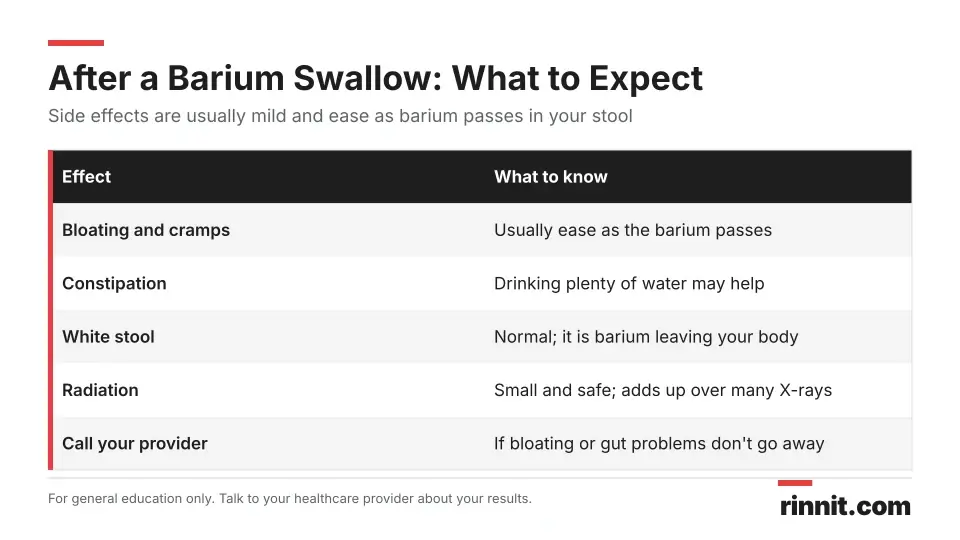
Bloating
Cramps
Constipation
White stool, which is normal and simply barium leaving your body
Drinking plenty of water may help the barium move through your system. [1]
What do barium swallow results mean?
There is no number-based normal range for an esophagram. A radiologist reviews the images, and your provider shares the results and explains them at a follow-up visit. This includes any next steps, such as other tests or treatment. [1]
A barium swallow is often one piece of the picture. Research shows that reflux seen on barium does not reliably confirm GERD, and a standard barium study is less accurate than manometry for checking esophageal muscle function. Your provider may order these tests to confirm what the images suggest. [3] [4]
What are the risks of a barium swallow?
An esophagram is a low-risk test. The main concerns are: [1]
Risk | What to know |
Radiation | A small, safe amount; exposure can add up with repeated X-rays |
Bloating and cramps | Usually ease as the barium passes |
Constipation | Drinking plenty of water may help |
Barium allergy | Tell your provider; iodine contrast may be used instead |
Sources: [1]
When should you call your provider?
Contact your provider if: [1]
Side effects such as a bloated belly do not go away, or you have not had a bowel movement within 2 days or cannot pass gas
You have ongoing problems with your esophagus or gut, even if the barium may not be the cause
Questions to ask your provider
Why do I need an esophagram, and what are you looking for?
Will I need effervescent granules or a barium tablet during the test?
How long should I stop eating and drinking beforehand?
Will I need other tests, such as an endoscopy or manometry?
When and how will I get my results?
Conclusion
An esophagram, or barium swallow, uses a barium drink and X-ray video to show how your esophagus looks and moves while you swallow. It is painless, needs no sedation and takes about 20 to 30 minutes, and it helps find problems such as dysphagia, achalasia, strictures and hiatal hernia. [1]
Side effects are usually mild and short-lived, such as bloating, constipation and white stool. Because barium findings are often combined with other tests, ask your provider how the results fit with the rest of your evaluation. [1] [3]
Keep learning: Read our guides to dysphagia, achalasia and hiatal hernia. For more on barium X-ray tests, see the MedlinePlus guide to the upper GI and small bowel series.
FAQ
What is an esophagram?
An esophagram, also called a barium swallow, is an X-ray test that shows how your esophagus works as you swallow a liquid containing barium.
Why would a doctor order a barium swallow?
It helps check for esophageal problems such as trouble swallowing, achalasia, esophageal spasms, strictures, hiatal hernia, diverticula, polyps, ulcers and esophageal cancer.
How do I prepare for a barium swallow?
Follow the radiology team's instructions about stopping eating and drinking, avoid gum and hard candy, and tell your provider about allergies, recent X-rays or a possible pregnancy.
Does a barium swallow hurt?
No. The test is painless and does not need sedation, though the barium drink may taste chalky.
How long does a barium swallow take?
The test usually takes about 20 to 30 minutes, and you can go home the same day.
What does barium taste like?
The barium drink contains sweeteners and flavoring, but it may still taste chalky.
Is the radiation from a barium swallow safe?
The test uses a small, safe amount of radiation. Radiation can add up over many X-rays, so tell your provider about recent imaging.
What happens after a barium swallow?
You may have bloating, cramps or constipation, and your stool may look white for a while. Drinking plenty of water helps the barium pass.
What if I am allergic to barium?
Tell your provider before the test. An iodine-based contrast agent may be used instead.
When will I get my barium swallow results?
Your provider explains the results at a follow-up visit, along with any next steps such as more tests or treatment.
When should I call my doctor after a barium swallow?
Call if side effects such as bloating do not go away, or if you have ongoing problems with your esophagus or gut.
Related Reading
Learn more in our guide to Dysphagia (Trouble Swallowing): Symptoms, Causes, Diagnosis & Treatment — Complete Guide.
Learn more in our guide to Achalasia: Symptoms, Causes, and Treatment.
Learn more in our guide to Acid Reflux & GERD: Symptoms, Causes, Diagnosis, and Treatment.
Learn more in our guide to Hiatal Hernia: Symptoms, Causes, and Treatment Options.
Learn more in our guide to Esophageal Strictures: Symptoms, Causes, Diagnosis, Treatment and When to Seek Emergency Care — What You Need to Know.
Learn more in our guide to Esophageal Spasms: Symptoms, Causes, and Treatment.
Videofluoroscopic Swallowing Study (VFSS): Modified Barium Swallow explains the video X-ray test that shows how you swallow.
References
Cleveland Clinic. Barium Swallow Test (Esophagram): What It Is & Why It's Done. Cleveland Clinic. Last updated December 12, 2025. https://my.clevelandclinic.org/health/diagnostics/22766-esophagram
Fass OZ, Pandolfino JE, Schauer JM, et al. Diagnostic Accuracy of Timed Barium Esophagram for Achalasia. Gastroenterology. 2025;169(1):63-72. PMID 40020937. https://doi.org/10.1053/j.gastro.2025.02.013
Bhardwaj R, Davis TA, Franz A, et al. Reflux Seen on a Barium Swallow is Not a Substitute For Ambulatory Reflux Monitoring in Symptomatic Patients. J Clin Gastroenterol. 2026;60(2):129-135. PMID 40009703. https://doi.org/10.1097/MCG.0000000000002133
Zambito G, Roether R, Kern B, et al. Is barium esophagram enough? Comparison of esophageal motility found on barium esophagram to high resolution manometry. Am J Surg. 2021;221(3):575-577. PMID 33228948. https://doi.org/10.1016/j.amjsurg.2020.11.028
Medical disclaimer
This article is for general education only and does not replace advice from a qualified healthcare professional. Talk to your doctor about your own diagnosis and treatment, and seek emergency care right away for severe or sudden symptoms.



Comments