Videofluoroscopic Swallowing Study (VFSS): Modified Barium Swallow

Updated: 2 days ago
Written and medically reviewed by Dr. Baraa Alnahhal, MD · Last reviewed: November 2026 · How we review
Quick Answer
A videofluoroscopic swallowing study (VFSS), also called a modified barium swallow, is a video X-ray that shows how food and liquid move from the mouth through the throat and into the esophagus. It helps find the cause of trouble swallowing (dysphagia) and checks for aspiration. Results guide exercises and diet changes.
What the research says
Bedside checks can overcall aspiration: in 53 people with acute stroke, a bedside swallowing assessment detected 80% of those who aspirated on videofluoroscopy, but only half of its positive results were true aspiration, because it often mistook laryngeal penetration for aspiration (Smith HA et al., Age Ageing, 2000) [2]
VFSS helps measure whether treatment works: in a randomized trial of 30 people with post-stroke dysphagia, VFSS findings showed fewer severe penetration-aspiration events after two weeks of breathing-swallow coordination training with biofeedback than with usual rehabilitation alone (Wang L et al., Ann Med, 2026) [3]
Key takeaways
A video X-ray of swallowing; also called a modified barium swallow.
Finds the cause of dysphagia and checks for aspiration.
Uses barium in liquids and foods of different textures.
Led by a speech-language pathologist with a radiologist.
Results guide swallowing exercises and diet changes.
Why is it done?
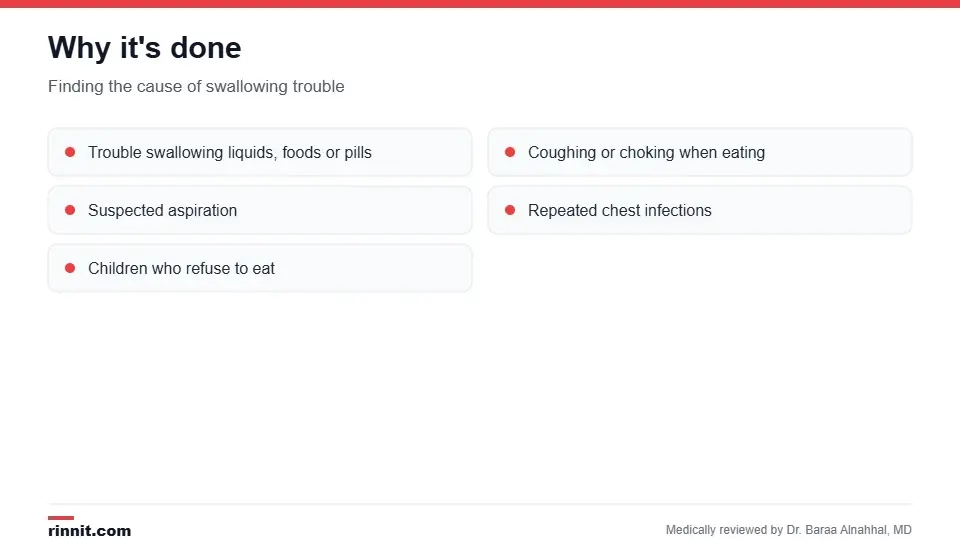
A VFSS shows what happens when you swallow.
Trouble swallowing certain liquids, foods or pills (dysphagia).
Coughing or choking while eating or drinking.
Suspected aspiration, which can lead to aspiration pneumonia.
In children, refusal to eat or repeated chest infections. Sources: [1]
VFSS vs barium swallow

A VFSS focuses on the mouth and throat.
Feature | VFSS (modified barium swallow) | |
Main focus | Mouth and throat, with a limited look at the esophagus | Esophagus |
Who leads it | Speech-language pathologist or radiologist | Radiologist |
Test materials | Liquids and foods of different textures | Mostly liquid barium |
Main goal | Swallowing safety and aspiration | Narrowing, reflux or other esophageal problems |
Sources: [1]
How do I prepare?
Tell your provider about your medicines, any contrast allergies and whether you could be pregnant.
You may be asked not to eat or drink for a time beforehand.
Avoid smoking, gum and hard candy, which increase saliva.
Wear comfortable, loose clothing. Sources: [1]
What happens during the test?
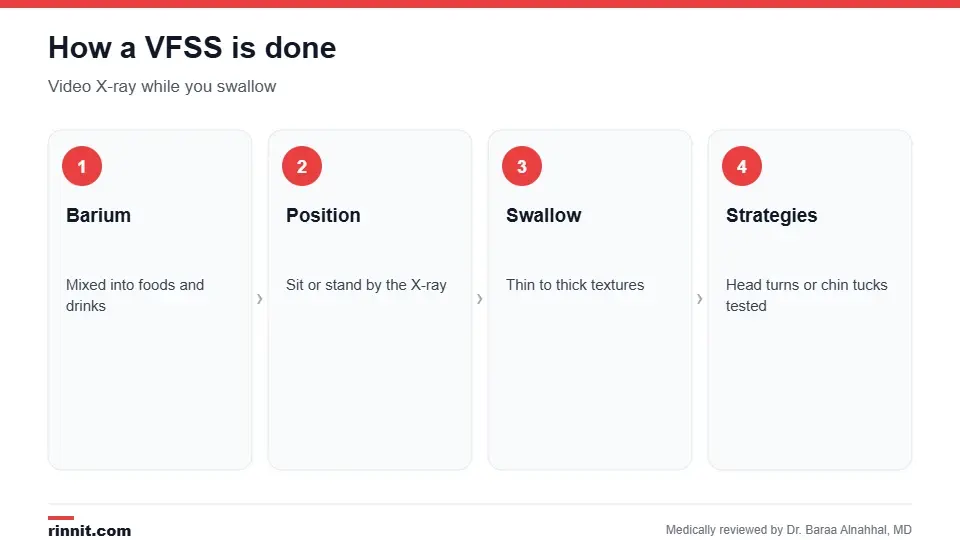
The test uses a live X-ray video.
Barium is mixed into liquids and foods so they show up on the X-ray.
You sit or stand next to the X-ray machine; young children may sit on a parent's lap.
You swallow thin liquids like juice, thicker liquids like honey, pudding and a cookie.
You may be asked to hold food in your mouth, swallow on cue, turn your head or tuck your chin to see which strategies help. Sources: [1]
Risks
A VFSS is safe with few risks. The main concern is that some test material could enter the windpipe, which the team watches closely. It uses X-rays, so tell your provider if you could be pregnant. Sources: [1]
Understanding your results
The speech-language pathologist and radiologist review the video, sometimes with you. Findings may include trouble forming food into a ball in the mouth, a delayed swallow that lets material slip into the windpipe, or narrowing in the esophagus. Next steps may include swallowing exercises, changing food textures and avoiding foods that are hard to swallow. Sources: [1, 2, 3]
Conclusion
A VFSS shows exactly what happens when you swallow, which helps your care team find safe ways for you to eat and drink. It's especially important after a stroke or when aspiration is suspected.
Keep learning: read about dysphagia and aspiration pneumonia.
Frequently asked questions
What is a VFSS?
A video X-ray that shows how you swallow.
Is it the same as a modified barium swallow?
Yes.
Why is it done?
To find the cause of swallowing problems and check for aspiration.
Who performs it?
A speech-language pathologist and/or a radiologist.
What will I swallow?
Barium mixed with liquids and foods of different textures.
Does it hurt?
No.
Is it safe?
Yes. The team watches closely for aspiration.
How is it different from a barium swallow?
A VFSS focuses on the mouth and throat; a barium swallow focuses on the esophagus.
What happens after the test?
You may get swallowing exercises or diet changes.
Can children have a VFSS?
Yes, often sitting on a parent's lap.
Related Reading
Dysphagia (Trouble Swallowing): Symptoms, Causes, Diagnosis & Treatment — Complete Guide the swallowing problem VFSS evaluates.
Esophagram (Barium Swallow): Purpose, Prep, Procedure and Results a related X-ray of the esophagus.
What Is Aspiration? Symptoms, Causes, and Treatment when food or liquid enters the airway.
What Is Aspiration Pneumonia? A Plain-Language Guide to the Lung Infection That Starts When Something Goes "Down the Wrong Pipe" a lung infection from aspiration.
Speech Therapy: What It Is, Who Needs It, and How It Works therapy that often follows a VFSS.
References
Cleveland Clinic. Videofluoroscopic Swallowing Study (VFSS). Cleveland Clinic. Last updated September 2, 2025. https://my.clevelandclinic.org/health/diagnostics/videofluoroscopic-swallowing-study-vfss
Smith HA, Lee SH, O'Neill PA, et al. The combination of bedside swallowing assessment and oxygen saturation monitoring of swallowing in acute stroke: a safe and humane screening tool. Age Ageing. 2000;29(6):495-499. PMID 11191240. https://doi.org/10.1093/ageing/29.6.495
Wang L, Qiao J, Wei Z, et al. Respiratory-swallow coordination training using bimodal signal biofeedback for patients with post-stroke dysphagia: a randomized controlled trial. Ann Med. 2026;58(1):2607218. PMID 41466097. https://doi.org/10.1080/07853890.2025.2607218
Medical disclaimer
This article is for general education only and does not replace advice from a qualified healthcare professional. Talk to your doctor about your own diagnosis and treatment, and seek emergency care right away for severe or sudden symptoms.



Comments