What Is Aspiration Pneumonia? A Plain-Language Guide to the Lung Infection That Starts When Something Goes "Down the Wrong Pipe"

Updated: 2 days ago
Medically reviewed by Dr. Baraa Alnahhal, MD. Last reviewed October 13, 2026. This content is for educational purposes and is not medical advice.
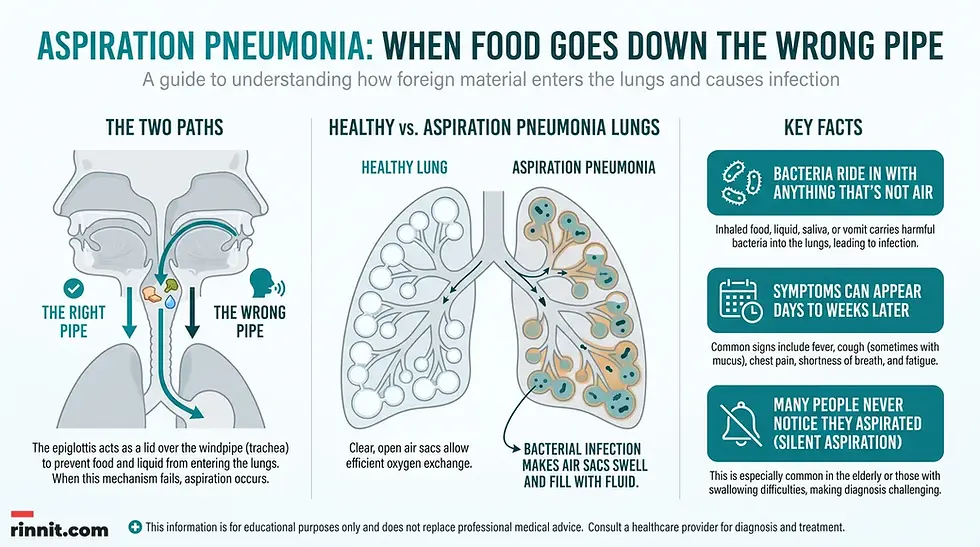
Quick Answer
Aspiration pneumonia is a bacterial lung infection that occurs when food, liquid, saliva, stomach acid or vomit is inhaled into the airways. It causes fever, shortness of breath, cough and chest pain, sometimes days or weeks later. People over 65 and those with swallowing problems are most at risk. It is usually treated with antibiotics.
What the research says
Aspiration pneumonia carries a real in-hospital death risk, driven by age and the need for a ventilator. In a retrospective cohort of 634 adults admitted to a Toronto teaching hospital with aspiration pneumonia between 2008 and 2018, 134 (21.1%) died during hospitalization. Older age (OR 1.72; 95% CI 1.47 to 2.02) and invasive mechanical ventilation (OR 2.57; 95% CI 1.54 to 4.31) were independent predictors of death (Shin et al., Journal of Otolaryngology - Head & Neck Surgery, 2023).
Swallowing trouble after a stroke sharply raises pneumonia risk. A meta-analysis of 42 studies with 26,366 acute-stroke patients found a pooled post-stroke dysphagia prevalence of 42%, and dysphagia was linked to higher odds of pneumonia (OR 4.08; 95% CI 2.13 to 7.79) and death (OR 4.07; 95% CI 2.17 to 7.63) (Banda et al., BMC Geriatrics, 2022).
Swallowing therapy may lower the risk, but the evidence is still limited. In a meta-analysis of 10 studies with 1,031 critically ill patients who had been on a breathing tube for 48 hours or more, swallowing therapy was linked to less severe dysphagia, a shorter time to oral intake, and a lower risk of aspiration pneumonia. The authors stressed that the evidence is limited and that higher-quality trials are needed (Chen et al., Dysphagia, 2024).
What Is Aspiration Pneumonia, Exactly?
Aspiration pneumonia is a bacterial infection in your lungs. It can happen when you aspirate, or inhale, something other than air into your respiratory tract. This can be food, liquid, saliva, stomach acid, vomit, or even a small foreign object. The infection causes the air sacs in your lungs, called alveoli, to swell and fill with fluid.
You've probably had something "go down the wrong pipe," meaning that food or liquid went down your windpipe (toward your lungs) instead of your esophagus (toward your stomach). When this happens, your body reacts and you cough it out. But some people are unable to get it out, and something ends up in their lungs that doesn't belong there. This can cause bacteria to grow, causing an infection (pneumonia).
Many people with aspiration pneumonia don't realize this has happened. This is called silent aspiration. The infection can develop days or even weeks after aspirating.
What Does Aspiration Pneumonia Feel Like?
Symptoms of aspiration pneumonia include:
Symptom | What to notice |
Fever | Elevated body temperature |
Shortness of breath (dyspnea) or wheezing | Struggling for air, or a whistling sound when breathing |
Coughing up blood or pus | Coughing up blood or thick infected fluid |
Chest pain | Pain in the chest area |
Bad breath | Noticeably unpleasant breath |
Extreme tiredness (fatigue) | Severe tiredness |
How Long Does It Take to Develop?
It may take days or weeks for symptoms of pneumonia to develop after you aspirate something. Remember that people with aspiration pneumonia often don't realize that they aspirated anything.
What Causes Aspiration Pneumonia?
Inhaling something into your lungs that shouldn't be there can lead to aspiration pneumonia, especially if you're unable to cough it out (or you don't notice). Anything that's not air can bring bacteria with it, which causes the infection.
Material | How it gets into the lungs |
Saliva and mucus | From your mouth and nose |
Stomach acid | Refluxed up from the stomach |
Vomit | Brought up into the throat |
Food or beverages | "Goes down the wrong pipe" during eating or drinking |
Small objects | Small foreign objects |

Who's at Higher Risk?
You're at a higher risk for aspiration pneumonia if you:
Risk factor | Why it matters |
Recent anesthesia or dental procedures | Have had general anesthesia or dental procedures recently |
Trouble coughing or swallowing (dysphagia) | Can happen after a stroke or brain injury, or with a nervous system disorder like Parkinson's disease or multiple sclerosis |
Alcohol or drug impairment | Are impaired by alcoholic beverages or drugs |
Age | Are older than 65 or younger than 5 |
Living situation | Live in an assisted living facility or nursing home |
Immune system | Have a weakened immune system |
What Are the Complications?
Aspiration pneumonia can lead to sepsis, a life-threatening reaction to an infection, and respiratory failure. This is why symptoms like chest pain, fever, and difficulty breathing call for emergency care: pneumonia can get worse quickly.
How Is Aspiration Pneumonia Diagnosed?
To diagnose aspiration pneumonia, your provider will ask you about your symptoms and your medical history. They may ask about any conditions that affect your ability to swallow or cough. Tests that can help providers diagnose aspiration pneumonia include:
Test | What it does |
Imaging | This could include chest X-rays or a CT scan. |
Blood tests | Can look for signs of infection. |
Sputum tests | You cough up mucus from your lungs for your provider to test for bacteria. |
Bronchoscopy | A provider uses a thin tube (bronchoscope) to look inside your lungs. |
Swallowing studies | Your provider might recommend an evaluation by a speech pathologist or an esophagram (barium swallow test) to diagnose swallowing issues. |

How Is Aspiration Pneumonia Treated?
Providers usually treat aspiration pneumonia with antibiotics. Depending on how severe your symptoms are, you might also need oxygen therapy or mechanical ventilation while the antibiotics work. If you have an ongoing condition that increases your risk for aspiration, you might need treatment for the underlying cause. Depending on the cause, treatments could include:
Treatment | What it addresses |
Antibiotics | The standard treatment. Fights the bacterial infection. |
Oxygen therapy | For more severe symptoms, supports breathing while antibiotics work |
Mechanical ventilation | For more severe symptoms, supports breathing while antibiotics work |
Speech therapy | For ongoing swallowing problems |
Tube feeding | For ongoing swallowing problems |
ACE inhibitors | For ongoing conditions that increase aspiration risk |
How Long Will Recovery Take?
It might take you a week or so after starting antibiotics to start to feel better. Many people are still tired up to a month into recovery. If you have an underlying medical condition that causes frequent aspiration, you'll need to work closely with a healthcare provider to manage it.
What Are the Chances of Surviving?
Most people survive aspiration pneumonia. Mortality (death rate) depends on the severity of the disease and other health conditions (comorbidities).
Can Aspiration Pneumonia Be Prevented?
To reduce your risk of aspiration (which can lead to pneumonia), you can:
Prevention step | Why it helps |
Manage underlying conditions | Manage any underlying medical conditions that can lead to aspiration, which include GERD (chronic acid reflux) and conditions that affect your ability to swallow or cough |
Limit alcohol | Avoid drinking alcohol to excess |
Stay upright | Stay upright when you're eating and drinking |
Chew slowly | Chew slowly and completely |
Avoid smoking and vaping | Avoid smoking, vaping and using nicotine products |
Avoid drug misuse | Avoid illegal drug use and misusing prescription drugs |
Dental care | Practice good dental hygiene and visit your dentist regularly |
When Should I Seek Care?
If you often feel like you're choking or you have difficulty swallowing, see your provider. You may need to see a specialist who can help diagnose and treat underlying conditions. Call 911 or your local emergency services number, or go to the emergency room, if you have symptoms like chest pain, fever and difficulty breathing. Pneumonia can get worse quickly.
What Questions Should I Ask My Doctor?
Question | Why it helps |
What caused this? | Establishes the source of the aspiration |
Could it happen again? | Frames the recurrence risk |
What are my treatment options? | Covers the full plan, from antibiotics to support for the underlying cause |
Do I need additional tests to look for conditions that lead to aspiration? | Looks for hidden swallowing or coughing problems |
When should I follow up with you? | Sets the recovery checkpoint |
Conclusion and next steps
Aspiration pneumonia is the infection that follows when something other than air (food, liquid, saliva, stomach acid, vomit, or a small object) slips down the windpipe instead of the esophagus. What makes it tricky is silence: many people never realize they aspirated at all, and symptoms like fever, shortness of breath, coughing up blood or pus, chest pain, bad breath, and extreme tiredness can take days or even weeks to appear.
The people at highest risk are the very young and the very old, people with swallowing trouble after a stroke, brain injury, or conditions like Parkinson's disease or multiple sclerosis, those recently under anesthesia, and people impaired by alcohol or drugs. Treatment is usually antibiotics, sometimes with oxygen or mechanical ventilation for severe cases, and most people survive. The danger comes from complications such as sepsis and respiratory failure, so chest pain with fever and difficult breathing means emergency care right now.
Take action: If you often feel like you're choking, struggle to swallow, or have a condition such as GERD, Parkinson's disease, or a history of stroke, tell your healthcare provider. Catching a swallowing problem early is the best protection against aspiration pneumonia. If you develop fever, chest pain, shortness of breath, or cough up blood or pus, don't wait. And day to day, the habits that protect you are simple: sit upright for meals, chew slowly and completely, go easy on alcohol, skip smoking and vaping, and keep up with dental care.
Frequently asked questions
What is aspiration pneumonia? A bacterial infection in the lungs that happens when you aspirate (inhale) something other than air, such as food, liquid, saliva, stomach acid, vomit, or a small foreign object. The infection causes the air sacs in your lungs (alveoli) to swell and fill with fluid [1].
What are the symptoms? Fever, shortness of breath (dyspnea) or wheezing, coughing up blood or pus, chest pain, bad breath, and extreme tiredness [1].
How long after aspirating do symptoms appear? It may take days or weeks for symptoms to develop after you aspirate something. Many people with aspiration pneumonia don't realize they aspirated anything [1].
What is silent aspiration? When aspiration happens without you noticing. Many people with aspiration pneumonia don't realize they aspirated anything at all [1] [3].
What causes it? Inhaling anything that's not air into your lungs: saliva and mucus from the mouth and nose, stomach acid, vomit, food or beverages, or small objects. These materials carry bacteria, which cause the infection, especially if you can't cough the material out [1].
Who's at higher risk? People who recently had general anesthesia or dental procedures; people with trouble coughing or swallowing (dysphagia) after a stroke, brain injury, or a nervous system disorder like Parkinson's disease or multiple sclerosis; people impaired by alcohol or drugs; people older than 65 or younger than 5; residents of assisted living facilities or nursing homes; and people with weakened immune systems [1].
What are the complications? Aspiration pneumonia can lead to sepsis, a life-threatening reaction to an infection, and respiratory failure [1].
How is it diagnosed? Your provider asks about symptoms and medical history, including conditions affecting swallowing or coughing. Tests can include chest X-rays or CT scans, blood tests, sputum tests, bronchoscopy, and swallowing studies (an evaluation by a speech pathologist or an esophagram/barium swallow test) [1].
How is it treated? Usually with antibiotics. Severe cases may also need oxygen therapy or mechanical ventilation while the antibiotics work. If an ongoing condition increases your aspiration risk, treatment may include speech therapy, tube feeding, or ACE inhibitors [1].
How long does recovery take? It might take a week or so after starting antibiotics to start feeling better, and many people are still tired up to a month into recovery [1].
What are the chances of surviving? Most people survive aspiration pneumonia. The death rate depends on the severity of the disease and other health conditions (comorbidities) [1].
How is aspiration pneumonia different from aspiration pneumonitis? Aspiration pneumonia is sometimes confused with aspiration pneumonitis. An infection causes aspiration pneumonia. Aspiration pneumonitis is inflammation in your lungs without an infection [1] [5].
How can I prevent it? Manage underlying conditions that can lead to aspiration (including GERD and conditions affecting swallowing or coughing), avoid drinking alcohol to excess, stay upright when eating and drinking, chew slowly and completely, avoid smoking, vaping and nicotine products, avoid illegal drug use and misusing prescription drugs, and practice good dental hygiene with regular dentist visits [1].
When should I go to the ER? Call 911 or your local emergency number or go to the emergency room if you have chest pain, fever and difficulty breathing. Pneumonia can get worse quickly [1].
Related Reading
Pneumonia: Complete Guide to Symptoms, Causes, and Treatment: the broader picture of how pneumonia develops and why aspiration is one of its routes.
Dysphagia (Trouble Swallowing): Symptoms, Causes, Diagnosis & Treatment — Complete Guide: how stroke, brain injury, and nervous system disorders make aspiration more likely.
Acid Reflux & GERD: Symptoms, Causes, Diagnosis, and Treatment: why reflux is a named aspiration risk and how treating it lowers pneumonia risk.
Videofluoroscopic Swallowing Study (VFSS): Modified Barium Swallow explains the video X-ray test that shows how you swallow.
Trusted External Resources
References
Cleveland Clinic. Aspiration Pneumonia. Cleveland Clinic. Last updated December 6, 2024. https://my.clevelandclinic.org/health/diseases/21954-aspiration-pneumonia
Cleveland Clinic. Pneumonia. Cleveland Clinic. Last updated April 16, 2026. https://my.clevelandclinic.org/health/diseases/4471-pneumonia
Cleveland Clinic. Silent Aspiration. Cleveland Clinic. Last updated August 27, 2025. https://my.clevelandclinic.org/health/diseases/24271-silent-aspiration
Shin D, et al. In-hospital mortality for aspiration pneumonia in a tertiary teaching hospital: A retrospective cohort review from 2008 to 2018. J Otolaryngol Head Neck Surg. 2023;52(1):23. PMID 36879258. https://doi.org/10.1186/s40463-022-00617-2
Son YG, et al. Pneumonitis and pneumonia after aspiration. J Dent Anesth Pain Med. 2017;17(1):1-12. PMID 28879323. https://doi.org/10.17245/jdapm.2017.17.1.1
Banda KJ, et al. Prevalence of dysphagia and risk of pneumonia and mortality in acute stroke patients: a meta-analysis. BMC Geriatr. 2022;22(1):420. PMID 35562660. https://doi.org/10.1186/s12877-022-02960-5
Chen L, et al. Interventions for Postextubation Dysphagia in Critically Ill Patients: A Systematic Review and Meta-analysis. Dysphagia. 2024;39(6):1013-1024. PMID 38558176. https://doi.org/10.1007/s00455-024-10695-1
Medical disclaimer
This guide is for general information only and is not a substitute for professional medical advice, diagnosis, or treatment. Always seek the advice of a physician or other qualified health provider with any questions about a medical condition. Never disregard professional medical advice or delay seeking it because of something you have read here. If you have chest pain, fever, or difficulty breathing, call 911 or seek emergency care immediately.



Comments