Peroral Endoscopic Myotomy (POEM): Minimally Invasive Relief for Achalasia

Updated: 3 days ago
Medically reviewed by Dr. Baraa Alnahhal, MD · Last reviewed: October 2026
Peroral Endoscopic Myotomy (POEM) is a minimally invasive endoscopic procedure designed to treat achalasia and other esophageal motility disorders. By using an endoscope inserted through the mouth, providers make precise cuts in the esophageal muscles to loosen them, allowing food to pass easily into the stomach. With an 88% clinical success rate and no external incisions, POEM offers a rapid recovery path, typically allowing patients to return to work within a week [1].
Quick Answer
Peroral endoscopic myotomy (POEM) is a non-surgical treatment for conditions like achalasia that cause swallowing difficulties [1]. Under general anesthesia, an endoscope passed through the mouth tunnels into the esophageal wall and cuts the lower esophageal sphincter muscles [1]. This permanently loosens the muscle to improve swallowing, and most patients report significant relief, with recovery of 10 to 14 days [1].
What the research says
POEM beat pneumatic dilation as a first treatment in a randomized trial. In 133 adults with newly diagnosed achalasia, treatment success at 2 years (symptom score of 3 or less, with no severe complications or re-treatment) occurred in 58 of 63 patients (92%) after POEM versus 34 of 63 (54%) after pneumatic dilation. Reflux esophagitis was more common after POEM (41% vs 7%), and no serious adverse events occurred after POEM (Ponds et al., JAMA, 2019) [2].
POEM matched laparoscopic Heller myotomy surgery at 2 years. In a trial of 221 patients with achalasia (112 assigned to POEM and 109 to surgery), clinical success at 2 years was 83.0% with POEM and 81.7% with surgery, meeting the noninferiority margin. Serious adverse events occurred in 2.7% versus 7.3%, but reflux esophagitis on endoscopy at 24 months was more common after POEM (44% vs 29%) (Werner et al., N Engl J Med, 2019) [3].
Research summaries are based on article abstracts retrieved from PubMed.
What is the POEM Procedure?
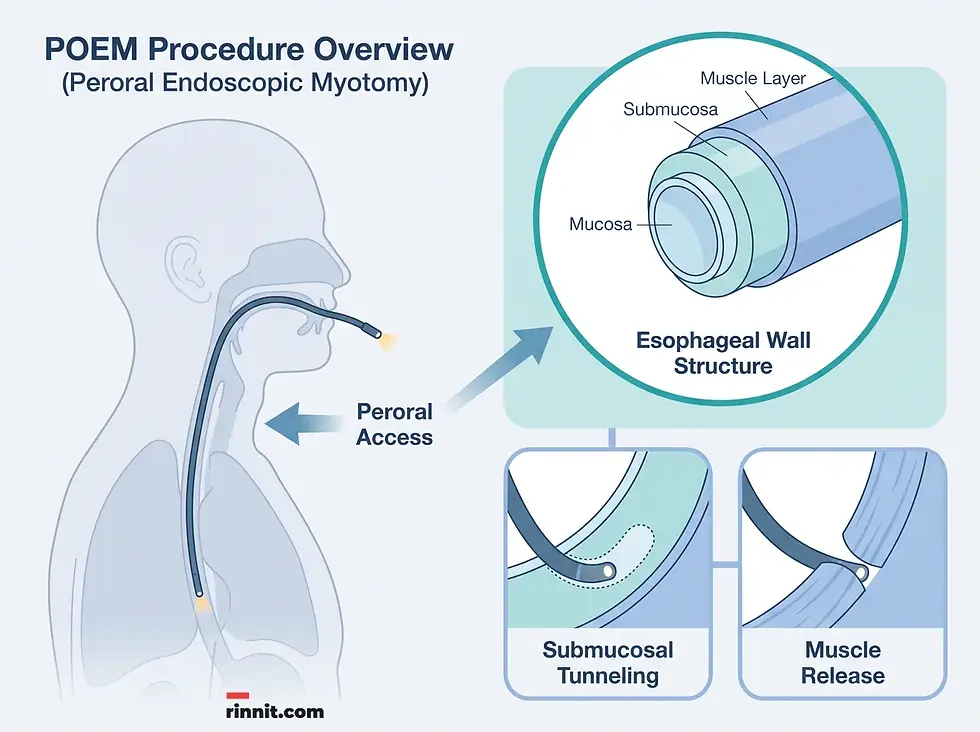
Peroral Endoscopic Myotomy, or POEM, represents a significant advancement in the treatment of swallowing disorders. Unlike traditional surgical methods that require incisions in the chest or abdomen, POEM is performed entirely through the mouth using an endoscope [1]. This flexible tube is equipped with a camera and specialized tools, allowing healthcare providers to access and treat the internal muscles of the esophagus without external scarring [1].
The primary goal of the POEM procedure is to address esophageal motility disorders, most notably achalasia. In these conditions, the muscles of the esophagus—specifically the lower esophageal sphincter—fail to relax, preventing food and liquids from entering the stomach. By strategically cutting these muscle fibers, POEM restores the natural passage of food, providing long-term relief from the persistent “stuck” sensation in the throat.
When is peroral endoscopic myotomy (POEM) used, and how successful is it?
POEM is widely considered a first-line treatment for patients suffering from chronic swallowing difficulties related to muscle dysfunction.
Condition | Description | Impact of POEM |
Achalasia | The lower esophageal sphincter fails to open during swallowing. | Relaxes the sphincter to allow food passage. |
Esophageal Spasms | Abnormal, painful muscle contractions in the esophagus. | Cuts overactive muscles to normalize motility. |
Motility Disorders | General dysfunction in the way esophageal muscles move food. | Loosens tight muscle segments for better flow. |
Research into the efficacy of the procedure has yielded highly positive results. A recent clinical study found that POEM maintains an 88% success rate in loosening esophageal muscles [1]. Furthermore, 95% of patients who undergo the procedure report a significant reduction in swallowing issues [1], highlighting its reliability as a therapeutic intervention.
What are the steps of the peroral endoscopic myotomy (POEM) procedure?
The POEM procedure is a meticulous process that typically takes between one and three hours to complete [1]. It is performed under general anesthesia to ensure patient comfort and safety [1].
Step 1: Accessing the Esophagus
The provider inserts a flexible endoscope through the patient’s mouth. A camera at the tip sends real-time images to a monitor, guiding the provider to the precise treatment area [1].
Step 2: Creating the Tunnel
A small cut is made in the mucosa, which is the innermost layer of the esophagus. The endoscope is then inserted into the submucosa—a layer of connective tissue—to create a tunnel that leads to the lower esophageal muscles [1].
Step 3: The Myotomy
Using a tiny surgical knife attached to the endoscope, the provider makes precise cuts in the muscles of the lower esophagus, the lower esophageal sphincter, and the upper portion of the stomach [1]. This “myotomy” is what permanently loosens the muscle tension.
Step 4: Closing the Mucosa
Once the muscle cutting is complete, the provider uses small medical clips to close the initial cut in the mucosa. The endoscope is then removed, concluding the procedure [1].
What does recovery after peroral endoscopic myotomy (POEM) involve?
Recovery from a POEM procedure is relatively swift due to its minimally invasive nature, though patients must follow a strict dietary progression to ensure proper healing.

Immediate Aftercare
Patients typically stay in the hospital overnight for observation. The following day, a barium X-ray is performed to confirm that the esophageal muscles are relaxed and the passage is clear [1].
Dietary Progression
The esophagus requires time to heal after the internal muscle cuts. Patients must adhere to the following schedule:
Returning to Activity
Most patients can return to work within seven days. However, those whose jobs involve heavy lifting (more than 10 pounds) should consult their provider for a specific timeline. A follow-up appointment is usually scheduled for 10 days post-procedure, with a more comprehensive esophagram performed at the three-month mark [1].
What are the risks and complications of peroral endoscopic myotomy (POEM)?
Complications from peroral endoscopic myotomy (POEM) are rare [1], though gastroesophageal reflux disease (GERD) is a more common side effect [2] [3].

Potential Complications
Rarely, patients may experience internal bleeding, esophageal rupture, or inflammation of the esophagus (esophagitis) [1]. A more common side effect is the development of gastroesophageal reflux disease (GERD), which occurs because the loosened sphincter may allow stomach acid to travel back up into the esophagus.
When to Seek Medical Attention
Patients should contact their surgical team immediately if they experience any of the following warning signs:
Conclusion
Peroral Endoscopic Myotomy (POEM) offers a highly effective, non-surgical solution for individuals struggling with debilitating swallowing disorders. By leveraging advanced endoscopic technology to treat internal muscle dysfunction, POEM provides a permanent improvement in quality of life with minimal downtime. For patients who have long suffered from the physical and emotional burden of achalasia, this procedure represents a clear path toward normal eating and improved health.
Frequently Asked Questions
Is POEM considered a surgery?
Technically, POEM is not a surgery because it does not require any incisions through the skin. It is an endoscopic procedure performed entirely through the mouth [1].
How long does the POEM procedure take?
The procedure generally takes between one and three hours [1], depending on the complexity of the esophageal muscle dysfunction.
Will I be awake during the procedure?
No. POEM is performed under general anesthesia [1], meaning you will be completely asleep and will not feel any pain during the process.
How long is the hospital stay?
Most patients are required to stay in the hospital for one night following the procedure so that the medical team can monitor for any immediate complications [1].
Can I eat normally right after the procedure?
No. You will start on a liquid diet for the first few days, followed by soft foods starting around day seven. A full return to normal diet typically takes about two weeks [1].
Does POEM cure achalasia permanently?
POEM is designed to provide long-term, permanent relief by cutting the muscle fibers that cause the blockage. While highly effective, some patients may require follow-up care for acid reflux.
What is the success rate of POEM?
Clinical studies show an 88% success rate in loosening the muscles and a 95% success rate in significantly reducing swallowing symptoms for patients [1].
Are there any scars after POEM?
Because the procedure is performed through the mouth, there are no external scars on the chest or abdomen [1].
When can I go back to work?
Most people can return to work within seven days, provided their job does not involve heavy physical labor or lifting more than 10 pounds [1].
What are the most common side effects?
The most common side effect is acid reflux (GERD), which can usually be managed with medication. Other complications like bleeding or infection are very rare.
How do I prepare for the POEM procedure?
Your healthcare provider will give you detailed instructions. In general, you follow a clear liquid diet for two days before the procedure and stop eating and drinking anything for 12 hours beforehand. Because you stay in the hospital overnight afterward, plan for that stay [1].
When should I call my doctor after POEM?
Contact your surgeon if you have chest pain or a sore throat, a fever of 101°F (38.3°C) or higher, coughing up blood, stools that look darker than usual, black or reddish, or if you feel very weak or faint [1].
Related Resources
External resource for deeper reading:
Cleveland Clinic. Peroral Endoscopic Myotomy (POEM) Procedure. Cleveland Clinic Health Library. Last updated March 14, 2025. https://my.clevelandclinic.org/health/procedures/peroral-endoscopic-myotomy-poem
Related Reading
References
Cleveland Clinic. Peroral Endoscopic Myotomy (POEM) Procedure. Cleveland Clinic Health Library. Last updated March 14, 2025. https://my.clevelandclinic.org/health/procedures/peroral-endoscopic-myotomy-poem
Ponds FA, Fockens P, Lei A, et al. Effect of Peroral Endoscopic Myotomy vs Pneumatic Dilation on Symptom Severity and Treatment Outcomes Among Treatment-Naive Patients With Achalasia: A Randomized Clinical Trial. JAMA. 2019;322(2):134-144. PMID: 31287522. DOI: 10.1001/jama.2019.8859
Werner YB, Hakanson B, Martinek J, et al. Endoscopic or Surgical Myotomy in Patients with Idiopathic Achalasia. N Engl J Med. 2019;381(23):2219-2229. PMID: 31800987. DOI: 10.1056/NEJMoa1905380
Medical disclaimer
This article is for informational purposes only and is not a substitute for professional medical advice, diagnosis, or treatment. Always seek the advice of your physician or other qualified health provider with any questions you may have about a medical condition.



Comments