GERD (Acid Reflux Disease): Symptoms, the 8 Lifestyle Triggers, and How to Get Relief

Updated: 2 days ago
Medically reviewed by Dr. Baraa Alnahhal, MD · Last reviewed: September 2026
Gastroesophageal reflux disease (GERD) happens when stomach acid flows back up into the esophagus and causes heartburn. This backwash, called acid reflux, is caused by the lower esophageal sphincter — the circular muscle valve at the bottom of the esophagus — relaxing at the wrong time or weakening, allowing acid to escape. Many people get occasional acid reflux, but when it happens repeatedly over time, it can cause GERD.
Quick Answer
What is it? A condition where stomach acid repeatedly flows back into the esophagus, causing heartburn and irritation of the esophageal lining.
What causes it? The lower esophageal sphincter — the muscle valve at the bottom of the esophagus — relaxes at the wrong time or weakens, allowing acid to back up.
Symptoms: Burning in the chest after eating (heartburn), sour backwash in the throat, upper belly or chest pain, trouble swallowing, and a lump sensation in the throat; at night it can cause cough, hoarseness, or worsening asthma.
When to see a doctor: Make an appointment for severe or frequent symptoms, or if you take nonprescription heartburn medicine more than twice a week; seek help right away for chest pain with shortness of breath or jaw or arm pain — it may be a heart attack.
Risk factors: Obesity, hiatal hernia, pregnancy, connective tissue disorders (such as scleroderma), and delayed stomach emptying; reflux is aggravated by smoking, large or late meals, fatty foods, alcohol, coffee, and aspirin.
Complications: Untreated long-term inflammation can cause esophagitis, narrowing of the esophagus (stricture), and precancerous changes called Barrett esophagus.
Treatment: A step-up ladder — lifestyle changes, nonprescription medicines (antacids, H-2 blockers, OTC PPIs), prescription-strength PPIs or P-CABs, deep-breathing training, and if needed, surgery (fundoplication, LINX, or TIF).
What Is GERD, and How Does Acid Reflux Happen?

The lower esophageal sphincter is a muscle valve that should close after swallowing. In acid reflux, it relaxes at the wrong time or weakens, letting stomach acid back up to irritate the esophageal lining.
Gastroesophageal reflux disease — usually shortened to GERD — happens when stomach acid flows back up into the esophagus and causes heartburn. This backwash is called acid reflux, and it can irritate the lining of the esophagus.
To understand how it happens, it helps to know how the system normally works. When you swallow, a circular band of muscle around the bottom of the esophagus — called the lower esophageal sphincter — relaxes to let food and liquid flow into the stomach. Then the sphincter closes again.
Acid reflux happens when the sphincter muscle at the lower end of the esophagus relaxes at the wrong time, allowing stomach acid to back up into the esophagus. If the sphincter does not relax the typical way or it weakens, the constant backwash of acid irritates the lining of the esophagus, often causing it to become inflamed. Many people experience acid reflux now and then. When acid reflux happens repeatedly over time, it can cause GERD. The good news: most people can manage the discomfort of GERD with lifestyle changes and medicines. And though it's uncommon, some may need surgery to help with symptoms.
What Does GERD Feel Like? Recognizing the Symptoms
Common symptoms of GERD include a burning sensation in the chest, often called heartburn. Heartburn usually happens after eating and might be worse at night or while lying down:
Heartburn: A burning sensation in the chest, usually after eating; might be worse at night or lying down
Sour backwash: Food or sour liquid comes back up into the throat
Upper belly or chest pain: Discomfort in the upper abdomen or chest area
Trouble swallowing (dysphagia): Food feels stuck or difficult to swallow
Lump sensation in the throat: A persistent feeling of something lodged in the throat
If you have nighttime acid reflux, you also might experience an ongoing cough, inflammation of the vocal cords known as laryngitis (hoarseness), or new or worsening asthma.

GERD's hallmark is heartburn after eating, but nighttime reflux can also cause cough, hoarseness, and asthma. Chest pain with shortness of breath is a heart-attack warning sign — get help immediately.
When to See a Doctor
Two rules matter here. The first is an emergency rule: seek medical help right away if you have chest pain, especially if you also have shortness of breath, or jaw or arm pain. These may be symptoms of a heart attack.
The second rule is about persistence: make an appointment with a healthcare professional if you have severe or frequent GERD symptoms, or if you take nonprescription medicines for heartburn more than twice a week.
What Causes GERD?
GERD is caused by frequent acid reflux or reflux of nonacidic content from the stomach. The mechanism centers on the lower esophageal sphincter — the circular band of muscle around the bottom of the esophagus. When you swallow, it relaxes to let food and liquid flow into the stomach, then closes again. If the sphincter does not relax as is typical or it weakens, stomach acid can flow back into the esophagus. This constant backwash of acid irritates the lining of the esophagus, often causing it to become inflamed.
What Raises Your Risk? The 5 Risk Factors and 5 Triggers
Conditions that can increase the risk of GERD:
Obesity: Excess pounds put pressure on the abdomen, pushing up the stomach and causing acid to reflux
Hiatal hernia: A bulging of the top of the stomach up above the diaphragm — the upper part of the stomach bulges through the diaphragm into the chest cavity
Pregnancy: Changes in body pressure and hormones increase reflux likelihood
Connective tissue disorders: Conditions such as scleroderma affect tissue strength, including the sphincter
Delayed stomach emptying: Food and acid stay in the stomach longer, giving reflux more opportunity
Factors that can aggravate acid reflux once you have it:
Smoking: Decreases the lower esophageal sphincter's ability to function properly
Eating large meals or eating late at night: A full stomach close to bedtime increases pressure and nighttime backwash
Fatty or fried foods: Common foods that trigger reflux episodes
Alcohol or coffee: Common beverages that trigger reflux episodes
Certain medicines, such as aspirin: Can aggravate the esophagus and reflux symptoms
What Can Happen If It Goes Untreated?
Over time, long-lasting inflammation in the esophagus can cause three complications:
Esophagitis: Stomach acid breaks down tissue in the esophagus, causing inflammation, bleeding, and sometimes an open sore called an ulcer; can cause pain and make swallowing difficult
Esophageal stricture: Acid damage causes scar tissue to form, which narrows the food pathway and leads to problems with swallowing
Barrett esophagus: Acid damage causes precancerous changes in the tissue lining the lower esophagus, associated with an increased risk of esophageal cancer
How Is GERD Diagnosed? The 5-Test Pathway
A healthcare professional might be able to diagnose GERD based on a history of symptoms and a physical examination. To confirm a diagnosis of GERD, or to check for complications, a care professional might recommend one or more of the following tests:
Upper endoscopy: A tiny camera on the end of a flexible tube visually examines the esophagus, stomach, and duodenum. May find inflammation or other complications; a tissue sample can be tested for Barrett esophagus; a narrowing can be stretched during the procedure
Ambulatory acid (pH) probe test: A monitor in the esophagus connects to a small computer worn at the waist or shoulder, or a clip placed during endoscopy; identifies when, and for how long, stomach acid regurgitates into the esophagus
X-ray of the upper digestive system: X-rays taken after drinking a chalky liquid (or a barium pill) that coats the digestive tract; useful for trouble swallowing and can diagnose a narrowing
Esophageal manometry: Measures the rhythmic muscle contractions in the esophagus while swallowing, typically done in people who have trouble swallowing
Transnasal esophagoscopy: A thin, flexible tube with a video camera passes through the nose and down into the esophagus to look for damage
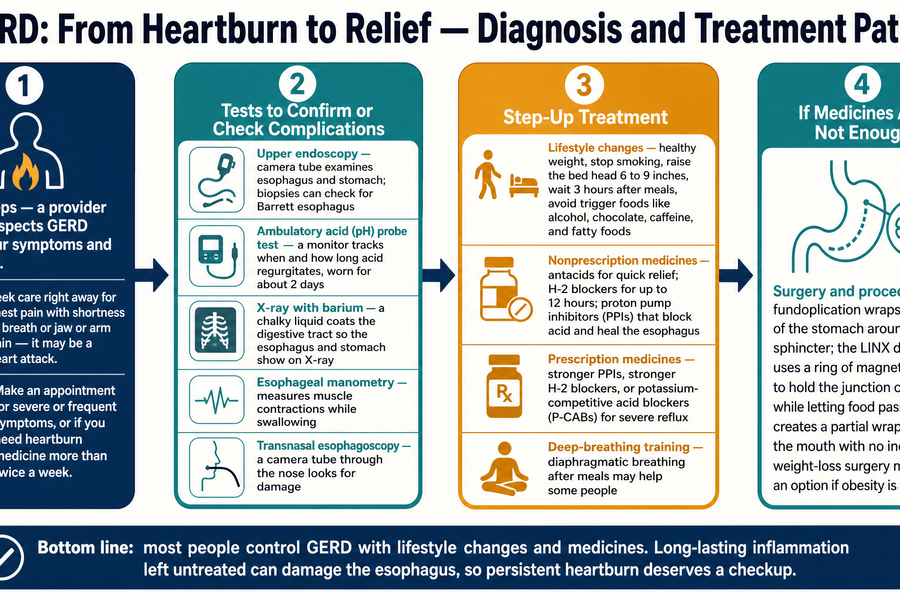
The step-up pathway for GERD — from first symptoms, through five possible diagnostic tests, up the treatment ladder from lifestyle changes to surgery.
How Is GERD Treated?
A healthcare professional is likely to recommend trying lifestyle changes and nonprescription medicines as a first line of treatment. If you don't experience relief within a few weeks, prescription medicine and additional testing may be recommended.
Nonprescription Medicines
Three classes of over-the-counter options work in different ways:
Antacids (calcium carbonate products such as Mylanta, Rolaids, and Tums): neutralize stomach acid for quick relief, but won't heal an inflamed esophagus; overuse can cause diarrhea or kidney complications
H-2 blockers (cimetidine, famotidine, nizatidine): reduce acid production; don't act as quickly as antacids but provide longer relief — up to 12 hours; stronger versions available by prescription
Proton pump inhibitors (PPIs) (OTC lansoprazole, omeprazole, esomeprazole): block acid production and allow time for damaged esophageal tissue to heal — stronger than H-2 blockers
If you start taking a nonprescription medicine for GERD, be sure to inform your care provider.
Prescription Medicines
When over-the-counter options fall short, prescription-strength treatments include:
Prescription-strength PPIs: Esomeprazole, lansoprazole, omeprazole, pantoprazole, rabeprazole, dexlansoprazole — generally well tolerated; might cause diarrhea, headaches, nausea, or rarely low vitamin B-12 or magnesium levels
Prescription-strength H-2 blockers: Prescription-strength famotidine and nizatidine — side effects are generally mild
Potassium-competitive acid blockers (P-CABs): Vonoprazan and tegoprazan — a newer class that may be recommended for severe acid reflux if other medicines haven't worked
Deep-Breathing Training
A technique known as diaphragmatic breathing may help improve GERD symptoms for some people. This exercise is done after eating and involves breathing deeply into the diaphragm rather than shallowly into the chest. Diaphragmatic breathing techniques should ideally be taught by a trained medical professional.
Surgery and Other Procedures
GERD can usually be controlled with medicine. But if medicines don't help, or if you wish to avoid long-term medicine use, a healthcare professional might recommend one of these options:
Fundoplication: The surgeon wraps the top of the stomach around the lower esophageal sphincter to tighten the muscle and prevent reflux; usually done laparoscopically; can be complete (Nissen) or partial (Toupet)
LINX device: A ring of tiny magnetic beads wrapped around the junction of the stomach and esophagus keeps it closed to acid but weak enough to allow food to pass; implanted with minimally invasive surgery
Transoral incisionless fundoplication (TIF): Tightens the sphincter using polypropylene fasteners, performed through the mouth with an endoscope; no surgical incision, quick recovery
Weight-loss surgery: Because obesity is a risk factor for GERD, a provider could suggest weight-loss surgery for eligible candidates
Alternative Medicine
Some complementary and alternative therapies — such as ginger, chamomile, and slippery elm — may be recommended to treat GERD. However, none have been proved to treat GERD or reverse damage to the esophagus. Talk to a healthcare professional if you're considering taking alternative therapies.
8 Lifestyle Changes That Reduce Acid Reflux
Lifestyle changes may help reduce the frequency of acid reflux. Here are the eight evidence-based steps, and why each one works:
Maintain a healthy weight: Excess pounds put pressure on the abdomen, pushing up the stomach and causing acid to reflux into the esophagus
Stop smoking: Smoking decreases the lower esophageal sphincter's ability to function properly
Elevate the head of your bed: Raise the head end 6 to 9 inches with blocks under the bed feet or a wedge, so gravity works against nighttime reflux — extra pillows alone are not effective
Start on your left side: Going to bed lying on your left side makes reflux less likely
Don't lie down after a meal: Wait at least three hours after eating before lying down or going to bed
Eat slowly and chew thoroughly: Put down your fork after every bite and pick it up again once you have chewed and swallowed that bite
Avoid trigger foods and drinks: Common triggers include alcohol, chocolate, caffeine, fatty foods, and peppermint
Don't wear tight-fitting clothing: Tight clothes around the waist put pressure on the abdomen and the lower esophageal sphincter
How to Prepare for Your Appointment
You may be referred to a doctor who specializes in the digestive system, called a gastroenterologist. Because appointments can be brief, preparation helps you make the most of your time:
Be aware of any pre-appointment restrictions, such as restricting your diet before your appointment
Write down your symptoms, including any that may seem unrelated to the reason for your visit
Write down any triggers to your symptoms, such as specific foods
Make a list of all your medicines, vitamins, and supplements
Write down your key medical information, including other conditions
Write down key personal information, along with any recent changes or stressors
Write down questions to ask your doctor
Ask a relative or friend to go with you to help you remember what was discussed
Questions to Ask Your Doctor
What's the most likely cause of my symptoms?
What tests do I need? Is there any special preparation for them?
Is my condition likely temporary or chronic?
What treatments are available?
Are there any restrictions I need to follow?
I have other health concerns. How can I best manage these conditions together?
What to Expect From Your Doctor
In addition to the questions you've prepared, don't hesitate to ask questions during your appointment anytime you don't understand something. Expect your doctor to ask you some of the following:
When did you begin experiencing symptoms? How severe are they?
Have your symptoms been continuous or occasional?
What, if anything, seems to improve or worsen your symptoms?
Do your symptoms wake you up at night?
Are your symptoms worse after meals or lying down?
Does food or sour material ever come up in the back of your throat?
Do you have trouble swallowing food, or have you had to change your diet to avoid difficulty swallowing?
Have you gained or lost weight?
Bottom Line
GERD sits at a curious intersection: it is among the most common digestive complaints in the world, yet it is also one of the most manageable — for most people, lifestyle changes and medicines bring the discomfort under control. The real risk is not the disease itself but the pattern many people fall into: years of casually self-medicating with nonprescription heartburn tablets while long-lasting inflammation quietly works on the esophagus. That is how esophagitis, strictures, and precancerous Barrett esophagus develop.
Here is the practical takeaway. If heartburn has become a fixture of your weeks — or you are reaching for nonprescription medicine more than twice a week — that is your signal to book an appointment rather than reach for another tablet. And never ignore chest pain accompanied by shortness of breath or jaw or arm pain: that combination needs emergency care, because it may be a heart attack, not heartburn.
Your next step: write down your symptoms and triggers for a few days, list your medicines, and bring both to an appointment. Most people leave with a clear diagnosis, a working treatment plan, and real relief within weeks.
Explore more of our digestive health guide: gastritis and the inflamed stomach lining.
Frequently Asked Questions
What is the difference between acid reflux and GERD?
Acid reflux is the backwash of stomach acid into the esophagus, and many people experience it occasionally. GERD is the disease stage: when acid reflux happens repeatedly over time, it causes gastroesophageal reflux disease. The difference is frequency and repetition — occasional reflux becomes GERD when it occurs over and over.
What causes GERD?
GERD is caused by the lower esophageal sphincter — the circular muscle valve at the bottom of the esophagus — relaxing at the wrong time or weakening. That allows stomach acid (or sometimes nonacidic stomach content) to flow back into the esophagus, where the constant backwash irritates and inflames the lining.
What are the symptoms of GERD?
The most common symptom is heartburn — a burning sensation in the chest that usually happens after eating and may be worse at night or lying down. Others include backwash of food or sour liquid into the throat, upper belly or chest pain, trouble swallowing, and a lump sensation in the throat. Nighttime reflux can also cause an ongoing cough, laryngitis, or new or worsening asthma.
When should I see a doctor for heartburn?
Make an appointment if your GERD symptoms are severe or frequent, or if you take nonprescription heartburn medicines more than twice a week. Seek emergency medical help right away if you have chest pain with shortness of breath or jaw or arm pain — these may be symptoms of a heart attack, not reflux.
How is GERD diagnosed?
A provider can often diagnose GERD from a symptom history and physical exam. To confirm the diagnosis or check for complications, tests may include an upper endoscopy (with biopsies for Barrett esophagus), an ambulatory acid (pH) probe test worn for about two days, a barium X-ray, esophageal manometry, or a transnasal esophagoscopy.
What are the treatment options for GERD?
Treatment follows a step-up ladder. First, lifestyle changes: healthy weight, quitting smoking, elevating the bed head 6 to 9 inches, and avoiding trigger foods. Then nonprescription medicines (antacids, H-2 blockers, OTC PPIs). If relief doesn't come within a few weeks, prescription PPIs, stronger H-2 blockers, or P-CABs. If medicines don't help, surgery options include fundoplication, the LINX magnetic bead device, TIF, or weight-loss surgery.
Can GERD go away on its own?
GERD usually can be controlled, but it typically needs active management — lifestyle changes and medicines — rather than waiting it out. For most people, control is achievable; a minority may need surgery. Ignoring persistent reflux is the risky path, since long-lasting inflammation can cause esophagitis, strictures, and precancerous Barrett esophagus.
References
Clinical content reviewed through March 10, 2025, based on the reference sources listed above. This article is for general information only and is not a substitute for professional medical advice, diagnosis, or treatment.
Comments