Lymph Node Biopsy: Types, What to Expect, Recovery and Results

Updated: 3 days ago
Written and medically reviewed by Dr. Baraa Alnahhal, MD · Last reviewed: November 2026 · How we review
Quick Answer
A lymph node biopsy is a procedure that removes all or part of a lymph node so a pathologist can test it for cancer, infection or immune conditions. It's done when a swollen lymph node doesn't go away or looks suspicious, and to diagnose and stage cancers such as lymphoma. It's usually an outpatient procedure.
What the research says
Core needle biopsy often diagnoses lymphoma: a meta-analysis of 32 studies with 3,027 core needle biopsies found an overall sensitivity of 86.4% for lymphoma, above 94% for some common types such as diffuse large B-cell lymphoma, but lower for some rarer types, which may need an open biopsy (Cottone C et al., Current Problems in Cancer, 2025) [2]
Neck node biopsies usually guide treatment: a meta-analysis of 22 studies with 1,120 patients found core needle biopsy of swollen neck lymph nodes gave a lymphoma diagnosis detailed enough to guide treatment in about 82% of cases (Warshavsky A et al., Head & Neck, 2020) [3]
Key takeaways
Removes all or part of a lymph node to test for cancer, infection or immune disease.
Types: fine-needle aspiration, core needle, open (excisional or incisional) and sentinel node biopsy.
Needle biopsy takes 10–30 minutes; open biopsy up to 45 minutes; usually same-day discharge.
Risks are rare: infection, bleeding, temporary numbness and, rarely, lymphedema.
Results may be ready the same day or take a few weeks.
Why is it done?
To find the cause of swollen lymph nodes that don't go away, especially if they're hard, fixed, growing or come with fever, night sweats or weight loss.
To diagnose and type lymphoma, including Hodgkin lymphoma and non-Hodgkin lymphoma.
To check whether another cancer has spread to the lymph nodes and to help stage it.
To diagnose serious infections such as tuberculosis, and immune conditions such as sarcoidosis. Sources: [1]
Types of lymph node biopsy
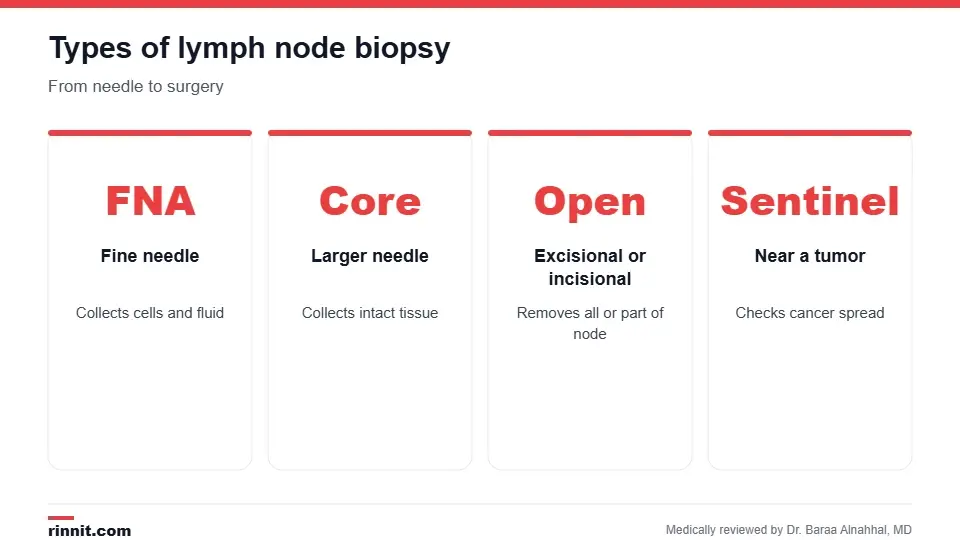
The type depends on where the node is and what's suspected.
Type | What's removed | Best for |
Cells and fluid through a thin needle | Checking for cancer spread or infection | |
Core needle biopsy | Thin cores of intact tissue | Diagnosing many lymphomas and cancers |
Excisional biopsy | The whole node through a small cut | Lymphoma typing; deep or hard-to-reach nodes |
Incisional biopsy | Part of a node | Large nodes or masses |
The first nodes a tumor drains to | Staging breast cancer and melanoma |
Biopsies are also named for their location: cervical (neck), axillary (armpit) or inguinal (groin). Sources: [1]
How do I prepare?
Tell your provider about all medicines, including over-the-counter drugs, herbs and supplements; you may need to stop blood thinners.
Mention bleeding disorders, allergies to anesthesia or latex, and whether you could be pregnant.
Follow any fasting instructions.
Arrange a ride home if you'll have sedation or general anesthesia. Sources: [1]
What happens during the biopsy?

Most lymph node biopsies are outpatient procedures.
You receive local anesthesia for nodes near the skin, or general anesthesia for deeper nodes.
The node is located by touch or with ultrasound, CT or mammogram, sometimes with a dye or tracer.
All or part of the node is removed with a needle or through a small cut.
The site is closed with stitches, which may dissolve or need removal later, and bandaged. Sources: [1]
A needle biopsy takes about 10–30 minutes and an open biopsy up to 45 minutes. You may feel a sting from the numbing injection but shouldn't feel pain during the procedure. The sample may be tested with methods such as flow cytometry and immunohistochemistry to identify the exact type of disease. Sources: [1, 2]
Recovery
Most people go home the same day.
Mild bleeding, swelling, bruising and soreness for a few days are normal; over-the-counter pain relievers usually help.
Avoid baths and hot tubs, and possibly showers, until your provider says it's OK.
Follow any limits on lifting and activity. Sources: [1]
Risks
Complications are rare and include infection, bleeding, numbness at the site that usually resolves within a month or two, lymphedema (swelling from poor lymph drainage) and, very rarely, axillary web syndrome. Call your provider for fever, chills, or swelling, warmth, redness or unusual drainage at the site. Sources: [1]
Understanding your results

Results may come back the same day or take a few weeks.
Results are reported as positive or negative and may be ready the same day or in a few weeks. A positive result names what was found, such as a type of lymphoma, cancer that has spread, an infection or sarcoidosis, and guides treatment and staging. A negative result is reassuring, but if a node keeps growing, your provider may recommend follow-up or another biopsy, since a needle sample can occasionally miss the diagnosis. Sources: [1, 2, 3]
Conclusion
A lymph node biopsy is the most reliable way to learn why a lymph node is enlarged. Needle biopsies are quick and minimally invasive, while an open biopsy may be needed for some lymphomas. Most people go home the same day with minimal discomfort.
Keep learning: read about swollen lymph nodes and lymphoma.
Frequently asked questions
What is a lymph node biopsy?
A procedure that removes all or part of a lymph node for lab testing.
Why would I need one?
For a swollen node that doesn't go away, or to diagnose or stage cancer.
What are the types?
Fine-needle aspiration, core needle, open (excisional or incisional) and sentinel node biopsy.
Does it hurt?
You'll be numbed or asleep; mild soreness afterward is common.
How long does it take?
About 10–30 minutes for a needle biopsy and up to 45 minutes for an open biopsy.
Can I go home the same day?
Usually, yes.
What are the risks?
Rare: infection, bleeding, temporary numbness and lymphedema.
How long do results take?
From the same day to a few weeks.
Can a needle biopsy diagnose lymphoma?
Often, yes, but some types need an open biopsy.
What if my result is negative but the node keeps growing?
Your provider may recommend another biopsy.
Related Reading
Swollen Lymph Nodes: Symptoms, Causes, and When to Seek Care causes of enlarged lymph nodes.
Lymphoma: Symptoms, Types, Causes, Diagnosis and Treatment the cancer most often diagnosed by node biopsy.
Hodgkin's Lymphoma: Symptoms, Causes & Treatment a lymphoma diagnosed with node biopsy.
Understanding Lymph Nodes: Your Body's Essential Filtration System how lymph nodes work.
Biopsy: What It Is, Types, Preparation, Risks and Results an overview of all biopsy types.
Endobronchial Ultrasound (EBUS): Lung Biopsy and Cancer Staging explains the ultrasound bronchoscopy used to biopsy chest lymph nodes.
References
Cleveland Clinic. Lymph Node Biopsy: Procedure & Results. Cleveland Clinic. Last updated April 2, 2024. https://my.clevelandclinic.org/health/diagnostics/lymph-node-biopsy
Cottone C, Kozlowski K, Sorrentino J, et al. Sensitivity of core needle biopsy in the diagnosis of lymphoma: a meta-analysis. Curr Probl Cancer. 2025;57:101203. PMID 40373459. https://doi.org/10.1016/j.currproblcancer.2025.101203
Warshavsky A, Rosen R, Perry C, et al. Core needle biopsy for diagnosing lymphoma in cervical lymphadenopathy: meta-analysis. Head Neck. 2020;42(10):3051-3060. PMID 32748464. https://doi.org/10.1002/hed.26381
Medical disclaimer
This article is for general education only and does not replace advice from a qualified healthcare professional. Talk to your doctor about your own diagnosis and treatment, and seek emergency care right away for severe or sudden symptoms.



Comments