Understanding Mediastinal Tumors: Types, Symptoms, and Treatments

Updated: 3 days ago
Medically reviewed by Dr. Baraa Alnahhal, MD · Last reviewed: October 2026
Mediastinal tumors are masses of cells that appear in the space between your lungs, called the mediastinum. They may be malignant (cancerous), but they're usually benign (noncancerous). Surgery is the most common treatment [1].
Quick Answer: What are mediastinal tumors?
Mediastinal tumors are rare growths in the chest area between the lungs, classified by whether they form in the front, middle or back. Common types include thymomas, lymphomas and germ cell tumors. Almost 40% of people have no symptoms, while others have cough or chest pain. Diagnosis uses a CT scan and often a biopsy, and surgery is most common. [1]
What the research says
The type of tumor depends on where it forms. In a study of 3,308 mediastinal lesions from international radiology databases, thymomas (27.8%), benign mediastinal cysts (20.0%), and lymphomas (16.1%) were the most common. Thymomas were the most common lesion in the prevascular (front) compartment (38.3%), benign cysts in the visceral (middle) compartment (16.8%), and neurogenic tumors in the paravertebral (back) compartment (53.9%) (Roden et al., J Thorac Oncol, 2020 [2]).
For selected patients with thymic cancers, minimally invasive surgery matched open surgery on key outcomes. A meta-analysis of 30 studies with 2,038 patients found less blood loss and shorter hospital stays with minimally invasive thymectomy. For stage I and II disease, complete (R0) resection and recurrence rates did not differ. The results were unadjusted and not from randomized trials (Friedant et al., J Thorac Oncol, 2016 [3]).
In children, video-assisted surgery shortened hospital stays and reduced complications. In a meta-analysis of 7 retrospective studies with 333 children, video-assisted surgery was linked to a hospital stay shorter by 3.23 days and fewer complications (odds ratio 0.40; 95% CI 0.19 to 0.82), with no significant difference in recurrence or mortality. More complex tumors still need open surgery (Noleto da Nobrega Oliveira et al., J Pediatr Surg, 2025 [4]).
What Is a Mediastinal Tumor?
Tumors, also called neoplasms, are masses of cells that can be benign or malignant. Mediastinal tumors are growths that form in the area of your chest between your lungs. This area, the mediastinum, contains your heart, aorta, esophagus, thymus, thyroid, trachea, lymph nodes, and nerves. The thymus is an organ that is part of your immune system [1].
Because of this location, mediastinal tumors that aren't treated can cause serious problems, even if they're not cancerous. These problems include spreading to the heart, the lining around the heart (pericardium), and the great vessels (the aorta and vena cava). Tumors in the back part of the mediastinum can press on the spinal cord [1].
How are mediastinal tumors classified by location?
Mediastinal tumors are classified based on where they are in the mediastinum: the anterior (front), middle, or posterior (back) [1]:
Location | Common tumor types | Clinical characteristics |
|---|---|---|
Anterior (front) | Thymoma and thymic carcinoma, thymic cysts, lymphoma, germ cell tumors, thyroid mass | Most likely to be malignant: approximately 60% of anterior masses are cancerous |
Middle | Bronchogenic cysts, enlarged lymph nodes (lymphadenopathy), pericardial cysts, tracheal and esophageal tumors | Many are benign cysts or swollen nodes, but tracheal and esophageal tumors may be benign or malignant |
Posterior (back) | Neurogenic tumors, enlarged lymph nodes, neuroenteric cysts | Neurogenic tumors are the most common, and most are benign |
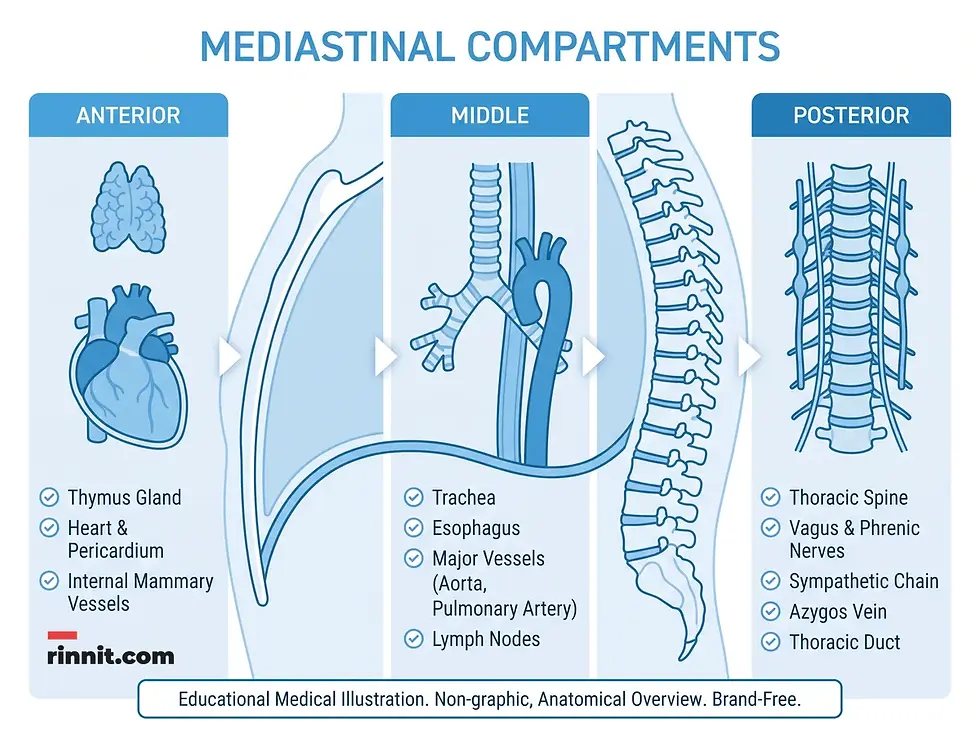
The mediastinum has anterior, middle, and posterior compartments, each with its own structures and typical tumors.
Anterior (Front) Masses
Thymoma and thymic carcinoma: thymomas are the most common mediastinal tumors. They are cancerous tumors that start in the thymus gland, and most grow slowly. Thymic carcinoma is a more aggressive cancer that grows and spreads more quickly.
Thymic cysts: these are benign and usually only need treatment if they press on nearby structures and cause symptoms.
Lymphoma: these malignant tumors include both Hodgkin and non-Hodgkin lymphoma. Learn more in our guides to lymphoma, Hodgkin's lymphoma, non-Hodgkin's lymphoma, and primary mediastinal large B-cell lymphoma.
Germ cell tumors: the mediastinum is the most common place for germ cell tumors to form other than the ovaries or testicles, and most are benign.
Thyroid mass: usually a benign growth, like a goiter.
Middle and Posterior Masses
Middle masses include small, benign bronchogenic cysts filled with fluid or mucus, swollen lymph nodes, benign pericardial cysts, and tracheal or esophageal tumors. Blood vessel conditions such as aortic aneurysm can also appear here. In the back of the mediastinum, neurogenic tumors form in nerve tissue and include nerve sheath tumors, ganglion cell tumors, and paragangliomas. Most are benign. To learn more, see our guide to nerve tumors [1].
Who Is Affected and How Common Are They?
Most people diagnosed with mediastinal tumors are between the ages of 30 and 50, but these tumors can develop at any age. In adults, most tumors form in the front of the mediastinum and are cancerous lymphomas or thymomas. In children, most tumors form in the back of the mediastinum, often begin in the nerves, and aren't cancerous. Mediastinal tumors are rare, occurring in less than 1% of the population [1].
What are the symptoms and causes of mediastinal tumors?
Almost 40% of people with mediastinal tumors don't notice symptoms. Instead, healthcare providers often discover these tumors incidentally on chest X-rays done for other reasons. Symptoms often result from the tumor putting pressure on surrounding structures, like the heart, airway, or spinal cord. Generally, children experience symptoms more commonly than adults, and malignant tumors cause symptoms more often than benign tumors [1].
Common Symptoms
Breathing: cough, wheezing, shortness of breath, high-pitched noisy breathing (stridor), or coughing up blood
Voice and swallowing: hoarseness or trouble swallowing
Whole-body signs: fever, chills, night sweats, or unexplained weight loss
Other signs: chest pain (somewhat rare), swollen or tender lymph nodes, and eye issues such as a drooping eyelid or small pupil on one side of the face

Symptoms often come from the tumor pressing on nearby structures.
What Causes Mediastinal Tumors?
Out-of-control cell growth: malignant and benign tumors form when cells multiply out of control. Researchers don't always know what causes cells to start growing atypically.
Response to an underlying condition: tumors may form in response to inflammation or an underlying infection or condition, as with swollen lymph nodes.
Atypical tissue development before birth: some tumors are congenital, including pericardial cysts, bronchogenic cysts, and germ cell tumors.
How are mediastinal tumors diagnosed and treated?
When a mediastinal mass appears on a chest X-ray, healthcare providers often do more tests, like imaging or bloodwork, to learn more about it [1]:
Chest X-ray: reveals masses in the mediastinum.
CT scan with IV contrast: shows the mass in more detail, including how it affects other structures in the chest, which helps plan treatment.
MRI: can show whether a mass is pressing on or invading nearby tissue.
PET scan: can help identify certain tumors, like lymphomas.
Blood tests: can reveal proteins or enzymes associated with certain tumors (tumor markers).
Biopsy: a sample from the mass shows the type of tissue and whether it contains cancer cells. Procedures include CT-guided needle biopsy, esophagoscopy, and bronchoscopy.
Mediastinoscopy with biopsy: your provider views the mediastinum by inserting a lighted tube into your chest and removes tissue samples for testing.
Effective Treatment Strategies
Treatment depends on the type of tumor, its location, its stage if it's cancerous, and your symptoms. Surgery is the most common treatment [1].
Treatment | Application | Goal |
|---|---|---|
Surgery | Cancerous tumors, tumors pressing on nearby organs, and tumors causing symptoms will likely need to be removed. Options include an incision through the breastbone (sternotomy) or minimally invasive video-assisted thoracoscopic surgery (VATS) | Remove the tumor |
Radiation therapy | Used alone or with other treatments, depending on the cancer stage, for thymomas, thymic cancer, or lymphoma | Destroy tumor tissue with high-energy X-ray beams |
Chemotherapy | Commonly used to treat thymic cancers | Kill cancer cells and shrink tumors |
Antibiotics | Needed if the mass results from an infection, as with swollen lymph nodes | Treat the infection |
Watchful waiting | May be used for a benign tumor that isn't causing symptoms | Monitor instead of treating directly |
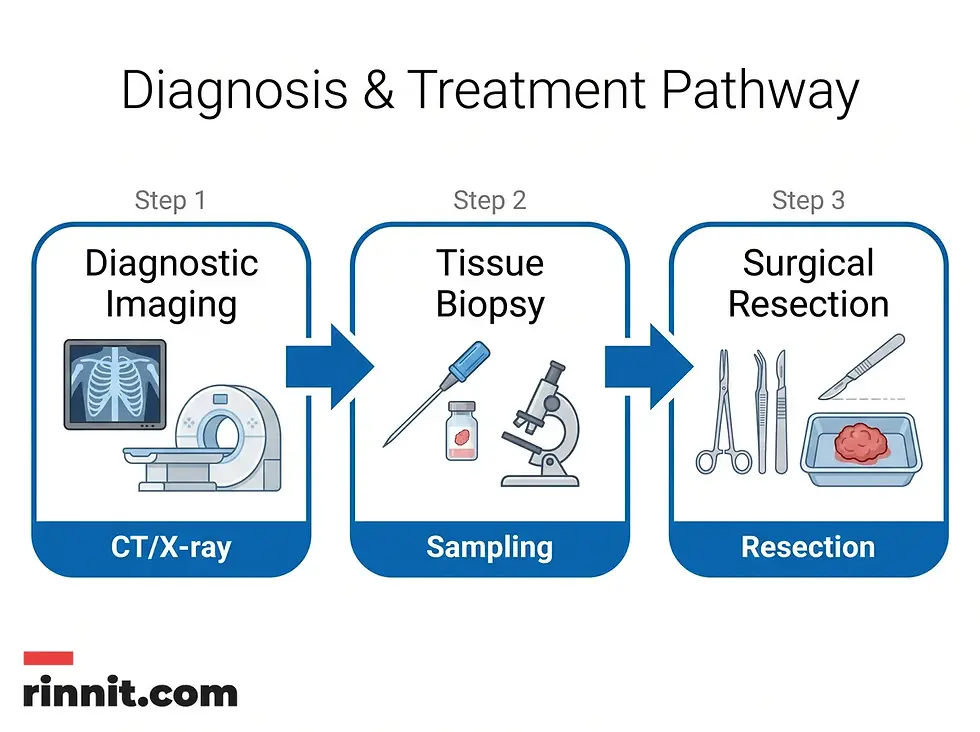
Imaging, tissue sampling, and surgical removal are the main steps for many mediastinal tumors.
What is the outlook for mediastinal tumors, and what questions should you ask?
Every type of tumor is different, and the outlook varies with the type of tumor, whether it's cancerous, and your general health. If you have a cancerous tumor, like a thymoma or lymphoma, ask your provider about cure rates and survival rates for your diagnosis. Mediastinal masses aren't preventable, but finding a tumor early can improve your chance of successful treatment. See a healthcare provider if you have shortness of breath, coughing, or other symptoms lasting longer than two weeks [1].
Questions to ask your doctor [1]:
What type of mediastinal tumor do I have?
Is the tumor malignant or benign?
Will the tumor require treatment, and which treatments do you recommend?
What are the benefits and risks of the treatment options?
What outcomes should I expect?
Should I look for signs of complications from either the tumor or treatment?
For a broader look at the area where these tumors form, see our guide to the chest (thorax).
What is the bottom line on mediastinal tumors?
Mediastinal tumors are rare, and their location makes them a complex medical challenge. Most are not cancer, and many that need treatment can be removed with surgery, including minimally invasive approaches in some cases. Because untreated tumors can cause serious problems even when benign, it is important to get symptoms that last longer than two weeks checked [1].
Your next step: if you have shortness of breath, a cough, hoarseness, or trouble swallowing that lasts longer than two weeks, see a healthcare provider, and ask what type of mediastinal tumor you may have and whether it needs treatment [1].
Frequently Asked Questions
What is the most common type of mediastinal tumor?
Thymomas are the most common type, and most mediastinal tumors form in the anterior (front) part of the mediastinum. Benign mediastinal cysts and lymphomas are also common.
Are all mediastinal tumors cancerous?
No. Only about 25% of mediastinal masses are cancer, although the chance of a malignant tumor is higher in the front part of the mediastinum, where about 60% are cancerous.
How are these tumors usually discovered?
Almost 40% of people with mediastinal tumors have no symptoms, and healthcare providers often find the tumors incidentally on a chest X-ray done for another reason.
Can children develop mediastinal tumors?
Yes. In children, most tumors form in the posterior (back) mediastinum, often begin in the nerves, and aren't cancerous.
What causes mediastinal tumors?
Causes include out-of-control cell growth, a response to inflammation or an underlying infection or condition, and atypical tissue development before birth (congenital).
Is surgery always necessary?
Surgery is the most common treatment, but your provider may monitor a benign tumor that isn't causing symptoms instead of treating it directly (watchful waiting).
What are the risks of leaving a tumor untreated?
Untreated tumors can cause serious problems even when they're not cancerous, including spreading to the heart, the lining around the heart, and the great vessels, and pressing on the spinal cord.
What is the role of a CT scan in diagnosis?
A CT scan with IV contrast shows the mass in more detail than a chest X-ray, including how it affects other structures inside the chest, which helps plan treatment.
What is the outlook for people with mediastinal tumors?
The outlook varies with the type of tumor, whether it is cancerous, and your general health, so ask your provider about likely outcomes for your diagnosis.
What is mediastinoscopy?
Mediastinoscopy is a procedure in which your provider views the mediastinum by inserting a lighted tube into your chest and removes tissue samples for testing.
Related Reading
Mediastinoscopy: Why It's Done, Procedure, Recovery and Risks explains the procedure that samples lymph nodes between the lungs to stage cancer.
References
Cleveland Clinic. Mediastinal tumor. Cleveland Clinic. December 13, 2022. https://my.clevelandclinic.org/health/diseases/13792-mediastinal-tumor
Roden AC, Fang W, Shen Y, et al. Distribution of mediastinal lesions across multi-institutional, international, radiology databases. J Thorac Oncol. 2020;15(4):568-579. PMID 31870881. https://doi.org/10.1016/j.jtho.2019.12.108
Friedant AJ, Handorf EA, Su S, et al. Minimally invasive versus open thymectomy for thymic malignancies: systematic review and meta-analysis. J Thorac Oncol. 2016;11(1):30-38. PMID 26762737. https://doi.org/10.1016/j.jtho.2015.08.004
Noleto da Nobrega Oliveira RE, Salvador ICMC, Passos FS, et al. Comparison of video-assisted surgery and open surgery for mediastinal tumor resection in pediatric population: a systematic review and meta-analysis. J Pediatr Surg. 2025;60(5):162271. PMID 40086163. https://doi.org/10.1016/j.jpedsurg.2025.162271
Medical disclaimer
This article is for informational purposes only and is not a substitute for professional medical advice, diagnosis, or treatment. The clinical information in this guide reflects source material last reviewed in December 2022.



Comments