Peripheral Nerve Tumors: Symptoms, Causes & Treatment — What a Growing Lump Can Mean

Updated: 3 hours ago
Medically reviewed by Dr. Baraa Alnahhal, MD · Last reviewed: September 2026
TL;DR
Peripheral nerve tumors are growths that form in or near nerves — the strands of tissue that transmit signals from the brain to the rest of the body. These tumors can occur anywhere in the body, and most of them are benign, meaning they are not cancerous. However, even benign tumors can lead to pain, nerve damage, and loss of function in the affected area. Symptoms depend on the tumor's location and typically include a swelling or lump under the skin, pain, tingling, or numbness, weakness or loss of function, and dizziness or loss of balance. Treatment usually involves surgery to remove the tumor while preserving nearby healthy nerves; when surgery is not possible, monitoring, stereotactic radiosurgery, or — for cancerous tumors — chemotherapy and radiation therapy may be used. Early diagnosis and treatment are the most important factors for a good outcome.
Quick Answer: What Is a Peripheral Nerve Tumor?
A peripheral nerve tumor is a growth that forms in or near the nerves that carry signals from the brain to the rest of the body.
These tumors can occur anywhere in the body, and most of them are benign (not cancerous).
Symptoms include a lump under the skin, pain, tingling or numbness, weakness or loss of function in the affected area, and dizziness or balance loss.
Six main types are recognized: acoustic neuroma (vestibular schwannoma), benign peripheral nerve tumors, desmoid tumors, malignant peripheral nerve sheath tumors (MPNSTs), neurofibromas, and schwannomas.
The cause is often unclear, but some tumors are linked to inherited syndromes (neurofibromatosis types 1 and 2, schwannomatosis) or gene changes; prior radiation treatment also raises risk.
Treatment usually involves surgery to remove the tumor without damaging nearby healthy tissue and nerves; monitoring, stereotactic radiosurgery, and cancer therapies are alternatives.
Early diagnosis and treatment are the most important factors for a good outcome — see a healthcare provider for any lump that grows quickly.

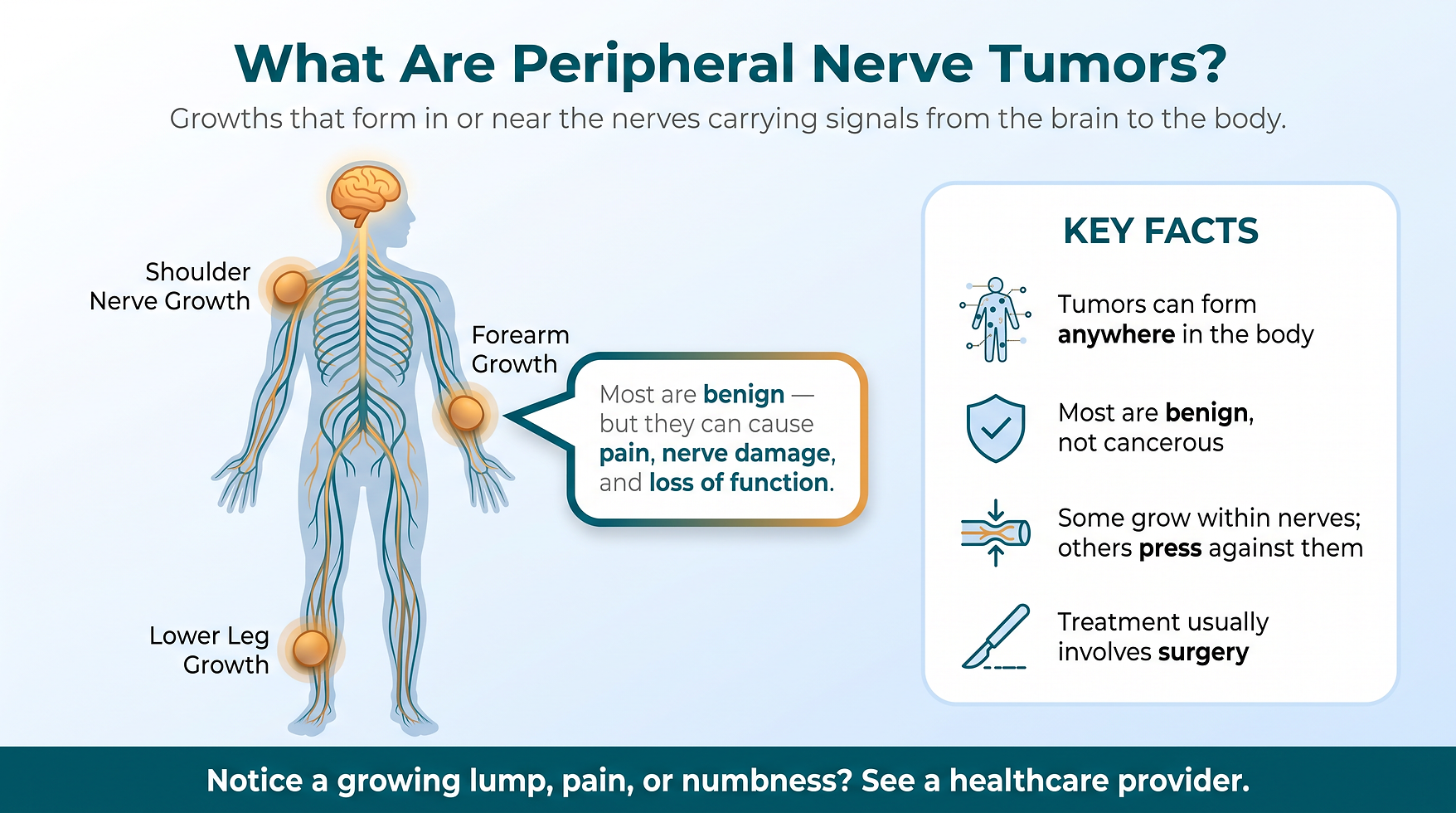
Figure 1: Peripheral nerve tumors in one view — where growths form on nerves, why most are benign, and why early care matters.
What Are Peripheral Nerve Tumors?
Peripheral nerve tumors are growths that form in or near nerves. Nerves are strands of tissue that transmit signals from the brain to the rest of the body. The peripheral nerves control muscles that allow you to walk, blink, swallow, pick things up, and do other activities.
Two basic growth patterns determine how a tumor behaves around the nerve:
Intraneural tumor: a tumor that grows within a nerve itself.
Extraneural tumor: a tumor that forms outside a nerve and presses against it.
Peripheral nerve tumors can occur anywhere in the body. Most of them are benign, meaning they are not cancerous. But even benign tumors can lead to pain, nerve damage, and loss of function in the affected area.
Treatment usually involves surgery to remove the tumor. When the tumor cannot be removed without damaging nearby healthy tissue and nerves, other treatments may be considered.
What Are the Different Types of Nerve Tumors?
Six main types of peripheral nerve tumors are recognized, ranging from benign growths to malignant cancers:
Tumor type | Description |
|---|---|
Acoustic neuroma (vestibular schwannoma) | A benign tumor that usually starts on the balance nerve (vestibular nerve), which runs next to the hearing nerve (cochlear nerve); these nerves lead from the inner ear to the brain. Pressure can cause hearing loss, ringing in the ear, and balance problems |
Benign peripheral nerve tumor | A noncancerous growth on or near a peripheral nerve |
Desmoid tumors | Tumors of the soft tissue that can press on nerves |
Malignant peripheral nerve sheath tumors (MPNSTs) | Cancerous tumors of the nerve sheath |
Neurofibroma | A benign tumor of the nerve sheath; often multiple in certain inherited syndromes |
Schwannoma | A benign tumor that develops from Schwann cells; grows along a nerve but can often be separated from healthy nerve fibers |
Some tumors take unusual shapes. A more complex nerve sheath tumor may form a dumbbell shape, occurring in the spine and lower abdomen and becoming intertwined with important nerves.
What Are the Symptoms of Peripheral Nerve Tumors?
The symptoms of a peripheral nerve tumor develop from direct effects on the main nerve or from the tumor pressing on nearby nerves, blood vessels, or tissues. As the tumor grows, it may be more likely to cause symptoms — although tumor size does not always determine effects.
Symptoms vary depending on where the tumors are located and the tissues affected:
Symptom | What it looks like |
|---|---|
Swelling or a lump | A lump under the skin — often the first visible sign |
Pain, tingling, or numbness | Nerve irritation or compression in the affected area |
Weakness or loss of function | The affected area may grow weaker or stop working normally |
Dizziness or loss of balance | Especially with tumors affecting balance-related nerves |
A useful special case worth knowing: vestibular schwannomas sit near the hearing and balance nerves of the inner ear. Pressure from these tumors can cause hearing loss, ringing in the ear, and balance problems, and in some cases the tumor may grow and affect the cerebellum or other nearby brain tissue.
When to See a Doctor
The guidance is simple: see your healthcare provider if you have any of the symptoms listed, especially if you have a lump that grows quickly.
Do not ignore a lump that persists or enlarges. Early evaluation determines whether the growth is a nerve tumor, what type it is, and whether treatment is needed.
What Causes Peripheral Nerve Tumors?
It is not clear why most peripheral nerve tumors develop. Some are linked to known inherited syndromes, and others may be caused by changes in a gene.
Cause | Details |
|---|---|
Unknown (most cases) | It is not clear why most peripheral nerve tumors develop |
Inherited syndromes | Neurofibromatosis (types 1 and 2) and schwannomatosis are linked to tumor development |
Gene changes | Other tumors may be caused by changes in a gene |

Figure 2: The six main tumor types, how intraneural and extraneural tumors grow differently, and the causes and risk factors behind them.
Who Is Most at Risk?
Two groups face clearly higher risk:
Risk factor | Why it raises risk |
|---|---|
Neurofibromatosis (types 1 and 2) and schwannomatosis | In these disorders, tumors develop on or near the nerves throughout the body; there are often multiple tumors; they can cause a variety of symptoms depending on location; these tumors are usually not cancerous |
A history of radiation treatment | A person exposed to radiation is at higher risk of developing peripheral nerve tumors years later |
What Complications Can Nerve Tumors Cause?
Peripheral nerve tumors can press against nerves, and this pressure can lead to complications — some of which may be permanent:
Complication | Effect |
|---|---|
Numbness and weakness | In the affected area |
Loss of function | In the affected area |
Trouble with balance | From pressure on balance-related nerves |
Pain | From irritation or compression of the nerve |
How Are Peripheral Nerve Tumors Diagnosed?
To diagnose a peripheral nerve tumor, a healthcare provider will ask about your symptoms and medical history. You may undergo a general physical exam and a neurological exam. Several tests may help pinpoint the cause of your symptoms:
Test | What it involves | What it shows |
|---|---|---|
MRI | Uses a magnet and radio waves | A detailed 3D view of nerves and tissue |
CT scan | A scanner rotates around the body, taking a series of images | A detailed view of the tumor and how it may be affecting you |
Electromyogram (EMG) | Small needles are placed in the muscles; an instrument records electrical activity as muscles move | How well the muscles respond, signaling possible nerve involvement |
Nerve conduction study | Often done together with an EMG | How fast nerves carry electrical signals to the muscles |
Tumor biopsy | A small sample of cells is removed and analyzed; may require local anesthesia (numbing an area) or general anesthesia (putting you to sleep) | Cell analysis — sometimes the only way to determine whether a tumor is cancerous |
Nerve biopsy | A biopsy of the nerve itself | Used for certain conditions, such as progressive peripheral neuropathy and enlarged nerves that mimic nerve tumors |
One practical note: peripheral nerve tumors aren't common, so it is important to find a provider who is experienced in diagnosing and treating them. If needed, seek a second opinion.
How Are Peripheral Nerve Tumors Treated?
Treatment depends on the type of tumor, what nerves and other tissues it affects, and symptoms. Options include:
Monitoring
Watching and waiting to see if the tumor grows may be an option if the tumor is in a place that makes removal difficult, or if it is small, slow growing, and causes few or no symptoms. You will have regular checkups and may have MRI scans, CT scans, or ultrasounds done every 6 to 12 months to see if the tumor is growing. If repeat scans show the tumor is stable, it may be monitored every several years.
Surgery
Some peripheral nerve tumors are removed with surgery. The goal is to take out the entire tumor without damaging nearby healthy tissue and nerves. When that is not possible, surgeons remove as much of the tumor as they can.
Surgical detail | What it means |
|---|---|
Schwannoma removal | Surgeons carefully remove schwannomas while preserving bundles of nerve fibers not affected by the tumor — these bundles are also called nerve fascicles |
Microsurgery advances | High-powered microscopes make it easier to tell the difference between a tumor and healthy tissue; nerve function can be monitored during surgery to preserve healthy tissue |
Surgical risks | Nerve damage and disability; risks depend on tumor size, location, and surgical approach |
Recurrence | Some tumors also grow back |
Stereotactic Radiosurgery
Stereotactic radiosurgery uses many small gamma rays to deliver a precise dose of radiation to the target — one type is called Gamma Knife radiosurgery. It is used to treat some peripheral nerve tumors in or around the brain, delivering radiation precisely without making an incision.
Risks of radiosurgery include weakness or numbness in the treated area, the possibility that the tumor may continue to grow, and — very rarely — the radiation could cause cancer in the treated area in the future.
Cancer Treatment
Cancerous tumors are treated with standard cancer therapies, including surgery, chemotherapy, and radiation therapy. Early diagnosis and treatment are the most important factors for a good outcome. Tumors may come back after treatment.

Figure 3: The treatment pathway — from a lump, pain, and numbness through MRI, biopsy, and treatment choice to rehabilitation and recovery.
What Is Rehabilitation After Treatment?
After surgery, you may need physical rehabilitation. Your healthcare provider may use a brace or a splint to keep your arm or leg in a position that helps you heal. Physical therapists and occupational therapists can help you recover function and mobility lost due to nerve damage or limb amputation.
How Can You Cope With a Nerve Tumor Diagnosis?
It can be stressful to deal with the possibility of peripheral nerve tumor complications, and choosing the best treatment can be a hard decision. Two suggestions may help:
Coping strategy | Why it helps |
|---|---|
Learn as much as you can about peripheral nerve tumors | The more you know, the better prepared you are to make good treatment choices; talk to your provider, a counselor, a social worker, or others who have had the condition |
Maintain a strong support system | Family, friends, and support groups can provide comfort and understanding; your provider or a social worker can connect you with a support group |
Preparing for Your Appointment
If your primary care provider thinks you have a peripheral nerve tumor, you will be referred to a specialist. Specialists include neurologists — doctors who are experts in disorders of the nervous system — and neurosurgeons — doctors trained in brain and nervous system surgery.
What you can do: before the appointment, prepare answers to the following questions:
Question to prepare for | Why it matters |
|---|---|
When did you first notice this problem? | Establishes the symptom timeline |
Has it gotten worse over time? | Shows whether the tumor is likely growing |
Have your parents or siblings ever had similar symptoms? | Flags possible inherited syndromes |
Do you have other medical problems? | Shapes treatment options |
What medicines or supplements do you take? | Affects anesthesia and treatment safety |
What surgeries have you had? | Informs the surgical approach |
What to expect from your doctor: your doctor may ask whether you have pain and where it is; whether you have any weakness, numbness, or tingling; whether your symptoms have been constant or come and go; and what treatments you have already tried for these problems.
Conclusion
Peripheral nerve tumors are growths that form in or near the nerves carrying signals from the brain to the rest of the body. They can appear anywhere, most are benign, and the most common warning signs are a lump under the skin, pain, tingling or numbness, weakness, and balance problems. Six tumor types are recognized — from benign schwannomas and neurofibromas to malignant peripheral nerve sheath tumors — and a biopsy is sometimes the only way to determine whether a tumor is cancerous.
If you notice a lump that grows quickly or persistent numbness, tingling, weakness, or balance problems, see a healthcare provider promptly. Diagnosis typically involves MRI, CT, EMG, nerve conduction studies, and sometimes biopsy, and treatment usually centers on surgery that removes the tumor while preserving healthy nerve function. Monitoring, stereotactic radiosurgery, and cancer therapies round out the options. Because early diagnosis and treatment are the most important factors for a good outcome — and some complications can be permanent — prompt evaluation is the best first step.
If you or a family member has an unexplained lump, tingling, or weakness that is not going away, schedule an evaluation with a healthcare provider today.
Frequently Asked Questions
What is a peripheral nerve tumor?
A peripheral nerve tumor is a growth that forms in or near nerves — the strands of tissue that transmit signals from the brain to the rest of the body. These tumors can occur anywhere in the body. Most are benign (not cancerous), but they can cause pain, nerve damage, and loss of function in the affected area.
Are nerve tumors cancerous?
Most peripheral nerve tumors are benign, meaning they are not cancerous. A minority are malignant peripheral nerve sheath tumors (MPNSTs), which are cancerous. A tumor biopsy is sometimes the only way to determine whether a tumor is cancerous.
What are the symptoms of a peripheral nerve tumor?
Symptoms develop from the tumor's direct effects on a nerve or from pressure on nearby nerves, blood vessels, or tissues. They include swelling or a lump under the skin, pain, tingling or numbness, weakness or loss of function in the affected area, and dizziness or loss of balance. Tumors near the inner ear (vestibular schwannomas) can also cause hearing loss and ringing in the ear.
What causes peripheral nerve tumors?
It is not clear why most peripheral nerve tumors develop. Some are linked to inherited syndromes such as neurofibromatosis types 1 and 2 and schwannomatosis. Others may be caused by changes in a gene. A history of radiation treatment also raises the risk of developing these tumors years later.
Who is at higher risk?
People with neurofibromatosis (types 1 and 2) or schwannomatosis have higher risk — tumors develop on or near nerves throughout the body, often as multiple growths, usually not cancerous. People with a history of radiation treatment face a higher risk of developing peripheral nerve tumors years after exposure.
How are peripheral nerve tumors diagnosed?
A provider asks about symptoms and medical history, then performs physical and neurological exams. Tests may include MRI (a detailed 3D view of nerves and tissue), CT scans, electromyogram (EMG), nerve conduction studies, and tumor or nerve biopsy. Because these tumors are uncommon, an experienced provider — and a second opinion if needed — is recommended.
What are the treatment options?
Treatment depends on the tumor type, affected nerves and tissues, and symptoms. Options include monitoring with scans every 6 to 12 months, surgery (the most common treatment, aimed at removing the tumor while preserving healthy nerves), stereotactic radiosurgery for tumors in or around the brain, and standard cancer therapies — surgery, chemotherapy, and radiation — for malignant tumors.
Can a nerve tumor come back after surgery?
Yes, some tumors grow back after treatment. Regular follow-up checkups and scans are important to detect recurrence early.
What is rehabilitation like after nerve tumor surgery?
After surgery, a brace or splint may keep the arm or leg in a position that supports healing. Physical therapists and occupational therapists help recover function and mobility lost due to nerve damage or limb amputation.
Related Reading
External References
Peripheral nerve tumors — Symptoms & Causes. Clinical reference page, last reviewed July 19, 2024. https://www.mayoclinic.org/diseases-conditions/peripheral-nerve-tumors/symptoms-causes/syc-20355070
Peripheral nerve tumors — Diagnosis & Treatment. Clinical reference page, last reviewed July 19, 2024. https://www.mayoclinic.org/diseases-conditions/peripheral-nerve-tumors/diagnosis-treatment/drc-20355075
References
This article is for general informational purposes and is not a substitute for professional medical advice, diagnosis, or treatment. Always consult a qualified healthcare professional about any medical condition.
Comments