Biomarker Testing for Cancer: What It Is, How It Works and What Results Mean

Updated: 2 days ago
Written and medically reviewed by Dr. Baraa Alnahhal, MD · Last reviewed: November 2026 · How we review
Quick Answer: What is biomarker testing for cancer?
Biomarker testing checks a sample of tissue, blood or other fluid for gene changes, proteins or other substances that give information about a cancer. These tumor markers help a provider profile the tumor, pick treatments that are more likely to work, predict how it may behave and check whether treatment is working. [1]
What the research says
Testing often finds a treatable gene change. Among 733 lung adenocarcinomas tested for 10 cancer-driving genes, 64% had at least one driver. People with a driver who received a matching targeted therapy had a median survival of 3.5 years, compared with 2.4 years for those with a driver who didn't, though the authors noted randomized trials are still needed. (Kris et al., JAMA, 2014) [2]
Biomarkers are reshaping cancer care. A 2024 review describes how biomarkers let oncologists tailor treatment to the molecular profile of each tumor, helped by better testing methods, knowledge of the immune environment around tumors and the ability to profile tumor material circulating in the blood. (Passaro et al., Cell, 2024) [3]
Key takeaways
Biomarker tests look for tumor markers, such as gene mutations and proteins, in tissue, blood or saliva. [1]
Results can point to targeted therapy or immunotherapy that may work better than standard treatment. [1]
Biomarkers can help predict how aggressive a tumor is and whether it has come back. [1]
Testing is routine for some cancers, including breast, colon and lung cancer. [1]
It isn't available for every cancer type, and not everyone with cancer needs it. [1]
What is biomarker testing?
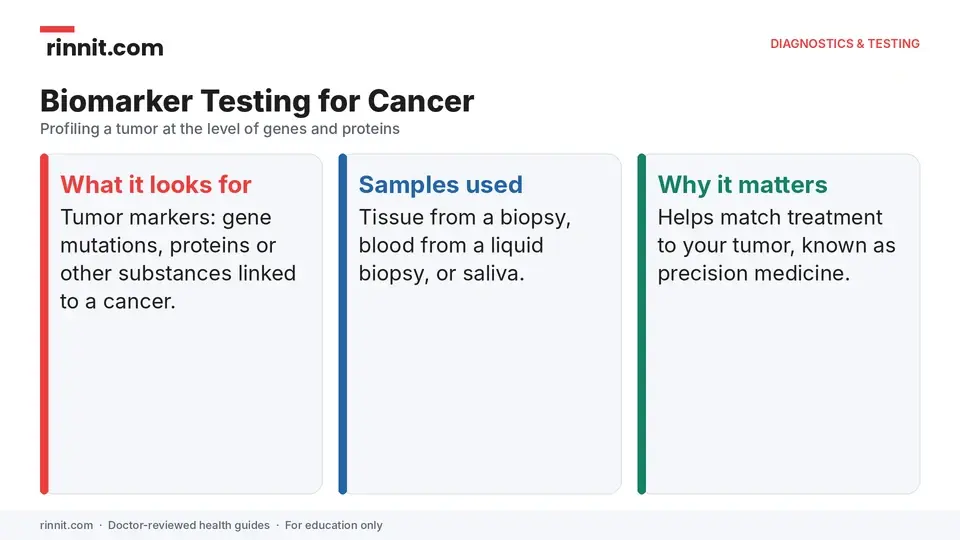
Biomarker tests check your tissue, blood or other fluids for tumor markers, also called biomarkers. Tumor markers are gene mutations, proteins or other substances that give information about a cancer diagnosis. [1]
Learning you have cancer is the first step in getting the right care. The details unique to your cancer, including its tumor markers, help your care team tailor your treatment plan. Biomarker testing makes precision medicine possible: personalized treatment that fights cancer at the level of molecules. [1]
How can biomarker test results help?

The results of a biomarker test may help your provider: [1]
Goal | How biomarkers help |
Recommend treatments | Some treatments, such as targeted therapy and immunotherapy, are designed for cancers with certain markers. They're often more successful and have fewer side effects than standard treatments like chemotherapy. |
Predict how aggressive a tumor is | Some markers suggest a tumor will grow fast or come back after treatment, which helps your provider decide how intensive treatment should be. |
See if treatment is working | Treatments that destroy cancer cells may lower biomarker levels, so a decline can mean treatment is helping. |
See if cancer has come back | Signs of cancer at the cell level often show up before symptoms do. |
Predict your chance of recovery | Markers may help predict your response to treatment or your chances of a cure. |
Sources: [1]
Biomarker testing isn't available for every cancer type, and not everyone with cancer needs it. But more and more, it helps providers pick the best treatments. [1]
Who should get biomarker testing?
For some cancers, biomarker testing is a routine part of diagnosis. For example, if you have breast cancer, your provider tests the cancer cells to see whether the cancer grows in response to estrogen or a protein called HER2. If it does, you can get treatments that block these substances. [1]
Other cancers with routine biomarker testing include colon cancer and lung cancer. If testing isn't routine for your cancer, your provider may still recommend it when it could open up better treatment options. It depends on your individual case. [1]
How does biomarker testing work?
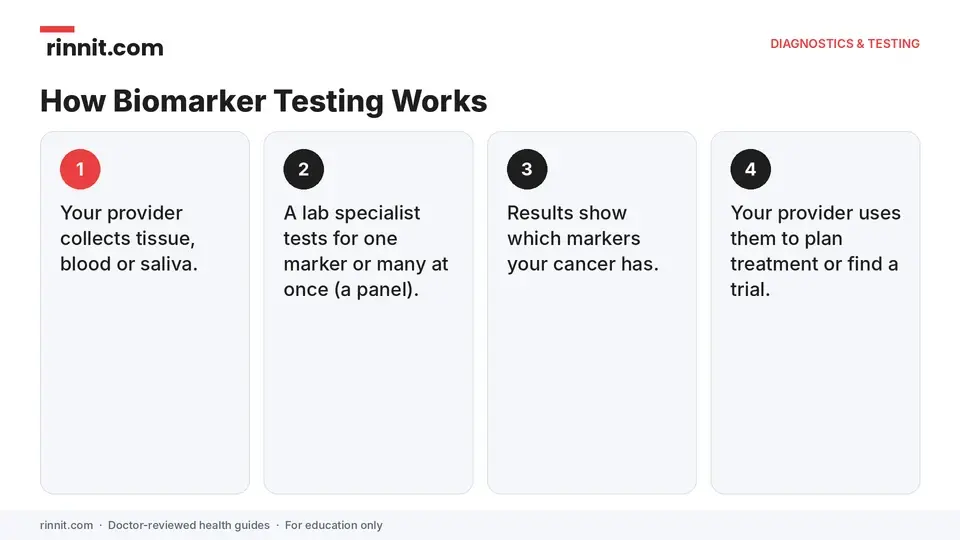
Your healthcare provider first collects a sample of tissue, blood or saliva. They may do this with: [1]
A biopsy to remove a small piece of tissue
A liquid biopsy, which is a type of blood test
A spit (saliva) test
The testing itself happens in a lab, where a specialist checks the sample for tumor markers. Depending on what your provider is looking for, the lab may test for: [1]
One specific biomarker
Many biomarkers at once, sometimes called a multigene or panel test
Gene changes in healthy cells, which can show whether you were born with a cancer-related gene variation or developed it later in life
Your provider can explain what the tests are looking for. [1]
Are there any risks?
There aren't many risks with biomarker tests themselves. Your provider will explain any side effects of the procedure used to collect your tissue or fluid sample before you agree to it. [1]
What do biomarker test results mean?
Your results may show that certain treatments are an option for you. You may be eligible for: [1]
FDA-approved treatments: treatments that have been tested and are considered safe and effective for your specific diagnosis.
Off-label treatments: treatments approved for other cancers with the same tumor marker, which means there's a chance they could work for yours.
Clinical trials: studies that give access to new treatments aimed at cancers with a marker you have.
Results can also inform your outlook. They may show the cancer is aggressive and needs more intensive treatment, or that it's likely to respond well to treatment. Your provider will explain what your results mean for your options. [1]
Is biomarker testing worth it?
It can be. Biomarker testing may be well worth it if it helps you access more effective treatment or gives you a clearer idea of how your disease may progress. Not every biomarker test can provide this information, so your provider is your best guide. Ask whether biomarker testing will be part of your diagnosis and, if not, whether it's an option. [1]
Conclusion
Biomarker testing helps your care team profile your cancer by finding the gene errors and proteins that fuel its growth. That information can lead to treatments designed to fight your specific tumor and help track how well treatment is working.
It isn't available for every cancer, and it may not change the plan for everyone. Talk with your provider about the possible benefits and limits of testing in your situation.
Keep learning: Read our guide to genetic testing for cancer risk or our explainer on BRCA testing. For more trusted, doctor-reviewed health guides, visit Rinnit.com.
FAQ
What is biomarker testing for cancer?
It checks tissue, blood or other fluids for gene changes and proteins that give information about a cancer.
What is a tumor marker?
A gene mutation, protein or other substance that gives information about a cancer diagnosis.
Why is biomarker testing done?
To help choose treatments, predict how aggressive a tumor is and check whether treatment is working.
How is a sample collected for biomarker testing?
Through a biopsy, a liquid biopsy blood test or a saliva test.
Which cancers routinely get biomarker testing?
Breast, colon and lung cancer are among the cancers routinely tested.
What is precision medicine?
Personalized treatment chosen based on the molecular features of your cancer.
Is biomarker testing the same as genetic testing?
Some biomarker tests look at genes, but others look at proteins or other substances.
Are there risks with biomarker testing?
Few. Any risks usually come from the procedure used to collect the sample.
Can biomarker results make me eligible for a clinical trial?
Yes. A marker you have may qualify you for a study of a new targeted treatment.
Does everyone with cancer need biomarker testing?
No. It isn't available for all cancers, so ask your provider whether it's right for you.
Related Reading
Non-Small Cell Lung Cancer: Understanding Symptoms, Types, and Treatments explains the lung cancer type in which biomarker testing routinely guides treatment.
Lung Cancer: Symptoms, Causes, Diagnosis, and Treatment Explained covers lung cancer symptoms, causes, diagnosis and treatment.
Breast Cancer: Symptoms, Causes, and Treatment explains breast cancer, where testing for hormone receptors and HER2 is routine.
Colon Cancer: Symptoms, Screening, Diagnosis, Treatment and Support covers colon cancer, another cancer that routinely gets biomarker testing.
Targeted Therapy for Cancer: How It Works, Types, Side Effects and Outlook explains the treatments that biomarker results often point to.
References
Cleveland Clinic. Biomarker Testing for Cancer. Cleveland Clinic. Last updated September 3, 2025. https://my.clevelandclinic.org/health/diagnostics/biomarker-testing
Kris MG, Johnson BE, Berry LD, et al. Using multiplexed assays of oncogenic drivers in lung cancers to select targeted drugs. JAMA. 2014;311(19):1998-2006. PMID 24846037. https://doi.org/10.1001/jama.2014.3741
Passaro A, Al Bakir M, Hamilton EG, et al. Cancer biomarkers: Emerging trends and clinical implications for personalized treatment. Cell. 2024;187(7):1617-1635. PMID 38552610. https://doi.org/10.1016/j.cell.2024.02.041
Medical disclaimer
This article is for general education only and does not replace advice from a qualified healthcare professional. Talk to your doctor about your own diagnosis and treatment, and seek emergency care right away for severe or sudden symptoms.



Comments