Amniocentesis: Why It's Done, What Happens, Risks and What Your Results Mean

Updated: 2 days ago
Written and medically reviewed by Dr. Baraa Alnahhal, MD · Last reviewed: November 2026 · How we review
Quick Answer: What is amniocentesis?
Amniocentesis is a prenatal test in which a provider uses a thin needle, guided by ultrasound, to take a sample of the amniotic fluid around the fetus. A lab checks fetal cells in that fluid for genetic and chromosome conditions. It's usually done between 15 and 20 weeks of pregnancy, takes about 30 minutes and is about 99% accurate. [1]
What the research says
The extra miscarriage risk from amniocentesis is small. Pooling 12 controlled studies covering 63,723 procedures, pregnancy loss after amniocentesis was 0.91% versus 0.58% in pregnancies without it, an added procedure-related risk of about 0.30%; in groups with similar baseline risk it fell to 0.12%. (Salomon et al., Ultrasound in Obstetrics & Gynecology, 2019) [2]
Earlier pooled data showed a similarly low figure. Among 42,716 women who had amniocentesis, miscarriage before 24 weeks occurred in 0.81% compared with 0.67% of controls, giving a procedure-related risk of about 0.11%. (Akolekar et al., Ultrasound in Obstetrics & Gynecology, 2015) [3]
In twin pregnancies, early loss rates matched background risk. Across 16 studies of nearly 6,000 twin pregnancies, overall fetal loss was 2.4% both with and without amniocentesis, and losses before 24 weeks or within 4 weeks of the test did not differ. (Di Mascio et al., Ultrasound in Obstetrics & Gynecology, 2020) [4]
Key takeaways
Amniocentesis tests amniotic fluid for genetic and chromosome conditions in the fetus. [1]
It is usually done between 15 and 20 weeks of pregnancy and is optional. [1]
The needle is in place for only one to two minutes, and the whole visit takes about 30 minutes. [1]
About 1 in 1,000 procedures leads to miscarriage, and pooled studies suggest the added risk may be even lower. [1] [2]
Results are about 99% accurate and can take from a few days to two weeks or more. [1]
What is amniocentesis?
Amniocentesis is a diagnostic prenatal test. A provider passes a thin, hollow needle through your belly and uterus into the amniotic sac and draws out a small amount of fluid. [1]
Amniotic fluid contains cells shed by the fetus, and those cells carry its genetic material. Testing them shows whether the fetus has certain congenital or genetic conditions. [1]
The test is most often done in the second trimester, between 15 and 20 weeks of pregnancy, though it is sometimes done in the third trimester. [1]
Why is amniocentesis done?
Your provider may suggest amniocentesis when: [1]
An ultrasound shows signs of a possible congenital condition
A prenatal screening test shows a higher chance of a chromosome disorder
You or your partner tests positive as a carrier of a genetic condition
The test is optional. Your provider should explain why they are recommending it and talk through its benefits and risks, but the decision belongs to you. [1]
Other reasons for amniocentesis
Amniotic fluid can also help guide care later in pregnancy: [1]
Fetal lung maturity: substances in the fluid show whether the lungs are developed enough for an early delivery if a complication arises
Rh incompatibility: the fluid shows how severe the incompatibility is
Polyhydramnios: when there is too much amniotic fluid, the procedure can remove some of it as treatment
What conditions can amniocentesis detect?

Amniocentesis can find chromosome, single-gene and neural tube conditions.
Group | Examples |
Chromosome conditions | Down syndrome, Edwards syndrome, Patau syndrome, Klinefelter syndrome, Turner syndrome |
Single-gene conditions | Cystic fibrosis, sickle cell disease, Duchenne muscular dystrophy, spinal muscular atrophy (SMA), Tay-Sachs disease |
Neural tube defects | Spina bifida, anencephaly |
Sources: [1]
The test can confirm whether a condition is present, but it cannot show how severe that condition will be. [1]
How do you prepare for amniocentesis?
Most people need no special preparation. Tell your provider about every medicine you take, because they may ask you to pause some of them before the test. [1]
It helps to bring questions with you, such as: [1]
Why is this test being recommended for me?
What are the risks?
What will happen during the procedure?
When will I get my results?
Can I meet with a genetic counselor?
What happens during amniocentesis?
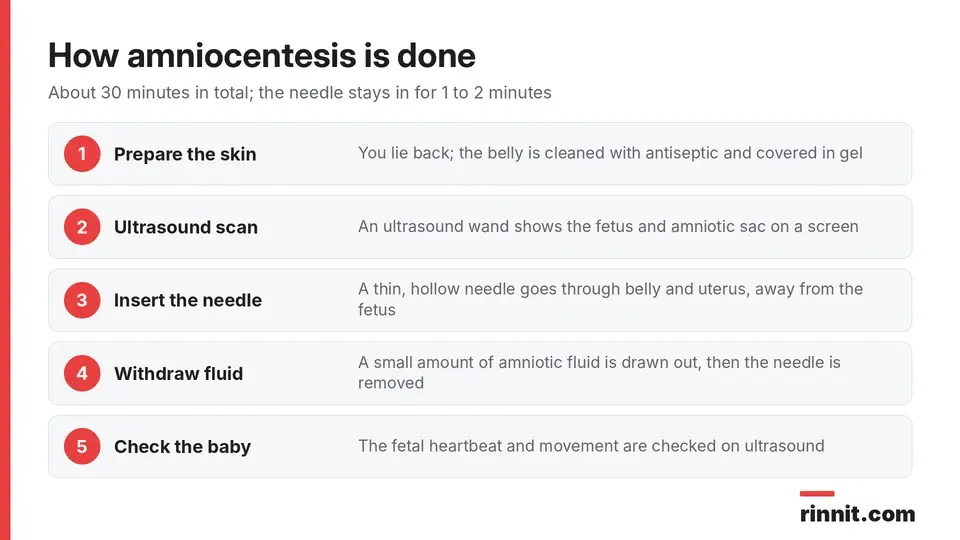
The needle stays in for only one to two minutes.
The procedure is usually performed by a perinatologist, a specialist in high-risk pregnancy. The steps are: [1]
You lie back on an exam table with your belly uncovered.
Your provider cleans the skin with an antiseptic and spreads gel on your belly.
An ultrasound wand shows the fetus and the amniotic sac on a screen.
Using the ultrasound as a guide, your provider inserts a thin, hollow needle through your belly and uterus into the sac, away from the fetus.
A small amount of fluid is drawn out and the needle is removed.
Your provider checks the fetal heartbeat and movement on ultrasound.
The whole appointment takes about 30 minutes, but the needle is inside your body for only one to two minutes. [1]
Does amniocentesis hurt?
You may feel a sting or some discomfort as the needle goes in, followed by mild cramping that can last a few hours. [1]
What does the lab do with the fluid?
The lab separates the fetal cells from the fluid and grows them for several days. It then tests the cells for the genetic conditions or neural tube defects your provider asked about. [1]
What happens after amniocentesis?
Plan to go home and rest for the remainder of the day. Acetaminophen can ease any soreness. Avoid strenuous activity, including exercise and sex, until your provider says it is fine. Most people are back to their usual routine within one to two days. [1]
What are the risks of amniocentesis?
Amniocentesis is generally safe, but it does carry some risks: [1]
Severe cramping
Bleeding or leaking of amniotic fluid
Injury or infection
Preterm labor
Miscarriage
About 1 to 2 in 100 people have spotting or cramping afterward, and about 1 in 1,000 procedures leads to miscarriage. [1]
Large pooled analyses put the added miscarriage risk from the procedure at roughly 0.1% to 0.3%. [2] [3]
Providers generally recommend the test when they believe its benefits outweigh these small but real risks. Feeling anxious is normal, so share any concerns before you decide. [1]
How accurate is amniocentesis?
Amniocentesis is about 99% accurate at showing whether a tested condition is present. It does not predict how mild or severe that condition will be. [1]
When will you get amniocentesis results?
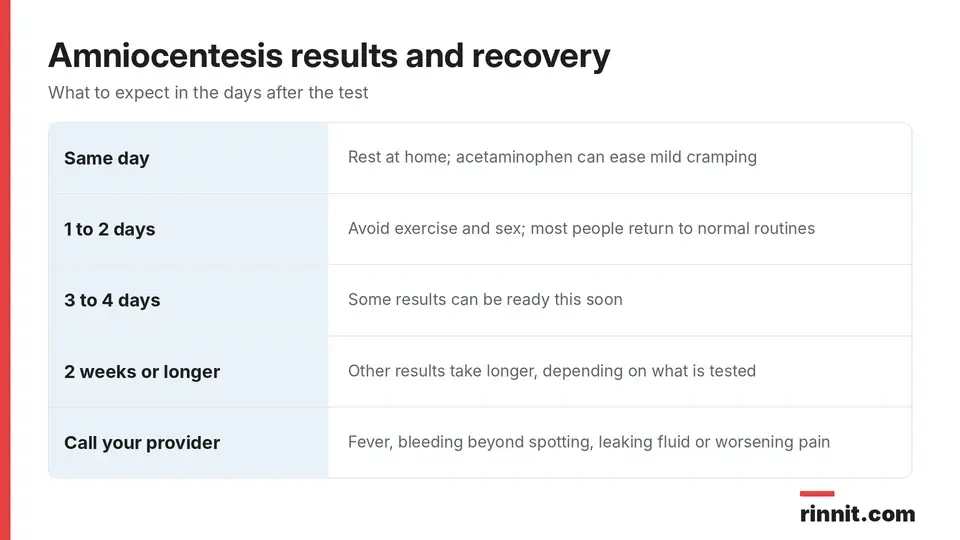
Timing depends on which conditions are being tested.
Some results come back as soon as three to four days after the test. Others take two weeks or longer, depending on what the lab is looking for. [1]
Result | What it means | Possible next steps |
Normal | No signs of the conditions that were tested | Routine prenatal care continues |
Abnormal | A tested condition was found | Your provider explains the findings; genetic counseling may be offered |
Abnormal, planning care | A condition is confirmed | A neonatologist can discuss treatments, surgery, medicines and newborn care |
Sources: [1]
When should you call your provider after amniocentesis?
Contact your provider right away if you notice: [1]
Fever or chills
Vaginal bleeding heavier than light spotting
Vaginal discharge or leaking fluid
Moderate to severe belly pain that is worse than mild cramps
Redness or swelling where the needle went in
Conclusion
Amniocentesis gives a clear, highly accurate answer about specific genetic, chromosome and neural tube conditions when screening or ultrasound raises a question. It is quick, usually done between 15 and 20 weeks, and carries a small risk of complications.
Whether to have it is your decision. Talk with your provider or a genetic counselor about why it is being offered, what it can and cannot tell you, and what you would do with the results.
Keep learning: Read our NIPT guide or our prenatal genetic testing guide. For more background, see MedlinePlus on amniocentesis.
FAQ
What is amniocentesis used for?
It tests a small sample of amniotic fluid for certain genetic, chromosome and neural tube conditions in the fetus.
When is amniocentesis done?
Usually between 15 and 20 weeks of pregnancy, though it is sometimes done in the third trimester.
Is amniocentesis painful?
Most people feel a brief sting and mild cramping that can last a few hours.
How long does amniocentesis take?
About 30 minutes in total, with the needle in place for only one to two minutes.
What is the miscarriage risk with amniocentesis?
About 1 in 1,000 procedures leads to miscarriage.
How accurate is amniocentesis?
It is about 99% accurate but cannot show how severe a condition will be.
How long do amniocentesis results take?
Some results arrive in three to four days; others take two weeks or longer.
Can amniocentesis detect Down syndrome?
Yes. It can detect Down syndrome and other chromosome conditions such as Edwards and Patau syndromes.
What should I avoid after amniocentesis?
Rest for the day and avoid strenuous activity, including exercise and sex, for a day or two.
Is amniocentesis required?
No. It is optional, and you decide after discussing benefits and risks with your provider.
Related Reading
Cordocentesis (PUBS): Umbilical Cord Blood Test, Risks and Results explains the umbilical cord blood test used when other prenatal tests are unclear.
Down Syndrome: Symptoms, Causes, Types & Life Expectancy — Complete Guide covers the most common chromosome condition amniocentesis can confirm.
Understanding Neural Tube Defects: Types, Causes, and Prevention explains spina bifida and anencephaly, which the test can detect.
Cystic Fibrosis: Symptoms, Causes, Diagnosis, and Treatment (2026 Guide) describes an inherited condition often tested for when parents are carriers.
Sickle Cell Disease: Causes, Symptoms, and Modern Treatment Options explains another single-gene condition that amniocentesis can identify.
Quad Screen: What the Second-Trimester Blood Test Checks For and What Results Mean explains the second-trimester blood screen for Down syndrome and neural tube defects.
FISH Test: How Fluorescence In Situ Hybridization Finds Gene Changes explains the glowing-probe lab test that finds gene and chromosome changes.
References
Cleveland Clinic. Amniocentesis: Purpose, Procedure, Risks & Recovery. Cleveland Clinic. Last updated May 15, 2025. https://my.clevelandclinic.org/health/diagnostics/4206-genetic-amniocentesis
Salomon LJ, Sotiriadis A, Wulff CB, et al. Risk of miscarriage following amniocentesis or chorionic villus sampling: systematic review of literature and updated meta-analysis. Ultrasound Obstet Gynecol. 2019;54(4):442-451. PMID 31124209. https://doi.org/10.1002/uog.20353
Akolekar R, Beta J, Picciarelli G, et al. Procedure-related risk of miscarriage following amniocentesis and chorionic villus sampling: a systematic review and meta-analysis. Ultrasound Obstet Gynecol. 2015;45(1):16-26. PMID 25042845. https://doi.org/10.1002/uog.14636
Di Mascio D, Khalil A, Rizzo G, et al. Risk of fetal loss following amniocentesis or chorionic villus sampling in twin pregnancy: systematic review and meta-analysis. Ultrasound Obstet Gynecol. 2020;56(5):647-655. PMID 32632979. https://doi.org/10.1002/uog.22143
Medical disclaimer
This article is for general education only and does not replace advice from a qualified healthcare professional. Talk to your doctor about your own diagnosis and treatment, and seek emergency care right away for severe or sudden symptoms.



Comments