Bone Marrow Biopsy: Why It's Done, What to Expect, Pain and Recovery

Updated: 2 days ago
Written and medically reviewed by Dr. Baraa Alnahhal, MD · Last reviewed: November 2026 · How we review
Quick Answer: What is a bone marrow biopsy?
A bone marrow biopsy is a procedure that removes a small amount of the soft tissue inside the bones (bone marrow) so a specialist can examine it. It helps diagnose blood disorders, cancer and other conditions that affect bone marrow. It takes 10 to 20 minutes, the area is numbed first, and most people go home the same day. [1]
What the research says
Simple comfort methods can ease pain during the procedure. A meta-analysis of 18 randomized trials with 1,017 people found that distraction, a powered (drill-assisted) biopsy needle and acupoint stimulation each significantly reduced pain during bone marrow aspiration and biopsy, while hypnosis did not. (Li et al., Journal of Clinical Nursing, 2024) [2]
Most people feel some pain, but serious complications are rare. In 184 people who had a bone marrow biopsy under local anesthesia, 91% felt pain, with a median score of 3 out of 10. Pain lasted a median of 36 hours. Bleeding was mild in 54% and moderate in 10%, with no severe bleeding and no infections. (Valebjørg et al., European Journal of Haematology, 2014) [3]
Extra pain relief on top of numbing medicine helps. In a trial of 100 people, those who inhaled the pain reliever methoxyflurane along with local anesthesia reported lower worst pain (average 4.9 vs 6.0) than those given a placebo, and side effects were all mild. (Spruyt et al., BMJ Supportive & Palliative Care, 2014) [4]
Key takeaways
A bone marrow biopsy removes a small core of marrow tissue to diagnose blood disorders, cancer and other marrow conditions. [1]
It's usually done with an aspiration, which removes liquid marrow first. [1]
The back of the hip bone is the most common site, and the area is numbed before the needle goes in. [1]
The procedure takes about 10 to 20 minutes, and you usually go home the same day. [1]
Serious complications are rare; keep the site dry and avoid strenuous activity for 24 hours. [1]
What is a bone marrow biopsy?
Bone marrow is the soft tissue inside your bones that makes blood cells and platelets. A bone marrow biopsy removes a small amount of this tissue so a specialist can examine it under a microscope. [1]
Providers often order a bone marrow biopsy when blood tests show problems with your blood cells or platelets. It takes about 10 to 20 minutes, and you usually don't need to stay in the hospital. [1]
Bone marrow aspiration vs. bone marrow biopsy
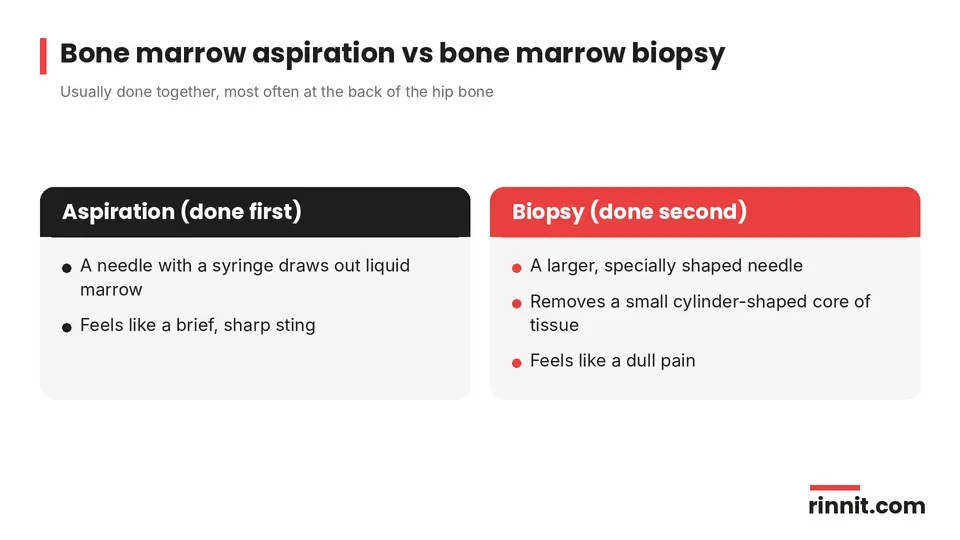
The two tests are related but separate, and they're usually done during the same visit: [1]
Feature | Bone marrow aspiration | Bone marrow biopsy |
What's removed | Liquid bone marrow | A small, cylinder-shaped core of marrow tissue |
Needle used | A needle with a syringe attached | A larger, specially shaped needle |
Order | Done first | Done after the aspiration |
What it feels like | A brief, sharp sting | A dull pain |
Sources: [1]
Why is a bone marrow biopsy done?
Your provider may recommend a bone marrow biopsy to: [1]
Diagnose a condition: When blood tests show an abnormal number of blood cells, the biopsy can help find blood disorders, cancer, infections or the cause of unexplained fevers.
Check cancer: It can show whether cancer has spread to the bone marrow or whether a tumor in the marrow is growing.
Monitor treatment: It shows whether treatment is working and whether your marrow is making enough healthy cells afterward. People in cancer treatment may have regular biopsies.
How do you prepare for a bone marrow biopsy?
Before the procedure, your provider will ask about your health and the medicines you take. [1]
If you take blood thinners, you may need to stop them first, because they can cause too much bleeding.
If you have hemophilia, your care team will take extra steps to manage bleeding.
Your provider will explain how the needle goes in and what comfort options are available, which may include a sedative to help you relax.
If you'll have a sedative, you may need to stop eating and drinking beforehand, and someone will need to drive you home.
What happens during a bone marrow biopsy?

The procedure is done in a provider's office or a hospital. You stay awake, though you may get medicine to help you relax. [1]
You lie on a table, usually on your side with your legs pulled up toward your belly.
Your provider cleans the skin over the back of your hip bone with antiseptic.
They inject numbing medicine down to the surface of the bone, which causes a brief, sharp pinch.
Through a small cut, they insert a needle with a syringe into the bone and draw out liquid marrow (aspiration).
They use a larger, specially shaped needle to remove a small, cylinder-shaped core of tissue (biopsy).
They remove the needle and press on the site to stop any bleeding.
The whole procedure takes about 10 to 20 minutes. [1]
Bone marrow biopsy at a glance
Item | Typical detail |
Where it's done | A provider's office or a hospital |
Most common site | Back of the hip bone |
Numbing | Local anesthetic, with an optional sedative to relax |
How long it takes | About 10 to 20 minutes |
Hospital stay | Usually not needed |
Recovery after sedation | 1 to 2 hours of rest before going home |
Sources: [1]
Does a bone marrow biopsy hurt?
The area is numbed first, but you'll likely feel some discomfort. Drawing out the liquid marrow causes a brief, sharp sting, and removing the tissue core causes a dull pain. Tell your provider if the pain is worse than you expected, because they may be able to adjust your medicine. [1]
What happens after a bone marrow biopsy?
If you had a sedative, you'll rest in a recovery room for 1 to 2 hours before going home. Your provider may suggest an over-the-counter pain reliever. For the first 24 hours: [1]
Keep the biopsy site dry
Avoid exercise and strenuous activity

What are the risks of a bone marrow biopsy?
Complications and side effects are very rare. The main risks are: [1]
Heavy bleeding at the biopsy site, which pressure usually stops
Infection, which your provider can treat
When will you get your results?
A specialist examines your samples, and your provider will explain the results and what comes next. What the results mean, and how soon you hear back, depends on your situation, so ask your provider when to expect them. [1]
When should you call your doctor?
Call your provider if you notice any of the following after your biopsy: [1]
Heavy bleeding or drainage from the site
Swelling
Skin discoloration that spreads
Fever
Pain that gets worse
Questions to ask your provider
Why do I need a bone marrow biopsy, and what are you looking for?
Will I have an aspiration and a biopsy?
Should I stop any medicines, such as blood thinners, beforehand?
Can I have a sedative or other pain relief during the procedure?
When and how will I get my results?
Conclusion
A bone marrow biopsy takes a small sample of the marrow inside your hip bone to diagnose blood disorders, cancer and other conditions, and to check how well treatment is working. It's usually done together with an aspiration and takes only 10 to 20 minutes.
The area is numbed first, and comfort options such as a sedative are often available. Serious problems are rare, and most people go home the same day with simple aftercare: keep the site dry and rest from strenuous activity for 24 hours.
Keep learning: Read our guides to bone marrow aspiration, biopsy, the complete blood count (CBC) and stem cell transplant.
FAQ
What is a bone marrow biopsy?
A bone marrow biopsy removes a small amount of marrow tissue, usually from the back of the hip bone, to diagnose blood disorders, cancer and other marrow conditions. [1]
Why would a doctor order a bone marrow biopsy?
Common reasons are abnormal blood counts, checking whether cancer has spread to the marrow, unexplained fevers and monitoring treatment. [1]
Is a bone marrow biopsy painful?
The area is numbed first, but you may feel a sharp sting when liquid marrow is drawn out and a dull pain when the tissue is removed. [1]
How long does a bone marrow biopsy take?
It takes about 10 to 20 minutes. [1]
Where is a bone marrow biopsy taken from?
The back of the hip bone is the most common site. [1]
Am I awake during a bone marrow biopsy?
Yes. You stay awake, though you may be given medicine to help you relax. [1]
What is the difference between bone marrow aspiration and biopsy?
Aspiration draws out liquid marrow with a needle and syringe, while biopsy removes a small core of tissue with a larger needle. [1]
What should I do after a bone marrow biopsy?
Keep the site dry and avoid exercise and strenuous activity for 24 hours; an over-the-counter pain reliever may help. [1]
What are the risks of a bone marrow biopsy?
Complications are very rare; the main risks are heavy bleeding at the site and infection. [1]
When should I call my doctor after a bone marrow biopsy?
Call for heavy bleeding or drainage, swelling, spreading skin discoloration, fever or worsening pain. [1]
Related Reading
Bone Marrow Donation: Who Can Donate and How It Works explains how bone marrow donation works.
Immunophenotyping: How It Identifies Blood Cells to Diagnose Leukemia and Lymphoma explains the marker test used to diagnose and classify leukemia and lymphoma.
Learn more in our guide to Bone Marrow Aspiration: What It Is, Why It's Done, and What to Expect.
Learn more in our guide to Understanding Leukemia: Types, Symptoms, and Modern Management.
Learn more in our guide to Lymphoma: Symptoms, Types, Causes, Diagnosis and Treatment.
Learn more in our guide to What Is Multiple Myeloma? A Plain-Language Guide to Symptoms, Causes, and Treatment.
Learn more in our guide to What Is Myelodysplastic Syndrome? A Plain-Language Guide to Symptoms, Causes, and Treatment.
Learn more in our guide to Aplastic Anemia: Symptoms, Causes, Treatment & Complete Guide.
Learn more in our guide to Myelofibrosis Complete Guide: Symptoms, Causes, Diagnosis, Treatment & Outlook.
Learn more in our guide to Bone Marrow Failure: Causes, Symptoms, and Treatment Explained.
References
Cleveland Clinic. Bone Marrow Biopsy: What It Is, Procedure & Results. Cleveland Clinic. Last updated August 12, 2026. https://my.clevelandclinic.org/health/diagnostics/17735-bone-marrow-biopsy
Li C, Zhang X, Zhuang X, et al. The effectiveness of non-pharmacological interventions on reducing pain in patients undergoing bone marrow aspiration and biopsy: A systematic review and meta-analysis of randomized controlled trials. J Clin Nurs. 2024;33(8):2829-2848. PMID 38549254. https://doi.org/10.1111/jocn.17121
Valebjørg T, Spahic B, Bremtun F, et al. Pain and bleeding associated with trephine biopsy. Eur J Haematol. 2014;93(4):267-272. PMID 24725088. https://doi.org/10.1111/ejh.12339
Spruyt O, Westerman D, Milner A, et al. A randomised, double-blind, placebo-controlled study to assess the safety and efficacy of methoxyflurane for procedural pain of a bone marrow biopsy. BMJ Support Palliat Care. 2014;4(4):342-348. PMID 24644183. https://doi.org/10.1136/bmjspcare-2013-000447
Medical disclaimer
This article is for general education only and does not replace advice from a qualified healthcare professional. Talk to your doctor about your own diagnosis and treatment, and seek emergency care right away for severe or sudden symptoms.



Comments