Bone Marrow Donation: Who Can Donate and How It Works

Updated: 2 days ago
Written and medically reviewed by Dr. Baraa Alnahhal, MD · Last reviewed: November 2026 · How we review
Quick Answer
Bone marrow donation is the collection of blood-forming stem cells from a healthy donor's hip bone for a bone marrow transplant, which may cure blood cancers and blood disorders such as leukemia and lymphoma. It takes about an hour under general anesthesia. Most donors return to work within a few days and fully recover in a few weeks.
What the research says
Serious problems after donating were rare: among 2,726 bone marrow donors and 6,768 blood stem cell donors, serious adverse events were rare but more common after marrow donation (2.38% vs. 0.56%), and cancer, autoimmune illness and blood clot rates were similar (Pulsipher MA et al., Blood, 2014) [2]
Marrow and blood stem cells gave similar survival: in a trial of 551 people receiving unrelated-donor transplants, 2-year survival was similar with blood stem cells or bone marrow (51% vs. 46%), with less graft failure but more chronic graft-versus-host disease using blood stem cells (Anasetti C et al., New England Journal of Medicine, 2012) [3]
Key takeaways
Bone marrow donation collects stem cells from the hip bone.
It may cure blood cancers and blood disorders.
About 70% of patients rely on a donor outside their family.
The collection takes about an hour under anesthesia.
Most donors recover fully in a few weeks.
What is bone marrow donation?
Bone marrow donation is also called bone marrow harvesting. Your marrow makes more than 200 billion new blood cells every day. Donated marrow is filtered and processed, then given to the recipient in a stem cell transplant. Sources: [1]
Why it matters

Matching uses HLA typing.
About 18,000 people each year learn they have a marrow disease a transplant could cure.
It may cure blood cancers and disorders such as aplastic anemia and non-Hodgkin lymphoma.
About 30% of patients find a match in their immediate family.
The other 70% rely on outside donors. Sources: [1]
In 2021, white patients had a 79% chance of finding a registry donor, compared with 29% for Black patients. Sources: [1]
Ways to donate stem cells
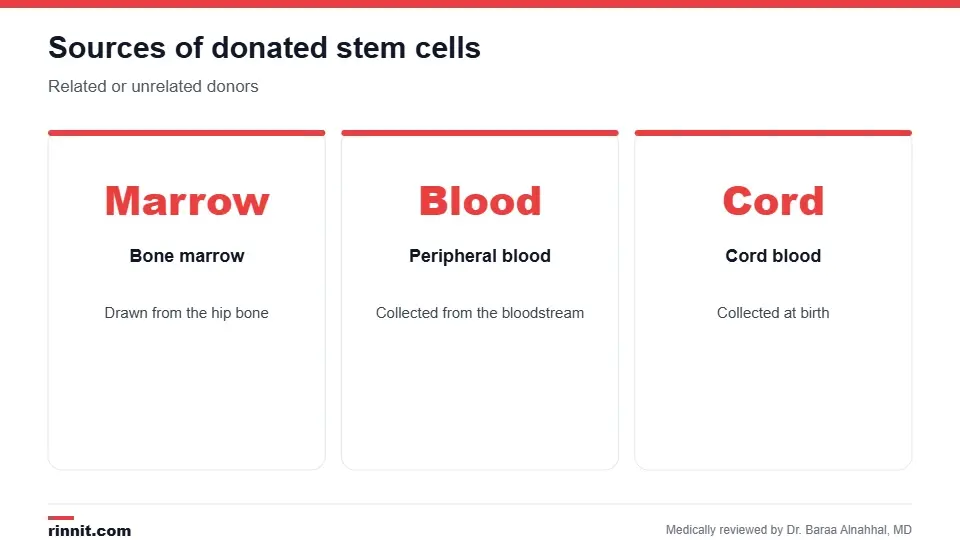
Donors can be related or unrelated to the recipient.
Source | How it's collected |
Bone marrow | Drawn from the hip bone with needles under anesthesia |
Collected from the bloodstream | |
Collected from the umbilical cord at birth |
You can join the NMDP registry online, at a donor center or with a mail-in cheek-swab kit. Sources: [1, 3]
Who can donate
You may not be able to donate if you're 60 or older, or have HIV, severe arthritis, an autoimmune disease, a bleeding disorder, a brain injury, chronic Lyme disease, heart disease, hepatitis B or C, kidney disease, insulin-requiring diabetes, treated chronic hip, back or spine pain, or chemotherapy or radiation in the past five years. Sources: [1]
How to prepare
A blood sample confirms you're a close match.
A counselor explains the risks, and you give informed consent.
You'll have blood tests, infectious disease tests, an EKG and a chest X-ray. Sources: [1]
What happens during donation

The collection takes about an hour.
You get general anesthesia and lie face down.
A provider inserts a needle into your hip bone, sometimes several times.
About 1 to 2 pints of liquid marrow are collected, only about 10% of your marrow.
Your red blood cells may be returned to you in recovery. Sources: [1]
The collection takes about an hour. Sources: [1]
Risks
Reaction to anesthesia.
Nerve or muscle damage.
Infection.
Injury at the needle site.
Tiredness, sore throat, nausea and weakness right afterward. Sources: [1, 2]
Most donors recover completely. Sources: [1]
Recovery
You'll spend about an hour in recovery, and someone must drive you home.
Expect lower back and hip soreness and bruising for a few days.
Over-the-counter pain relievers help.
Return to work and normal activities after a few days.
Full recovery takes a few weeks; iron supplements may be recommended. Sources: [1]
When to call your provider
Fever or other signs of infection.
Tenderness or redness at the needle site on your hip. Sources: [1]
Conclusion
Donating bone marrow takes about an hour and a few weeks of recovery, but it can give someone a chance at a cure. Joining a registry helps more patients, especially those with fewer matches, find a donor.
Keep learning: read about stem cell transplants and blood stem cell donation.
Frequently asked questions
What is bone marrow donation?
Collecting blood-forming stem cells from a donor's hip bone for a transplant.
Does donating bone marrow hurt?
You're under general anesthesia; afterward your hip and back may be sore.
Where is marrow taken from?
The hip (pelvic) bone.
How much marrow is taken?
About 1 to 2 pints, only about 10% of your marrow.
How long does donation take?
About an hour.
How long is recovery?
A few days to return to work and a few weeks to fully recover.
Who can't donate?
People 60 or older and people with certain health conditions.
How do I join the registry?
Online, at a donor center or with a cheek-swab kit.
How are donors matched?
By HLA typing.
Is donating safe?
Most donors recover completely; serious problems are rare.
Related Reading
Stem Cell Transplant (Bone Marrow Transplant): Types, Risks, and Recovery how transplants work.
Blood Stem Cell Donation: How It Works, Who Can Donate, and What to Expect donating stem cells from blood.
Allogeneic Stem Cell Transplant: Process, Risks and Recovery transplants from a donor.
Bone Marrow Biopsy: Why It's Done, What to Expect, Pain and Recovery a test that also samples marrow.
Aplastic Anemia: Symptoms, Causes, Treatment & Complete Guide a condition a transplant may cure.
References
Cleveland Clinic. Bone Marrow Donation: Who Can Donate and How It Works. Cleveland Clinic. Last updated October 27, 2022. https://my.clevelandclinic.org/health/treatments/24387-bone-marrow-donation
Pulsipher MA, Chitphakdithai P, Logan BR, et al. Lower risk for serious adverse events and no increased risk for cancer after PBSC vs BM donation. Blood. 2014;123(23):3655-3663. PMID 24735965. https://doi.org/10.1182/blood-2013-12-542464
Anasetti C, Logan BR, Lee SJ, et al. Peripheral-blood stem cells versus bone marrow from unrelated donors. N Engl J Med. 2012;367(16):1487-1496. PMID 23075175. https://doi.org/10.1056/NEJMoa1203517
Medical disclaimer
This article is for general education only and does not replace advice from a qualified healthcare professional. Talk to your doctor about your own diagnosis and treatment, and seek emergency care right away for severe or sudden symptoms.



Comments