Cord Blood Banking: Benefits, Public vs. Private and How It Works

Updated: 2 days ago
Written and medically reviewed by Dr. Baraa Alnahhal, MD · Last reviewed: November 2026 · How we review
Quick Answer
Cord blood banking is the collection and storage of blood left in the umbilical cord after birth. Cord blood is rich in stem cells that can be used in transplants for leukemia, lymphoma, sickle cell disease and some immune disorders. You can donate to a public bank or pay a private bank. Collection is painless and safe.
What the research says
Cord blood worked well for some leukemia patients: in 582 people with acute leukemia or myelodysplastic syndrome, those with leftover disease before transplant had about 3 times higher risk of death with a mismatched unrelated donor and about 3 times higher relapse risk with unrelated donors than with cord blood (Milano F et al., New England Journal of Medicine, 2016) [2]
One or two cord blood units had trade-offs: across 9 studies of 3,864 acute leukemia patients, double-unit cord blood transplants lowered relapse risk but raised graft-versus-host disease, while overall survival favored single-unit transplants (Odutola PO et al., Leukemia Research, 2024) [3]
Key takeaways
Cord blood is collected from the umbilical cord after birth.
Its stem cells can treat some blood cancers and blood disorders.
Public banking is usually free; private banking has fees.
Collection takes a few minutes and is safe.
Decide by about 34 weeks of pregnancy.
What is cord blood banking?
After delivery, a small amount of blood stays in the umbilical cord and placenta. It contains stem cells that can mature into different blood cells. Banks label samples so they can be matched to a recipient. Sources: [1]
Why it's used

Donated stem cells must match the recipient.
Cancers such as leukemia and lymphoma.
Bone marrow diseases.
Anemias such as sickle cell disease.
Certain immune system disorders.
Research is studying it for Parkinson's disease and diabetes. Sources: [1]
Cord blood can be used in an allogeneic stem cell transplant. Sources: [1, 2, 3]
Public vs. private banks
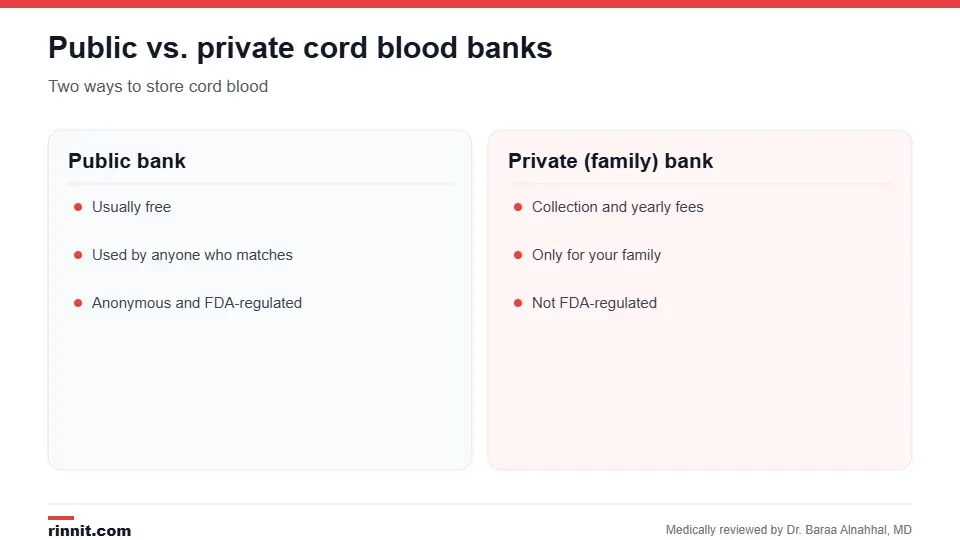
Private banking is usually recommended when a sibling has a condition stem cells could treat.
Feature | Public bank | Private (family) bank |
Who can use it | Anyone who matches, or research | Only your family |
Cost | Usually free if your hospital works with one | Collection fee plus yearly storage fees |
Regulation | FDA-licensed | Must register with the FDA; no license needed |
Best for | Helping others | Families with a child who has a condition stem cells could treat |
The chance of your child needing their own cord blood is low. Sources: [1]
How to prepare
Decide by about 34 weeks of pregnancy.
Some hospitals don't stock collection kits, so one may need to be sent.
Complete a consent form and health history questions.
Private banks require the collection fee before delivery. Sources: [1]
Eligibility questions may ask about your age, whether you're having one baby, recent tattoos or piercings, transfusions and chemotherapy. Sources: [1]
How cord blood is collected

Collection takes just a few minutes.
Right after the cord is clamped and cut, the provider places a needle into the cord.
The blood is collected into a bag.
It's sent to the bank.
The bank types and screens it, then freezes it until a match is found. Sources: [1]
Collection takes a few minutes and works with vaginal birth or C-section. Sources: [1]
Is it safe?
Collection is harmless. It doesn't hurt you or your baby and doesn't affect labor or delivery. Sources: [1]
Making the decision
Banking is a personal choice. Most children won't use their own cord blood. Public banking is usually free, but not every hospital collects for public banks. Private banking costs vary. Sources: [1]
When to talk to your provider
Your provider usually brings this up at a prenatal visit. Ask them about public versus private banking and whether it suits your family. Sources: [1]
Conclusion
Cord blood banking is a quick, painless way to save stem cells that can help treat serious blood diseases. Deciding early in pregnancy gives you time to choose between public donation and private storage.
Keep learning: read about stem cell transplants and the umbilical cord.
Frequently asked questions
What is cord blood banking?
Collecting and storing blood from the umbilical cord after birth.
Why is cord blood valuable?
It contains stem cells used to treat some blood cancers and disorders.
Does collection hurt my baby?
No. It's painless and safe.
Can I bank cord blood after a C-section?
Yes.
What's the difference between public and private banks?
Public banks share with anyone who matches; private banks keep it for your family.
How much does it cost?
Public banking is usually free; private banks charge fees.
When should I decide?
By about 34 weeks of pregnancy.
How long does collection take?
Just a few minutes.
Will my child need their own cord blood?
The chances are low.
Is private banking regulated?
Private banks must register with the FDA and follow its tissue-handling rules, but they don't need the license that public banks need.
Related Reading
Stem Cell Transplant (Bone Marrow Transplant): Types, Risks, and Recovery how stem cell transplants work.
Allogeneic Stem Cell Transplant: Process, Risks and Recovery transplants from a donor.
Understanding Stem Cells: The Body’s Biological Building Blocks what stem cells are.
The Umbilical Cord: Function, Anatomy, and Newborn Care the umbilical cord.
Sickle Cell Anemia: Symptoms, Causes, Treatment & Complete Guide a condition cord blood may treat.
References
Cleveland Clinic. Cord Blood Banking: Benefits, Process & What To Expect. Cleveland Clinic. Last updated March 4, 2026. https://my.clevelandclinic.org/health/treatments/23981-cord-blood-banking
Milano F, Gooley T, Wood B, et al. Cord-blood transplantation in patients with minimal residual disease. N Engl J Med. 2016;375(10):944-953. PMID 27602666. https://doi.org/10.1056/NEJMoa1602074
Odutola PO, Olorunyomi PO, Olorunyomi I. Single vs double umbilical cord blood transplantation in acute leukemia: systematic review and meta-analysis. Leuk Res. 2024;142:107517. PMID 38761563. https://doi.org/10.1016/j.leukres.2024.107517
Medical disclaimer
This article is for general education only and does not replace advice from a qualified healthcare professional. Talk to your doctor about your own diagnosis and treatment, and seek emergency care right away for severe or sudden symptoms.



Comments