Understanding Stem Cells: The Body’s Biological Building Blocks

Updated: 2 days ago
Medically reviewed by Dr. Baraa Alnahhal, MD · Last reviewed: October 2026
Stem cells are unique biological building blocks capable of developing into various cell types and replicating themselves throughout a person's life. They play a critical role in repairing damaged tissues and maintaining organ function. Modern medicine utilizes stem cells to treat serious conditions like blood cancer and bone fractures, while researchers study them to unlock new treatments for complex diseases [1]. Understanding the different types of stem cells—embryonic, adult, and induced—is key to recognizing their vast potential in healthcare and regenerative medicine.
Quick Answer
Stem cells are the only cells in the body that can both copy themselves and become specialized cells such as muscle, bone or blood cells. They act as a natural repair system, maintaining and fixing tissues throughout life. Providers use stem cell therapy to treat blood cancers and orthopedic injuries, and researchers study them to understand disease [1].
What the research says
Adult cells can be reprogrammed into stem cells. Researchers generated induced pluripotent stem (iPS) cells from adult human skin fibroblasts using four defined factors (Oct3/4, Sox2, Klf4 and c-Myc). The resulting cells resembled embryonic stem cells in shape, growth, gene expression and telomerase activity, and could differentiate into cell types of all three germ layers (Takahashi et al., Cell, 2007 [2]).
Stem cell approaches for osteoarthritis are still experimental. A network meta-analysis of 27 controlled studies in rats (456 animals) found that exosomes released by stem cells reduced cartilage damage in knee osteoarthritis models (OARSI score standardized mean difference −3.78, 95% CI −4.76 to −2.80). Publication bias shrank one effect estimate from 3.41 to 1.26 after correction, and the authors said the findings need confirmation in larger, more rigorous studies (Zhao et al., Stem Cells Translational Medicine, 2026 [3]).

What are stem cells and what do they do?
Stem cells are often described as the foundation of the human body due to their extraordinary ability to transform into specialized cell types. Unlike other cells that have a fixed role, stem cells can become blood, bone, or muscle cells as needed [1]. A defining characteristic of these cells is their ability to make endless copies of themselves, ensuring that the body’s supply remains available over a lifetime [1]. This unique self-replication process allows for the continuous maintenance and repair of various tissues.
In the field of medical research, stem cells serve three primary purposes. First, they allow scientists to observe how diseases develop in specific organs by watching stem cells change as they grow [1]. Second, they provide a pathway to discovering new treatments by studying how these cells fix or replace damaged tissues [1]. Finally, specially prepared stem cells are used to test the safety and effectiveness of new medications before they are administered to human patients [1].
What are the types of stem cells?
Stem cells are grouped into three main categories, each with its own distinct origins and capabilities. These include naturally occurring cells found in the body and those created through advanced laboratory techniques.
Stem Cell Type | Origin | Primary Capability |
Embryonic (Pluripotent) | Created by sperm and egg | Can become any of the 200+ cell types in the body. |
Adult Stem Cells | Found in various tissues | Replace and repair damaged cells in specific tissues. |
Induced Pluripotent (iPSCs) | Lab-made from adult cells | Act like embryonic cells and can turn into many cell types. |
Adult stem cells are further categorized by the tissues they support. For instance, hematopoietic stem cells located in the bone marrow are responsible for maintaining the blood and immune systems [1]. Mesenchymal stem cells, found in various other tissues, focus on the repair and maintenance of bone, cartilage, muscle, and fat [1].
Medical Applications and Research Sources
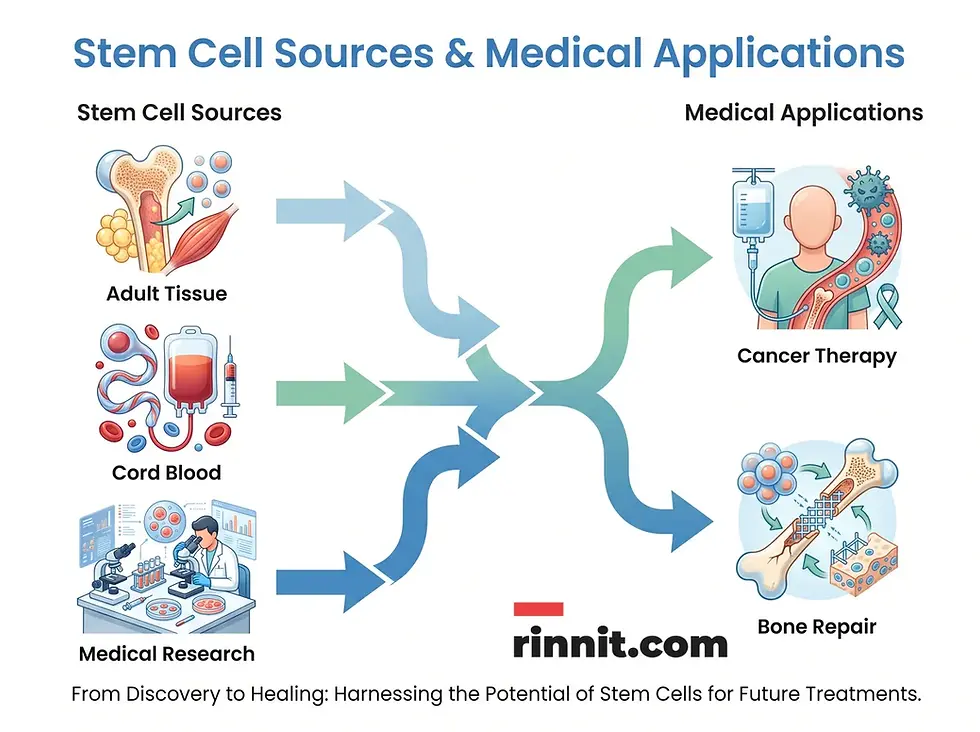
Stem cell therapy has become a vital treatment option for several serious medical conditions. Currently, healthcare providers utilize these cells to address hematological and orthopedic issues, while ongoing research explores their potential for other chronic ailments [1].
Application | Condition Treated | Mechanism |
Blood Cancer | Leukemia, Multiple Myeloma, Lymphoma | Stem cell transplants to restore healthy blood production. |
Blood Disorders | Various forms of Anemia | Transplants to replace dysfunctional hematopoietic cells. |
Orthopedics | Broken Bones | Bone grafts using mesenchymal stem cells to repair damage. |
Investigational | Osteoarthritis | Researching the use of mesenchymal cells for joint repair. |
To support these therapies and research, stem cells are harvested from various sources. These include donated adult tissue, umbilical cord blood, and donated embryos from in vitro fertilization [1]. Additionally, induced pluripotent stem cells (iPSCs) are created in laboratories to provide a versatile and ethical source for study and treatment development.
What conditions affect stem cell health?
The health of stem cells can be significantly impacted by diseases that target the areas where they develop. Since hematopoietic stem cells are produced in the bone marrow, any condition affecting this spongy tissue can lead to cellular damage [1]. For example, aplastic anemia, leukemia, and multiple myeloma directly interfere with the bone marrow's ability to produce healthy stem cells [1]. Myeloproliferative disorders also pose a threat to these vital building blocks [1], highlighting the importance of early diagnosis and treatment for marrow-related illnesses.

Conclusion
Stem cells are the indispensable foundation of human biology, providing the means for growth, repair, and long-term survival. Their unique ability to replicate and specialize makes them one of the most powerful tools in modern medicine. Whether they are being used to treat blood cancers or to research new therapeutic pathways, stem cells continue to offer hope for the future of healthcare. The FDA has approved only a few stem cell products, mainly blood-forming cord blood cells for certain blood disorders, so be cautious of clinics selling unapproved stem cell treatments for joint pain or other conditions. By protecting the health of the tissues that house these cells, individuals can support their body’s natural ability to heal and regenerate.
Frequently Asked Questions
What are stem cells?
Stem cells are unique cells that can transform into different cell types, such as blood, bone, and muscle, and have the ability to replicate themselves throughout a lifetime.
What is the main difference between embryonic and adult stem cells?
Embryonic stem cells can become any of the 200+ cell types in the body, whereas adult stem cells are generally limited to repairing and replacing cells in specific tissues.
How are stem cells used in medical treatment?
Healthcare providers use stem cell therapy to treat conditions like blood cancers (leukemia, lymphoma), certain blood disorders, and severe bone fractures.
What are induced pluripotent stem cells (iPSCs)?
iPSCs are lab-made stem cells created by changing donated adult cells so they behave like embryonic stem cells, allowing them to turn into many different cell types.
Where do researchers get stem cells for study?
Sources include donated adult tissue, umbilical cord blood, donated embryos from in vitro fertilization, and lab-made iPSCs.
Can stem cells fix broken bones?
Yes, providers may use bone grafts that combine specialized mesenchymal stem cells with other materials to repair damage to bones and surrounding tissues.
What conditions can damage stem cells?
Diseases that affect the bone marrow, such as leukemia, aplastic anemia, and multiple myeloma, can damage the stem cells responsible for blood production.
Are there different types of adult stem cells?
Yes, examples include hematopoietic stem cells (for blood and immune systems) and mesenchymal stem cells (for bone, muscle, and fat).
Can you increase stem cells naturally with vitamins?
While researchers are studying whether certain vitamins help the body produce more stem cells, there is currently no confirmed evidence that supplements make a difference.
Why are stem cells important for research?
Stem cells help scientists understand how diseases develop, find new ways to treat illnesses, and test the safety of new medical treatments.
Related Reading
Cord Blood Banking: Benefits, Public vs. Private and How It Works explains cord blood banking.
References
Cleveland Clinic. Stem Cells. Cleveland Clinic. Last updated September 8, 2025. https://my.clevelandclinic.org/health/body/24892-stem-cells
Takahashi K, Tanabe K, Ohnuki M, et al. Induction of pluripotent stem cells from adult human fibroblasts by defined factors. Cell. 2007;131(5):861-872. PMID 18035408. https://doi.org/10.1016/j.cell.2007.11.019
Zhao Y, You H, Wang X, et al. Exosome therapy for knee osteoarthritis: a network meta-analysis based on rat models. Stem Cells Translational Medicine. 2026;15(9). PMID 42613148. https://doi.org/10.1093/stcltm/szag069
Medical disclaimer
The information provided in this article is for educational purposes only and should not be used as a substitute for professional medical advice, diagnosis, or treatment. Always seek the advice of your physician or other qualified health provider with any questions you may have regarding a medical condition.



Comments