Allogeneic Stem Cell Transplant: Process, Risks and Recovery

Updated: 2 days ago
Written and medically reviewed by Dr. Baraa Alnahhal, MD · Last reviewed: November 2026 · How we review
Quick Answer
An allogeneic stem cell transplant is a treatment that replaces unhealthy stem cells in the bone marrow with healthy stem cells from a donor. It treats some blood cancers, blood disorders and immune system disorders and may cure some of them. Full recovery takes more than two years. The main risks are graft-versus-host disease (GVHD), rejection and infections.
What the research says
Donor transplants lowered relapse in AML: a meta-analysis of 24 trials with 6,007 adults with acute myeloid leukemia in first remission found a donor transplant lowered the risk of relapse or death by 20% and death by 10%, with benefit in intermediate- and poor-risk AML (Koreth J et al., JAMA, 2009) [2]
High survival in sickle cell disease: in a registry of 1,000 people with sickle cell disease who received transplants from matched siblings, 5-year overall survival was 92.9% and event-free survival was 91.4% (Gluckman E et al., Blood, 2017) [3]
Key takeaways
An allogeneic transplant uses stem cells from a donor.
It treats some blood cancers and blood disorders and may cure some.
Conditioning with chemo or radiation comes first.
The infusion itself is painless and takes up to an hour.
GVHD, rejection and infection are the main risks.
What is an allogeneic stem cell transplant?
"Allogeneic" means the stem cells come from another person. It's different from an autologous transplant, which uses your own cells. About 40% of stem cell transplants use donated cells. Learn more about stem cell transplants. Sources: [1]
Conditions it treats

It's often used when other treatments fail or the condition returns.
Aplastic anemia.
Lymphoma.
Myeloproliferative neoplasms.
Sickle cell disease. Sources: [1]
How to prepare
You'll have tests such as a complete blood count, echocardiogram, EKG and liver and kidney tests.
If you have cancer, a bone marrow biopsy helps estimate relapse risk.
A central venous catheter is placed in a large vein in your upper chest. Sources: [1]
The transplant process

Your vital signs are monitored during the infusion.
Conditioning: Chemotherapy and/or full-body radiation kill cancer cells, make room in your marrow and lower your immunity to reduce rejection. This takes one to two weeks in the hospital.
Infusion: Donor stem cells are given through your central line, like a blood transfusion. It's painless and takes 30 minutes to an hour.
Engraftment: The new cells settle in your marrow and begin making blood cells. Sources: [1]
Infusion side effects are rare and usually mild, such as chills, fever or shortness of breath. Sources: [1]
Risks
Risk | What it means |
Graft-versus-host disease (GVHD) | Donor cells attack your body's cells |
Rejection | Your body attacks the donor cells; prevented with immunosuppressants |
Infections | Your immune system is weak while it rebuilds |
Sources: [1]
Recovery
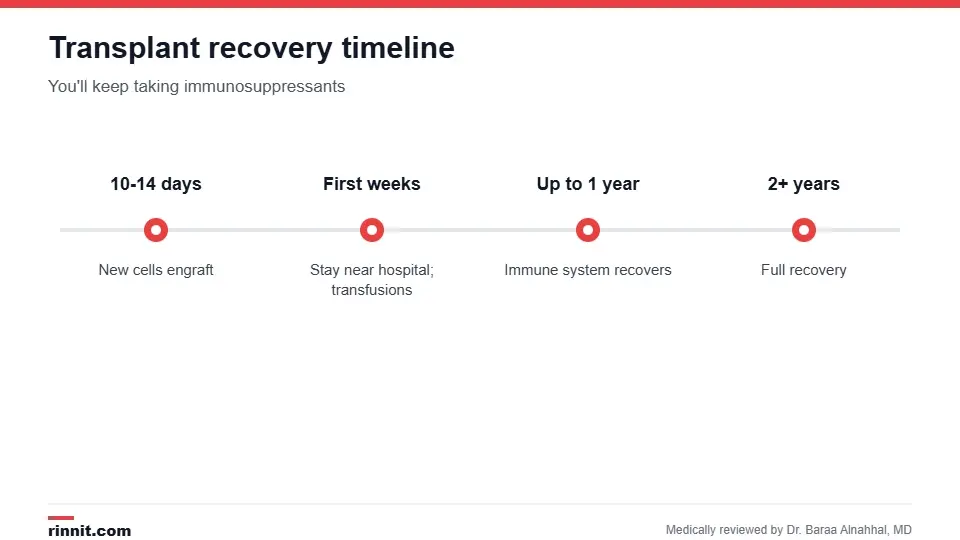
You'll continue immune-suppressing medicine.
When | What to expect |
10 days to 2 weeks | New cells engraft |
First weeks | Stay in or near the hospital; transfusions may be needed |
Up to 1 year | Immune system recovers |
More than 2 years | Full recovery |
You'll keep taking immunosuppressants and have follow-up visits to check for infections. Sources: [1]
Outlook
There's no single success rate because many diseases are treated. One study of people who were alive and cancer-free 2 years after transplant reported 10-year survival of 81% for ALL and 76% for AML. Sources: [1, 2, 3]
When to call your care team
Signs of GVHD: belly cramps, diarrhea, itchy rash, nausea, vomiting or yellow skin.
Signs of infection: chills, cough, runny nose, dizziness, shortness of breath or painful urination.
A fever of 100.4°F (38°C) or higher. Sources: [1]
Conclusion
An allogeneic stem cell transplant can cure some blood cancers and disorders by giving you a healthy new blood-forming system. Recovery is long, so close follow-up and quick reporting of symptoms are key.
Keep learning: read about stem cell transplants and autologous transplants.
Frequently asked questions
What is an allogeneic stem cell transplant?
A transplant that uses healthy stem cells from a donor.
How is it different from an autologous transplant?
An autologous transplant uses your own cells.
What conditions does it treat?
Leukemia, lymphoma, myelodysplastic syndrome, aplastic anemia and sickle cell disease.
Can it cure cancer?
It may cure certain disorders.
What is conditioning?
Chemotherapy and/or radiation that prepare your body for new cells.
Does the infusion hurt?
No. It's painless, like a blood transfusion.
What is GVHD?
When donor cells attack your body's cells.
When do the new cells start working?
In about 10 days to two weeks.
How long is recovery?
Immune recovery takes up to a year; full recovery more than two years.
When should I call my care team?
For a fever of 100.4°F (38°C) or higher or signs of GVHD.
Related Reading
Bone Marrow Donation: Who Can Donate and How It Works explains how bone marrow donation works.
Cord Blood Banking: Benefits, Public vs. Private and How It Works explains cord blood banking.
Stem Cell Transplant (Bone Marrow Transplant): Types, Risks, and Recovery an overview of stem cell transplants.
Autologous Stem Cell Transplant: Procedure, Benefits, and Recovery a transplant using your own cells.
Blood Stem Cell Donation: How It Works, Who Can Donate, and What to Expect how donors give stem cells.
Acute Myeloid Leukemia (AML): What It Is, Who Gets It, and How It Is Treated a common reason for transplant.
Donor Lymphocyte Infusion (DLI): How It Works, Benefits, Risks and Recovery a follow-up treatment with donor cells.
References
Cleveland Clinic. Allogeneic Stem Cell Transplant: Procedure & Recovery. Cleveland Clinic. Last updated March 24, 2025. https://my.clevelandclinic.org/health/treatments/22790-allogeneic-stem-cell-transplantation
Koreth J, Schlenk R, Kopecky KJ, et al. Allogeneic stem cell transplantation for acute myeloid leukemia in first complete remission: systematic review and meta-analysis of prospective clinical trials. JAMA. 2009;301(22):2349-2361. PMID 19509382. https://doi.org/10.1001/jama.2009.813
Gluckman E, Cappelli B, Bernaudin F, et al. Sickle cell disease: an international survey of results of HLA-identical sibling hematopoietic stem cell transplantation. Blood. 2017;129(11):1548-1556. PMID 27965196. https://doi.org/10.1182/blood-2016-10-745711
Medical disclaimer
This article is for general education only and does not replace advice from a qualified healthcare professional. Talk to your doctor about your own diagnosis and treatment, and seek emergency care right away for severe or sudden symptoms.



Comments