Stem Cell Transplant (Bone Marrow Transplant): Types, Risks, and Recovery

Updated: 6 days ago
Written and medically reviewed by Dr. Baraa Alnahhal, MD · Last reviewed: October 2026 · How we review
Quick Answer: What is a stem cell transplant?
A stem cell transplant, also called a bone marrow transplant, is a procedure that replaces unhealthy blood-forming stem cells with healthy ones to treat certain blood cancers, blood disorders and autoimmune diseases. An autologous transplant uses your own stem cells, and an allogeneic transplant uses a donor's. The infusion is painless, and recovery takes about two months to a year. [1]
What the research says
Survival after donor transplants has improved substantially. A comparison of 2,279 first-time allogeneic transplant patients found the risk of death was 34% lower in 2013–2017 than in 2003–2007, with fewer serious infections and less graft vs. host disease. (McDonald et al., Ann Intern Med, 2020)
People who reach the 2-year mark usually do well long term. In 10,632 people who were alive and disease-free 2 years after an allogeneic transplant, 85% were still alive 10 years after transplant. (Wingard et al., J Clin Oncol, 2011)
Newer prevention medicines lower serious graft vs. host disease. In a randomized trial of 431 adults, 52.7% on a post-transplant cyclophosphamide–based regimen were alive without severe GVHD or relapse at 1 year, compared with 34.9% on standard prevention. (Bolaños-Meade et al., N Engl J Med, 2023)
Key takeaways
A stem cell transplant is also called a bone marrow transplant or hematopoietic stem cell transplant.
Most transplants use stem cells collected from the bloodstream. Some use bone marrow or umbilical cord blood.
It is usually considered when other treatments haven't worked or a condition has come back.
Donor (allogeneic) transplants carry a higher risk of infection and graft vs. host disease.
A fever over 38 °C (100.4 °F) during recovery needs a call to your care team.
What is a stem cell transplant?
A stem cell transplant is a procedure that replaces cancerous, abnormal or damaged blood-forming stem cells with healthy ones, which then settle in and start making healthy blood again. [1]
Stem cells live in your bone marrow, the soft tissue inside your bones. They are the "factory" that makes your blood cells. [1]
More than 22,000 people in the United States have a disease that a stem cell transplant could cure. Most people have this procedure when other treatments haven't worked, or when their condition returns after treatment. [1]
Other names for this procedure:
Bone marrow transplant
Hematopoietic stem cell transplant
Where do the stem cells for a transplant come from?
The stem cells for a transplant usually come from the bloodstream, and sometimes from bone marrow or donated umbilical cord blood. [1]
Source | What it is | How often it's used |
Peripheral blood | Immature stem cells circulating in your bloodstream | Most transplants |
Bone marrow | Stem cells taken directly from the marrow | Some transplants |
Umbilical cord blood | Stem cells from donated cord blood | Some transplants |
Source: [1]
What are the types of stem cell transplant?
The two types of stem cell transplant are autologous, which uses your own stem cells, and allogeneic, which uses a donor's stem cells. [1]
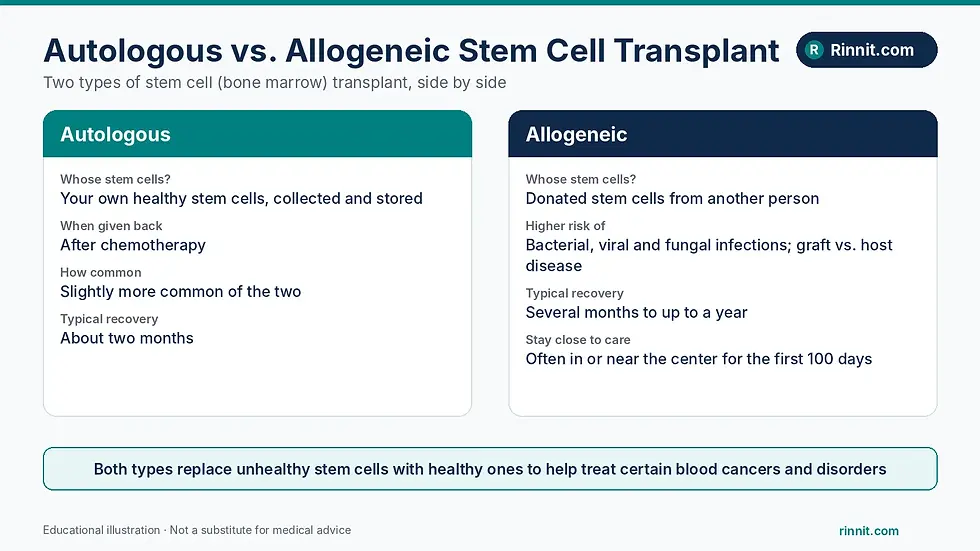
Feature | Autologous transplant | Allogeneic transplant |
Stem cell source | Your own healthy stem cells | A donor's stem cells |
How it works | Cells are collected, stored, then given back after chemotherapy | Donor cells replace your cancerous, abnormal or damaged stem cells |
How common | Slightly more common | Slightly less common |
Main extra risks | Fewer than allogeneic | Bacterial, viral and fungal infections; graft vs. host disease (GvHD) |
Typical recovery | About 2 months | Several months up to a year |
Source: [1]
Autologous stem cell transplant
In an autologous stem cell transplant, your care team collects your own healthy stem cells and stores them, then gives them back to you after chemotherapy. [1]
This type is used for certain cancers, blood disorders and autoimmune diseases. Read our full guide to autologous stem cell transplant for a step-by-step look. [1]
Allogeneic stem cell transplant
In an allogeneic stem cell transplant, stem cells come from another person, a donor, and are given to someone whose own stem cells are cancerous, abnormal or damaged. Not everyone who needs a donor is able to find one. [1]
Who may need a stem cell transplant?
People who may need a stem cell transplant have certain blood cancers, blood disorders or autoimmune diseases that haven't responded to other treatments, including: [1]
Certain blood cancers, such as some types of lymphoma
Certain blood disorders
Certain autoimmune diseases (with autologous transplants)
Not everyone with cancer or a blood disorder is a candidate. Your healthcare provider will look at your condition, options and likely outcomes before recommending it. [1]
How does a stem cell transplant work?
A stem cell transplant works much like getting medicine through an IV: the healthy stem cells flow into your body through a thin tube in a large vein, whether they are your own or a donor's. [1]

Preparation. You receive fluids and medicines to help prevent side effects and lower the chance your body rejects the new cells.
Infusion. The stem cells flow into your body through a central venous catheter, a thin tube placed in a large vein. This can take several hours.
Monitoring. During the infusion, your care team checks often for fever, chills and other side effects.
Does a stem cell transplant hurt?
A stem cell transplant itself is not painful. Many people do have side effects during recovery, such as nausea, vomiting and general discomfort, and medicines can help manage these. [1]
What are the benefits and risks of a stem cell transplant?
The main benefit of a stem cell transplant is a chance to cure or slow certain blood cancers and blood disorders, while the biggest risk is that the transplant does not control the illness. [1]
Benefits
Can cure or slow certain blood cancers and blood disorders
Offers hope for a cure or remission when other treatments haven't worked
Risks
The biggest risk is that the transplanted stem cells don't slow or eliminate the illness. Cancer can come back after a transplant, but this becomes less likely as time passes. [1]
Complications depend on your overall health, age and past treatment, including the chemotherapy given before transplant (called conditioning). Allogeneic transplants are more likely to cause: [1]
Complication | What it means |
Bacterial infections | Infections caused by bacteria |
Viral infections | Infections caused by viruses |
Fungal infections | Infections caused by fungi (molds and yeasts) |
Graft vs. host disease (GvHD) | The donor's immune cells attack the recipient's body |
Source: [1]
Your healthcare provider will walk you through the possible complications so you can weigh them against the potential benefits.
How successful is a stem cell transplant?
How successful a stem cell transplant is depends on the type and stage of your condition, previous treatments, your age and your body's ability to heal. [1]
The type of condition you have
Whether the disease is early- or late-stage
Whether you've had previous cancer treatments
Your age
Your body's ability to heal
Because every person is different, overall survival rates and life expectancy are hard to predict for one individual. Your healthcare provider can explain what the numbers mean for your situation. [1]
How long is recovery after a stem cell transplant?
Recovery after a stem cell transplant takes about 2 months after an autologous transplant and several months to a year after an allogeneic transplant. [1]
Transplant type | Typical recovery time | What to expect |
Autologous | About 2 months | Gradual return of energy and blood counts |
Allogeneic | Several months to 1 year | You may need to stay in or near the hospital or treatment center for the first 100 days |
Source: [1]
A successful transplant is not an overnight change. Full recovery can take a year or more. [1]
Tips to make recovery easier
Be gentle with your skin. Your skin may be more sensitive. Use mild soap and shampoo, moisturize, and protect your skin from the sun.
Eat nutritious meals. Focus on lean protein, a variety of fruits and vegetables, whole grains and low-fat dairy.
Avoid risky foods. Skip undercooked meat and fish, unwashed fruits and vegetables, and unpasteurized dairy.
Protect yourself from infections. Wash your hands, stay away from people who are sick, and ask your provider which vaccines you need.
Care for your teeth. See your dentist every six months and keep up good oral hygiene.
Rest when you need to. Some days you'll feel exhausted; others you'll feel fine. A hard day doesn't mean you're doing badly; it means you need a break.
Support your mental health. Recovery can feel like an emotional rollercoaster. A therapist or support group can help. Ask your provider for recommendations.
If you notice memory or focus problems after chemotherapy, our guide to chemo brain explains what helps.
When should you call your care team after a stem cell transplant?
Call your care team right away after a stem cell transplant if you develop a fever over 38 °C (100.4 °F) or any of these symptoms during recovery: [1]

Fever over 38 °C (100.4 °F)
Chills
Coughing, sneezing or a runny nose
Frequent or painful urination
Lightheadedness or dizziness
Rash
Shortness of breath
Conclusion
A stem cell transplant can offer a new chance at life for people with certain blood cancers, blood disorders and autoimmune diseases, especially when other treatments haven't worked. It can mean a cure or remission.
It also brings real physical demands and significant risks, and recovery takes time. Talking openly with your healthcare provider about the benefits, risks and your personal outlook is the best first step.
Want clear, doctor-reviewed health guides like this one? Explore more articles in the Rinnit.com health library and bookmark this page to share with family members who are supporting you through treatment.
FAQ
Is a bone marrow transplant the same as a stem cell transplant?
Yes, a bone marrow transplant is the same procedure as a stem cell transplant. It is also called a hematopoietic stem cell transplant.
What is the difference between autologous and allogeneic transplants?
An autologous transplant uses your own stored stem cells, while an allogeneic transplant uses stem cells from a donor.
Which type of stem cell transplant is more common?
Autologous transplants are slightly more common than allogeneic transplants.
How long does the stem cell infusion take?
The stem cell infusion may take several hours. It is given through a central venous catheter, much like receiving medicine through an IV.
Is a stem cell transplant painful?
A stem cell transplant itself isn't painful. Side effects like nausea, vomiting and discomfort can happen during recovery, and medicines can help.
How long is recovery after a stem cell transplant?
Recovery takes about two months after an autologous transplant. After an allogeneic transplant, recovery can take several months to a year or more.
Why do some people stay near the hospital for 100 days?
After an allogeneic transplant, providers may recommend staying in or near the treatment center for the first 100 days so they can monitor you closely.
What is graft vs. host disease?
Graft vs. host disease is a complication of donor transplants in which the donor's immune cells attack the recipient's body. It is more likely with allogeneic transplants.
Can cancer come back after a stem cell transplant?
Yes, cancer can come back after a stem cell transplant. But the chance of it coming back becomes lower as time passes.
What foods should I avoid after a stem cell transplant?
After a stem cell transplant, avoid undercooked meat and fish, unwashed fruits and vegetables, and unpasteurized dairy.
When should I call my doctor after a transplant?
Call your doctor after a transplant for a fever over 38 °C (100.4 °F), chills, cough or cold symptoms, painful or frequent urination, dizziness, a rash or shortness of breath.
Related reading
Bone Marrow Donation: Who Can Donate and How It Works explains how bone marrow donation works.
Cord Blood Banking: Benefits, Public vs. Private and How It Works explains cord blood banking.
Allogeneic Stem Cell Transplant: Process, Risks and Recovery explains donor stem cell transplants.
Autologous Stem Cell Transplant: Procedure, Benefits, and Recovery
Bone Marrow Failure: Causes, Symptoms, and Treatment Explained
Aplastic Anemia: Symptoms, Causes, Treatment & Complete Guide
Sickle Cell Anemia: Symptoms, Causes, Treatment & Complete Guide
Leukapheresis: What It Is, How It Works, Uses, Risks and Recovery
Further reading
References
Cleveland Clinic. Stem Cell (Bone Marrow) Transplant. Cleveland Clinic. Last updated March 24, 2025. https://my.clevelandclinic.org/health/treatments/22567-stem-cell-transplants
McDonald GB, Sandmaier BM, Mielcarek M, et al. Survival, Nonrelapse Mortality, and Relapse-Related Mortality After Allogeneic Hematopoietic Cell Transplantation: Comparing 2003-2007 Versus 2013-2017 Cohorts. Ann Intern Med. 2020;172(4):229-239. PMID 31958813. https://doi.org/10.7326/M19-2936
Wingard JR, Majhail NS, Brazauskas R, et al. Long-term survival and late deaths after allogeneic hematopoietic cell transplantation. J Clin Oncol. 2011;29(16):2230-2239. PMID 21464398. https://doi.org/10.1200/JCO.2010.33.7212
Bolaños-Meade J, Hamadani M, Wu J, et al. Post-Transplantation Cyclophosphamide-Based Graft-versus-Host Disease Prophylaxis. N Engl J Med. 2023;388(25):2338-2348. PMID 37342922. https://doi.org/10.1056/NEJMoa2215943
Health Resources and Services Administration. Donation and Transplantation Statistics. Blood Stem Cell (HRSA). Last updated October 2026. https://bloodstemcell.hrsa.gov/data/donation-and-transplantation-statistics
Medical disclaimer
This article is for educational purposes and does not replace advice from your healthcare provider or transplant team. Decisions about a stem cell transplant should be made with specialists who know your medical history. If you have a fever or trouble breathing during recovery, contact your care team or seek emergency care right away.



Comments