Myelofibrosis Complete Guide: Symptoms, Causes, Diagnosis, Treatment & Outlook

Updated: 2 days ago
Medically reviewed by Dr. Baraa Alnahhal, MD · Last reviewed: October 2026
Quick Answer
Myelofibrosis is a type of bone marrow cancer that causes scarring inside the marrow, making it hard to produce healthy blood cells and leading to fatigue, easy bruising and an enlarged spleen. Some people have no symptoms and may not need immediate treatment. Treatment usually relieves symptoms, and a bone marrow transplant is the only potentially curative approach.
What the research says
Ruxolitinib shrank the spleen and eased symptoms in a placebo-controlled trial. In a double-blind trial of 309 patients with intermediate-2 or high-risk myelofibrosis, a spleen volume reduction of 35% or more at 24 weeks occurred in 41.9% of those on ruxolitinib versus 0.7% on placebo. A 50% or greater improvement in total symptom score occurred in 45.9% versus 5.3%, and deaths were fewer with ruxolitinib (13 versus 24; hazard ratio 0.50, 95% CI 0.25–0.98). Anemia and thrombocytopenia were the most common adverse events. (Verstovsek et al., N Engl J Med, 2012) [3]
Ruxolitinib also beat the best available therapy. In a trial of 219 patients, 28% of those on ruxolitinib had a spleen volume reduction of 35% or more at week 48 versus 0% on the best available therapy, and mean palpable spleen length fell 56% with ruxolitinib while rising 4% with the best available therapy. An effect on overall survival had not yet been shown in that trial. (Harrison et al., N Engl J Med, 2012) [4]
Donor stem cell transplant offers survival for many eligible patients but carries substantial risk. A meta-analysis of 43 studies (8,739 patients) found overall survival of 66.7% at 1 year (95% CI 63.5–69.8%) and 55.0% at 5 years (95% CI 51.8–58.3%), with non-relapse mortality of 30.5% at 5 years (95% CI 25.9–35.5%) and acute graft-versus-host disease in 44.0% of patients. (Bewersdorf et al., Transplant Cell Ther, 2021) [5]
Myelofibrosis at a Glance
Question | Answer |
What type of disease is it? | A bone marrow cancer (a myeloproliferative neoplasm) |
What actually goes wrong? | Scarring in the bone marrow makes healthy blood cell production hard |
Primary vs. secondary | Primary = appears on its own; secondary = caused by another blood cell condition |
Main symptoms | Fatigue, left rib pain/fullness, bruising, bleeding, night sweats, fever, bone pain |
Key genetic changes | JAK2, CALR, MPL — testing affects prognosis and treatment options |
Main risk factors | Age over 50, another blood cell condition, benzene exposure, high-dose radiation |
Major complication | Enlarged spleen, portal hypertension, extramedullary growths, bleeding, leukemia |
How is it diagnosed? | Physical exam, blood tests, CT/MRI, bone marrow aspiration and biopsy, DNA testing |
Treatment goal | Relief from symptoms; donor bone marrow transplant offers a chance of cure |
Who decides treatment intensity? | Risk formulas that combine disease features and overall health |
What Is Myelofibrosis?
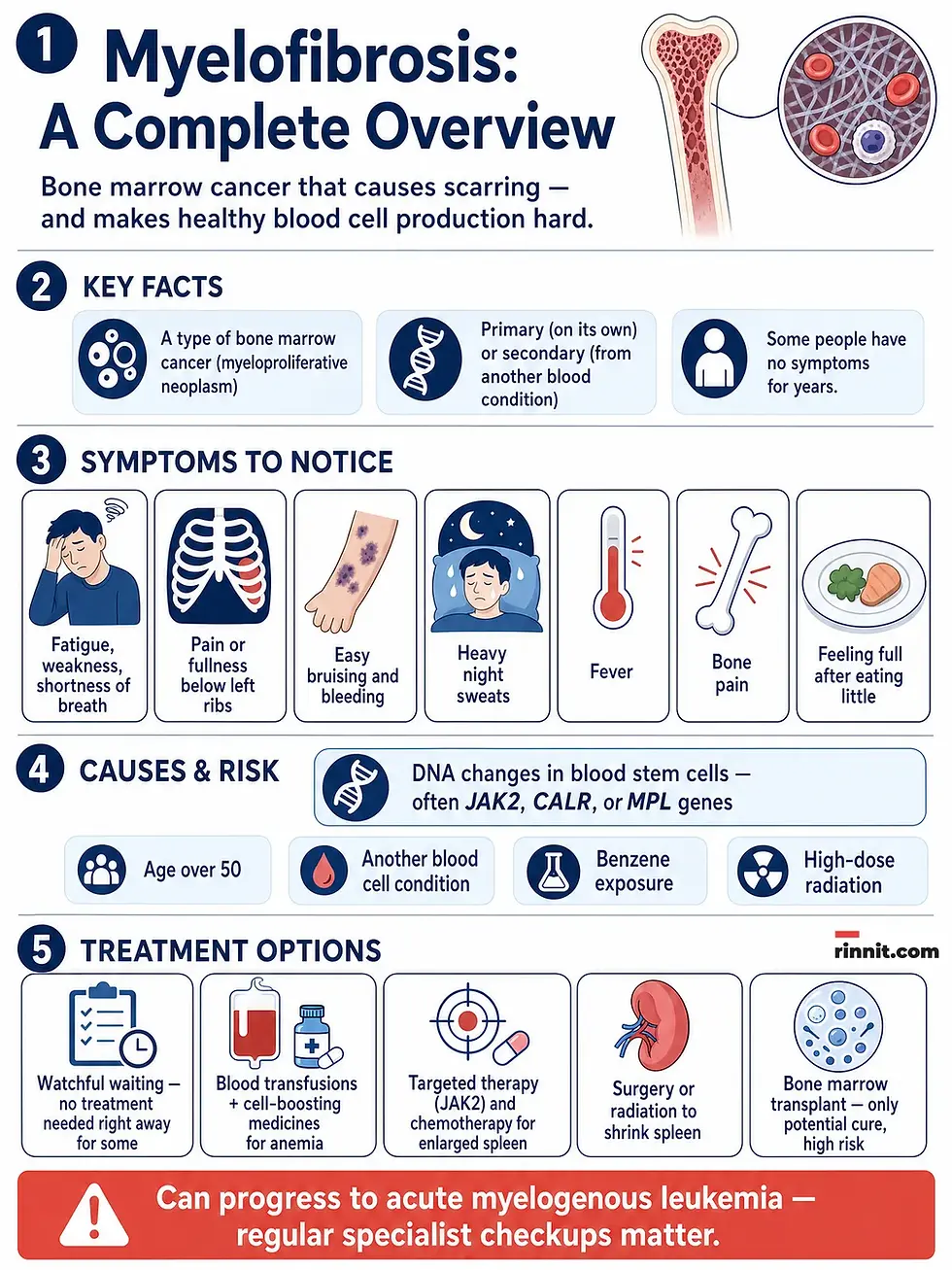
Myelofibrosis is a kind of bone marrow cancer. The bone marrow is the soft matter inside the bones where blood cells are made. Myelofibrosis causes scarring in the bone marrow, and that scarring makes it hard for the marrow to produce healthy blood cells.
The disease takes two forms. When it happens on its own, it is called primary myelofibrosis. When it is caused by another blood cell condition, it is called secondary myelofibrosis. Some people have no symptoms and might not need treatment right away, while others with more-serious forms of the disease will need treatment — which typically focuses on relieving symptoms.
Myelofibrosis belongs to a group of cancers called myeloproliferative neoplasms — cancers that cause the body to make too many blood cells that don't work right. Myelofibrosis and the other myeloproliferative neoplasms can lead to different types of leukemia, the cancer that affects the body's blood-forming tissues.
How does bone marrow normally work, and how does myelofibrosis affect it?
Myelofibrosis damages the bone marrow, which normally makes blood stem cells that turn into red blood cells, white blood cells and platelets. The bone marrow makes cells called blood stem cells — versatile cells that can become the other kinds of blood cells circulating through your body. When needed, these stem cells turn into:
Red blood cells that carry oxygen to the body.
White blood cells that help fight infections.
Platelets that help stop bleeding.
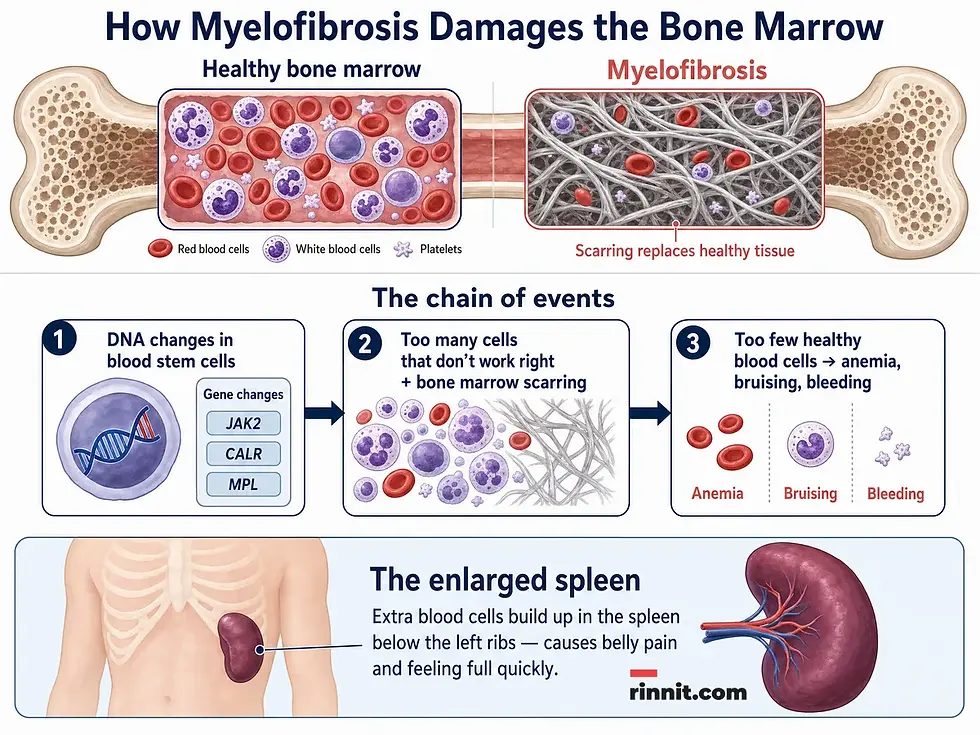
In myelofibrosis, two problems work together: the DNA changes tell stem cells to overproduce blood cells that don't work like healthy ones, and the scarring makes it hard to make healthy blood cells at all. Both forces drive the cell counts down and cause the symptoms.
What are the symptoms of myelofibrosis?
Myelofibrosis symptoms come largely from having too few healthy blood cells, such as weakness and tiredness when there are too few red blood cells. Signs and symptoms may include:
Feeling tired, weak, or short of breath.
Pain or fullness below the ribs on the left side (a sign of an enlarged spleen).
Easy bruising.
Easy bleeding.
Sweating a lot while sleeping, so you wake feeling covered in sweat.
Fever.
Bone pain.
Feeling full after eating a small amount of food.
Symptom | What's happening behind it |
Fatigue, weakness, shortness of breath | Too few red blood cells to carry oxygen |
Pain or fullness below left ribs | Extra blood cells build up in the spleen |
Easy bruising and bleeding | Too few healthy platelets to stop bleeding |
Night sweats and fever | The cancer-driven overactivity of the blood system |
Bone pain | The marrow itself is scarred and stressed |
Early fullness when eating | A swollen spleen presses on the stomach |
When to See a Doctor
Make an appointment with a doctor or healthcare professional if you have any symptoms that worry you. Because several myelofibrosis symptoms — like fatigue — are common to many conditions, the combination and persistence of symptoms matter, and only testing can confirm what is really going on.
What Causes Myelofibrosis?
The cause of myelofibrosis is often unclear, but the disease always starts in the bone marrow. The cancer begins when blood stem cells develop changes in their DNA. A cell's DNA holds the instructions that tell the cell what to do. In healthy blood stem cells, the DNA gives instructions to turn into blood cells in a controlled way.
In myelofibrosis, the DNA changes give different instructions: the stem cells make more blood cells than the body needs, and those blood cells don't work like healthy ones. The disease also causes scarring in the bone marrow, which makes it hard to make healthy blood cells. The extra nonworking cells and the scarring together lead to too few healthy blood cells — which drives the symptoms.
Healthcare professionals have discovered several genetic changes in the DNA that can cause myelofibrosis, including changes to the:
Janus kinase 2 gene, also called JAK2.
Calreticulin gene, also called CALR.
Thrombopoietin receptor gene, also called MPL.
Your healthcare team might test your cancer cells to see if these changes are present — and the results can impact your prognosis and your treatment options.
What are the risk factors for myelofibrosis?
Although the cause of myelofibrosis often isn't known, several things can raise the risk:
Risk factor | How it raises risk |
Increasing age | Can affect anyone, but most often diagnosed in people older than 50 |
Another blood cell condition | A small portion develop it as a complication of essential thrombocythemia or polycythemia vera |
Exposure to benzene | Linked to high levels of exposure to the industrial chemical benzene |
Exposure to radiation | Very high doses of radiation increase the risk |
What complications can myelofibrosis cause?
If left unmanaged, myelofibrosis can create a cascade of complications — most of them starting with the spleen.
Enlarged Spleen
People with myelofibrosis often have an enlarged spleen. The spleen is tucked below the rib cage on the left side of the belly, and one of its jobs is storing extra blood cells. In myelofibrosis, the extra blood cells made by the bone marrow build up in the spleen and make it swell. The spleen might even start making blood cells itself if the bone marrow is severely scarred — creating more cells and more swelling. A severely enlarged spleen can cause belly pain and the feeling of fullness after eating only a little food.
Portal Hypertension
Portal hypertension is the medical term for increased pressure in the portal vein, the vein that brings blood to the liver. If an enlarged spleen sends more blood than usual to the liver, the pressure can force blood into smaller veins and cause bleeding in the stomach and esophagus.
Growths in Other Areas of the Body
If the bone marrow struggles to make blood cells, other organs — such as the liver and spleen — might start making them. Tissue growths capable of making blood cells can form in other areas of the body too. This can lead to bleeding in the digestive system, coughing or spitting up blood, compression of the spinal cord, or seizures.
Bleeding Complications
Myelofibrosis makes it hard for the body to make healthy platelets — the blood cells that help stop bleeding. With too few healthy platelets, you may bruise more easily and face an increased risk of dangerous bleeding.
Leukemia
Some people with myelofibrosis develop acute myelogenous leukemia (AML), a type of blood and bone marrow cancer that often gets worse quickly. For a full picture of how AML behaves and how it is treated, our acute myelogenous leukemia guide covers the condition in depth.
How is myelofibrosis diagnosed?
Diagnosis often starts with a physical exam and builds through blood tests, imaging, and a look directly at the bone marrow.
Physical Exam
Your healthcare professional may ask about your symptoms and examine your body, including feeling your belly to check for signs of swelling in the spleen and liver.
Blood Tests
A complete blood count (CBC) counts the number of cells in a blood sample. In people with myelofibrosis, this test often finds low numbers of red blood cells. White blood cell and platelet counts may be higher or lower than expected.
Imaging Tests
Imaging tests make pictures of the inside of the body. For myelofibrosis, they show whether the spleen and liver are larger than usual and whether scar tissue has replaced healthy tissue in the bone marrow. These may include computerized tomography (CT) scans and magnetic resonance imaging (MRI) scans.
Bone Marrow Aspiration and Biopsy
In a bone marrow aspiration, a thin needle removes a small amount of liquid bone marrow, usually from the back of the hip bone (the pelvis). A biopsy is often done at the same time, removing a small piece of solid bone tissue along with its enclosed marrow. In myelofibrosis, this test may find signs of scarring in the bone marrow.
Testing Cancer Cells for DNA Changes
If concerning cells are found in the blood or bone marrow, they may be tested for DNA changes — most commonly JAK2, CALR, and MPL. The changes found help the team make a diagnosis and shape the treatment plan.
Test | What it looks for |
Physical exam | Belly swelling in the spleen and liver |
Complete blood count (CBC) | Low red blood cells; white cell and platelet counts higher or lower than expected |
CT and MRI scans | Enlarged spleen/liver; scar tissue replacing healthy marrow |
Bone marrow aspiration and biopsy | Scarring in the bone marrow |
Cancer cell DNA testing | JAK2, CALR, MPL changes that guide diagnosis and treatment |
What are the treatment options for myelofibrosis?
Treatments for myelofibrosis include blood transfusions and medicines such as chemotherapy and targeted therapy, plus surgery to remove the spleen, radiation therapy, and bone marrow transplant (also called stem cell transplant).
For most people, the goal of treatment is to provide relief from symptoms. For some, a bone marrow transplant may provide a chance for a cure — but it can be very hard on the body and might not be an option for many people.
How Doctors Decide on Treatment
To find out which treatments are most likely to benefit you, your healthcare professional may use risk formulas that take into account many aspects of your cancer and your overall health. You may be assigned a risk category that indicates how serious your condition is:
Risk category | What it means | Typical approach |
Lower risk | Might grow slowly | Treatment might not be needed right away, or may focus on controlling symptoms |
Higher risk | Might be getting worse quickly | Stronger treatments, such as a bone marrow transplant, may be considered |
Treatment May Not Be Needed Right Away
If you don't have any symptoms, immediate treatment might not be necessary. Rather than treating right away, your healthcare professional may monitor your health closely through regular checkups and exams — some people remain symptom-free for years.
Treatments for Anemia
If myelofibrosis is causing severe anemia, your team may recommend blood transfusions or medicines that increase blood cell production.
Treatments for an Enlarged Spleen
If an enlarged spleen is causing complications, options include:
Targeted therapy. This cancer treatment uses medicines that attack specific chemicals in cancer cells. By blocking these chemicals, the medicines can cause cancer cells to die. For myelofibrosis, targeted therapy uses JAK inhibitors such as ruxolitinib, which calm an overactive signaling pathway and can help whether or not you have a JAK2 gene change.
Chemotherapy. Strong medicines that treat cancer.
Surgery to remove the spleen (splenectomy). Used if other treatments don't help.
Radiation therapy. Powerful energy beams that can reduce the size of the spleen; used if surgery isn't an option.
Bone Marrow Transplant
A bone marrow transplant — also called a bone marrow stem cell transplant — puts healthy bone marrow stem cells into the body, replacing cells hurt by chemotherapy and other treatments. For myelofibrosis, the healthy stem cells come from a donor, so the procedure is called an allogeneic stem cell transplant.
Before the transplant, you receive chemotherapy or radiation therapy to destroy your own bone marrow. Then the healthy donor stem cells are put into your body. This treatment has the potential to cure myelofibrosis, but it also carries a high risk of life-threatening side effects and isn't an option for everyone.
Palliative Care
Palliative care is a special type of healthcare that helps people with serious illnesses feel better. A team of doctors, nurses, and other specially trained professionals works to relieve pain and other symptoms and improve quality of life for you and your family. It can be provided at the same time as strong cancer treatments such as surgery, chemotherapy, or radiation therapy — and when used alongside other treatments, people with cancer may feel better and live longer.
How can people cope with myelofibrosis and find support?
A myelofibrosis diagnosis can cause strong feelings such as shock, fear or sadness. Some people feel shocked, scared, or sad when they get the news. With time, each person finds a way to cope — and until you find what works for you, these ideas may help:
Learn enough to feel comfortable making decisions. Ask your healthcare team for good sources of information. As you learn more, you may feel more confident about decisions regarding your care.
Find a good listener. A friend, family member, counselor, medical social worker, or clergy member can help you process hopes and fears. Consider joining a support group — in your community or online — for useful information, practical tips, and encouragement.
Take time for yourself. You may have many appointments, and some days you may feel sick even if you don't look sick — and some days you may simply be tired of having cancer. Set aside time each day for something you enjoy, find ways to relax, and lean on hobbies that take your mind off cancer for a little while.
How should you prepare for a myelofibrosis appointment?
If your healthcare professional thinks you have myelofibrosis, you may be referred to a specialist — often a hematologist, a doctor who specializes in blood diseases. Appointments can be short, so preparation helps.
What You Can Do
When you make the appointment, ask if there's anything to do in advance, such as fasting before a specific test. Then make a list of:
Your symptoms, including any that don't seem related to the reason for your appointment.
Key personal information, including major stresses, recent life changes, and family medical history.
All medications, vitamins, or other supplements you take, including doses.
Questions to ask your doctor.
Take a family member or friend along, if possible, to help you remember the information you're given.
Questions to Ask Your Doctor
Do I have cancer?
Do I need more tests?
What are my treatment options?
What are the potential risks of these treatment options?
Do any of the treatments cure my cancer?
Can I have a copy of my pathology report?
How much time can I take to consider my treatment options?
Are there brochures or other printed materials I can take with me? What websites do you recommend?
What would happen if I chose not to have treatment?
Don't hesitate to ask other questions.
What to Expect From Your Doctor
Your healthcare professional is likely to ask several questions, such as:
When did your symptoms begin?
Have your symptoms been continuous or occasional?
How bad are your symptoms?
What, if anything, seems to improve your symptoms?
What, if anything, seems to worsen your symptoms?
Frequently Asked Questions
What is myelofibrosis?
Myelofibrosis is a type of bone marrow cancer that causes scarring in the bone marrow, making it hard for the body to produce healthy blood cells. It is one of the cancers known as myeloproliferative neoplasms and can occur on its own (primary) or develop from another blood cell condition (secondary).
What causes myelofibrosis?
Myelofibrosis often starts when blood stem cells in the bone marrow develop DNA changes — most commonly in the JAK2, CALR, or MPL genes — that tell the body to make too many blood cells that don't work right, while scarring blocks the production of healthy ones. Risk factors include age over 50, another blood cell condition, high benzene exposure, and high-dose radiation.
What are the first signs of myelofibrosis?
Early signs include feeling tired, weak, or short of breath; pain or fullness below the ribs on the left side; easy bruising and bleeding; drenching night sweats; fever; bone pain; and feeling full after eating small amounts of food. Because these symptoms are common to many conditions, any persistent cluster of them should be checked by a doctor.
Is myelofibrosis curable?
For some people, a donor bone marrow (stem cell) transplant is the only treatment with the potential to cure myelofibrosis. However, it is very hard on the body, carries a high risk of life-threatening side effects, and is not an option for everyone — so most treatment focuses on relieving symptoms.
What happens to the spleen in myelofibrosis?
Extra blood cells made by the scarred marrow often build up in the spleen, and the spleen may even start making blood cells itself — both of which make it swell. A severely enlarged spleen causes belly pain and early fullness, can drive dangerous portal hypertension, and may require targeted therapy, chemotherapy, surgery, or radiation.
How is myelofibrosis diagnosed?
Diagnosis typically involves a physical exam, a complete blood count, CT or MRI imaging to check the spleen, liver, and marrow, a bone marrow aspiration and biopsy taken from the hip bone, and DNA testing of cancer cells for JAK2, CALR, and MPL changes that shape the treatment plan.
Conclusion
The three lessons to carry away: First, myelofibrosis is a bone marrow cancer whose core problem is scarring — the DNA changes overproduce broken blood cells while scar tissue blocks healthy ones. Second, the spleen is the disease's loudest megaphone: pain or fullness below the left ribs, early fullness when eating, and easy bruising all trace back to it. Third, treatment is risk-stratified — some patients can be safely watched for years, while those at higher risk may consider the only potential cure, a donor bone marrow transplant.
This guide has walked you through what myelofibrosis is, how it develops at the genetic level, what symptoms to notice, the full diagnostic pathway, and every treatment option — from watchful waiting to transplant. If you or someone you love is facing a possible diagnosis, you now have the vocabulary and the questions to make that first specialist conversation far more productive.
The disease's connection to leukemia makes it a natural next stop in our blood-cancer series — continue reading with our acute myelogenous leukemia guide.
This article is for general information only and does not replace professional medical advice, diagnosis, or treatment. Always consult a qualified healthcare provider for decisions about your health.
Related Reading
Learn more in our guide to Bone Marrow Biopsy: Why It's Done, What to Expect, Pain and Recovery.
References
Mayo Clinic Staff. Myelofibrosis - Symptoms and causes. Mayo Clinic. May 2, 2025. https://www.mayoclinic.org/diseases-conditions/myelofibrosis/symptoms-causes/syc-20355057
Mayo Clinic Staff. Myelofibrosis - Diagnosis and treatment. Mayo Clinic. May 2, 2025. https://www.mayoclinic.org/diseases-conditions/myelofibrosis/diagnosis-treatment/drc-20355062
Verstovsek S, et al. A double-blind, placebo-controlled trial of ruxolitinib for myelofibrosis. N Engl J Med. 2012;366(9):799-807. PMID 22375971. https://doi.org/10.1056/NEJMoa1110557
Harrison C, et al. JAK inhibition with ruxolitinib versus best available therapy for myelofibrosis. N Engl J Med. 2012;366(9):787-98. PMID 22375970. https://doi.org/10.1056/NEJMoa1110556
Bewersdorf JP, et al. Outcomes of Allogeneic Hematopoietic Cell Transplantation in Patients With Myelofibrosis-A Systematic Review and Meta-Analysis. Transplant Cell Ther. 2021;27(10):873.e1-873.e13. PMID 34052505. https://doi.org/10.1016/j.jtct.2021.05.016



Comments