Bone Marrow Aspiration: What It Is, Why It's Done, and What to Expect

Updated: 6 days ago
Written and medically reviewed by Dr. Baraa Alnahhal, MD · Last reviewed: October 2026 · How we review
Quick Answer
Bone marrow aspiration is a test that takes a small sample of the liquid part of your bone marrow, usually from the back of the hipbone. Doctors use it to find the cause of blood cancers like leukemia, lymphoma and myeloma, and blood disorders like anemia. It takes about 30 to 45 minutes, and you go home the same day. [1]
What the research says
Serious problems are rare. A national survey of 19,259 bone marrow procedures found just 16 adverse events, about 0.08%. Bleeding was the most common, making up 11 of the 16. (Bain, J Clin Pathol, 2005) [2]
Distraction can lower pain. A meta-analysis of 18 trials (1,017 patients) found that distraction techniques clearly reduced procedure pain (SMD −0.85), and acupoint stimulation (SMD −1.02) and powered biopsy devices (SMD −0.27) helped too. Hypnosis showed no clear benefit. (Li et al., J Clin Nurs, 2024) [3]
A quicker pull gives a better sample. In a trial of 482 patients, slow aspiration had about 3 times higher odds of a poor-quality sample than rapid aspiration (OR 3.05). Rapid aspiration hurt slightly more, a difference of just 1 point on a 10-point pain scale. (Grønkjær et al., Acta Haematol, 2016) [4]
What is a bone marrow aspiration?
A bone marrow aspiration is a test that uses a thin, hollow needle and a syringe to draw out a small amount of the liquid part of your bone marrow. [1]
Bone marrow is the soft, squishy tissue and liquid in the middle of your bones. After the sample is taken, a pathologist, a doctor who studies samples in the lab, looks at it under a microscope.
The test is usually done by a hematologist (blood specialist) or an oncologist (cancer specialist). You can read a short patient overview of the bone marrow aspiration test as well.
Why do doctors order a bone marrow aspiration?
Doctors most often order a bone marrow aspiration when a blood test shows unexpected changes in your blood cells or platelets, to find out why. [1]
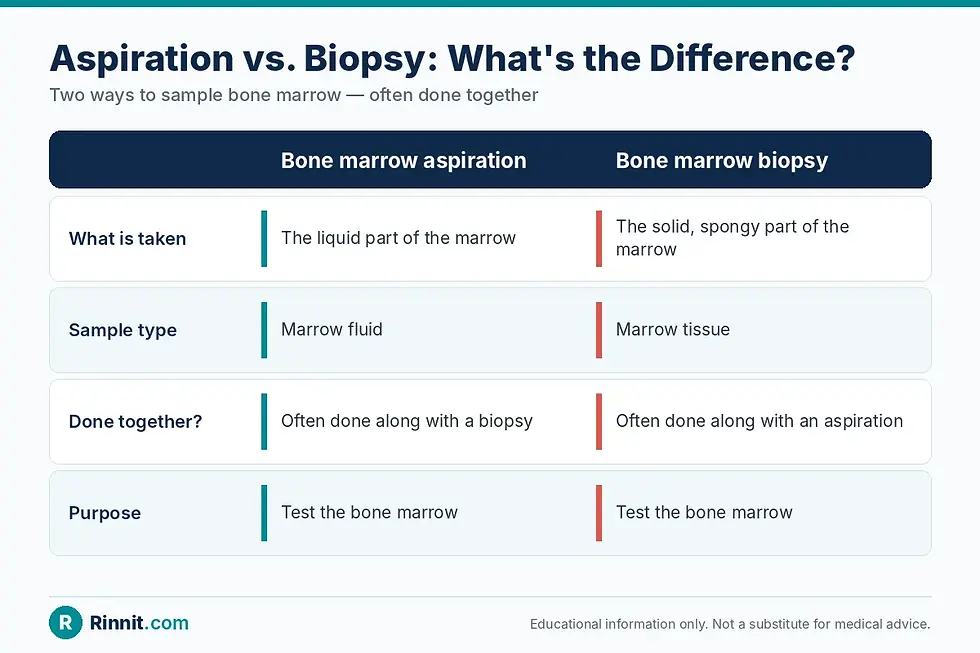
What is the difference between bone marrow aspiration and biopsy?
A bone marrow aspiration takes the liquid part of the marrow, while a bone marrow biopsy takes the solid, spongy part, and the two are often done together. [1]
Bone marrow aspiration | Bone marrow biopsy | |
|---|---|---|
What is taken | The liquid part of the marrow | The solid, spongy part of the marrow |
Sample type | Marrow fluid | Marrow tissue |
Done together? | Often, in the same visit | Often, in the same visit |
Because doctors often do both at once, you may hear them called one procedure. Learn more about the bone marrow biopsy.
How do you prepare for a bone marrow aspiration?
Preparing for a bone marrow aspiration usually means listing your medicines, telling your team if you feel anxious and arranging a ride home if you'll get sedation. [1]
Your care team will give you specific instructions. In general:
List your medicines. Tell your doctor about everything you take. You may be asked to pause some medicines before the test.
Speak up about anxiety. If you feel very nervous, say so. You may be offered medicine beforehand to help you relax.
Arrange a ride. If you'll get sedation, plan for someone to drive you home.
What happens during a bone marrow aspiration?
During a bone marrow aspiration, your doctor numbs the skin over the back of your hipbone, inserts a thin, hollow needle into the bone and draws out a small amount of liquid marrow. [1]
First, your vital signs are checked. You may get medicine to help you relax or ease discomfort. Then you lie on your side or stomach.
Next, your doctor will:
Clean the skin over the back of your hipbone.
Inject a local anesthetic to numb the skin and the surface of the bone.
Make a small cut and insert a thin, hollow needle into your pelvic bone.
Attach a syringe and draw out a small amount of liquid marrow.
Remove the needle and syringe.
Place a bandage over the area.
The whole procedure usually takes 30 to 45 minutes. You go home the same day, though you may need to wait for any sedating medicine to wear off first.

Does bone marrow aspiration hurt?
Bone marrow aspiration can cause some discomfort, mainly a sting from the numbing shot and a brief, shooting pain as the marrow is drawn out. [1]
Most people notice two moments:
A sting when the numbing medicine is injected into the skin.
A brief, shooting pain in the hip and leg as the liquid marrow is drawn out.
Ask your doctor to walk you through the steps beforehand and explain how they'll manage your discomfort. Knowing what's coming often makes it easier, and studies show distraction techniques can reduce pain during the procedure. [3]
What is recovery like after a bone marrow aspiration?
Recovery after a bone marrow aspiration usually involves a few days of soreness at the needle site and sometimes mild bruising on the lower back or buttocks. [1]
When | What to expect or do |
|---|---|
First 24 hours | Keep the bandage area clean and dry. Your care team will tell you when to remove the bandage. |
First few days | Soreness at the needle site. Back pain when bending over is common. |
First few days | Pain may spread down the back of your leg. |
First week | Mild bruising on the lower back or buttocks is common. |
What are the risks of bone marrow aspiration?
Bone marrow aspiration is generally a safe test, and uncommon risks include an allergic reaction to the anesthetic, bleeding and infection. [1] [2]
An allergic reaction to the anesthetic
Bleeding
Infection
When should you call your doctor after a bone marrow aspiration?
Call your care team right away after a bone marrow aspiration if you have a fever, white or cream-colored discharge, more bleeding than expected, or a swollen, warm needle site. [1]
A fever
Cream-colored or white discharge from the needle site
Bleeding from the site that's more than you expected
Swelling and warmth around the site

When will you get bone marrow aspiration results?
Bone marrow aspiration results can take a few days to a few weeks, depending on which lab tests your doctor orders on the sample. [1]
These tests may include:
Flow cytometry
FISH (fluorescence in situ hybridization)
Karyotype test
Next-generation sequencing, which identifies genetic mutations in cancer
What the results mean depends on why you had the test. Your doctor will explain the findings and any next steps.
Conclusion
A bone marrow aspiration is a short, same-day test that samples the liquid part of your marrow to help explain unusual blood test results. You may feel a sting and a brief sharp pain, followed by a few days of soreness. Serious problems are uncommon. Most important, the results can be the first step toward the right diagnosis and treatment.
Have a bone marrow test coming up? Bookmark this guide and bring the warning-sign list to your appointment. Explore more plain-language, evidence-based guides in the Rinnit Health Library.
Frequently Asked Questions
What is bone marrow aspiration used to diagnose?
Bone marrow aspiration helps diagnose blood cancers such as leukemia, lymphoma and myeloma, and blood disorders such as anemia, iron overload and low white blood cell levels.
How long does a bone marrow aspiration take?
A bone marrow aspiration takes about 30 to 45 minutes. You go home the same day.
Is bone marrow aspiration painful?
It can cause discomfort, including a sting from the numbing shot and a brief shooting pain in the hip and leg while the marrow is drawn. Medicine to help you relax may be offered.
Where on the body is bone marrow taken from?
Bone marrow is usually taken from the back of the hipbone (pelvic bone).
What's the difference between bone marrow aspiration and biopsy?
Aspiration takes the liquid part of the marrow, while a biopsy takes the solid, spongy part. They're often done together.
Will I be awake during the procedure?
The area is numbed with a local anesthetic, and you may also get medicine to help you relax. If you receive sedation, someone needs to drive you home.
How long does pain last after a bone marrow aspiration?
Soreness at the site usually lasts a few days. Mild bruising on the lower back or buttocks may appear in the first week.
When should I worry after a bone marrow aspiration?
Call your doctor right away for fever, white or cream-colored discharge, more bleeding than expected, or a swollen, warm site.
How long do bone marrow aspiration results take?
Results take from a few days to a few weeks, depending on which lab tests are run.
Can I drive myself home after a bone marrow aspiration?
Not if you get sedating medicine, so plan for someone to drive you home. If you only get numbing medicine, ask your care team whether driving is OK.
Related Reading
Learn more in our guide to Bone Marrow Biopsy: Why It's Done, What to Expect, Pain and Recovery.
References
Cleveland Clinic. Bone Marrow Aspiration: Purpose & Procedure. Cleveland Clinic. Last updated September 10, 2025. https://my.clevelandclinic.org/health/treatments/22297-bone-marrow-aspiration
Bain BJ. Bone marrow biopsy morbidity: review of 2003. J Clin Pathol. 2005;58(4):406-408. PMID: 15790706. https://doi.org/10.1136/jcp.2004.022178
Li C, Zhang X, Zhuang X, et al. The effectiveness of non-pharmacological interventions on reducing pain in patients undergoing bone marrow aspiration and biopsy: a systematic review and meta-analysis of randomized controlled trials. J Clin Nurs. 2024;33(8):2829-2848. PMID: 38549254. https://doi.org/10.1111/jocn.17121
Grønkjær M, Hasselgren CF, Østergaard ASL, et al. Bone marrow aspiration: a randomized controlled trial assessing the quality of bone marrow specimens using slow and rapid aspiration techniques and evaluating pain intensity. Acta Haematol. 2016;135(2):81-87. PMID: 26505268. https://doi.org/10.1159/000438480
Medical disclaimer
This article is for general education and does not replace advice from your own doctor. Always follow the instructions your care team gives you before and after any test.



Comments