Carrier Screening: Genetic Testing Before or During Pregnancy

Updated: 2 days ago
Written and medically reviewed by Dr. Baraa Alnahhal, MD · Last reviewed: November 2026 · How we review
Quick Answer
Carrier screening is a genetic test that shows whether you carry a gene change for an inherited condition you could pass to your children. It's done with a blood, saliva or cheek swab sample, ideally before pregnancy. If both partners carry the same recessive condition, each pregnancy has a 25% chance of an affected child.
What the research says
Expanded panels find more at-risk pregnancies: modeling based on 346,790 people found that guideline-based carrier screening identified as few as 6% to as many as 87% of the affected pregnancies that expanded screening would detect, depending on ancestry (Haque IS et al., JAMA, 2016) [2]
Being a carrier is common: in 2,530 people of reproductive age screened for 152 recessive conditions, 38.5% carried at least one disease-causing variant, and about 4% of couples were found to be at risk, many of whom then used prenatal diagnosis or embryo testing (Lu J et al., Arch Gynecol Obstet, 2025) [3]
Key takeaways
Shows whether you carry a gene change you could pass on.
Carriers usually have no symptoms.
Best done before pregnancy, or in the first trimester.
If both partners carry the same condition, each child has a 1 in 4 chance of having it.
A negative result lowers risk but can't rule out every condition.
How does carrier status work?
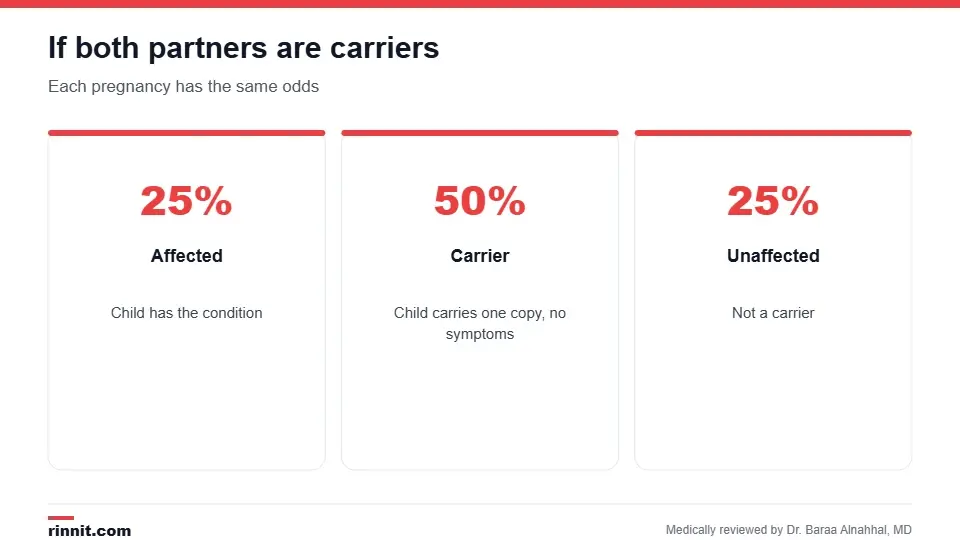
The odds are the same for every pregnancy.
Most carrier screening looks for autosomal recessive conditions. You have two copies of each gene; a carrier has one changed copy and one typical copy, which usually masks the change. A child must inherit a changed copy from both parents to have the condition. For X-linked conditions, carriers are usually female and often have mild or no symptoms. Sources: [1]
When both partners carry the same condition | Chance for each pregnancy |
Child has the condition | 25% (1 in 4) |
Child is a carrier | 50% (1 in 2) |
Child is neither affected nor a carrier | 25% (1 in 4) |
Sources: [1]
What conditions are tested?
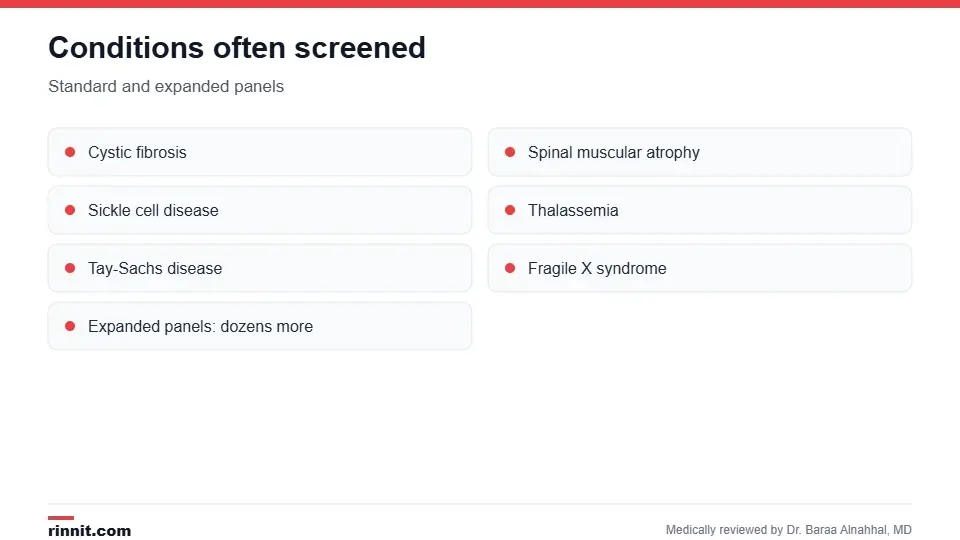
Expanded panels test for dozens of conditions.
Standard panels: cystic fibrosis, spinal muscular atrophy, fragile X syndrome, sickle cell disease, Tay-Sachs disease and thalassemia.
Expanded panels: dozens more, such as congenital adrenal hyperplasia and Wilson disease.
Targeted panels: conditions in your family or more common in your ancestry. Sources: [1, 2]
Expanded testing is now commonly recommended. Sources: [1]
When should you get screened?

Screening before pregnancy gives more options.
Before pregnancy (ideal): gives time to consider options such as IVF with preimplantation genetic testing, donor eggs or sperm, or adoption.
During pregnancy: your provider should offer it in the first trimester; results can guide tests like chorionic villus sampling or amniocentesis.
Higher risk: people with a family history of an inherited condition or who know they're carriers. Sources: [1, 3]
How is it done?
A sample of blood, saliva or cells from inside your cheek is collected. You may need to avoid eating or drinking briefly before a saliva or cheek swab test; otherwise no preparation is needed. A fertility specialist, genetic counselor or OB/GYN may order it. Sources: [1]
Understanding your results
Negative: no known variants were found, so the risk for your children is very low for the tested conditions, though not zero.
Positive: you're a carrier of one or more conditions; your partner should consider screening. Sources: [1]
Results usually take several days to a few weeks. A genetic counselor can explain what results mean, help you share information with relatives and talk through family planning options. Rarely, the test shows that you have a mild form of a condition yourself. Sources: [1]
Conclusion
Carrier screening gives you and your partner information to plan a family with confidence. It's simple, low risk and most useful before pregnancy, when it offers the widest range of choices.
Keep learning: read about prenatal genetic testing and NIPT.
Frequently asked questions
What is carrier screening?
A genetic test that shows whether you carry a gene change for an inherited condition.
Do carriers have symptoms?
Usually not.
When should I get it?
Ideally before pregnancy, or in the first trimester.
What sample is used?
Blood, saliva or a cheek swab.
What conditions are tested?
Often cystic fibrosis, SMA, sickle cell disease, thalassemia and Tay-Sachs.
What if both partners are carriers?
Each pregnancy has a 25% chance of an affected child.
Does a negative result guarantee a healthy baby?
No. It lowers risk for the tested conditions only.
What is expanded carrier screening?
A panel that checks for dozens of conditions.
How long do results take?
Several days to a few weeks.
Should my partner be tested?
Yes, especially if your result is positive.
Related Reading
Genetic Testing (DNA Tests): Types, Uses, Risks and What Results Mean an overview of genetic testing.
Prenatal Genetic Testing: Screening vs Diagnostic Tests, Timing and Accuracy tests during pregnancy.
Cystic Fibrosis: Symptoms, Causes, Diagnosis, and Treatment (2026 Guide) a common condition on carrier panels.
Tay-Sachs Disease: Symptoms, Causes, Testing, and Supportive Care an inherited condition screened for.
Preimplantation Genetic Testing (PGT): Types, Process, Results and Accuracy an option for at-risk couples.
References
Cleveland Clinic. What Is Carrier Screening? Cleveland Clinic. Last updated August 26, 2024. https://my.clevelandclinic.org/health/diagnostics/carrier-screening
Haque IS, Lazarin GA, Kang HP, et al. Modeled fetal risk of genetic diseases identified by expanded carrier screening. JAMA. 2016;316(7):734-742. PMID 27533158. https://doi.org/10.1001/jama.2016.11139
Lu J, Chen J, Mei L, et al. Clinical application of expanded carrier screening based on next-generation sequencing in the Chinese population. Arch Gynecol Obstet. 2025;312(3):949-957. PMID 40553156. https://doi.org/10.1007/s00404-025-08100-9
Medical disclaimer
This article is for general education only and does not replace advice from a qualified healthcare professional. Talk to your doctor about your own diagnosis and treatment, and seek emergency care right away for severe or sudden symptoms.



Comments