Alpha-Fetoprotein (AFP) Test: Pregnancy Screening, Cancer Marker and What Results Mean

Updated: 2 days ago
Written and medically reviewed by Dr. Baraa Alnahhal, MD · Last reviewed: November 2026 · How we review
Quick Answer
The alpha-fetoprotein (AFP) test is a blood test that measures AFP, a protein made by a developing baby's liver. In pregnancy, it's a screening test done at 16–22 weeks for neural tube defects and Down syndrome. Outside pregnancy, it's used as a tumor marker, mainly for liver cancer. An abnormal result is not a diagnosis; follow-up tests are needed.
What the research says
AFP alone misses many early liver cancers: a network meta-analysis of 170 studies and 62,643 people with cirrhosis found AFP and ultrasound were similarly limited for very-early liver cancer (sensitivity 39% and 34%), while contrast MRI and CT performed better at every stage (Rogers G et al., BMJ Open Gastroenterology, 2026) [2]
Combining AFP with other markers helps: across 15 studies and 19,021 patients with chronic liver disease, the GALAD score, a model built from five clinical measures including AFP, detected liver cancer with 82% sensitivity and 89% specificity, while AFP alone identified only 38% of early-stage cases (Guan MC et al., Journal of Clinical Medicine, 2023) [3]
Key takeaways
AFP is made by the fetal liver; healthy adults have very low levels, and babies' levels fall to low ranges by age 1.
In pregnancy, an optional screening test at about 16–22 weeks, often combined with other markers and ultrasound.
High AFP in pregnancy may signal a neural tube or abdominal wall defect, twins or a wrong due date; low AFP may signal a higher chance of Down syndrome.
In adults, high AFP can occur with liver cancer, cirrhosis, hepatitis and some testicular or ovarian cancers.
No preparation; results in several days; abnormal results lead to ultrasound, repeat testing or amniocentesis.
What is alpha-fetoprotein?
AFP is a protein produced mainly by the liver of a developing baby. Some of it crosses the placenta into the pregnant person's blood, where it can be measured. After birth, AFP levels fall quickly, reaching low adult levels by about age 1. In adults, raised AFP usually means liver cells, or certain tumor cells, are producing it again. Sources: [1]
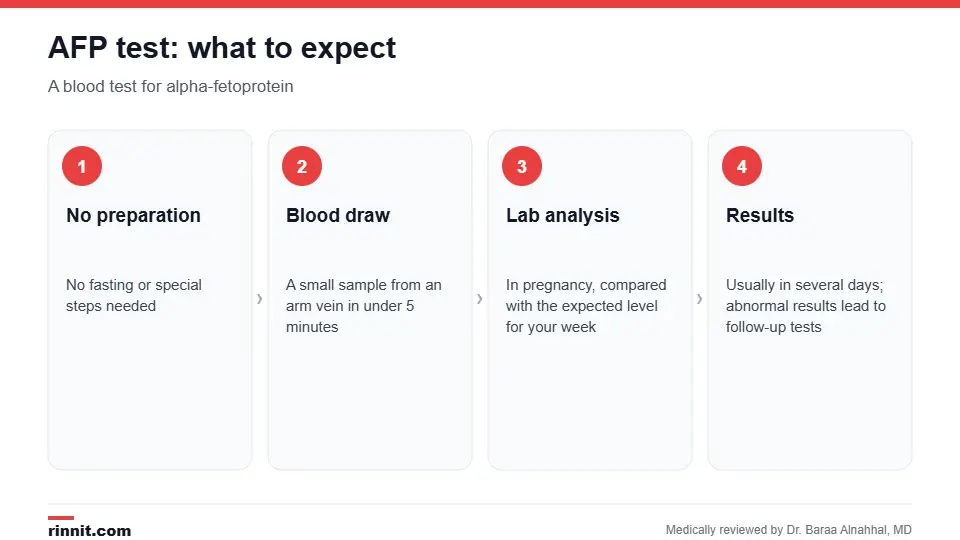
The AFP test is a routine blood draw that takes under 5 minutes.
Why is the test done?
In pregnancy, AFP screening is optional and offered to everyone, typically between 16 and 22 weeks. It may be especially recommended with a family history of birth defects, age over 35 or diabetes. It is often part of a multiple-marker blood screen. It can flag: Sources: [1]
Neural tube defects such as spina bifida and anencephaly.
Abdominal wall defects such as gastroschisis and omphalocele.
Down syndrome and other chromosome conditions.
Twins or triplets, or an incorrect due date.
Outside pregnancy, AFP is used as a tumor marker to help detect and monitor liver cancer and some testicular and ovarian cancers. Levels can also rise with cirrhosis, hepatitis A, B or C, and toxic or autoimmune hepatitis. AFP is not useful for cancers in general, and fatty liver usually doesn't raise it. Sources: [1]
How do I prepare?
No special preparation is needed. In pregnancy, your exact gestational age matters for interpreting the result, so confirm your dates with your provider. Sources: [1]
What happens during the test?
A provider cleans the skin and draws blood from a vein in your arm with a small needle.
The sample is sent to a lab.
The test takes under five minutes. Sources: [1]
Understanding your results

AFP in pregnancy is reported against the expected level for the week.
In pregnancy, results are reported as low, within the expected range, or high for your stage of pregnancy. Results usually take several days. Sources: [1]
Result | What it may mean | Usual next step |
Higher than expected | Higher chance of a neural tube or abdominal wall defect; twins; due date earlier than thought | Detailed ultrasound; sometimes amniocentesis |
Within expected range | Lower chance of these conditions | Routine care |
Lower than expected | Higher chance of Down syndrome or another chromosome condition; due date later than thought | Ultrasound, cell-free DNA testing or amniocentesis |
The test detects about 8 in 10 cases of spina bifida and about 19 in 20 cases of anencephaly. Most people with an abnormal screen have a healthy baby, which is why follow-up tests such as ultrasound, prenatal genetic testing or amniocentesis are needed before any diagnosis. Sources: [1]
AFP as a liver cancer marker

AFP works best combined with imaging and other markers.
In adults with cirrhosis or chronic hepatitis B, AFP is often checked alongside ultrasound every 6 months for liver cancer surveillance. On its own, it misses many early tumors: in one network meta-analysis, AFP detected only 39% of very-early liver cancers, and in another only 38% of early-stage cases. Scores that combine AFP with other markers, such as GALAD, perform better, and contrast MRI or CT is used when results are uncertain. Sources: [2, 3]
Risks
The test is very safe. You may have mild soreness, bruising or redness where the needle went in, usually gone within a day. Sources: [1]
Conclusion
The AFP test does two different jobs: in pregnancy it screens for certain birth defects and chromosome conditions, and in adults it helps detect and track liver and some germ cell cancers. In both cases, an abnormal result is a reason for follow-up testing, not a diagnosis. Ask your provider which follow-up test fits your situation.
Keep learning: read about cirrhosis and the nuchal translucency scan.
Frequently asked questions
When is the AFP test done in pregnancy?
Usually between 16 and 22 weeks, often as part of a multiple-marker screening test.
Is the AFP test required in pregnancy?
No. It is an optional screening test offered to everyone.
What does a high AFP mean in pregnancy?
A higher chance of a neural tube or abdominal wall defect, twins, or a due date that is off. Follow-up tests are needed.
What does a low AFP mean in pregnancy?
A higher chance of Down syndrome or another chromosome condition, or a due date that is later than thought.
How accurate is AFP screening?
It detects about 8 in 10 cases of spina bifida and about 19 in 20 cases of anencephaly, but many abnormal screens turn out normal.
What does a high AFP mean in adults?
It can occur with liver cancer, cirrhosis, hepatitis or some testicular and ovarian cancers. Further tests are needed.
Is AFP a good test for liver cancer?
It helps, but on its own it misses many early tumors. It works best with ultrasound or MRI and combined scores such as GALAD.
Do I need to fast?
No. No preparation is needed.
How long do results take?
Usually several days.
What happens after an abnormal result?
Usually a detailed ultrasound, repeat blood test or amniocentesis in pregnancy, or imaging such as MRI or CT in adults.
Related Reading
Understanding Neural Tube Defects: Types, Causes, and Prevention the birth defects a high AFP can point to.
Down Syndrome: Symptoms, Causes, Types & Life Expectancy — Complete Guide the chromosome condition a low AFP can point to.
Liver Cancer: A Comprehensive Guide to Symptoms, Causes, and Treatment the cancer AFP helps detect and monitor.
Testicular Cancer: The Young Man's Cancer That's Highly Curable — Symptoms, Self-Exam Guidance, and Treatment Explained a germ cell cancer where AFP is a tumor marker.
Prenatal Genetic Testing: Screening vs Diagnostic Tests, Timing and Accuracy the screening and diagnostic tests that follow an abnormal AFP.
Tumor Markers: Common Types, How They're Used, Results and Limits explains the main tumor marker tests and what their results can and can't show.
References
Cleveland Clinic. Alpha-Fetoprotein (AFP) Test: Procedure & Results. Cleveland Clinic. Last updated September 1, 2026. https://my.clevelandclinic.org/health/diagnostics/24301-alpha-fetoprotein-test
Rogers G, Derezea E, Sadler L, et al. Diagnostic accuracy of surveillance tests for hepatocellular carcinoma in cirrhosis: a systematic review and network meta-analysis. BMJ Open Gastroenterology. 2026;13(1):e002155. PMID 42468998. https://doi.org/10.1136/bmjgast-2025-002155
Guan MC, Zhang SY, Ding Q, et al. The performance of GALAD score for diagnosing hepatocellular carcinoma in patients with chronic liver diseases: a systematic review and meta-analysis. Journal of Clinical Medicine. 2023;12(3):949. PMID 36769597. https://doi.org/10.3390/jcm12030949
Medical disclaimer
This article is for general education only and does not replace advice from a qualified healthcare professional. Talk to your doctor about your own diagnosis and treatment, and seek emergency care right away for severe or sudden symptoms.



Comments