DNA Paternity Test: Types, Accuracy, Timing and What Results Mean

Updated: 2 days ago
Written and medically reviewed by Dr. Baraa Alnahhal, MD · Last reviewed: November 2026 · How we review
Quick Answer: What is a DNA paternity test?
A DNA paternity test shows whether a man is a child's biological father by comparing DNA, usually from a cheek swab. It can be done after birth or during pregnancy, as early as the 8th week. Results show a probability of paternity of either 0 or 99.9. Only tests done at an approved facility can be used in court. [1]
What the research says
Blood-based prenatal paternity testing can match invasive testing. In 15 family trios, fetal DNA read from the mother's blood was 100% concordant with DNA from amniotic fluid, and the method gave paternity probabilities above 99.9999%, all confirmed by standard short tandem repeat testing. (Tam et al., Prenatal Diagnosis, 2020) [2]
The method separates the true father from unrelated men. In 34 real parentage cases tested from maternal blood with 1,795 DNA markers, the statistical model correctly identified each biological father and clearly separated him from 90 unrelated men. (Qu et al., Transfusion, 2018) [3]
Key takeaways
A paternity test compares genetic markers a child shares with the mother and the possible father. [1]
Prenatal testing can start as early as the 8th week of pregnancy; postnatal tests are done after birth. [1]
The noninvasive blood test (NIPP) is very safe; amniocentesis and CVS are invasive and carry a rare risk of miscarriage. [1]
At-home kits are cheaper but may be less accurate and are not accepted in court. [1]
Health insurance does not cover paternity testing. [1]
What is a DNA paternity test?
A DNA paternity test identifies a child's biological father by analyzing DNA. Lab technicians look for genetic markers that the child shares with the biological mother and with the possible father. Samples come from the mother, the possible father and sometimes the fetus or child. [1]
Why is paternity testing done?
Knowing paternity matters for several reasons: [1]
Legal rights, such as child support, custody, Social Security benefits and inheritance
Medical history, to know about inherited conditions in the family such as cystic fibrosis and certain cancers
A child's knowledge of their family history
What are the types of paternity tests?
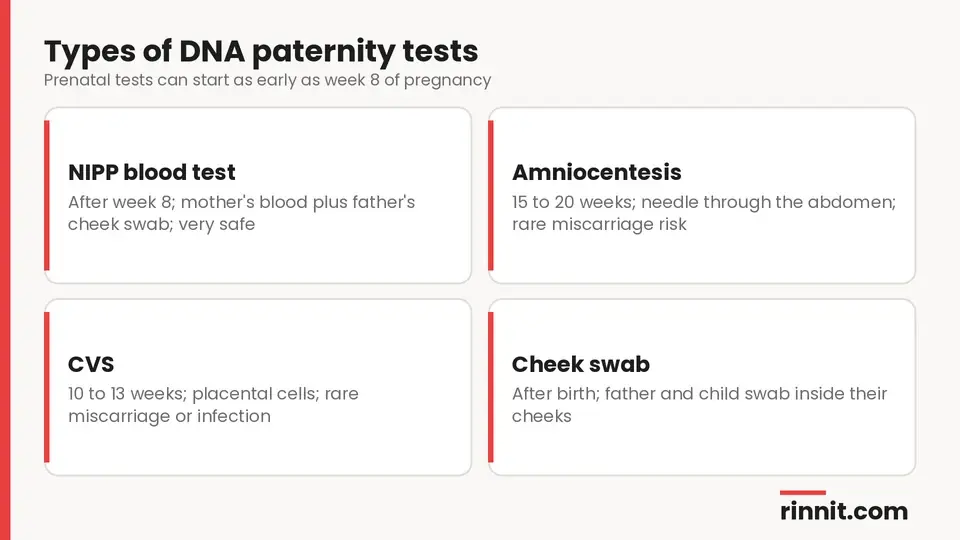
Test | When it's done | How the sample is taken | Main risks |
Noninvasive prenatal paternity (NIPP) | After the 8th week of pregnancy | Blood from the mother plus a cheek swab from the possible father | Pain, bleeding, bruising, fainting or infection from the blood draw |
Amniocentesis | 15 to 20 weeks of pregnancy | A thin needle through the abdomen collects amniotic fluid | Rare miscarriage or premature labor |
Chorionic villus sampling (CVS) | 10 to 13 weeks after the last period | Placental cells collected through the cervix or abdomen | Rare miscarriage or infection |
Cheek swab | After birth | The possible father and child swab the inside of their cheeks | None listed |
Sources: [1]
The NIPP test is described as 99.9% accurate and very safe because it uses traces of fetal DNA in the mother's blood instead of a needle into the uterus. [1]
How do you prepare for a paternity test?
For a cheek swab, avoid brushing your teeth, using mouthwash, putting in dentures, smoking or using chewing tobacco for at least 1 hour beforehand. These can affect the sample. [1]
If a blood sample is needed, drinking extra fluids, eating healthy foods, moisturizing your arms and gentle exercise may help. [1]
During pregnancy, the mother may need an ultrasound to confirm how far along she is. [1]
How long does the test take?
Sample | Time to collect |
Cheek swab | Less than a minute |
Blood draw | A few minutes |
Amniocentesis or CVS | About 10 minutes each |
Sources: [1]
At-home vs facility paternity tests
At-home kits include cheek swabs, collection tubes or envelopes and a mailing envelope. Results usually come back a week or two after the lab receives the samples. [1]

At-home tests are usually cheaper but may be less accurate. [1]
At-home results are not accepted in court; legal cases need testing at an approved facility. [1]
Choose a kit that analyzes more genetic markers. The industry standard is 16, and more markers mean higher accuracy. [1]
Check that the lab is accredited by the American Association of Blood Banks (AABB) or a similar standards body. [1]
New York State does not permit at-home paternity tests; testing must be done at an approved facility. [1]
What do paternity test results mean?
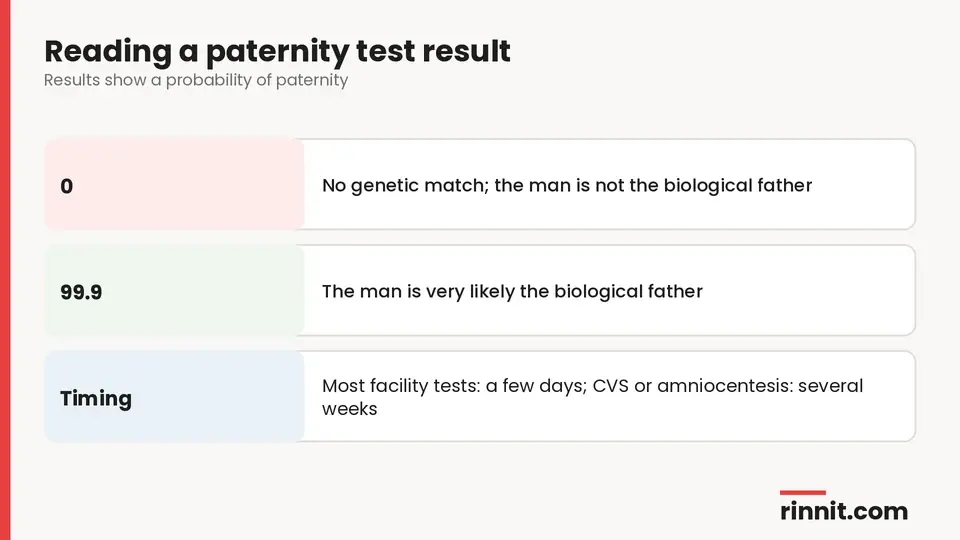
Result | What it means |
Probability of paternity 0 | No genetic match; the man is not the biological father |
Probability of paternity 99.9 | The man is very likely the biological father |
Sources: [1]
Most facility tests take a few days. Results from CVS and amniocentesis can take several weeks, and some companies offer same-day or one-day results for an extra fee. [1]
Can an ancestry test prove paternity?
No. Ancestry DNA tests can suggest possible relatives, but only a paternity test can prove paternity. [1]
Can you test paternity without the father?
The father's own sample is the most accurate. If he has died, samples may be obtained from a medical facility, coroner's office or medical examiner's office. If he is unavailable, samples from his biological relatives, such as his parents, siblings, grandparents, aunts or uncles, may be used, because close relatives share much of their DNA. [1]
How much does a paternity test cost?
At-home tests range from $15 to $200, plus lab fees (often over $100) and shipping or handling. Facility-based tests cost up to $500. Health insurance does not cover paternity testing. [1]
Conclusion
A DNA paternity test compares genetic markers to show whether a man is a child's biological father. Cheek swab tests after birth are quick, and a blood test during pregnancy can give an answer from the 8th week without a needle in the uterus.
If you need results for legal reasons, use an approved, accredited facility. A healthcare provider can help you choose the right test.
Keep learning: Read our guides to prenatal genetic testing, amniocentesis and chorionic villus sampling (CVS), or learn how genetic testing works in general.
FAQ
What is a DNA paternity test?
A test that compares DNA, usually from a cheek swab, to show whether a man is a child's biological father. [1]
How accurate is a DNA paternity test?
Lab results show 0 (not the father) or 99.9 (very likely the father); the noninvasive prenatal blood test is described as 99.9% accurate. [1]
How early in pregnancy can paternity be tested?
As early as the 8th week of pregnancy, using a blood sample from the mother. [1]
Is prenatal paternity testing safe?
The blood-based NIPP test is very safe; amniocentesis and CVS carry a rare risk of miscarriage. [1]
How do I prepare for a cheek swab paternity test?
Avoid brushing, mouthwash, dentures, smoking and chewing tobacco for at least 1 hour beforehand. [1]
Are at-home paternity tests accurate?
They may be less accurate than lab tests and are not admissible in court. [1]
How long do paternity test results take?
Most facility tests take a few days; at-home kits take a week or two after the lab gets the samples. [1]
Can paternity be tested without the father?
Yes, using samples from close relatives or, if he has died, from a medical facility or medical examiner. [1]
Can an ancestry test prove paternity?
No; only a paternity test can prove paternity. [1]
Does insurance cover paternity testing?
No; health insurance does not cover it. [1]
Related Reading
Cystic Fibrosis: Symptoms, Causes, Diagnosis, and Treatment (2026 Guide) explains one inherited condition that knowing paternity can help identify.
Down Syndrome: Symptoms, Causes, Types & Life Expectancy — Complete Guide covers a genetic condition where family history matters.
References
Cleveland Clinic. DNA Paternity Test: Procedure, Accuracy & Results. Cleveland Clinic. Last updated April 17, 2024. https://my.clevelandclinic.org/health/diagnostics/10119-dna-paternity-test
Tam JCW, Chan YM, Tsang SY, et al. Noninvasive prenatal paternity testing by means of SNP-based targeted sequencing. Prenat Diagn. 2020;40(4):497-506. PMID 31674029. https://doi.org/10.1002/pd.5595
Qu N, Xie Y, Li H, et al. Noninvasive prenatal paternity testing using targeted massively parallel sequencing. Transfusion. 2018;58(7):1792-1799. PMID 29536546. https://doi.org/10.1111/trf.14577
Medical disclaimer
This article is for general education only and does not replace advice from a qualified healthcare professional. Talk to your doctor about your own diagnosis and treatment, and seek emergency care right away for severe or sudden symptoms.



Comments