Trisomy Explained: Understanding Extra Chromosomes and Genetic Health

Updated: 3 days ago
Medically reviewed by Dr. Baraa Alnahhal, MD · Last reviewed: October 17, 2026
Editorial note: This article is provided for educational purposes only. It is not medical advice. Always consult a qualified healthcare professional about your individual health situation.
Quick Answer
Trisomy is a genetic condition in which a person has three copies of a chromosome instead of two, giving 47 chromosomes instead of 46 [1], due to a spontaneous cell division error. Some, such as trisomy 21 (Down syndrome), commonly result in live birth, while many end in miscarriage [1]. Prenatal screening estimates risk, diagnostic tests confirm it, and management is lifelong.
What the research says
Blood-based screening is highly accurate for the common trisomies. Pooling 35 studies, cell-free DNA testing of maternal blood detected 99.7% of trisomy 21 cases (false-positive rate 0.04%), 97.9% of trisomy 18 (0.04%), and 99.0% of trisomy 13 (0.04%) in singleton pregnancies (Gil et al., Ultrasound in Obstetrics & Gynecology, 2017) [2].
Survival with trisomy 13 or 18 is low but not zero. In a nine-state U.S. study of 693 children with trisomy 13 and 1,113 with trisomy 18, five-year survival was 9.7% and 12.3%, respectively (Meyer et al., American Journal of Medical Genetics Part A, 2016) [3].
Most trisomy 21 begins in the mother’s egg cell. In a genotyping study of 102 people with Down syndrome, 93% of cases were of maternal origin, 5% paternal, and 2% arose after fertilization; 86% of the maternal errors happened in the first meiotic division (Vraneković et al., Genetic Testing and Molecular Biomarkers, 2012) [4].
When should you see a doctor about trisomy?
Contact your healthcare provider if you have symptoms of a miscarriage, which most often happens in the first three months of pregnancy: cramping, lower back pain, abdominal pain, light to heavy bleeding, or chills or fever [1].
If you are planning a pregnancy, are 35 or older, or have a screening result that suggests a higher chance of a chromosomal condition, talk with a genetic counselor or maternal-fetal medicine specialist about screening and diagnostic options.
What Is Trisomy?
Trisomy is a fundamental shift in the human genetic blueprint. The body normally contains 23 pairs of chromosomes, 46 in total, with half inherited from each parent [1]. During meiosis, the cell division that forms egg and sperm cells, an error can leave an extra copy of one chromosome. The result is 47 chromosomes [1]. The word itself translates to “three bodies,” [1] reflecting the extra genetic material.
Trisomy can occur in any pregnancy, and it happens randomly [1]. The risk is higher for pregnancies after age 35, but because far more babies are born to parents under 35, most babies with trisomy are born to younger parents [1]. Trisomy 21 is the most common type, affecting nearly 6,000 babies a year in the United States, about 1 in 700 births [1].
Type of trisomy | Common name | Chromosome affected |
Trisomy 21 | Down syndrome | Chromosome 21 |
Trisomy 18 | Edwards syndrome | Chromosome 18 |
Trisomy 13 | Patau syndrome | Chromosome 13 |
XXY | Klinefelter syndrome | Sex chromosomes |
XYY | Jacobs syndrome | Sex chromosomes |
XXX | Trisomy X (triple X syndrome) | Sex chromosomes |
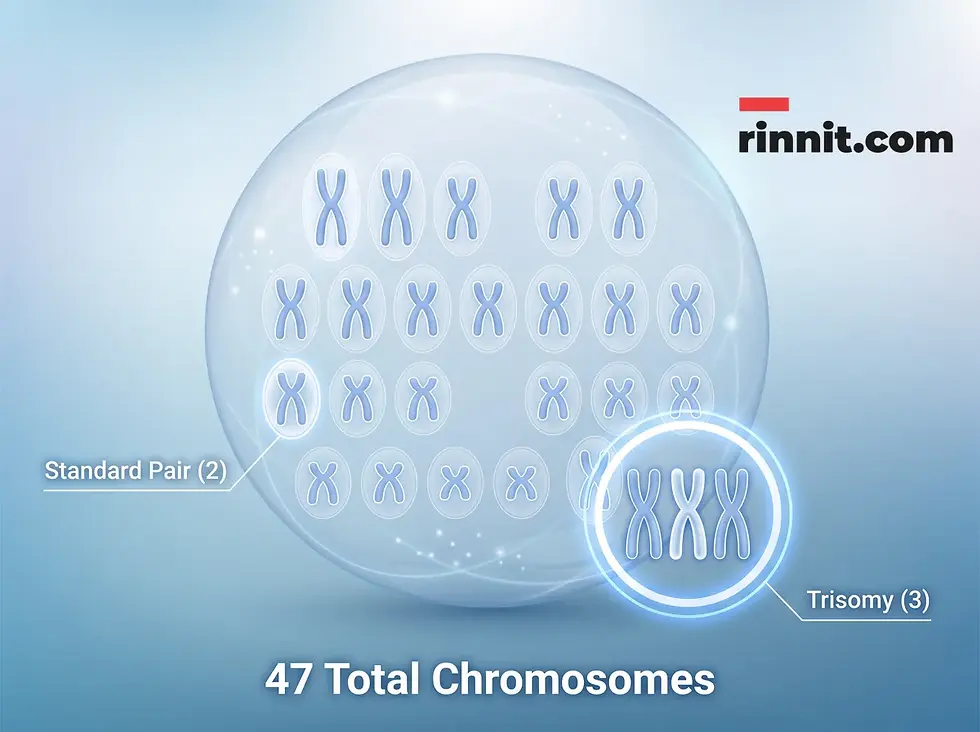
Trisomy is different from monosomy, in which a chromosome copy is missing (45 in total), and from triploidy, in which an entire extra set of chromosomes is present (69 in total).
What are the symptoms and prenatal signs of trisomy?
An extra chromosome can show up as specific signs during pregnancy and as distinctive physical characteristics after birth. During a prenatal ultrasound, providers look for “soft markers” that may suggest a trisomy condition. These signs raise suspicion but do not confirm a diagnosis.
Diagnostic category | Key indicators and symptoms |
Prenatal (ultrasound) | Excess amniotic fluid, a small placenta, a single umbilical artery, reduced fetal activity, a small-for-age baby, and physical abnormalities such as heart problems or a cleft palate [1]. |
After birth (physical) | Slanted eyes, a round face with a flat profile, cleft palate, and small stature [1]. |
Internal and developmental | Heart defects, lung or kidney problems, developmental delays, and intellectual disability [1]. |

The specific features depend on which chromosome is affected, because each chromosome plays a different role in the body’s blueprint.
How Is Trisomy Diagnosed?
Pregnancy screening usually combines a maternal blood test with a specialized ultrasound that checks for signs such as excess amniotic fluid, nuchal translucency (fluid under the skin behind the neck), and limb lengths [1]. Screening estimates risk. If the risk is high, confirmatory testing can give a definitive answer.
Noninvasive prenatal testing (NIPT): A maternal blood sample, usually taken after 10 weeks [1], screens for chromosomal conditions. It is a screening test, so a positive result should be confirmed with a diagnostic test.
Chorionic villus sampling (CVS): Between 10 and 13 weeks [1], a small sample of placental cells is tested for genetic conditions.
Amniocentesis: Between 15 and 20 weeks [1], a small sample of amniotic fluid is tested.
Percutaneous umbilical blood sampling (PUBS): A small sample of blood from the baby’s umbilical cord is tested [1].
After birth: A physical examination and chromosome analysis of a blood sample from the baby confirm the diagnosis [1].
Early diagnosis helps families and care teams prepare for the specialized care a child may need.
How is trisomy managed with long-term support?
Trisomy is a lifelong condition with no cure for the underlying genetic change, but a multidisciplinary approach can improve quality of life. Treatment plans are individualized and change as a child grows.
Surgical interventions: To repair congenital heart defects or physical differences such as a cleft palate [1].
Therapeutic support: Speech, physical, and behavioral therapies [1] to support developmental milestones.
Educational assistance: Specialized support at school [1] for intellectual disability.
Medical monitoring: Ongoing care for related conditions such as frequent ear infections, heart problems, or sleep apnea.
Medicines: To treat symptoms of related medical conditions [1] that develop over time.

What is the outlook for people with trisomy?
An extra chromosome changes the blueprint for development and causes physical differences present at birth along with intellectual disability. Many children with trisomy develop further health concerns, but with adequate treatment many can live full lives [1], particularly with trisomy 21.
Survival is much lower for trisomy 13 and trisomy 18 after the first weeks of life because of the severity of the condition, especially delayed or abnormal organ development [1]. Care teams assess each baby’s health and offer treatment to improve survival.
Conclusion
Understanding trisomy is the first step toward effective support for affected individuals and their families. Trisomy arises by chance, cannot be prevented, and can range from conditions compatible with a long, active life to conditions with very low survival.
Screening and diagnostic testing can identify trisomy early in pregnancy, and individualized care — surgery, therapies, educational support, and medical monitoring — helps children reach their potential.
Your next step: If you have concerns about genetic risks or have received a screening result, consult a genetic counselor or a maternal-fetal medicine specialist. Early information and professional guidance help you make informed decisions about your family’s health and future care.
Related reading: Edwards Syndrome (Trisomy 18) | Chromosome Counting Errors, Miscarriage, and Down Syndrome
Sources: Cleveland Clinic — Trisomy | Gil et al., 2017 | Meyer et al., 2016 | Vraneković et al., 2012
Frequently Asked Questions
1. What is the most common type of trisomy?
Trisomy 21, also known as Down syndrome. Nearly 6,000 babies are born with it each year in the United States, about 1 in 700 births.
2. Can trisomy be prevented?
No. Trisomy occurs spontaneously when cells divide, and it is not caused by anything a parent did. Healthy habits support a healthy pregnancy, but they do not prevent trisomy.
3. Does age affect the risk of trisomy?
Yes. The risk is higher for pregnancies after age 35, and advanced maternal age is the best-established risk factor. Because far more babies are born to parents under 35, however, most babies with trisomy are born to younger parents.
4. What is the difference between trisomy and monosomy?
Trisomy means an extra copy of a chromosome (47 in total), while monosomy means a missing copy (45 in total).
5. Is trisomy always inherited from a parent?
No. It most often arises by chance when egg or sperm cells form, and rarely in early cell divisions. It is not caused by something the parent did during pregnancy.
6. What are the signs of trisomy on a prenatal ultrasound?
Possible signs include excess amniotic fluid, a single umbilical artery, a small placenta, reduced fetal movement, a small-for-age baby, and physical abnormalities such as heart problems or a cleft palate. These signs raise suspicion but do not confirm a diagnosis.
7. What is NIPT?
Noninvasive prenatal testing (NIPT) is a blood test, available after 10 weeks, that screens for common trisomies. In singleton pregnancies it detects more than 99% of trisomy 21 cases, about 98% of trisomy 18, and 99% of trisomy 13, but a positive result should be confirmed with CVS or amniocentesis.
8. Can a person with trisomy live a full life?
Many can, particularly with trisomy 21, with lifelong medical care, therapies, and educational support. Outlook varies by type, and survival for trisomy 13 and 18 is low after the first weeks of life.
9. Why do many trisomy pregnancies end in miscarriage?
The extra genetic material often causes severe developmental problems that a pregnancy cannot sustain, and most of these miscarriages happen in the first three months.
10. What is Patau syndrome?
Patau syndrome is trisomy 13, an extra copy of chromosome 13.
11. What is Edwards syndrome?
Edwards syndrome is trisomy 18, an extra copy of chromosome 18.
12. Are there trisomies that affect the sex chromosomes?
Yes. They include Klinefelter syndrome (XXY), Jacobs syndrome (XYY), and trisomy X (XXX).
13. How is trisomy confirmed after birth?
By a physical examination and a chromosome analysis of a blood sample from the baby.
14. Does trisomy affect intelligence?
Autosomal trisomies such as trisomy 21, 18, and 13 are associated with intellectual disability or developmental delay, to varying degrees. Effects of the sex chromosome trisomies vary widely and are often milder.
15. What should I do if I suspect a miscarriage?
Contact your healthcare provider right away if you have cramping, lower back pain, abdominal pain, light to heavy bleeding, or chills or fever.
Related Reading
Nuchal Translucency (NT) Scan: Timing, Procedure, Accuracy and Results explains the first-trimester ultrasound that screens for this condition.
Learn more in our guide to NIPT Test (Noninvasive Prenatal Testing): What It Screens For, Accuracy and Results.
Chorionic Villus Sampling (CVS): What It Is, Why It's Done, Risks and Results explains how chorionic villus sampling checks a pregnancy for genetic conditions in the first trimester.
References
Cleveland Clinic. Trisomy: Types of Trisomy Disorders. Cleveland Clinic. May 3, 2022. https://my.clevelandclinic.org/health/diseases/22912-trisomy
Gil MM, Accurti V, Santacruz B, et al. Analysis of cell-free DNA in maternal blood in screening for aneuploidies: updated meta-analysis. Ultrasound Obstet Gynecol. 2017;50(3):302-314. PMID 28397325. https://doi.org/10.1002/uog.17484
Meyer RE, Liu G, Gilboa SM, et al. Survival of children with trisomy 13 and trisomy 18: a multi-state population-based study. Am J Med Genet A. 2016;170A(4):825-837. PMID 26663415. https://doi.org/10.1002/ajmg.a.37495
Vraneković J, Babić Božović I, Grubić Z, et al. Down syndrome: parental origin, recombination, and maternal age. Genet Test Mol Biomarkers. 2012;16(1):70-73. PMID 21861707. https://doi.org/10.1089/gtmb.2011.0066
Medical disclaimer
This article is for education only and is not a substitute for professional medical advice, diagnosis, or treatment. Cramping, abdominal or lower back pain, or bleeding during pregnancy warrants prompt medical attention. Always consult a qualified healthcare professional about your individual health situation.



Comments