Hypoplastic Left Heart Syndrome (HLHS): What It Is, Symptoms, Surgery Stages, and Lifelong Care

Updated: 3 days ago
Medically reviewed by Dr. Baraa Alnahhal, MD · Last reviewed: October 2026
Hypoplastic left heart syndrome (HLHS) is a rare heart condition that a child is born with, in which the left side of the heart does not form fully and is too small to pump blood well. The right side of the heart must then pump blood to the lungs and to the rest of the body [1]. Babies are usually very sick soon after birth, and HLHS needs urgent treatment: medicines, a series of heart surgeries, or a heart transplant [2]. With treatment and lifelong follow-up care, many children now survive into adulthood [1].
Quick Answer: What is hypoplastic left heart syndrome?
Hypoplastic left heart syndrome (HLHS) is a rare congenital heart defect in which the left ventricle, aorta and left-side valves are too small to pump blood to the body. It causes blue or gray skin, fast breathing and poor feeding within hours of birth. It is an emergency treated with medicine, staged surgeries or transplant, plus lifelong specialist care. [1] [2]
What the research says
Survival has improved dramatically. A multi-specialty white paper reported that survival to age 5 years (including the Fontan stage) ranged from 50% to 69%, and that current expectations are that 70% of newborns born today with HLHS may reach adulthood (Feinstein et al., Journal of the American College of Cardiology, 2012 [3]).
Two shunt designs for the first surgery ended up with similar survival by age 3. In the Single Ventricle Reconstruction trial of 549 infants with a single right ventricle, transplant-free survival at 3 years was 67% with a right ventricle-to-pulmonary artery shunt versus 61% with a modified Blalock-Taussig shunt (not a significant difference, P = 0.15). The right ventricle-to-pulmonary artery group needed more catheter procedures over time (Newburger et al., Circulation, 2014 [4]).
Follow-up procedures are common. In the same trial population, 97 of 549 infants (18%) needed a procedure to treat recoarctation (re-narrowing of the aorta) after the Norwood operation, at a median age of about 5 months. Transplant-free survival at 12 months did not differ between those with and without recoarctation (Hill et al., Circulation, 2013 [5]).
What Is Hypoplastic Left Heart Syndrome?
Hypoplastic left heart syndrome (HLHS) is a rare heart condition that a child is born with, which makes it a congenital heart defect. In this condition, the left side of the heart does not develop fully and is too small to pump blood well. As a result, the right side of the heart must do double duty, pumping blood to both the lungs and the rest of the body [1].
Treatment for HLHS may include medicines, heart surgery, or a heart transplant. Advances in care have improved the outlook for babies born with this condition [1].
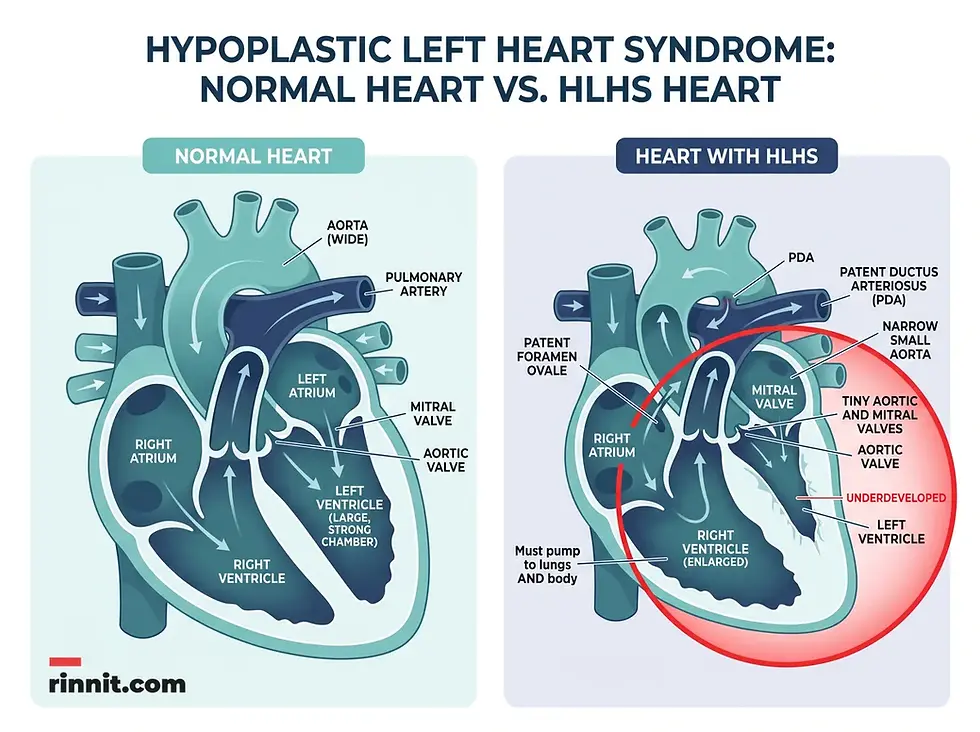
A normal heart compared with a heart with HLHS.
To understand HLHS, it helps to know how a typical heart works. A typical heart has two upper chambers (the right and left atria), which receive incoming blood, and two lower, more muscular chambers (the right and left ventricles), which pump blood out of the heart. The heart valves act as gates at the chamber openings, keeping blood flowing in the right direction [1]. In HLHS:
Left ventricle: normally pumps oxygen-rich blood out to the body; in HLHS it is too small and cannot pump blood well.
Aorta: the body's main artery; in HLHS it is too small.
Aortic valve: the gate between the left ventricle and aorta; in HLHS it is too small.
Mitral valve: the gate between the left atrium and left ventricle; in HLHS it is too small.
Right ventricle: normally pumps blood to the lungs only; in HLHS it must pump to the lungs and the body.
Symptoms of Hypoplastic Left Heart Syndrome
Babies born with HLHS are usually very sick soon after birth. The symptoms reflect the body's struggle to get enough oxygen-rich blood [1]:
Skin color change: blue or gray skin, lips, or fingernails. Depending on skin color, these changes may be harder or easier to see.
Breathing: rapid, difficult breathing.
Feeding: poor feeding.
Extremities: cold hands and feet.
Pulse: weak pulse.
Activity level: being more drowsy or less active than usual.
When shock can develop
Without treatment, a baby with HLHS may go into shock, a life-threatening state in which organs stop getting enough blood. Symptoms of shock include [1]:
Cool, clammy skin that can be pale, or lips that can be blue or gray.
A weak and rapid pulse.
Breathing that may be slow and shallow or very fast.
Dull eyes that seem to stare.
When to see a doctor
HLHS requires immediate emergency medical help. Get emergency care if your baby has any of the following [1]:
Changes in skin or nail color.
Trouble breathing or fast breathing.
A weak pulse or a fast pulse.
Cool, clammy skin.
How Hypoplastic Left Heart Syndrome Happens
HLHS happens in the womb while a baby's heart is developing. The exact cause is not known, but gene changes may play a role [1]. In a developing baby with HLHS, several structures on the left side of the heart do not grow enough [1]:
The lower left heart chamber, called the left ventricle.
The body's main artery, called the aorta.
The heart valves on the left side of the heart, called the aortic and mitral valves.
Because these structures are too small, the body cannot get enough oxygen-rich blood.
The two lifesaving openings
In the womb and for the first days after birth, every baby has two natural openings that help blood circulate [1]:
Ductus arteriosus: a vessel that connects the pulmonary artery directly to the aorta, letting the right side of the heart send blood to the body.
Foramen ovale: a natural opening between the upper chambers of the heart that lets oxygen-rich blood return to the right side of the heart.
In a typical newborn, the ductus arteriosus closes after the first day or two of life, and the left side of the heart takes over pumping blood to the body. But in babies with HLHS, the left side cannot pump blood well. So they need medicine to keep these connections open and keep blood flowing to the body until they have heart surgery [1].
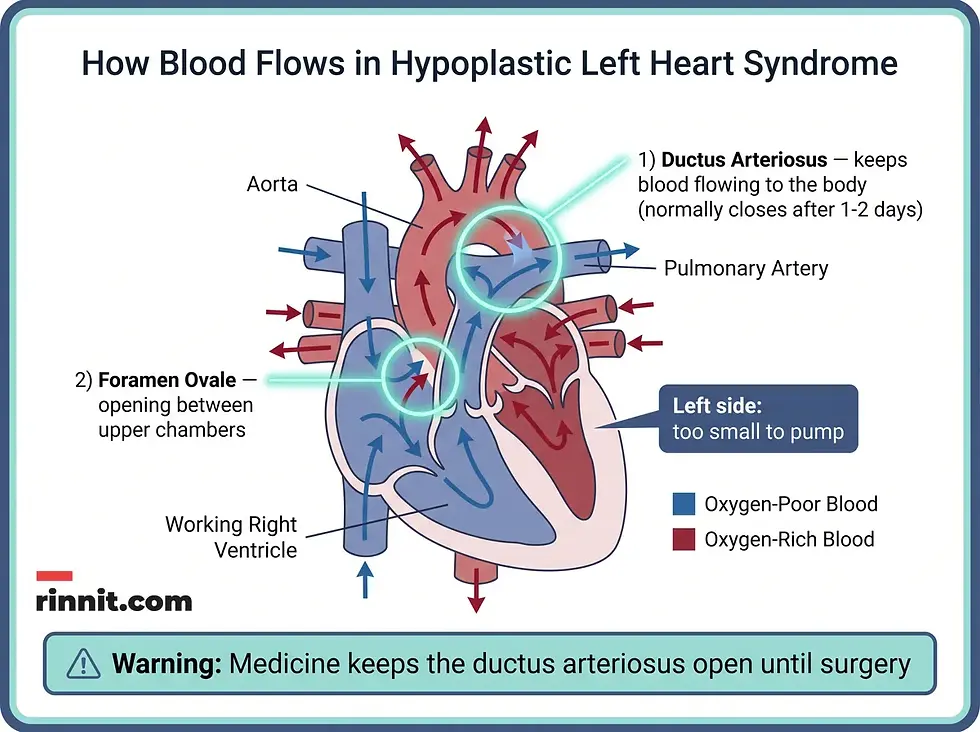
The ductus arteriosus and foramen ovale keep blood flowing until surgery.
Risk Factors
There are very few known risk factors for HLHS. Parents who have a child with HLHS have a higher risk of having another baby with this or a similar condition. There are no other clear risk factors [1].
Complications
With proper treatment, many babies with HLHS survive. However, they need many surgeries and can have less energy and other ongoing challenges. Possible complications include [1]:
Easy fatigue: getting tired more easily during sports or other exercise.
Arrhythmias: irregular heartbeats.
Edema: fluid buildup in the lungs, stomach area, legs, and feet.
Poor growth: not growing well.
Developmental conditions: conditions related to the brain and nervous system.
Further interventions: the need for more heart surgeries or a heart transplant.
Prevention
There is no way to prevent hypoplastic left heart syndrome. If you were born with a heart condition yourself, talk with a heart doctor and a genetic counselor before getting pregnant [1].
How Hypoplastic Left Heart Syndrome Is Diagnosed
The physical exam
To diagnose HLHS, a healthcare professional examines the baby and listens to the baby's heart. The professional may hear a sound called a heart murmur — a noise caused by rushing blood flow [2].
Diagnostic tests
Pregnancy ultrasound: a routine ultrasound exam in the second trimester usually can tell whether the baby has HLHS before birth.
Echocardiogram: uses sound waves to make pictures of the heart and shows how blood flows through it. After birth, it can show that the left ventricle and heart valves are small, and that the aorta may be small.
Treatment of Hypoplastic Left Heart Syndrome
A baby born with HLHS needs urgent treatment. Treatment can include many surgeries or a heart transplant. Medicines and other therapies are used to manage symptoms before heart surgery. If HLHS is found before birth, healthcare professionals usually recommend giving birth at a hospital with a cardiac surgery center [2].
Medicines
The medicine alprostadil (Prostin VR Pediatric) is used to keep the ductus arteriosus open. In most babies this vessel closes soon after birth, but in babies with HLHS it needs to stay open so blood can reach the rest of the body [2].
Therapies while waiting for surgery
Ventilator: a breathing machine for babies who have trouble breathing.
IV fluids: fluids delivered through a tube inserted into a vein.
Feeding tube: for babies who have trouble feeding or tire while feeding.
Surgery and other procedures
Most children with HLHS need several surgeries, carried out in stages [2].
Atrial septostomy
This treatment uses tubes called catheters and a balloon to make or widen an opening between the heart's upper chambers, letting more blood flow between them. It is done if the foramen ovale closes or is too small. Babies born with a hole in the heart, called an atrial septal defect, might not need an atrial septostomy [2].
The three-stage surgical pathway
Stage 1 — Norwood procedure (often within the first two weeks of life): rebuilds the aorta and connects it to the right lower chamber, and adds a shunt to send blood to the lungs.
Stage 2 — Bidirectional Glenn procedure (usually between 4 and 6 months of age): removes the first shunt and connects the superior vena cava (the large vein draining the head and arms) to the pulmonary artery.
Stage 3 — Fontan procedure (usually between 3 and 4 years of age): creates a path for blood from the lower legs (the inferior vena cava) to flow directly into the pulmonary arteries.
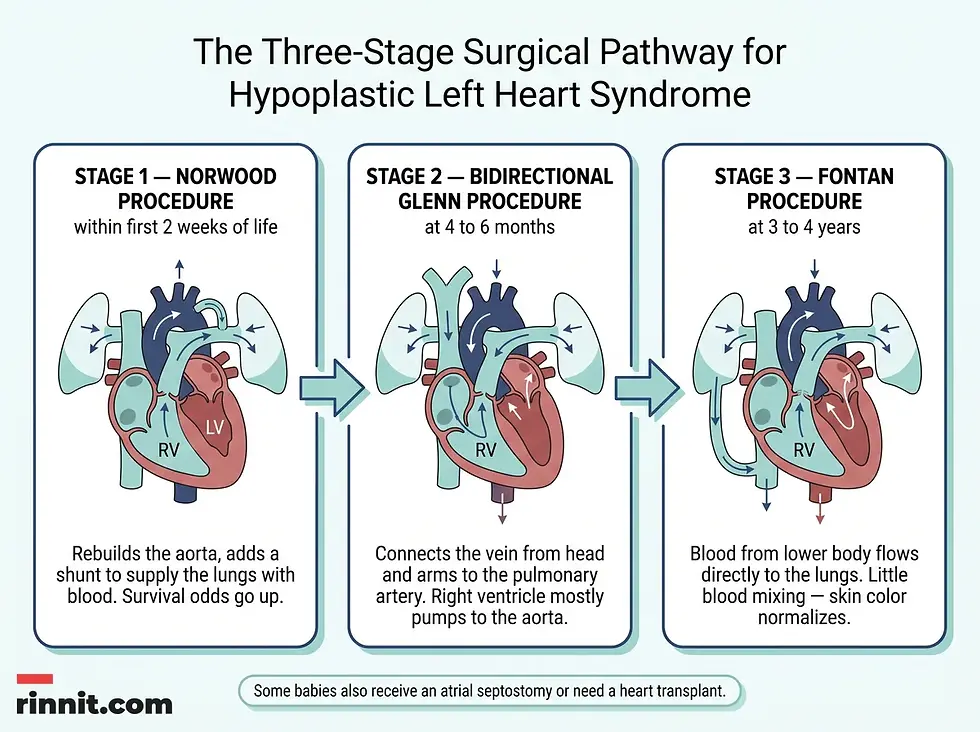
The three-stage surgical pathway. Some babies also receive an atrial septostomy or need a heart transplant.
Norwood procedure details. There are various ways to do this treatment. Surgeons rebuild the aorta and connect it to the heart's lower right chamber, then add a tube called a shunt to provide the lungs with blood. The shunt either connects the body's main artery to the pulmonary arteries (the arteries leading to the lungs), or it goes from the right lower heart chamber to the pulmonary arteries. This lets the right lower heart chamber pump blood to both the lungs and the body [2].
Sometimes a mixed, or hybrid, procedure is done instead. Heart surgeons place a stent in the ductus arteriosus to maintain the opening between the pulmonary artery and the aorta, then place bands around the pulmonary arteries to reduce blood flow to the lungs, and also make an opening between the upper chambers of the heart [2].
After the Norwood procedure, a baby's skin often still appears slightly blue or gray because oxygen-rich and oxygen-poor blood continue to mix within the heart. Once a baby has this treatment, however, the odds of survival can go up [2].
Bidirectional Glenn procedure details. This is usually the second surgery, typically done when a child is between 4 and 6 months of age. It removes the first shunt and connects the superior vena cava to the pulmonary artery, so the lungs receive blood from the vein instead of the shunt. This lessens the work of the right lower heart chamber, letting it pump blood mainly to the aorta, and lets most of the oxygen-poor blood returning from the body flow directly into the lungs. Blood with more oxygen is then pumped to the aorta to supply organs and tissues throughout the body [2].
Fontan procedure details. This surgery is usually done when a child is between 3 and 4 years of age. The surgeon creates a path for blood from the lower legs to flow directly into the pulmonary arteries through the inferior vena cava, and the pulmonary arteries send the blood into the lungs. After this surgery, there is little mixing of oxygen-rich and oxygen-poor blood in the heart, so the skin should no longer look blue or gray [2].
Heart transplant
Many babies with HLHS need a heart transplant. Children who have heart transplants need to take medicines for life so that their bodies do not reject the donor heart [2].
Follow-Up Care for Children
After surgery or a transplant, a baby needs lifelong care with a heart doctor trained in congenital heart disease to watch for complications. The child may need further treatment or other medicines for those complications [2].
Some children may need to take antibiotics before certain dental or other procedures to help prevent infections — ask your child's healthcare professional whether preventive antibiotics are needed. Some children also may need to limit physical activity [2].
Follow-Up Care for Adults
Adults who were born with HLHS need to see a heart doctor trained in congenital heart disease in adults. Recent advances in surgical care have helped children with HLHS grow into adulthood, so it is not yet clear what challenges an adult with the condition might face. Adults need regular, lifelong follow-up care to watch for changes in the condition. Read more in our guide to adult congenital heart disease [2].
Adults with HLHS who are thinking about becoming pregnant should talk with their healthcare professionals about pregnancy risks and birth control options. Having HLHS raises the risk of the following [2]:
Heart and blood vessel problems during pregnancy.
Miscarriage.
A baby being born with a congenital heart defect.
Coping and Support
Living with HLHS or caring for a baby with the condition can be challenging. The following guidance may help [2]:
Seek support. Ask family and friends for help — caregivers need breaks. Ask your child's cardiologist about support groups. Consider a counselor or therapist if you often feel anxious, sad, or too stressed. Teens and adults with HLHS can ask about support groups for people their age with congenital heart disease.
Keep health records. Write down the diagnosis, medicines, surgeries, and other treatments with dates, doctor and surgeon names and phone numbers, and emergency contact numbers. Include copies of surgery reports. This helps new healthcare professionals and supports the move from pediatric to adult cardiology care.
Talk about concerns. Ask the healthcare team which activities are safest for your child. If some are off-limits, encourage your child in other hobbies. Adults with HLHS should ask about activities they can safely do.
Bottom Line
Hypoplastic left heart syndrome is a rare but serious heart defect that demands immediate action. Babies with HLHS are usually very sick within hours of birth, and blue or gray skin, fast breathing, poor feeding, or a weak pulse should always be treated as a medical emergency. Today's treatment — medicines to keep critical blood pathways open, followed by the Norwood, Glenn, and Fontan surgical stages or a heart transplant — has turned what was once a fatal diagnosis into a manageable, though lifelong, condition. Many children now survive into adulthood with structured, lifelong follow-up care.
Your next step: if you are expecting a baby diagnosed with HLHS or caring for a newborn with heart concerns, ask your healthcare team about the nearest hospital with a cardiac surgery center, and keep a written record of every treatment, surgery date, and specialist contact from day one.
Frequently Asked Questions
What is hypoplastic left heart syndrome?
Hypoplastic left heart syndrome (HLHS) is a rare congenital heart defect present at birth in which the left side of the heart does not develop fully. The left ventricle, aorta, and left-side heart valves are too small to pump blood to the body, so the right side of the heart must pump blood to both the lungs and the rest of the body. Treatment may include medicines, staged heart surgeries, or a heart transplant.
What are the symptoms of hypoplastic left heart syndrome in a newborn?
Babies with HLHS are usually very sick soon after birth. Symptoms include blue or gray skin, lips, or fingernails; rapid, difficult breathing; poor feeding; cold hands and feet; a weak pulse; and being more drowsy or less active than typical babies. Without treatment, a baby may go into shock, with cool clammy skin, a weak rapid pulse, abnormal breathing, and dull staring eyes.
Is hypoplastic left heart syndrome an emergency?
Yes. HLHS requires urgent treatment after birth. Get emergency medical help if a baby shows changes in skin or nail color, trouble breathing or fast breathing, a weak or rapid pulse, or cool clammy skin. Babies with HLHS also need medicines to keep the ductus arteriosus open until surgery.
What causes hypoplastic left heart syndrome?
HLHS happens in the womb while a baby's heart develops. The exact cause is not known, but gene changes may play a role. The left side of the heart — the left ventricle, aorta, and aortic and mitral valves — does not grow enough, so the body cannot get enough oxygen-rich blood.
Can hypoplastic left heart syndrome be prevented?
No. There is no way to prevent hypoplastic left heart syndrome. If you were born with a heart condition, the guidance is to talk with a heart doctor and a genetic counselor before getting pregnant.
Can HLHS be detected before birth?
Yes. A routine pregnancy ultrasound during the second trimester usually can tell if a baby has HLHS. After birth, an echocardiogram — which uses sound waves to make pictures of the heart — can confirm the diagnosis by showing the small left ventricle, small heart valves, and small aorta.
What is the first surgery for a baby with hypoplastic left heart syndrome?
The first surgery is usually the Norwood procedure, often done within the first two weeks of life. Surgeons rebuild the aorta and connect it to the heart's lower right chamber, then add a shunt to provide the lungs with blood. After the Norwood procedure, a baby's skin may still appear slightly blue or gray, but the odds of survival go up.
What is the Fontan procedure?
The Fontan procedure is the third stage of HLHS surgery, usually done when a child is between 3 and 4 years of age. The surgeon creates a path for blood from the lower legs (through the inferior vena cava) to flow directly into the pulmonary arteries, which send blood into the lungs. After this surgery there is little mixing of oxygen-rich and oxygen-poor blood, and the skin should no longer look blue or gray.
Do children with hypoplastic left heart syndrome need lifelong care?
Yes. After surgery or a transplant, a child needs lifelong care with a heart doctor trained in congenital heart disease to watch for complications. Some children need preventive antibiotics before certain dental or other procedures, and some may need to limit physical activity. Adults born with HLHS also need regular lifelong follow-up with a specialist trained in adult congenital heart disease.
Can adults with hypoplastic left heart syndrome have children?
Adults with HLHS who are thinking about becoming pregnant should talk with their healthcare professionals about pregnancy risks and birth control options. HLHS raises the risk of heart and blood vessel problems during pregnancy, miscarriage, and a baby being born with a congenital heart defect.
Related Reading
Fetal Echocardiogram: What It Checks, When It's Done and What Results Mean explains the prenatal heart ultrasound used to find this condition before birth.
References
Mayo Clinic Staff. Hypoplastic left heart syndrome - Symptoms and causes. Mayo Clinic. October 6, 2026. https://www.mayoclinic.org/diseases-conditions/hypoplastic-left-heart-syndrome/symptoms-causes/syc-20350599
Mayo Clinic Staff. Hypoplastic left heart syndrome - Diagnosis and treatment. Mayo Clinic. January 21, 2025. https://www.mayoclinic.org/diseases-conditions/hypoplastic-left-heart-syndrome/diagnosis-treatment/drc-20350605
Feinstein JA, Benson DW, Dubin AM, et al. Hypoplastic left heart syndrome: current considerations and expectations. Journal of the American College of Cardiology. 2012;59(1 Suppl):S1-S42. PMID 22192720. https://doi.org/10.1016/j.jacc.2011.09.022
Newburger JW, Sleeper LA, Frommelt PC, et al. Transplantation-free survival and interventions at 3 years in the Single Ventricle Reconstruction trial. Circulation. 2014;129(20):2013-2020. PMID 24705119. https://doi.org/10.1161/CIRCULATIONAHA.113.006191
Hill KD, Rhodes JF, Aiyagari R, et al. Intervention for recoarctation in the Single Ventricle Reconstruction trial: incidence, risk, and outcomes. Circulation. 2013;128(9):954-961. PMID 23864006. https://doi.org/10.1161/CIRCULATIONAHA.112.000488
Medical disclaimer
This article is for informational purposes only and is not a substitute for professional medical advice, diagnosis, or treatment. Always consult a qualified healthcare professional for diagnosis and treatment decisions. The clinical information in this guide reflects source material last reviewed in September 2026.



Comments