ASD Closure: Procedure, Risks and Recovery

Updated: 2 days ago
Written and medically reviewed by Dr. Baraa Alnahhal, MD · Last reviewed: November 2026 · How we review
Quick Answer
ASD closure is a procedure that closes an atrial septal defect, a hole in the wall between the heart's two upper chambers. Large holes make the heart and lungs work harder and, untreated, can cause arrhythmias, heart failure and stroke. The hole is closed with a device through a catheter or with a patch during surgery.
What the research says
Catheter closure had fewer complications than surgery: a review of 33 studies found transcatheter ASD closure had fewer complications than surgery in adults (odds ratio 0.45) and children (odds ratio 0.26), with shorter hospital stays and no difference in deaths (Chambault AL et al., Cardiology in the Young, 2022) [2]
Minimally invasive surgery closed more holes but had more complications: in a review of 6 studies with 1,577 people, minimally invasive surgery closed the defect slightly more often than a device (99.8% vs. 97.3%) but had more complications (16.2% vs. 7.1%) and longer stays (5.6 vs. 1.3 days) (Mylonas KS et al., Pediatric Cardiology, 2020) [3]
Key takeaways
ASD closure seals a hole between the heart's upper chambers.
Large holes can cause heart failure, arrhythmias and stroke.
Closure can be done by catheter or by surgery.
Catheter closure has fewer complications and shorter stays.
Early closure gives a near-normal life expectancy.
What is ASD closure?
Every baby is born with a small opening between the atria that usually closes within weeks or months. When it doesn't, it's an atrial septal defect, a type of congenital heart disease. A heart surgeon or interventional cardiologist performs the closure. Sources: [1]
Why it's done
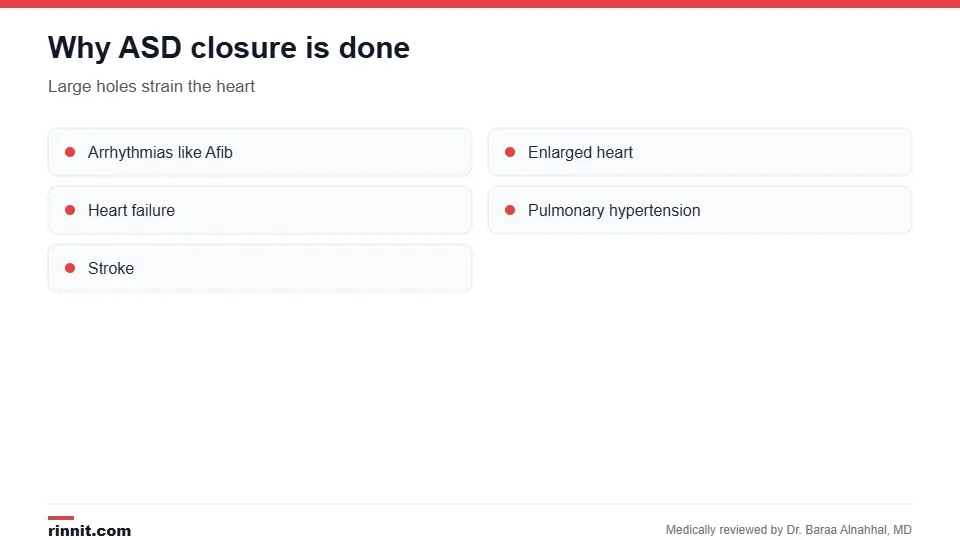
It's often done in young children to prevent heart damage.
Arrhythmias such as atrial fibrillation or flutter.
An enlarged heart.
Heart failure.
Pulmonary hypertension.
Shortness of breath.
Stroke. Sources: [1]
It's often done in young children to prevent future heart damage, or during surgery for another heart defect. Sources: [1]
Types of ASD closure

The choice depends on the hole's size and location and your health.
Approach | How it works | Best for |
Transcatheter | A device is guided through a leg vein to plug the hole | Smaller ASDs without other problems |
Surgical | A patch, plug or stitches close the hole through a chest incision | Larger or complex ASDs |
Robotic | Surgery with robotic tools, at some centers | Selected patients |
Learn more about cardiac closure devices. Sources: [1, 2, 3]
What happens during the procedure
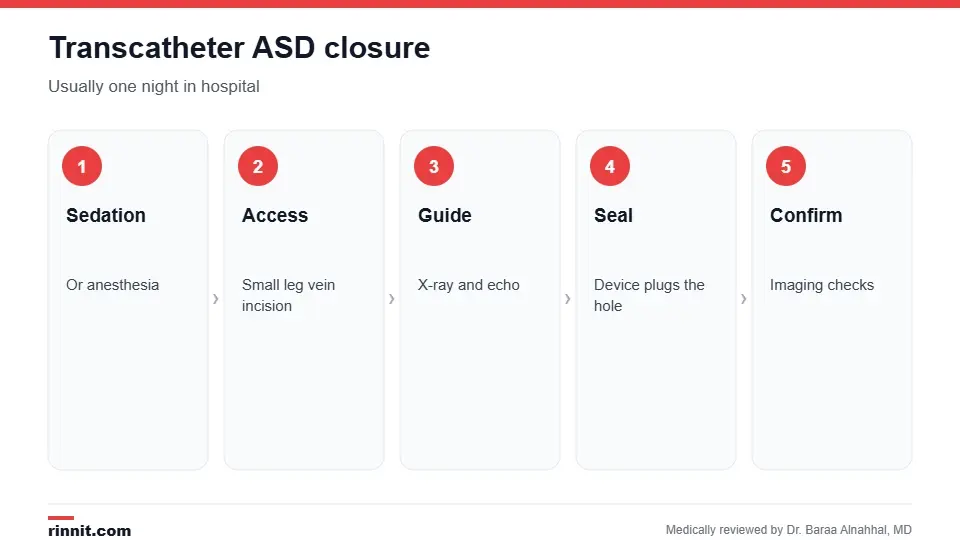
Imaging confirms the hole is closed.
Transcatheter: a catheter carrying the device is guided from a leg vein to the heart using X-ray and an echocardiogram, and the device seals the hole.
Surgery: under general anesthesia with a heart-lung machine, the surgeon opens the chest and closes the hole with a patch, plug or stitches.
Afterward, imaging confirms success, and you stay one or more nights. Sources: [1]
Risks
Allergy to device materials.
Arrhythmia.
Bleeding that may need a transfusion.
Damage to heart tissue or veins.
Infection at the incision or around the device.
Kidney failure.
Stroke or ministroke. Sources: [1, 2, 3]
Recovery
After surgery, limit activity for a few weeks.
After transcatheter closure, normal activity usually resumes within a week.
Take blood-clot prevention medicine for about six months.
Take antibiotics before dental work for at least six months.
Follow-up tests include echocardiograms and EKGs. Sources: [1]
Outlook
Repeat closure is rare. People 25 or younger at closure have about the same life expectancy as peers without an ASD. Older people may have a slightly shorter lifespan, but closing the ASD helps them live longer than leaving it open. Sources: [1]
When to call your provider
Blood, fluid or pus from the incision.
Chest pain.
Confusion or fainting.
Fever.
Shortness of breath.
A fluttering or irregular heartbeat. Sources: [1]
Conclusion
ASD closure seals a hole in the heart and prevents long-term strain on your heart and lungs. Many people can have it done through a catheter with a quick recovery.
Keep learning: read about atrial septal defects and PFO closure.
Frequently asked questions
What is ASD closure?
A procedure that closes a hole between the heart's upper chambers.
Does every ASD need closing?
No. Small holes may not need treatment.
How is it done?
With a catheter device or with surgery.
Is catheter closure safer than surgery?
Studies show fewer complications and shorter stays.
How long is the hospital stay?
Usually one or more nights.
When can I return to normal activity?
Within a week after catheter closure; a few weeks after surgery.
Will I need medicine afterward?
Yes, clot prevention for about six months.
Why take antibiotics before dental work?
To prevent infection around the device.
Can the hole reopen?
Repeat closure is rare.
Will I live a normal life?
Most people do, especially if treated young.
Related Reading
Atrial Septal Defect (ASD): Symptoms, Types, Causes, Diagnosis & Treatment — Complete Guide the condition it treats.
Cardiac Closure Devices: How Doctors Seal a Hole in the Heart Without Open-Heart Surgery closure devices.
PFO Closure: Procedure, Benefits, and Recovery a related heart closure.
Congenital Heart Disease (CHD): Types, Causes, Symptoms, and Survival Outlook congenital heart conditions.
Adult Congenital Heart Disease: What It Is, How It's Diagnosed, and Why Lifelong Follow-Up Matters heart defects in adults.
References
Cleveland Clinic. ASD Closure: Procedure, Risks and Recovery. Cleveland Clinic. Last updated March 8, 2022. https://my.clevelandclinic.org/health/treatments/22461-asd-closure
Chambault AL, Olsen K, Brown LJ, et al. Transcatheter versus surgical closure of atrial septal defects: a systematic review and meta-analysis of clinical outcomes. Cardiology in the Young. 2022;32(1):1-9. PMID 34819196. https://doi.org/10.1017/S1047951121004583
Mylonas KS, Ziogas IA, Evangeliou A, et al. Minimally invasive surgery vs device closure for atrial septal defects: a systematic review and meta-analysis. Pediatric Cardiology. 2020;41(5):853-861. PMID 32162027. https://doi.org/10.1007/s00246-020-02341-y
Medical disclaimer
This article is for general education only and does not replace advice from a qualified healthcare professional. Talk to your doctor about your own diagnosis and treatment, and seek emergency care right away for severe or sudden symptoms.



Comments