Cardiac Closure Devices: How Doctors Seal a Hole in the Heart Without Open-Heart Surgery

Updated: 6 days ago
Written and medically reviewed by Dr. Baraa Alnahhal, MD · Last reviewed: October 31, 2026 · How we review
Quick Answer: What is a cardiac closure device?
A cardiac closure device is a small implant that plugs an opening in the wall between the heart's two upper chambers, treating an atrial septal defect (ASD) or patent foramen ovale (PFO). Most are placed through a leg vein with a catheter and need one night in hospital; fainting or chest pain afterward needs prompt medical care. [1]
What the research says
Closing a PFO lowers the chance of another stroke. A 2026 review of 32 studies with 16,698 adults found that PFO closure cut the risk of a repeat stroke or mini-stroke (TIA) by about half compared with medicines alone (odds ratio 0.52), but raised the chance of a heart rhythm problem called atrial fibrillation (odds ratio 3.45). (Hammad et al., Cardiovascular Revascularization Medicine, 2026)
Catheter repair of an ASD means fewer complications and a shorter stay. Pooling 33 studies, adults who had catheter closure left hospital about 4 days sooner and had roughly half the complications (odds ratio 0.45) of those who had surgery, with no difference in deaths. (Chambault et al., Cardiology in the Young, 2022)
The benefit is real, but the decision is personal. Across 6 randomized trials with 3,750 people, PFO closure lowered stroke by 44% but made atrial fibrillation about 4 times more likely, so the overall "net benefit" was similar to medicines — the authors advise choosing treatment person by person. (Kolokathis et al., Hellenic Journal of Cardiology, 2023)
Key takeaways
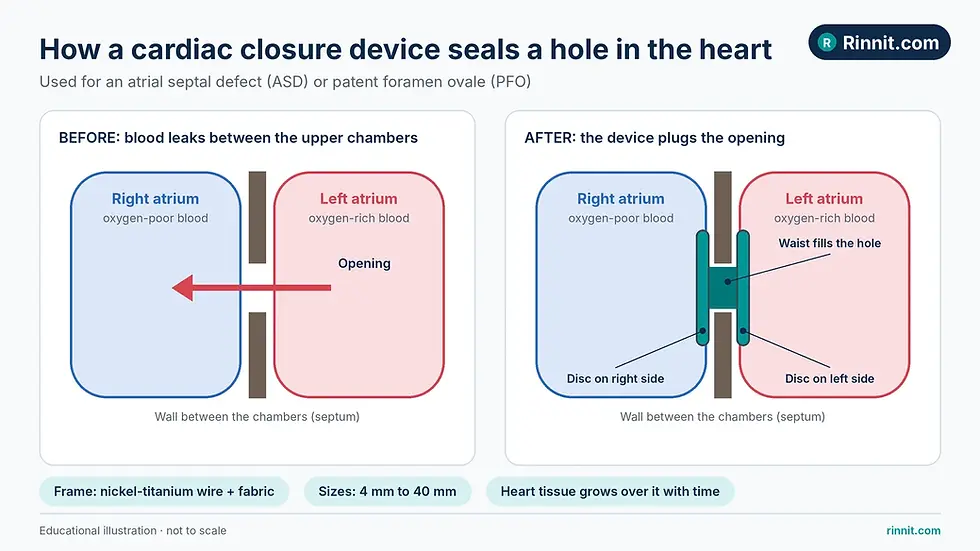
A cardiac closure device is a small, two-disc implant that seals a hole between the heart's upper chambers.
It treats an atrial septal defect (ASD) and a patent foramen ovale (PFO), and is also used to help prevent stroke in people with a PFO.
More than 80% of ASDs are now repaired with a catheter through a leg vein instead of open-heart surgery.
Device placement succeeds in more than 93% of cases in various studies.
Expect one night in hospital, light activity in a day or two, and about two weeks of taking it easy.
For the first six months, you'll take a blood thinner and need antibiotics before dental work and other procedures that can cause bleeding.
Call your doctor right away if you faint or have chest pain after the procedure.
What is a cardiac closure device?
A cardiac closure device is an implant that fills a hole in the interatrial septum — the wall that separates the left and right upper chambers (atria) of your heart. [1]
It's sometimes called an ASD closure device or a septal occluder. Its job is simple: keep the oxygen-rich blood on the left side of your heart from mixing with the oxygen-poor blood on the right side.
Doctors have used these devices for decades. Over time, your own heart tissue grows over the device, and it becomes part of your heart wall. [1]
What is the difference between an ASD and a PFO?
An ASD is a true hole in the heart wall that is present at birth, while a PFO is a flap-like opening that every baby has before birth but that should have sealed shortly after. [1]
Feature | Atrial septal defect (ASD) | Patent foramen ovale (PFO) |
What it is | A hole in the wall between the upper chambers that shouldn't be there | A normal opening used before birth that stayed open ("patent") |
Present since | Birth | Birth — it should close soon after |
Main reason to close it | Symptoms such as shortness of breath, tiredness or palpitations | To help prevent a stroke |
About 6 to 10 of every 10,000 babies are born with an ASD. [1]
Before birth, a baby doesn't use its lungs, so blood takes a shortcut through the foramen ovale. After birth, this opening normally closes. When it doesn't, doctors call it a patent foramen ovale.
Want the full picture of the defect itself? See our atrial septal defect guide.
Why would someone need a cardiac closure device?
Someone needs a cardiac closure device when a hole between the upper heart chambers lets blood mix or flow the wrong way, causing symptoms or raising stroke risk. [1]
Here's why that matters:
The left atrium holds blood that is full of oxygen, ready to go to your body.
The right atrium holds blood that has already delivered its oxygen.
When the two mix, your heart can't send enough oxygen to your body.
Some openings close on their own or are so small they never cause trouble. Closure is usually considered for people who have:
Shortness of breath
Fatigue (feeling tired all the time)
Heart palpitations (a pounding or fluttering heartbeat)
A PFO linked to a higher risk of stroke
People of all ages receive cardiac closure devices.
What are cardiac closure devices made of?
Cardiac closure devices are made of a nitinol (nickel and titanium) wire frame covered with polyester fabric, and some also contain platinum. [1]
Most look like two small round discs joined by a narrow mesh "waist":
One disc sits on the right side of the heart wall.
The other disc sits on the left side.
The waist sits inside the hole and fills it.
Devices range in size from 4 mm to 40 mm, so your care team can match the device to your opening.
Types of closure devices
Device type | What it's designed for |
Septal occluder | Standard ASD closure |
PFO occluder | Closing a patent foramen ovale |
Multi-hole (cribriform) occluder | A septum with more than one hole |
Large-ASD occluder | Bigger atrial septal defects |
Septal closure system | ASD and PFO closure |
Your cardiologist chooses the type and size based on the shape, size and location of your opening.
How is a cardiac closure device placed?
A cardiac closure device is placed either through a thin tube (catheter) passed from a leg vein to the heart, or during open-heart surgery. Today, more than 80% of ASDs are repaired with cardiac catheterization rather than open-heart surgery. [1]
The catheter procedure, step by step
Access. The doctor guides a special catheter into your heart through a vein in your leg.
Measuring. A small balloon passed through the catheter measures the exact size of the opening.
Opening the device. The device is slowly pushed out of the catheter. One disc opens on each side of the hole.
Checking the position. X-ray and ultrasound images confirm the device is sitting in the right spot.
Release. Once it's in place, the doctor releases the device and removes the catheter.

Catheter closure vs. open-heart surgery
Feature | Catheter closure | Open-heart surgery |
How it's done | Through a leg vein | Through the chest |
How well it works | As well as surgery | Effective |
Safety | As safe as surgery | Complications happen more often |
Comfort | Less discomfort | More discomfort |
Hospital stay | Usually one night | Longer |
Recovery | About two weeks of taking it easy | Takes longer |
What are the benefits of a cardiac closure device?
The main benefits of a cardiac closure device are a high success rate, results that match surgery, and — when placed by catheter — less discomfort and a shorter hospital stay. [1] [3]
High success rate: Placement succeeds in more than 93% of cases across various studies.
As good as surgery: Catheter-placed devices work as well and are as safe as devices placed during open-heart surgery.
Easier recovery: Less discomfort and a shorter hospital stay than surgery.
Stroke prevention: Research suggests catheter closure of a PFO is better than medicine alone for preventing a stroke. [2]
What are the risks of a cardiac closure device?
The risks of a cardiac closure device include blood clots, abnormal heart rhythms, device movement, infection of the heart lining and, rarely, device erosion. [1]
Possible complication | What it means |
Aortic insufficiency | Blood leaks backward through the aortic valve |
Clots can form on the device | |
The heartbeat becomes irregular | |
Device moving out of place | The device shifts from its position |
Infection of the heart's inner lining, for example after dental work | |
Small leak around the device | Most leaks stop within the first year |
Harder future access to the left atrium | Can make some later heart procedures more difficult |
Device erosion | Rare — an estimated 0.04% to 0.3% chance |
Overall, the procedure is generally safe. The risk of dying in hospital from this type of surgery is very low, at 0.3% to 0.9%. [1]
How do doctors lower the risk of complications?
Doctors lower the risk of complications by prescribing a blood thinner, choosing the right device and size, and using newer device designs that keep the heart accessible for future procedures. [1]
Preventing clots: You'll usually take a blood-thinning medicine for about six months after the device is placed, most often aspirin, sometimes with clopidogrel (antiplatelet medicines).
Keeping future options open: Newer devices let catheters pass through them, so doctors can still reach the left atrium later — for example, for ablation to treat atrial fibrillation. Older devices don't have this feature.
Preventing erosion: Careful choice of the right device type and size for each person.
How can you protect your heart from infection after a closure device?
You can protect your heart from infection after a closure device by telling every provider about it, keeping your teeth and gums healthy, and taking antibiotics before procedures that can cause bleeding during the first six months. [1]
Your six-month infection-prevention checklist:
✅ Tell all your doctors and dentists you have a cardiac closure device. Carrying a card with this information helps.
✅ Contact your doctor if you have signs of infection, such as a sore throat, body aches or fever.
✅ Brush, floss and look after your gums every day.
✅ See your dentist regularly.
✅ Take antibiotics before any procedure that may cause bleeding — including dental work (even a basic cleaning), invasive tests and most surgeries.
✅ Ask your doctor which antibiotic to take and how much.
What is recovery like after a cardiac closure device?
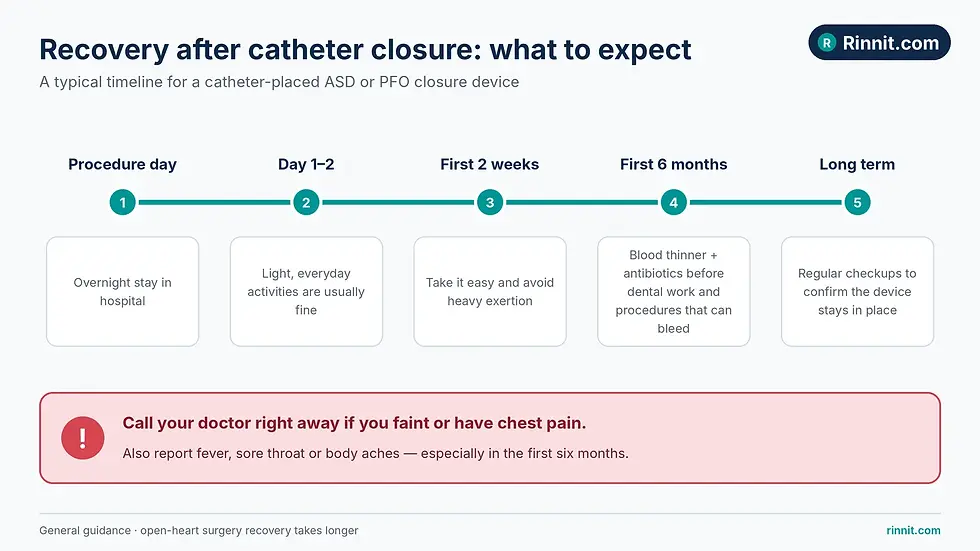
Recovery after a catheter-placed cardiac closure device usually means one night in hospital, light activity after a day or two, and about two weeks of taking it easy. [1]
When | What to expect |
Procedure day | Overnight stay in hospital |
Day 1–2 | Non-strenuous, everyday activities are usually fine |
First 2 weeks | Take it easy and avoid heavy exertion |
First 6 months | Blood thinner, plus antibiotics before dental work and procedures that can cause bleeding |
Long term | Regular checkups to confirm the device stays in place and works well |
Recovery from open-heart surgery takes longer.
Can you have an MRI with a cardiac closure device?
You can often have an MRI scan with a cardiac closure device, but there may be restrictions, such as using a machine with a weaker magnetic field. [1]
MRI safety depends on your specific device. Before any scan, tell the imaging team you have a closure device and ask your cardiologist for its details.
What happens if a cardiac closure device isn't an option?
If a cardiac closure device isn't an option, the opening can be closed with surgery instead. [1]
This surgery can often be done using minimally invasive or robot-assisted methods, which use smaller cuts than traditional open-heart surgery.
When should you call your doctor after a cardiac closure device?
You should call your doctor right away if you faint or have chest pain after getting a cardiac closure device. [1]
Also contact your doctor if you notice signs of infection — fever, sore throat or body aches — especially in the first six months.
Keep every follow-up appointment. These checkups confirm the device is staying in place and working correctly.
Conclusion
A cardiac closure device seals a hole between your heart's upper chambers so oxygen-rich blood goes where it should. For most people, it's placed through a leg vein, works as well as surgery, and allows a quick return to everyday life.
The first six months matter most: take your blood thinner, protect yourself from infection, and keep your checkups. Never ignore fainting or chest pain.
Your next step: Bring this guide to your next cardiology appointment and ask which device type, size and approach fit your heart. For more plain-language heart guides reviewed by a physician, explore our Diseases & Conditions library and read up on congenital heart defects and atrial septal defect basics.
Frequently asked questions
Is a cardiac closure device safe?
Yes. Placing a cardiac closure device is generally safe, and catheter placement is as safe as surgery. Serious problems such as device erosion are rare (0.04%–0.3%). [1]
How long does it take to recover from ASD or PFO closure?
After catheter closure, most people stay one night in hospital, resume light activities in a day or two, and take it easy for about two weeks. Open-heart surgery takes longer. [1]
How big is an ASD closure device?
ASD closure devices range from 4 mm to 40 mm. Doctors measure your opening with a small balloon to choose the right size. [1]
Does the device stay in the heart forever?
Yes. Over time, your own heart tissue grows over the device material, and it becomes part of your heart wall. [1]
Do I need antibiotics before dental work after a closure device?
Yes — for the first six months, take antibiotics before any procedure that may cause bleeding, including routine teeth cleaning. Ask your doctor which antibiotic and dose to use. [1]
Does PFO closure prevent stroke?
Research suggests catheter closure of a PFO is better than medicine alone for preventing a stroke, though it can raise the chance of atrial fibrillation. [1] [2] [4]
Can I have an MRI after getting a closure device?
Often yes, but you may need a machine with a weaker magnetic field. Check the MRI safety of your specific device with your doctor first. [1]
Do I need open-heart surgery to get a closure device?
Usually not. Most closure devices are placed through a thin tube passed from a vein in the leg to the heart, and more than 80% of ASDs are now repaired this way.
Will I need blood thinners after a closure device?
Yes. You will usually take a blood thinner for a period after the procedure, often for the first six months, to lower the risk of clots on the device.
Can I get a closure device if I have a nickel allergy?
Tell your doctor if you have a nickel allergy, because many devices have a nickel and titanium frame. Your care team can decide whether a device is still right for you.
Related Reading
ASD Closure: Procedure, Risks and Recovery explains ASD closure.
References
Cleveland Clinic. Cardiac Closure Devices for ASD & PFO. Cleveland Clinic. Last updated October 26, 2022. https://my.clevelandclinic.org/health/treatments/16838-cardiac-implant-closure-devices-in-adults
Hammad A, Ahmad A, Khraisat O, et al. Patent foramen ovale closure vs medical therapy in secondary prevention of stroke and TIA: A systematic review and meta-analysis. Cardiovasc Revasc Med. 2026;85:1-9. PMID 40683784. https://doi.org/10.1016/j.carrev.2025.06.037
Chambault AL, Olsen K, Brown LJ, et al. Transcatheter versus surgical closure of atrial septal defects: a systematic review and meta-analysis of clinical outcomes. Cardiol Young. 2022;32(1):1-9. PMID 34819196. https://doi.org/10.1017/S1047951121004583
Kolokathis K, Thomopoulos C, Tsioufis K. Net clinical benefit of PFO closure versus medical treatment in patients with cryptogenic stroke: A systematic review and meta-analysis. Hellenic J Cardiol. 2023;70:46-52. PMID 36584788. https://doi.org/10.1016/j.hjc.2022.12.010
Medical disclaimer
This article is for general education only and does not replace advice from your own doctor. If you have a closure device and faint, have chest pain or develop signs of infection, contact your healthcare provider or emergency services right away.



Comments