Minimally Invasive Heart Surgery: Types, Benefits, Risks, and Recovery

Updated: 6 days ago
Written and medically reviewed by Dr. Baraa Alnahhal, MD · Last reviewed: October 2026 · How we review
Quick Answer: What is minimally invasive heart surgery?
Minimally invasive heart surgery is heart surgery done through one or more small chest incisions instead of the single long incision used in open-heart surgery. Surgeons use a thin camera tube with long tools, or robotic arms, to repair or replace valves, close holes and bypass arteries, usually with less pain, less scarring and a faster recovery. [1]
What the research says
Shorter hospital stays after mitral valve surgery. A review of 119 studies with 38,106 patients found that people who had minimally invasive mitral valve surgery left hospital about 2.2 days sooner in randomized trials, with no significant difference in short-term complications or death. (Eqbal et al., Journal of Cardiac Surgery, 2022) [3]
Lower 30-day death rates and shorter stays for aortic valve replacement. Across 75 comparative studies, minimally invasive aortic valve replacement was linked to lower 30-day mortality (odds ratio 0.65) and shorter hospital and intensive care stays than full sternotomy, although the operations took longer. (Servito et al., Innovations, 2025) [2]
Durable results for complex mitral valve repair. In 18 studies of 1,905 patients followed for an average of 51.6 months, the rate of leak recurrence or reoperation was 1.7% after minimally invasive repair and 1.3% after sternotomy, a difference that was not statistically significant. (Moscarelli et al., Annals of Thoracic Surgery, 2020) [4]
Key takeaways
Minimally invasive heart surgery reaches the heart through small chest incisions rather than one long cut. [1]
The two main types are thoracoscopic surgery and robotically assisted surgery. [1]
It can treat valve disease, holes in the heart, blocked coronary arteries, atrial fibrillation and some heart tumors. [1]
The operation usually takes about 2 to 6 hours, and most people return to usual activities within 2 to 4 weeks. [1]
Bleeding, infection, irregular heartbeats and stroke are still possible, and the surgeon may rarely need to switch to open surgery. [1]
What is minimally invasive heart surgery?
Minimally invasive heart surgery is an operation on the heart performed through one or more small incisions in the chest. Open-heart surgery, by contrast, uses one long incision down the chest. [1]
Smaller incisions mean less tissue is disturbed. For many people, that translates into less pain, less visible scarring and a quicker return to daily life. [1]
It is not a single operation. It is an approach that surgeons can use for several different heart procedures, from valve repair to coronary artery bypass. [1]
What are the types of minimally invasive heart surgery?
Minimally invasive heart surgery comes in two main types: thoracoscopic surgery and robotically assisted surgery. [1]
Type | How it works | What the surgeon uses |
Thoracoscopic surgery | The surgeon works through small incisions while watching a video screen | A thoracoscope (a thin tube with a tiny camera) and long, thin surgical tools |
Robotically assisted surgery | The surgeon sits at a console and controls robotic arms that hold the instruments | Robotic arms with surgical tools and a camera, guided by the surgeon's hand movements |
In both types, the surgeon is in full control. The robot does not operate on its own; it translates the surgeon's movements into precise motions inside the chest. [1] Read more in our guide to robotically assisted heart surgery.
Which conditions can minimally invasive heart surgery treat?
Minimally invasive heart surgery can treat several structural and rhythm problems of the heart, including valve disease, holes in the heart and blocked coronary arteries. [1]
Procedure | What it treats | Learn more |
Heart valve repair or replacement | A valve that leaks or is too narrow | |
Atrial septal defect (ASD) closure | A hole in the wall between the upper heart chambers | |
Patent foramen ovale (PFO) closure | A small flap-like opening between the upper chambers that did not close after birth | |
Coronary artery bypass | Blocked arteries that supply the heart muscle | |
Maze procedure | Atrial fibrillation (an irregular heartbeat) | |
Cardiac tumor removal | Certain tumors growing in the heart | |
Ventricular assist device (VAD) placement | Severe heart failure needing a pump to support the heart |
Not everyone with these conditions is a candidate. Your heart team decides which approach is safest for you. [1]
How is minimally invasive heart surgery different from open-heart surgery?
Minimally invasive heart surgery differs from open-heart surgery mainly in the size and number of incisions: several small cuts instead of one long one. [1]

Feature | Minimally invasive heart surgery | Open-heart surgery |
Incision | One or more small chest incisions | One long chest incision |
Scarring | Less visible | More visible |
Pain after surgery | Usually less | Usually more |
Blood loss | Usually less | Usually more |
Hospital stay | Usually shorter | Usually longer |
Risk of bleeding and infection | Lower | Higher |
Sources: [1]. For a full explanation of the traditional approach, see our guide to open-heart surgery.
How do you prepare for minimally invasive heart surgery?
Preparing for minimally invasive heart surgery usually involves adjusting some medications and following your surgical team's instructions in the days before the operation. [1]
Medications: You may need to stop certain medicines for a short time before surgery. Never stop a medicine on your own; ask your care team which ones and when. [1]
Anesthesia: You receive general anesthesia, so you are fully asleep and feel no pain during the operation. [1]
Skin preparation: A small area of hair may be shaved where the incisions will be made. [1]
What happens during minimally invasive heart surgery?
Minimally invasive heart surgery usually takes about 2 to 6 hours and follows five main stages. [1]

Preparation. You are put under general anesthesia. A heart-lung machine keeps blood flowing through your body while the surgeon works on the heart. [1]
Small incisions. The surgeon makes one or more small incisions in the chest. [1]
Inserting the tools. A thin camera tube and long tools, or robotic arms, are passed through the incisions. [1]
The repair. The surgeon repairs or replaces the target structure, such as a valve, or closes a defect. [1]
Closing. The incisions are closed with stitches. [1]
What are the benefits of minimally invasive heart surgery?
The main benefits of minimally invasive heart surgery are a faster recovery, less pain and smaller scars compared with open-heart surgery. [1]
Faster recovery
Less blood loss
Less visible scarring
Less pain
Shorter hospital stay
Lower risk of bleeding and infection
Research supports several of these benefits. In large reviews, minimally invasive valve surgery was linked to shorter hospital stays, and for aortic valve replacement, to lower 30-day mortality. [2][3]
What are the risks of minimally invasive heart surgery?
Minimally invasive heart surgery carries the same main risks as other heart operations — bleeding, infection, irregular heartbeats and stroke — although complication rates are generally lower than with open procedures. [1]
Risk | What it means |
Bleeding | Blood loss during or after the operation |
Infection | Infection at the incision sites or inside the chest |
Irregular heartbeat (arrhythmia) | The heart beats too fast, too slow or unevenly — learn more about heart arrhythmia |
Stroke | Interrupted blood flow to the brain — see our stroke guide |
Conversion to open surgery | Rarely, the surgeon switches to open surgery mid-operation if the minimally invasive approach becomes unsafe |
Sources: [1]. Longer operating times are another trade-off: studies show the heart-lung machine is often needed for longer with minimally invasive valve surgery. [2][4]
What is recovery like after minimally invasive heart surgery?
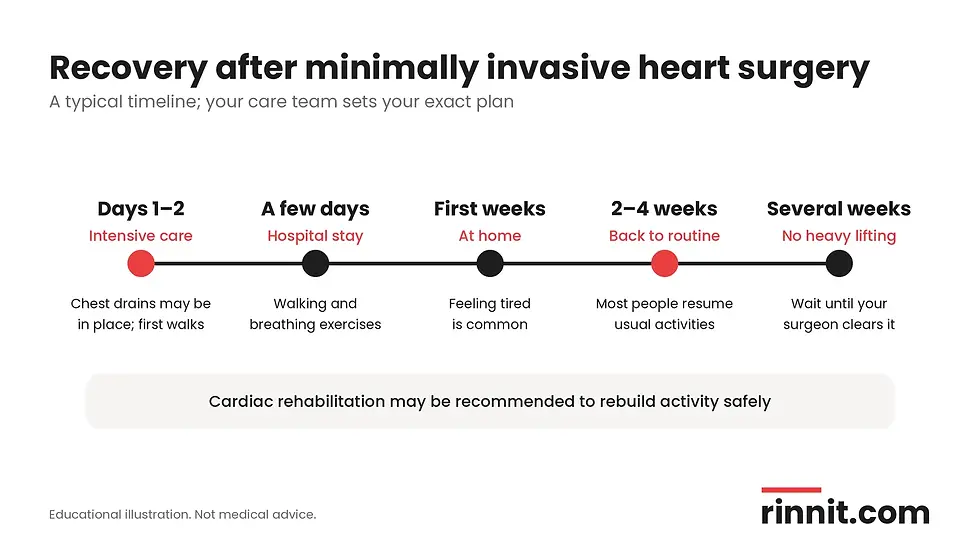
Recovery after minimally invasive heart surgery usually starts with 1 to 2 days in intensive care, and most people return to their usual activities within 2 to 4 weeks. [1]
Time after surgery | What to expect |
Days 1–2 | Intensive care unit; chest tubes may drain fluid; you start walking and breathing exercises within a day or two |
A few days | Hospital stay, depending on your condition |
First few weeks | Feeling tired is common |
2–4 weeks | Most people return to usual activities |
Several weeks | Avoid heavy lifting until your surgeon says it is safe |
Sources: [1]
Your care team may recommend cardiac rehabilitation, a supervised program that helps you rebuild activity safely and build heart-healthy habits. [1]
When should you call your doctor after minimally invasive heart surgery?
Call your doctor after minimally invasive heart surgery if you notice signs of infection, fluid build-up or heart rhythm problems. [1]
Drainage, pus, or a lot of swelling or redness at an incision
Fever or chills
Heart palpitations (a racing, pounding or fluttering heartbeat) — see heart palpitations
Swelling or fluid build-up in the legs or feet
Weight gain of more than 3 pounds (about 1.4 kg) in one week
If you have chest pain, trouble breathing, sudden weakness on one side, or trouble speaking, call emergency services right away.
Conclusion
Minimally invasive heart surgery lets surgeons repair many heart problems through small incisions instead of one long cut. For the right patient, that can mean less pain, smaller scars, a shorter hospital stay and a faster return to normal life, with results that research shows can match open surgery. [1][2][4]
It is still major heart surgery, with real risks. The best approach depends on your condition and overall health, and only your heart team can make that call.
Next step: Bring this guide to your next appointment and ask your surgeon, "Am I a candidate for a minimally invasive approach, and why or why not?" Then explore our Heart Health: The Complete Plain-Language Guide to keep your heart strong before and after surgery.
FAQ
What is minimally invasive heart surgery?
Minimally invasive heart surgery is heart surgery done through one or more small chest incisions instead of one long incision. Surgeons use a thin camera tube and long tools, or robotic arms, to work on the heart. [1]
Is minimally invasive heart surgery safer than open-heart surgery?
Minimally invasive heart surgery generally has lower complication rates than open-heart surgery, including a lower risk of bleeding and infection. It still carries risks such as irregular heartbeats and stroke. [1]
How long does minimally invasive heart surgery take?
Minimally invasive heart surgery usually takes about 2 to 6 hours. The exact time depends on the procedure being done. [1]
How long is the hospital stay after minimally invasive heart surgery?
The hospital stay after minimally invasive heart surgery is usually a few days, starting with 1 to 2 days in intensive care. The exact length depends on your condition. [1]
How long does it take to recover from minimally invasive heart surgery?
Most people return to their usual activities within 2 to 4 weeks after minimally invasive heart surgery. Feeling tired for a few weeks is common, and heavy lifting should be avoided for several weeks. [1]
Which heart conditions can be treated with minimally invasive surgery?
Minimally invasive heart surgery can treat heart valve disease, atrial septal defects, patent foramen ovale, blocked coronary arteries, atrial fibrillation (with the maze procedure) and some heart tumors. It is also used to place ventricular assist devices. [1]
Can minimally invasive heart surgery turn into open-heart surgery?
Minimally invasive heart surgery can rarely be converted to open surgery during the operation. Surgeons do this only if continuing through small incisions becomes unsafe. [1]
When should I call my doctor after minimally invasive heart surgery?
Call your doctor after minimally invasive heart surgery if you have fever, chills, pus or redness at an incision, palpitations, leg swelling, or weight gain of more than 3 pounds in one week. [1]
What is robotic heart surgery?
Robotic heart surgery is a type of minimally invasive heart surgery. The surgeon sits at a console and controls robotic arms that hold a camera and small tools placed through small chest incisions.
Will I need cardiac rehab after minimally invasive heart surgery?
Many people are referred to cardiac rehabilitation after heart surgery. It is a supervised program of exercise, education and support that helps you recover safely and build strength.
Related Reading
Heart Surgery: Types, What to Expect and Recovery explains the types of heart surgery and recovery.
References
Cleveland Clinic. Minimally Invasive Heart Surgery. Cleveland Clinic. Last updated August 1, 2022. https://my.clevelandclinic.org/health/treatments/17233-minimally-invasive-heart-surgery
Servito M, Ramsay H, Mann S, et al. Surgical Outcomes After Minimally Invasive Versus Full Sternotomy Aortic Valve Replacement: Meta-Analysis of 75 Comparative Studies. Innovations (Phila). 2025;20(3):257-264. PMID 40359073. https://doi.org/10.1177/15569845251335969
Eqbal AJ, Gupta S, Basha A, et al. Minimally invasive mitral valve surgery versus conventional sternotomy mitral valve surgery: A systematic review and meta-analysis of 119 studies. J Card Surg. 2022;37(5):1319-1327. PMID 35170791. https://doi.org/10.1111/jocs.16314
Moscarelli M, Fattouch K, Gaudino M, et al. Minimal Access Versus Sternotomy for Complex Mitral Valve Repair: A Meta-Analysis. Ann Thorac Surg. 2020;109(3):737-744. PMID 31479637. https://doi.org/10.1016/j.athoracsur.2019.07.034
Medical disclaimer
This article is for general education only and does not replace advice from your doctor or heart surgeon. Decisions about heart surgery depend on your individual condition and should be made with your care team. If you think you are having a medical emergency, call your local emergency number immediately.



Comments