Triple Bypass Surgery: Who Needs It, What Happens, Risks, and Recovery

Updated: 5 days ago
Written and medically reviewed by Dr. Baraa Alnahhal, MD · Last reviewed: October 2026 · How we review
Quick Answer: What is triple bypass surgery?
Triple bypass surgery is an operation that reroutes blood around three blocked areas in the coronary arteries using blood vessels taken from the chest, arm or leg. It treats coronary artery disease with multiple blockages when angioplasty is unsuitable or has failed. The operation takes three to six hours, and home recovery usually takes about six weeks. [1]
What the research says
Bypass surgery lowered long-term death rates compared with stenting in multivessel disease. A pooled analysis of 11 randomized trials with 11,518 patients found 5-year death rates of 9.2% after bypass surgery versus 11.2% after stenting. In people with blockages in several arteries the gap was 8.9% versus 11.5%, and it was widest in people with diabetes (10.0% versus 15.5%). (Head et al., Lancet, 2018) [2]
Joining cardiac rehab after bypass surgery was linked to a 38% lower risk of death. A meta-analysis of 31 studies covering 228,337 patients found that people who took part in cardiac rehabilitation after bypass surgery had lower total mortality than those who did not (hazard ratio 0.62). (Salzwedel et al., Eur J Prev Cardiol, 2020) [3]
Exercise-based rehab cut hospital readmissions by about a quarter. Across 25 randomized trials with 4,106 people recovering from bypass surgery or stenting, exercise-based cardiac rehab lowered all-cause hospital admissions by 26% (relative risk 0.74), halved heart attacks (relative risk 0.50) and improved quality of life, with no change in death rates. (Shi et al., Int J Surg, 2025) [4]
Key takeaways
Triple bypass surgery creates three new routes for blood to reach the heart muscle, one around each blocked section. [1]
It is usually open-heart surgery; smaller-incision and robot-assisted options suit only a few carefully selected people. [1]
Most people spend one night in intensive care, then three to five days in a regular hospital room. [1]
Plan for about six weeks of home recovery with no driving and no lifting over 10 pounds. [1]
More than 75% of people are alive 10 years after coronary bypass surgery. [1]
Triple bypass surgery at a glance
Question | Short answer |
What it treats | Coronary artery disease with blockages in three areas [1] |
Other names | Coronary artery bypass graft (CABG), triple heart bypass [1] |
Graft sources | A blood vessel from the leg, arm or chest [1] |
Operation time | 3 to 6 hours [1] |
Hospital stay | 1 night in intensive care + 3 to 5 days in a regular room [1] |
Home recovery | About 6 weeks or more [1] |
Serious complications | Avoided by more than 95% of people [1] |
10-year survival | More than 75% [1] |
What is triple bypass surgery?
Triple bypass surgery is an operation that reroutes blood around three blocked areas in your coronary arteries, the vessels that supply blood to your heart muscle. [1]
A surgeon takes a healthy blood vessel from another part of your body and attaches it to your heart. Blood then flows through this open vessel instead of trying to push through the blocked one. [1]
You may hear doctors call it a coronary artery bypass graft, or CABG. "Triple" simply means three blocked areas are bypassed. It is usually performed as open-heart surgery. [1]
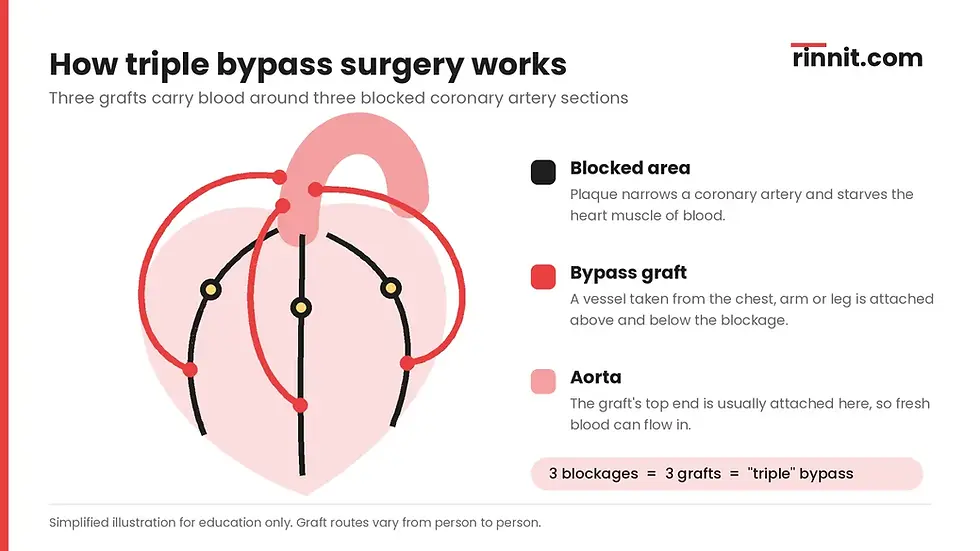
Each graft carries blood from the aorta to a point just past one blockage. Three blockages means three grafts.
Who needs triple bypass surgery?
People with coronary artery disease who have plaque buildup in three parts of their heart arteries are the main candidates for triple bypass surgery. [1]
Plaque is a buildup of fats and cholesterol. It narrows the arteries that feed the heart muscle and can cause chest pain, shortness of breath and heart attacks. [1]
Doctors usually recommend triple bypass surgery when: [1]
A blockage of 50% or more is found in the left main coronary artery.
A blockage of 70% or more is found in the branch coronary arteries.
A less invasive procedure, angioplasty, did not work, or was not advised because the blockages are too severe or complex.
If you are weighing surgery against stents, our guide to coronary revascularization: PCI vs. bypass surgery walks through both options.
How common is triple bypass surgery?
Coronary artery bypass grafting is one of the most common major operations performed worldwide, and triple bypass is one type of it. [1]
Can triple bypass surgery be minimally invasive?
Triple bypass surgery can be minimally invasive, but only for a small number of highly selected people. [1]
Some people qualify for an operation through a single 3-inch cut between the ribs. Others can have a robotically assisted operation through a few 2-inch cuts. These approaches usually do not use a heart-lung machine, so the heart keeps beating during surgery. Your surgeon will advise which method fits your case. [1]
Feature | Open-heart triple bypass | Minimally invasive triple bypass |
Incision | About 6 inches, down the middle of the chest [1] | One 3-inch cut between the ribs, or a few 2-inch cuts for robotic surgery [1] |
Breastbone | Split down the middle, then wired back together [1] | Reached through the gap between the ribs [1] |
Who it suits | Most people needing a triple bypass [1] | Only highly selected people [1] |
What happens before triple bypass surgery?
Before triple bypass surgery, your healthcare provider orders a set of tests to map your blockages and check your overall health. [1] These may include:
A coronary angiogram
A chest X-ray or chest CT scan
Blood tests
An echocardiogram
An electrocardiogram (EKG)
An ultrasound of the carotid arteries in your neck
Timing | What to expect |
Several days before | You stop certain medicines, as instructed by your care team [1] |
Night before | No food or drink after midnight [1] |
Morning of surgery | You change into a hospital gown and leave belongings with a family member [1] |
Just before surgery | An IV line delivers medicine to put you to sleep, and a breathing tube is placed [1] |
What happens during triple bypass surgery?
During open-heart triple bypass surgery, you are fully asleep under general anesthesia while the surgeon performs four main steps: [1]
Opening the chest. A vertical cut of about 6 inches is made down the middle of your chest.
Reaching the heart. The breastbone is split down the middle (a sternotomy).
Taking the graft vessels. A blood vessel is removed from your leg, arm or chest.
Attaching the grafts. One end of each vessel is sewn to the aorta, the body's main artery, and the other end to the coronary artery just below the blockage. If an artery from under the collarbone is used, its upper end may stay connected and only the lower end is attached to the heart. This is repeated for each blocked area.
How long does triple bypass surgery take?
Triple bypass surgery takes three to six hours. [1]
What happens after triple bypass surgery?
After triple bypass surgery, you wake up in intensive care with a breathing tube, heart monitors and possibly drainage tubes. The breathing tube usually stays in for up to 12 hours. [1]
Monitoring: Machines track your heart rate and blood pressure around the clock. [1]
Clot prevention: You receive IV medicine to help prevent blood clots. [1]
Long-term medicines: Most people take aspirin for life, and some also take a second antiplatelet medicine for about six months. [1]
Moving again: You will be walking around your room and the hallways before long. [1]
Cardiac rehab: Your surgeon may recommend cardiac rehabilitation to strengthen your heart as you recover. [1]
What are the benefits of triple bypass surgery?
The main benefit of triple bypass surgery is that new blood routes protect the heart muscle from damage. [1] This can:
Ease chest pain
Reduce shortness of breath
Improve quality of life
Offer a better chance of survival than medicines alone or angioplasty with stenting in some people [1]
Triple bypass surgery is a strong option for people with multiple blockages that are too complex for angioplasty and stenting to work as well as surgery. [1]
What are the risks of triple bypass surgery?
More than 95% of people who have coronary bypass surgery do not have serious complications. The risk is higher for people with certain other health conditions and for those having emergency surgery. [1]
Possible complication | Learn more |
Kidney failure | |
Stroke | |
Blood clots | |
Failure of the graft vessel | — |
Infection of the breastbone | |
Atrial fibrillation (irregular heartbeat) |
For a planned (elective) triple bypass, the overall chance that the operation is fatal is generally less than 1%. [1]
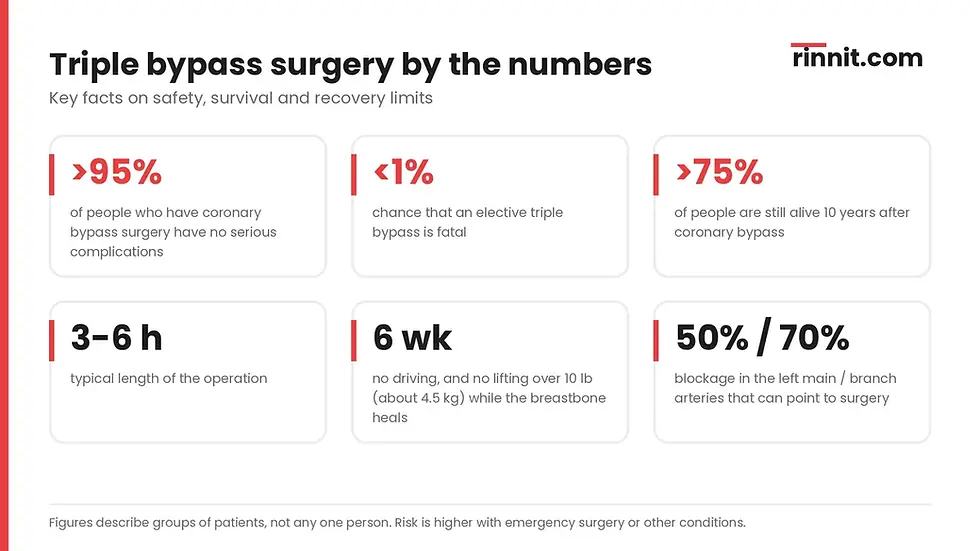
The key numbers on safety, survival and recovery limits after triple bypass surgery.
How long is recovery after triple bypass surgery?
Recovery after triple bypass surgery takes about six weeks or more once you leave the hospital, after a hospital stay of roughly four to six days in total. [1]
Some people feel ready in about four weeks; others need longer. Your care team will encourage you to return early to everyday activities while avoiding anything strenuous. [1]
Time after surgery | What usually happens |
First 12 hours | Breathing tube removed [1] |
Night 1 | Intensive care unit [1] |
Days 1 to 2 | Eating again and walking around [1] |
Days 2 to 6 | Regular hospital room for another 3 to 5 days [1] |
Weeks 1 to 6 | Home recovery: daily activities yes, strenuous activity no, no driving, no lifting over 10 lb [1] |
After 6 weeks | Gradual return to strenuous activity and heavy lifting [1] |

A typical path from pre-surgery tests to full activity. Your own plan may differ.
When can you eat, walk and drive after triple bypass surgery?
Most people eat and walk within one to two days of triple bypass surgery, but should not drive for six weeks. [1]
After open-heart surgery, your breastbone has been split and wired back together, and it needs time to heal. Until then, do not lift anything heavier than 10 pounds (about 4.5 kg). For reference, a gallon of milk weighs about 8 pounds. [1]
What is the life expectancy after triple bypass surgery?
Life expectancy after triple bypass surgery is often many years: more than 75% of people are still alive 10 years after coronary bypass surgery. [1]
You can improve your long-term outlook by taking your prescribed medicines and by: [1]
Eating a healthy diet
Avoiding all tobacco use
Exercising regularly
When should you call a doctor after triple bypass surgery?
Call your healthcare provider after triple bypass surgery if you notice signs of infection or other warning signs once you are home: [1]
Bleeding from your wound
Fever
Wound pain that gets worse
Go to every follow-up appointment, even when you feel well. Call 911 or your local emergency number for chest pain, sudden shortness of breath, fainting, or signs of a stroke such as face drooping, arm weakness or trouble speaking. These visits confirm that you are healing properly and catch complications early. [1]
Conclusion
Triple bypass surgery is a long-established, trusted treatment for coronary artery disease with multiple blockages. It reroutes blood around three blocked areas, protects the heart muscle, and gives most people relief from chest pain and breathlessness. [1]
The recovery is real work: several days in hospital and about six weeks of careful healing at home. But the outlook is encouraging. Serious complications are uncommon, and most people are still alive a decade later, especially when they stay on their medicines, avoid tobacco, eat well and exercise regularly. [1]
Knowing what to expect can make the operation feel far less daunting. Write down your questions and bring them to your heart team; there is no question too small.
Keep learning: read our guides to coronary artery disease, PCI vs. bypass surgery and cardiac rehab — and share this article with anyone in your family preparing for heart surgery.
Further reading from trusted sources: a clinician-level overview of coronary artery bypass grafting and a printable patient sheet, What Is Coronary Artery Bypass Surgery?
FAQ
Is triple bypass surgery the same as open-heart surgery?
Triple bypass surgery is usually performed as open-heart surgery, through a cut down the middle of the chest and a split breastbone. In a small number of carefully selected people, surgeons can use smaller cuts between the ribs or a robot-assisted approach. [1]
How long does triple bypass surgery take?
Triple bypass surgery usually takes three to six hours. You are fully asleep under general anesthesia for the whole operation. [1]
How long do you stay in the hospital after a triple bypass?
Most people stay one night in intensive care after a triple bypass, then three to five more days in a regular hospital room. You will usually be eating and walking within one to two days. [1]
How long does it take to recover from triple bypass surgery?
Recovery from triple bypass surgery usually takes about six weeks or more after leaving the hospital. Some people recover in about four weeks, while others need longer. [1]
When can you drive after triple bypass surgery?
Most people should not drive for six weeks after triple bypass surgery, because the breastbone needs time to heal. During this time, avoid lifting anything heavier than 10 pounds. [1]
Is triple bypass surgery dangerous?
Triple bypass surgery is a major operation, but more than 95% of people who have coronary bypass surgery do not have serious complications. The chance of death from a planned triple bypass is generally less than 1%, though risk is higher in emergencies or with other health conditions. [1]
How long can you live after a triple bypass?
Many people live for many years after triple bypass surgery, and more than 75% of people are still alive 10 years after coronary bypass. Taking prescribed medicines, avoiding tobacco, eating well and exercising improve the long-term outlook. [1]
What are the warning signs after triple bypass surgery?
Warning signs after triple bypass surgery include bleeding from the wound, fever, wound pain that gets worse, and a fast heart rate. Contact your healthcare provider promptly if any of these appear. [1]
What is the difference between a triple bypass and a stent?
A stent opens a narrowed artery from the inside using a thin catheter, while a triple bypass is surgery that creates new routes for blood around three blockages. Bypass is often preferred when several arteries are blocked or stents are not a good fit.
What is cardiac rehab after triple bypass surgery?
Cardiac rehab is a supervised program of exercise, education and support that helps you recover and lowers the risk of future heart problems. Ask your care team for a referral.
Related Reading
Coronary Artery Bypass Graft (CABG) Surgery: Procedure and Recovery explains heart bypass surgery and recovery.
References
Cleveland Clinic. What Is a Triple Heart Bypass? Cleveland Clinic. Last updated January 10, 2023. https://my.clevelandclinic.org/health/treatments/24591-triple-bypass-surgery
Head SJ, Milojevic M, Daemen J, et al. Mortality after coronary artery bypass grafting versus percutaneous coronary intervention with stenting for coronary artery disease: a pooled analysis of individual patient data. Lancet. 2018;391(10124):939-948. PMID 29478841. https://doi.org/10.1016/S0140-6736(18)30423-9
Salzwedel A, Jensen K, Rauch B, et al. Effectiveness of comprehensive cardiac rehabilitation in coronary artery disease patients treated according to contemporary evidence based medicine: Update of the Cardiac Rehabilitation Outcome Study (CROS-II). Eur J Prev Cardiol. 2020;27(16):1756-1774. PMID 32089005. https://doi.org/10.1177/2047487320905719
Shi Y, Xu H, Dong J. Exercise-based cardiac rehabilitation for patients undergoing coronary artery operation: a systematic review and meta-analysis based on current randomized controlled trials. Int J Surg. 2025;111(3):2708-2721. PMID 39903572. https://doi.org/10.1097/JS9.0000000000002268
Medical disclaimer
This article is for general educational purposes only and does not replace professional medical advice, diagnosis or treatment. Always speak with your doctor or heart surgeon about your own situation, and call your local emergency number if you think you are having a medical emergency.



Comments