What Is Atrial Fibrillation (AFib)? Symptoms, Causes, and Treatment

Updated: 1 day ago
Medically reviewed by Dr. Baraa Alnahhal, MD · Last reviewed: October 2026
Quick Answer: What is atrial fibrillation and is it serious?
Atrial fibrillation (AFib) is an irregular heart rhythm in which chaotic electrical signals in the heart's upper chambers cause a fast, irregular heartbeat. [1] It is serious even without symptoms because it raises the risk of blood clots that can cause a stroke. [1] It is diagnosed with an EKG and treated with medications, ablation and lifestyle changes. [1]
What the research says
According to PubMed:
AFib at a younger age carries bigger relative risks. In a Danish nationwide cohort of 216,579 people with AFib and 866,316 matched controls followed for an average of 7.9 years, people diagnosed at 50 or younger had hazard ratios of 2.18 for ischaemic stroke, 8.64 for heart failure, and 2.74 for death compared with controls, and lost an expected 9.2 years of life; the estimates decreased with older age (Paludan-Müller et al., Eur Heart J, 2024) [2].
A heart implant can replace blood thinners after ablation for some people. In a randomized trial of 1,600 people with AFib and elevated stroke risk who had catheter ablation, left atrial appendage closure caused less major or clinically relevant bleeding than oral anticoagulation at 36 months (8.5% versus 18.1%) and was noninferior for death, stroke, or systemic embolism (5.3% versus 5.8%) (Wazni et al., N Engl J Med, 2025) [5].
Serious illness can trigger AFib. Among 27,851 people hospitalized with COVID-19 and no history of AFib, 5.4% (1,517 people) developed new-onset AFib; they died far more often (45.2% versus 11.9%), but after adjustment for other illness factors the link to death was no longer statistically significant (Rosenblatt et al., Circ Arrhythm Electrophysiol, 2022) [3].
Cutting back on alcohol reduced AFib recurrences in regular drinkers. In a randomized trial of 140 adults with AFib who drank 10 or more standard drinks a week, AFib returned in 53% of those who abstained versus 73% of those who kept drinking (hazard ratio 0.55, 95% CI 0.36–0.84), and the share of time spent in AFib over 6 months was lower in the abstinence group (Voskoboinik et al., N Engl J Med, 2020) [10].
For AFib with weakened heart pumping, catheter ablation outperformed medicines. A meta-analysis of 7 randomized trials (1,163 patients with AFib and a left ventricular ejection fraction of 45% or less) found ablation linked to lower all-cause mortality (risk ratio 0.52, 95% CI 0.37–0.72), a 4.8-point greater improvement in ejection fraction, and fewer heart-failure hospitalizations than medical therapy (Cui et al., Arq Bras Cardiol, 2024) [11].
Study details are from PubMed abstracts.
Key Takeaways
AFib is an irregular rhythm in the heart's upper chambers caused by chaotic electrical signals. [1]
Symptoms include palpitations, extreme fatigue, dizziness, fainting, shortness of breath, and chest pain. [6]
AFib raises the risk of blood clots, stroke, and heart failure — even without noticeable symptoms. [1]
Diagnosis is confirmed with an EKG, supported by an echocardiogram, blood tests, and heart monitors. [1]
Treatment combines lifestyle changes, blood thinners, rate and rhythm medications, and procedures like ablation. [1]
There is no cure, [6] but consistent management lowers stroke risk and helps you live a long, active life.
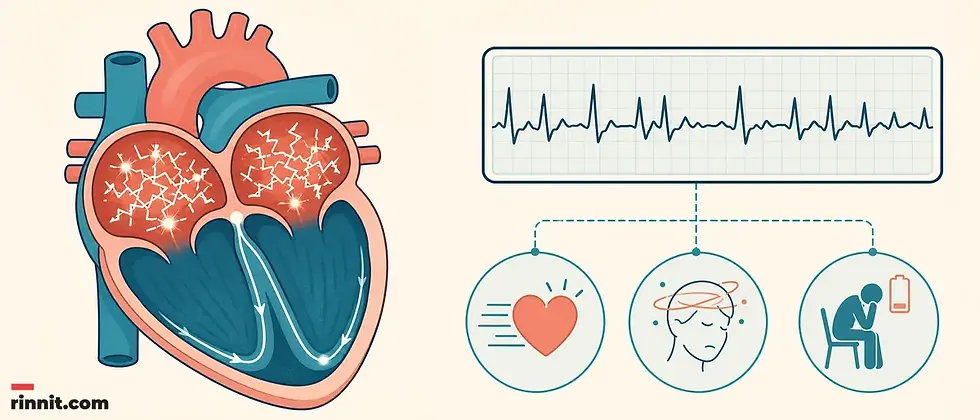
What Is Atrial Fibrillation?
Atrial fibrillation (AFib) is an irregular heart rhythm that begins in the upper chambers of your heart, called the atria. [1] With AFib, your heart's electrical system doesn't work as it should. Instead of sending signals in a steady pattern, it sends many different signals at the same time. [6]
This produces a fast, chaotic rhythm in the upper chambers. The atria can't do a good job of contracting or pumping blood into the lower chambers (ventricles). The ventricles respond to the atria, so they also contract irregularly — causing a fast, irregular heartbeat. [6] The heartbeat you feel is actually the ventricles' contractions. [6]
A helpful way to picture it: imagine several conductors directing an orchestra instead of one. The musicians wouldn't know who to follow, and the music would lose its rhythm. That is what happens to your heartbeat with AFib. [6]
Why Is AFib Considered Serious?
Whether or not you feel symptoms, being in AFib is serious. An out-of-rhythm heart raises your risk of dangerous blood clots forming inside the heart and traveling to vital organs. If a clot reaches the brain, it can cause a stroke. AFib can also lead to heart failure over time. [1]
That's why it's important to learn the symptoms and talk with your healthcare provider about your personal risk factors. AFib is one of the most common arrhythmias in the world. [1] [4] An estimated 50 million people worldwide had AFib in 2020, and estimates predict 12 million people in the U.S. will have AFib by 2030. [1]
What Are the Symptoms of AFib?
AFib symptoms come from the heart beating fast and irregularly, which affects how well blood moves through your body. The most common experiences include a fluttering or racing feeling in the chest, often described as butterflies or a fish flopping inside.
Symptom | What it feels like |
Heart palpitations | Butterflies or a fish flopping in your chest; heart racing or pounding |
Extreme fatigue | Unusual tiredness that doesn't match your activity level |
Dizziness or lightheadedness | Feeling unsteady or like the room is spinning |
Fainting (syncope) | Briefly losing consciousness |
Shortness of breath (dyspnea) | Trouble catching your breath, even at rest |
Chest pain (angina) | Pain, pressure, or tightness in the chest |

When should I go to the emergency room?
Call 911 or your local emergency number immediately if you have chest pain, severe shortness of breath, or if you faint or feel like you might faint. [6] These signs can point to a heart attack or stroke and require urgent care.
What Causes Atrial Fibrillation?
AFib starts with changes to the heart's tissue and electrical system. [1] Several conditions can cause those changes, and they are summarized below.
Cause category | Examples |
Other cardiovascular disease | Coronary artery disease, heart valve disease, heart failure |
Other medical conditions | High blood pressure, overweight, obesity, hyperthyroidism, chronic kidney disease, obstructive sleep apnea |
Genetic variants | Gene changes associated with AFib; may explain some cases that begin at a younger age |
Heart surgery | AFib can begin after heart surgery done for another reason, and sometimes during recovery from non-cardiac surgery |
What increases your risk of AFib?
Having any of the conditions above raises your risk. Beyond those, several lifestyle and demographic factors also play a role.
Risk factor | How it affects risk |
Increasing age | Risk rises as you get older, especially after age 65 |
Excessive alcohol use | Drinking beyond recommended limits, including binge drinking, raises risk |
Critical illness | Serious illnesses requiring hospitalization, such as sepsis or severe COVID-19, raise risk |
Lack of physical activity | Not getting enough daily movement increases the likelihood of AFib |
Extreme exercise training | At least three hours a day of high-intensity endurance training over many years raises risk |
How Is AFib Diagnosed?
An electrocardiogram (ECG or EKG) is the test that diagnoses atrial fibrillation. [1] It creates a graph of the electrical signals traveling through your heart, and the results can show AFib or other types of arrhythmias. [6] An irregular, chaotic waveform on the EKG strip is the signature of AFib.
Your provider will also build a fuller picture of your heart health:
Diagnostic step | What it does |
Physical exam and medical history | Establishes symptoms, risk factors, and overall heart health |
Blood tests | Check for other conditions, including those that could affect your treatment plan |
Echocardiogram (echo) | Evaluates the heart's structure and function with ultrasound |
Holter monitor | A wearable device that records your heart's electrical activity during daily life |
Cardiac event monitor | A longer-term wearable that captures electrical activity around your daily activities |
What Are the Stages of AFib?
AFib is a progressive condition. It develops in stages and can get worse over time. [1] Providers use an updated four-stage framework to diagnose and treat it. [6]
Stage | What it means |
Stage 1: At risk for AFib | You have risk factors such as high blood pressure, obesity, diabetes, sleep apnea, excessive alcohol use, poor cardiovascular endurance, or age over 65 |
Stage 2: Pre-AFib | Your heart's electrical activity or structure is already changing, further raising risk |
Stage 3: AFib | An ECG/EKG confirms atrial fibrillation; this stage has four substages |
Stage 4: Permanent AFib | You and your provider decide together to stop trying to control the rhythm, and AFib remains constant |
In Stage 2, providers look for signs such as atrial tachycardia, atrial flutter, an enlarged left or right atrium, or frequent ectopic heartbeats. [8] You're also at Stage 2 if you have conditions linked with high AFib risk, including coronary artery disease, heart failure, heart valve disease, thyroid disease, hypertrophic cardiomyopathy, or neuromuscular disorders. [8]
What are the AFib substages?
Once an ECG confirms AFib, providers divide Stage 3 into four substages. [8]
Substage | Description |
Paroxysmal AFib | Episodes come and go; each lasts less than one week and usually stops on its own; stroke risk remains higher than average |
Persistent AFib | Episodes are continuous, each lasting more than one week; treatment is needed to stop them |
Long-standing persistent AFib | Episodes continue for one year or longer |
Successful AFib ablation | AFib stops after a surgery or catheter-based procedure |
You can move between substages. [8] For example, persistent AFib might return some time after a successful ablation.
How Is AFib Treated?
AFib treatment involves one or more of four approaches: lifestyle changes, medications, ablation therapy, and other procedures. [6] Your provider builds a plan around your stage, symptoms, and stroke risk.
What lifestyle changes help with AFib?
Lifestyle changes matter across all stages of AFib — even before you have any symptoms. Your provider will help you reach and maintain a healthy weight, limit alcohol consumption, avoid tobacco, get the recommended amount of physical activity, and manage conditions that raise your AFib risk, including high blood pressure, obesity, obstructive sleep apnea, and diabetes. [1]
What medications treat AFib?
Medications for AFib serve three distinct purposes: preventing blood clots, controlling heart rate, and restoring a normal rhythm.
Medication purpose | Examples |
Blood thinners (anticoagulants) to lower stroke risk | Apixaban, rivaroxaban, dabigatran, edoxaban (DOACs); warfarin in some cases |
Heart rate control | Carvedilol, digoxin, diltiazem, metoprolol, verapamil |
Heart rhythm control (normal sinus rhythm) | Amiodarone, dofetilide, dronedarone, flecainide, propafenone |
Your provider may prescribe medications to control your heart rate and/or rhythm. These prevent damage to your heart and reduce uncomfortable or anxiety-inducing symptoms. [6] In general, you'll need a blood thinner (anticoagulant) if you're at risk of stroke. [1] Providers typically prescribe oral anticoagulants called DOACs; in some cases, warfarin is prescribed instead. [1]
What is ablation for AFib?
Ablation is an umbrella term for procedures that create scar tissue in your heart. [6] We usually think of scars as harmful, but here the scar tissue helps your heart's electrical system work better — the scars block abnormal signals so your heart can beat in a normal rhythm. [6]
Ablation type | How it works |
Catheter ablation | A minimally invasive procedure; thin tubes are guided through your blood vessels to your heart. Pulmonary vein isolation (PVI) ablation is a common type used for AFib |
Maze procedure (surgical ablation) | The surgeon creates scar tissue in a maze pattern to block abnormal signals; usually performed during heart surgery done for another reason, such as bypass (CABG) or valve surgery |
What other procedures treat AFib?
Procedure | What it does |
Cardioversion | A device (defibrillator) or medicine is used to return your heart rhythm to normal |
Left atrial appendage (LAA) closure | If you can't tolerate blood thinners, a device is implanted to seal off a sac in the heart where blood clots can easily form, lowering stroke risk |

Can Your Heart Go Back to Normal After AFib?
Yes. Sometimes your heart returns to a normal rhythm on its own — this is the case with paroxysmal AFib. [4] [6] If you have persistent or long-standing AFib, you need treatment to end an episode. [6]
But it's important to know there's no cure for AFib. Once you have it, you have it for life. [6] Your provider will help you manage the condition. Treatment can lower your risk of a stroke and help you experience fewer symptoms.
What Is the Life Expectancy With AFib?
A study published in 2024 found that people with AFib had a shorter life expectancy than those without it. The number of years lost varied by age at diagnosis — the younger you are when diagnosed, the more years are lost compared with people your age who don't have AFib. [2]
Age at diagnosis | Average life expectancy |
30 years old | 72 years (about 11.3 years shorter than expected) |
50 years old | 75 years (about 9.2 years shorter than expected) |
70 years old | 82 years (about 5.4 years shorter than expected) |
Remember that statistics tell only part of the story. Working closely with your healthcare team to manage AFib and any other medical conditions gives you the best chance at a long life.
How Do I Take Care of Myself With AFib?
The same habits that lower your risk of AFib help you feel better when you have it. Eating nutritious foods and getting 30 minutes of physical activity five days a week helps your heart. [6] You can break your activity into 10-minute chunks to make it easier. Cutting out tobacco products and alcohol is good for your heart, too. [6]
There's no single schedule for seeing your healthcare provider — it depends on your symptoms, treatment plan, and any follow-ups after procedures. Keep all scheduled appointments, track your medications, and bring a list to every visit (keeping a copy in your wallet is smart for emergencies). Share any new symptoms, such as medication side effects, and always ask your provider before taking over-the-counter medicines like cold and flu remedies or nutritional supplements, since these can affect your heart rate or interact with your prescriptions. [6]
Can I check for AFib at home?
If you think you have AFib symptoms, call your healthcare provider right away. Your provider may ask you to check your pulse — if it feels erratic or weak, that could be a sign you're in AFib. [9] But sometimes you won't notice pulse changes, especially if your AFib isn't advanced. You may just feel tired or out of breath, and you can't always tell whether symptoms come from AFib or something else. That's why calling your provider is essential: you can't diagnose AFib yourself.
Questions to Ask Your Healthcare Provider
Consider bringing these questions to your next visit:
How can I reduce my risk factors?
Can you connect me with a dietitian?
Can you recommend any local health and fitness programs?
Conclusion
Atrial fibrillation is a progressive condition, but it's a highly manageable one. From Stage 1 risk awareness through permanent AFib, modern medicine offers clear tools at every step: lifestyle changes that protect the heart, anticoagulants that cut stroke risk, medications that calm the heart's pace or restore its rhythm, and procedures like ablation that help the heart beat normally again. [1] The single most important action is to take symptoms seriously and get an EKG — because even symptom-free AFib carries stroke risk. [1]
Next step: If you or a loved one experiences a fluttering, racing, or irregular heartbeat, contact your healthcare provider promptly. Want to share these findings with your family or your practice? Turn them into a clear, shareable infographic using the free infographic templates at Rinnit and create health visuals in minutes.
FAQ
What is the main difference between a normal heartbeat and AFib?
A normal heartbeat follows one steady electrical signal through the heart. In AFib, the upper chambers fire many chaotic signals at once, causing a fast, irregular rhythm. [1]
Is atrial fibrillation the same as a heart attack?
No. AFib is an electrical rhythm problem; a heart attack is a blockage in blood flow to the heart muscle. However, they can share symptoms like chest pain, so both need prompt evaluation.
Can AFib go away on its own?
Sometimes — paroxysmal AFib episodes often stop on their own within a week. [4] [6] Persistent and long-standing AFib require treatment to end an episode, and there is no permanent cure for the condition. [6]
Does AFib always cause symptoms?
No. You can have AFib without noticing anything — which is why it remains dangerous even when you feel fine. The stroke risk exists whether or not you feel palpitations. [1]
What are the most common AFib triggers?
Common risk factors include high blood pressure, obesity, diabetes, sleep apnea, excessive alcohol use, older age, and extreme endurance training. [1] Acute triggers can include sepsis and severe infections. [1]
Can lifestyle changes stop AFib from progressing?
Lifestyle changes — healthy weight, limited alcohol, no tobacco, regular activity, and managing blood pressure, sleep apnea, and diabetes — are important across all stages, including before symptoms appear, and help keep AFib from progressing. [1]
Why do I need blood thinners if I don't feel sick?
Blood thinners lower the risk that clots will form in the heart and travel to the brain, causing a stroke. Providers typically prescribe them when your stroke risk is elevated, regardless of symptoms. [1]
What does AFib ablation do?
Ablation creates small, controlled scars in the heart that block the abnormal electrical signals, helping the heart beat in a normal rhythm. [6] It can be done through a catheter or during surgery. [1]
Is it safe to exercise with AFib?
Yes — regular moderate activity (such as 30 minutes five days a week) is recommended and benefits the heart. [6] Only extreme, many-hours-a-day endurance training raises AFib risk. [1] Follow your provider's guidance on intensity.
Will my heart medication change over time?
Likely. The medications you need to manage AFib may change as your condition evolves. [6] Your provider will adjust your plan over time, which is why keeping all follow-up appointments matters.
How common is AFib?
An estimated 50 million people worldwide had AFib in 2020. [1] An estimated 12 million people in the U.S. will have AFib by 2030, [6] and it causes nearly half a million hospitalizations a year in the U.S. [7]
Can I check my own pulse to detect AFib?
Your provider may ask you to check your pulse — an erratic or weak pulse can be a sign of AFib. [9] But many people, especially in early stages, feel no pulse change, so a professional EKG is needed for diagnosis. [1]
References
Joglar JA, Chung MK, Armbruster AL, et al. 2023 ACC/AHA/ACCP/HRS guideline for the diagnosis and management of atrial fibrillation: a report of the American College of Cardiology/American Heart Association Joint Committee on Clinical Practice Guidelines. Circulation. 2024;149(1):e1-e156. PMID 38033089. https://doi.org/10.1161/CIR.0000000000001193
Paludan-Müller C, Vad OB, Stampe NK, et al. Atrial fibrillation: age at diagnosis, incident cardiovascular events, and mortality. Eur Heart J. 2024;45(24):2119-2129. PMID 38592444. https://doi.org/10.1093/eurheartj/ehae216
Rosenblatt AG, Ayers CR, Rao A, et al. New-onset atrial fibrillation in patients hospitalized with COVID-19: results from the American Heart Association COVID-19 Cardiovascular Registry. Circ Arrhythm Electrophysiol. 2022;15(5):e010666. PMID 35475654. https://doi.org/10.1161/CIRCEP.121.010666
Saleh K, Haldar S. Atrial fibrillation: a contemporary update. Clin Med (Lond). 2023;23(5):437-441. PMID 37775166. https://doi.org/10.7861/clinmed.2023-23.5.Cardio2
Wazni OM, Saliba WI, Nair DG, et al. Left atrial appendage closure after ablation for atrial fibrillation. N Engl J Med. 2025;392(13):1277-1287. PMID 39555822. https://doi.org/10.1056/NEJMoa2408308
Cleveland Clinic. Atrial Fibrillation (AFib). Cleveland Clinic Health Library. Last reviewed October 14, 2026. https://my.clevelandclinic.org/health/diseases/16765-atrial-fibrillation-afib
Centers for Disease Control and Prevention. About Atrial Fibrillation. CDC Heart Disease. Last reviewed October 26, 2023. https://www.cdc.gov/heart-disease/about/atrial-fibrillation.html
American Heart Association. Stages of AFib. American Stroke Association patient handout (figure from the 2023 ACC/AHA/ACCP/HRS AF Guideline Writing Committee). 2024. https://www.stroke.org/-/media/Files/Health-Topics/Atrial-Fibrillation/Stages-of-AFib.pdf
British Heart Foundation. How to check your pulse. BHF. Published October 18, 2024. https://www.bhf.org.uk/heart-health/tests/checking-your-pulse
Voskoboinik A, Kalman JM, De Silva A, et al. Alcohol abstinence in drinkers with atrial fibrillation. N Engl J Med. 2020;382(1):20-28. PMID 31893513. https://doi.org/10.1056/NEJMoa1817591
Cui Y, Yao J, Zhang J, et al. Catheter ablation for atrial fibrillation in patients with left ventricular ejection fraction ≤ 45%: a meta-analysis of randomized controlled trials. Arq Bras Cardiol. 2024;121(1):e20230214. PMID 38422349. https://doi.org/10.36660/abc.20230214
Related Reading
Disclaimer: This article is for general informational purposes only and is not medical advice. Always consult a qualified healthcare provider for diagnosis and treatment decisions tailored to your situation.
Electrocardiogram (EKG or ECG): Why It's Done, How to Prepare, What Happens and Results explains the quick, painless EKG test used to check for irregular heart rhythms.
Implantable Loop Recorder (ILR): What It Is, How It's Placed and What It Shows explains the long-term heart monitor that can catch rhythm problems linked to this condition.



Comments