Implantable Loop Recorder (ILR): What It Is, How It's Placed and What It Shows

Updated: 2 days ago
Written and medically reviewed by Dr. Baraa Alnahhal, MD · Last reviewed: November 2026 · How we review
Quick Answer: What is an implantable loop recorder?
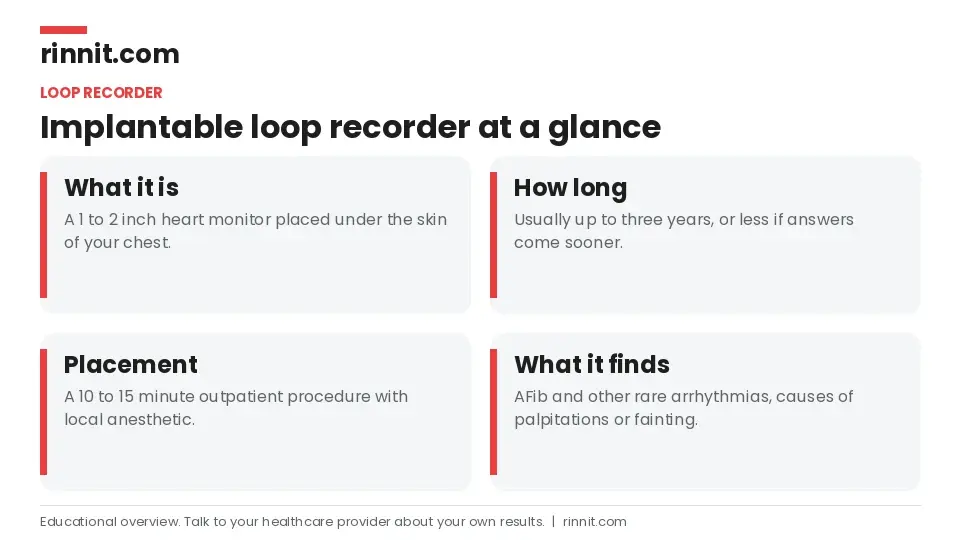
An implantable loop recorder (ILR) is a small heart monitor that a cardiologist places under the skin of the chest. It watches the heart rate and rhythm around the clock, usually for up to three years. It helps diagnose arrhythmias, such as AFib, and causes of palpitations or fainting that an EKG or short-term monitor could not catch. [1]
What the research says
Long-term monitoring finds far more hidden AFib after an unexplained stroke. In 441 people with a stroke of unknown cause, AFib was found in 12.4% of those with an insertable monitor by 12 months, compared with 2.0% with usual follow-up. (Sanna et al., The New England Journal of Medicine, 2014) [2]
Finding more AFib does not always mean fewer strokes. In 6,004 adults aged 70 to 90 with stroke risk factors, loop recorders found AFib in 31.8% versus 12.2% with usual care, but stroke or embolism rates were not significantly different (4.5% vs 5.6%), suggesting not every case of screen-detected AFib needs the same treatment. (Svendsen et al., The Lancet, 2021) [3]
Key takeaways
An ILR is a small device placed under the skin of the left chest to record your heart rhythm. [1]
Most stay in for up to three years, but it may come out sooner if your provider gets the answers they need. [1]
It is used to find causes of palpitations or fainting and to diagnose AFib and other rare arrhythmias. [1]
Placement is a 10- to 15-minute outpatient procedure with local anesthetic and mild sedation. [1]
It records automatically and also when you press a handheld activator during symptoms. [1]
It does not affect your heart; it only monitors and records. [1]
What is an implantable loop recorder?
An ILR, also called an insertable cardiac monitor, monitors your heart's electrical activity and records anything that should not be there. Unlike other ambulatory monitors you wear for a few days or weeks, it sits under your skin for long-term monitoring. [1]
Why would you need one?
Your cardiologist may recommend a loop recorder to: [1]
Find what is causing heart palpitations or fainting when other tests have not given enough information
Diagnose AFib and other arrhythmias that happen too rarely for other tests to catch
Monitor and treat an arrhythmia you have already been diagnosed with
Watch your heart's electrical activity after a heart attack or stroke
How does a loop recorder work?
The device is small and rectangular, less than half an inch thick and about 1 to 2 inches long, with a battery and electrical circuit inside a metal case. It rests just beneath your skin. You may see a faint outline, but it should not cause pain or discomfort. [1]
How it records | What happens |
When you have symptoms | You press a button on a handheld activator, and the device saves your heart activity at that moment and shortly before it. |
Automatically | It saves abnormal rhythms even when you feel nothing, such as silent AFib or a faint you do not remember. |
Sending data | A transmitter regularly sends the saved data to your cardiologist. |
Sources: [1]
Before the procedure
Your cardiologist will review your medical history, examine you and may order tests such as: [1]
Tilt table test
If these tests do not show a heart problem but you still have symptoms, a loop recorder may be the next step. Arrange for someone to drive you home, because you will be sedated and should not drive for 24 hours. [1]
What happens during placement?
This is an outpatient procedure, so you go home the same day, and general anesthesia is not needed. An electrophysiologist, a cardiologist who specializes in the heart's electrical system, will: [1]
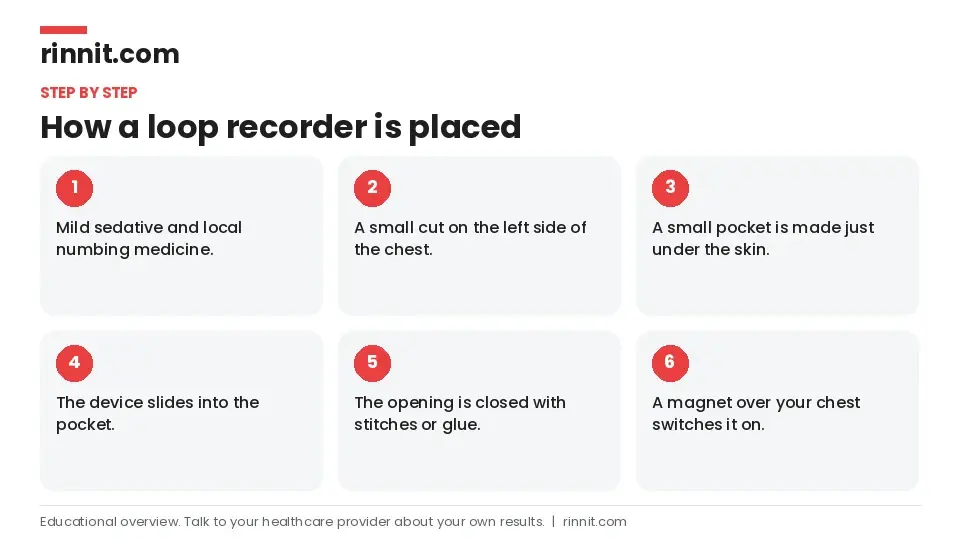
Give you a mild sedative to relax you and a local anesthetic so you do not feel pain.
Make a small cut in the skin on the left side of your chest.
Create a small pocket just under the skin.
Slide the loop recorder into the pocket.
Close the opening with stitches or surgical glue.
Move a magnet over your chest to switch the device on.
The procedure takes about 10 to 15 minutes. [1]
Pros and cons
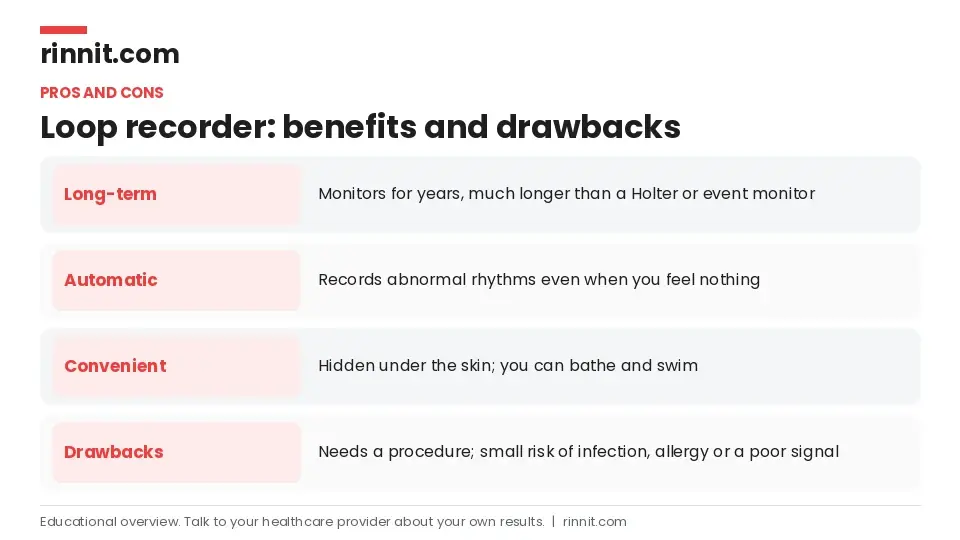
Benefits | Drawbacks |
Long-term monitoring, often for years | Requires a procedure to place it |
Records automatically, even without symptoms | Risk of infection near the device, which needs antibiotics and sometimes moving the device |
Hidden and convenient; you can bathe and swim | Possible allergy to device materials |
Fits an active job or lifestyle | Sometimes a poor signal, which may mean moving the device |
Sources: [1]
Research cited by the source shows that the longer an ILR stays in, the more AFib it finds, with three times as many cases detected at 30 months as at six months. A loop recorder cannot damage your heart. It does not change your heart rate, give a shock or affect your heart's activity. [1]
After placement
Most people go home right away and return to normal routines. Before you leave, you learn how to use: [1]
A handheld activator to press when you have symptoms
A transmitter that regularly sends data to your cardiologist
You also get wound-care instructions. The area may be sore or bruised for several days, which is normal. Your provider will tell you when you can get it wet. [1]
What results does it give?
The loop recorder saves graphs and numbers showing your heart's electrical activity, including how fast or slow it beats and the rhythm. Your cardiologist reviews the data and lets you know when results are ready to discuss. The results can diagnose or rule out arrhythmias and guide treatment. [1]
When to call your doctor
Call your cardiologist right away if the incision site has: [1]
Redness or color changes
Swelling
Bleeding
Pus or discharge
Loop recorder vs. pacemaker
A loop recorder is a diagnostic test; a pacemaker is a treatment. A loop recorder only monitors and records, while a pacemaker detects abnormal rhythms and sends signals to correct them. Your loop recorder results can show whether you need a pacemaker. A loop recorder is not designed to detect a heart attack, though it can pick up arrhythmias caused by one. [1]
A heart attack is a medical emergency. If you have chest pain or other heart attack symptoms, call 911 or your local emergency number right away. [1]
Conclusion
It can be frustrating when symptoms you clearly feel refuse to show up on a test. An implantable loop recorder gives long-term, round-the-clock monitoring, so there is a much better chance your doctor can see the problem as it happens and find the right treatment. [1]
Keep learning: Read our guide to the Holter monitor or our guide to atrial fibrillation. For more trusted, doctor-reviewed health guides, visit Rinnit.com.
FAQ
What is an implantable loop recorder?
It is a small heart monitor placed under the skin of your chest that records your heart rhythm for up to about three years. [1]
Why would I need a loop recorder?
To find the cause of palpitations or fainting, or to diagnose AFib and other rare arrhythmias that other tests missed. [1]
How is a loop recorder put in?
Through a small cut on the left chest under local anesthetic and mild sedation, in about 10 to 15 minutes. [1]
Does getting a loop recorder hurt?
You get numbing medicine and a sedative; the area may be sore or bruised for a few days afterward. [1]
How long does a loop recorder stay in?
Most stay in for up to three years, but it may come out sooner. [1]
Can I shower or swim with a loop recorder?
Yes, once your wound has healed and your provider says it is OK to get it wet. [1]
Can a loop recorder damage my heart?
No. It only monitors and records; it does not change your heart rate or deliver shocks. [1]
Is a loop recorder the same as a pacemaker?
No. A loop recorder is a diagnostic monitor, while a pacemaker treats abnormal rhythms. [1]
Can a loop recorder detect a heart attack?
No, but it can detect arrhythmias that develop as a complication of a heart attack. [1]
When should I call my doctor after a loop recorder is placed?
Call right away for redness, swelling, bleeding, or pus at the incision site. [1]
Related Reading
What Is Atrial Fibrillation (AFib)? Symptoms, Causes, and Treatment explains AFib, one of the main arrhythmias a loop recorder is used to find.
Atrial Fibrillation (AFib): Symptoms, Causes & Treatment Guide covers AFib symptoms and treatment once a loop recorder confirms it.
Heart Arrhythmia: Symptoms, Types, Causes, Diagnosis & Treatment — Complete Guide explains abnormal heart rhythms that may be too rare for short-term tests to catch.
Heart Palpitations: Causes, Symptoms & Treatment Guide covers palpitations, a common reason a cardiologist recommends a loop recorder.
Vasovagal Syncope: Why You Faint and What to Do About It explains fainting episodes that a loop recorder can help investigate.
Embolic Stroke (Brain Embolism): Symptoms, Causes, and Treatment covers strokes caused by clots, after which long-term heart monitoring may be used.
Cardiac Event Monitor: Types, How to Wear It and How It Differs From a Holter explains the weeks-long heart rhythm monitor for symptoms that come and go.
References
Cleveland Clinic. Implantable Loop Recorder (ILR). Cleveland Clinic. Last updated September 29, 2025. https://my.clevelandclinic.org/health/diagnostics/24543-loop-recorder
Sanna T, Diener HC, Passman RS, et al. Cryptogenic stroke and underlying atrial fibrillation. N Engl J Med. 2014;370(26):2478-2486. PMID 24963567. https://doi.org/10.1056/NEJMoa1313600
Svendsen JH, Diederichsen SZ, Højberg S, et al. Implantable loop recorder detection of atrial fibrillation to prevent stroke (The LOOP Study): a randomised controlled trial. Lancet. 2021;398(10310):1507-1516. PMID 34469766. https://doi.org/10.1016/S0140-6736(21)01698-6
Medical disclaimer
This article is for general education only and does not replace advice from a qualified healthcare professional. Talk to your doctor about your own diagnosis and treatment, and seek emergency care right away for severe or sudden symptoms.



Comments