Holter Monitor: What It Detects, How It Works and Results

Updated: 2 days ago
Written and medically reviewed by Dr. Baraa Alnahhal, MD · Last reviewed: November 2026 · How we review
Quick Answer: What is a Holter monitor?
A Holter monitor is a battery-powered heart monitor that records the heart rate and rhythm without a break for 24 to 48 hours. You wear it under your clothes while you go about your normal day. Because it records longer than a standard EKG, it has more chances to catch an irregular heartbeat or the cause of unexplained dizziness. [1]
What the research says
Longer recordings catch more rhythm problems. In 146 people who wore a 24-hour Holter monitor and a 14-day adhesive patch monitor at the same time, the patch detected 96 arrhythmia events over its full wear time compared with 61 events found by the Holter monitor. (Barrett et al., The American Journal of Medicine, 2014) [2]
Many arrhythmias first show up after 48 hours. In more than 1.1 million people using up to 14 days of continuous patch monitoring, the median time to the first meaningful arrhythmia was more than 48 hours, even in people with daily symptoms (about 3.5 days), and roughly 60% to 64% of arrhythmias appeared after day two. (Battisti et al., Heart Rhythm, 2026) [3]
Extended Holter monitoring after stroke finds more atrial fibrillation. In 356 people with a recent ischemic stroke, longer study Holter monitoring (median about 162 hours) found atrial fibrillation in 4.5% of patients, compared with 2.0% using routine monitoring of about 51 hours. (Hellwig et al., Stroke and Vascular Neurology, 2024) [4]
Key takeaways
A Holter monitor records your heart rhythm continuously for 24 to 48 hours while you do your usual activities. [1]
It is often used when a standard EKG, which records for only a few minutes, does not explain your symptoms. [1]
No special preparation is needed, but the device must stay dry, so plan to shower before it is attached. [1]
Keeping a diary of your symptoms and activities helps your provider match what you felt to the recording. [1]
There are no known risks besides possible skin irritation from the electrode tape. [1]
Research shows that some rhythm problems appear only after 48 hours, so your provider may suggest longer monitoring if a Holter test is normal. [2] [3]
What is a Holter monitor?
A Holter monitor is a wearable, battery-powered device that records your heart rhythm and heart rate for 24 to 48 hours without breaks. It is a type of ambulatory electrocardiogram (ECG or EKG), meaning it records your heart while you move around rather than while you lie still in a clinic. [1]
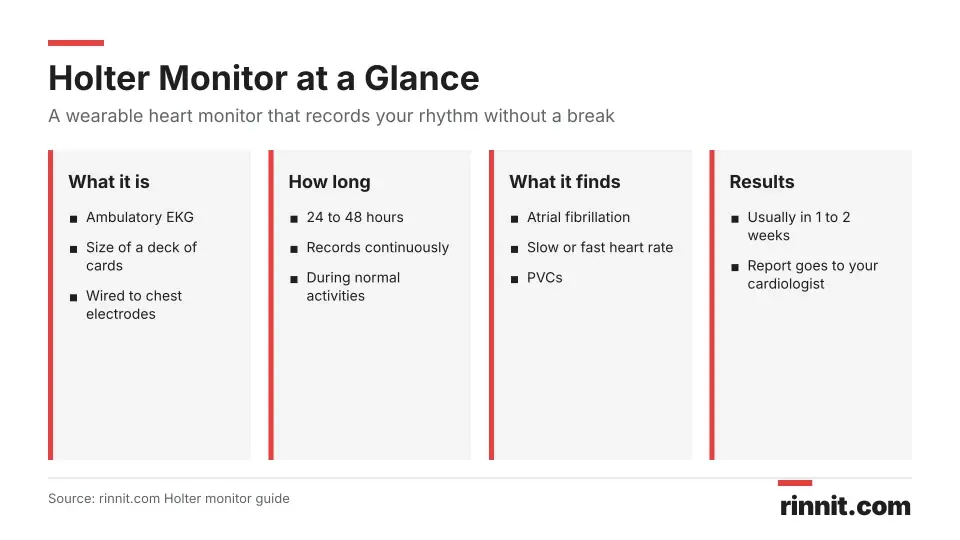
The monitor is lightweight and about the size of a deck of playing cards. Wires connect it to sticky electrodes on your chest, and you wear it under your clothes. It is named after Dr. Norman J. Holter, who created it in the 1950s. [1]
A Holter monitor does not send information to your provider in real time. If you have worrying symptoms while wearing it, seek emergency care rather than waiting for the results. [1]
Why is a Holter monitor test done?
A standard EKG records your heart for only a few minutes, so it can miss a rhythm problem that comes and goes. Recording over one or two full days gives more chances to catch unusual heart activity. Your provider may order a Holter monitor to: [1]
Find the cause of an arrhythmia (irregular heartbeat)
Look into heart palpitations, such as a racing, pounding or fluttering heartbeat
Find the cause of unexplained dizziness
Check for an irregular heartbeat when a standard EKG found nothing
Check how well your heart medicines are working
Sources: [1]
How is a Holter monitor different from other heart tests?
A standard EKG, a Holter monitor and an event monitor all record your heart rhythm, but each one records it in a different way. [1]
Feature | Standard EKG | Holter monitor | Event monitor |
How long it records | A few minutes, at the time of the test | Continuously for 24 or 48 hours | Not continuously |
When it records | Only during the test | All the time while you wear it | Only when you feel symptoms and activate it |
What it shows | Heart activity at that moment | How rhythm and symptoms change over a day or two | Heart activity during the symptoms you record |
Sources: [1]
How do you prepare for a Holter monitor test?
You do not need any special preparation for a Holter monitor test. Because the device can't get wet once it is attached, you may want to shower or bathe beforehand. [1]
Shower first. You won't be able to bathe, shower or swim while you wear the monitor.
Mention allergies. Tell your provider if you are allergic to tape or adhesives.
Plan to keep a diary. You will be asked to write down any symptoms and what you were doing when they happened.
Sources: [1]
What happens during a Holter monitor test?
A healthcare provider fits the monitor, and then you wear it under your clothes during your normal daily activities. [1]

Your provider attaches at least two electrodes to your chest. They may shave a small area of your chest so the electrodes stay on.
The provider connects the monitor to the electrodes with wires and explains how to care for the device.
You and your provider decide where to carry the monitor, such as in a pocket or bag, or on a strap around your neck, waist or shoulder.
You learn how to keep a log of symptoms, such as shortness of breath, skipped or uneven heartbeats and chest pain, along with the time and what you were doing.
You wear the monitor for 24 or 48 hours during your normal daily activities while it records your heart rhythm continuously.
You return the monitor, and your provider removes the electrodes.
Sources: [1]
What to avoid while wearing a Holter monitor
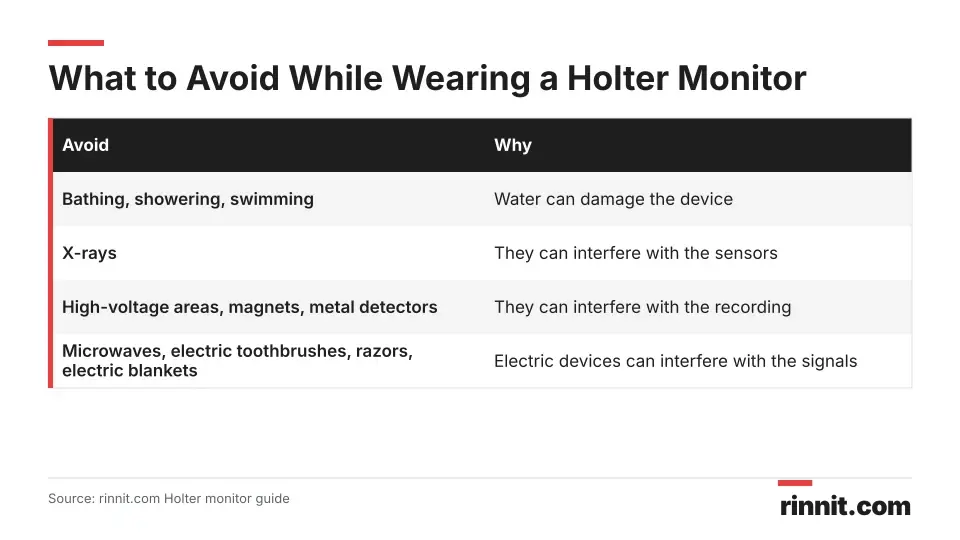
Some things can damage the device or interfere with the signals from the electrodes. While you wear the monitor, avoid the following: [1]
Avoid | Why |
Bathing, showering and swimming | Water can damage the device |
X-rays | They can interfere with the sensors |
High-voltage areas, magnets and metal detectors | They can interfere with the recording |
Microwaves, electric toothbrushes, razors and electric blankets | Electric devices can interfere with the signals |
Sources: [1]
Holter monitor at a glance
Item | Typical detail |
Size | About the size of a deck of playing cards |
How long you wear it | 24 to 48 hours |
Electrodes | At least two, attached to your chest |
Preparation | None needed; shower beforehand |
Pain | None |
Results | Usually within about one to two weeks |
Sources: [1]
What happens after a Holter monitor test?
After 24 or 48 hours, you return the monitor to your provider, who removes the electrodes. Providers don't check the device while it records. Instead, they look at the data once you return it. [1]
The recording is processed along with the notes from your symptom diary, and a report is sent to your cardiologist (heart specialist). Your provider compares the times you wrote down with the EKG recording to see whether your symptoms matched a change in your heart rhythm. [1]
What do Holter monitor results mean?
Your provider will usually contact you within about one to two weeks after the test. The results show how your heart rate and rhythm behaved over the recording and whether any symptoms you logged lined up with a rhythm change. [1]
A Holter monitor can show arrhythmias such as: [1]
Finding | What it means |
Atrial fibrillation | A type of arrhythmia (irregular heart rhythm) |
Bradycardia | A heart rate that is slower than expected |
Tachycardia | A heart rate that is faster than expected |
Premature ventricular contractions (PVCs) | Early heartbeats that start in the heart's lower chambers (ventricles) |
Sources: [1]
If your results are abnormal, your provider will explain what they mean and may recommend next steps, such as: [1]
More heart tests
Heart medicines
A pacemaker
Cardioversion, to help restore a steady rhythm
Ablation, a procedure that uses heat or cold to create scar tissue that treats abnormal rhythms
Sources: [1]
A Holter monitor can't diagnose anxiety. If anxiety causes palpitations, though, the monitor records them, and your diary notes help your provider make sense of the recording. If a Holter test is normal but your symptoms continue, studies suggest that a longer monitoring period may catch rhythm problems a 24- to 48-hour recording misses. [1] [2] [3]
What are the risks of a Holter monitor?
There are no known risks or pain from wearing a Holter monitor. The main side effect is skin itching or irritation where the electrode tape sits. Tell your provider before the test if you are allergic to tape or adhesives. [1]
When should you call your provider?
No one watches your recording while you wear the monitor, so seek medical care if symptoms develop. Contact your provider if: [1]
You have trouble using the monitor or have questions about it
An electrode comes loose
You have heart-related symptoms that worry you
Sources: [1]
Questions to ask your provider
Why do I need a Holter monitor, and what are you looking for?
Should I wear it for 24 or 48 hours?
What symptoms should I write down in my diary?
What should I do if an electrode comes loose?
If the results are normal but my symptoms continue, would longer monitoring help?
Conclusion
A Holter monitor records your heart rhythm continuously for 24 to 48 hours while you go about your day. It helps find the cause of an irregular heartbeat, palpitations or unexplained dizziness, especially when a standard EKG was normal, and it can show how well heart medicines are working. [1]
The test is painless, needs no special preparation and has no known risks beyond mild skin irritation. Keeping the device dry, avoiding sources of interference and writing down your symptoms give your provider the clearest picture. Because some rhythm problems appear only after 48 hours, your provider may suggest longer monitoring if your symptoms continue. [1] [3]
Keep learning: Read our guides to heart arrhythmia, heart palpitations and atrial fibrillation. For more on this test, see the MedlinePlus guide to the Holter monitor.
FAQ
What is a Holter monitor?
A Holter monitor is a small, battery-powered device you wear for 24 to 48 hours that records your heart rate and rhythm without a break during your normal daily activities.
Why would a doctor order a Holter monitor?
It helps find the cause of an irregular heartbeat, heart palpitations or unexplained dizziness, especially when a standard EKG was normal, and it can show how well heart medicines are working.
How long do you wear a Holter monitor?
You usually wear it for 24 or 48 hours, then return it to your provider so the recording can be reviewed.
How do I prepare for a Holter monitor test?
No special preparation is needed. You may want to shower or bathe beforehand, because the device can't get wet while you wear it.
Does a Holter monitor hurt?
No. Wearing a Holter monitor is painless, though the electrode tape can sometimes cause itching or skin irritation.
Can I shower with a Holter monitor?
No. Don't bathe, shower or swim while wearing it, because water can damage the device.
What should I avoid while wearing a Holter monitor?
Avoid X-rays, high-voltage areas, magnets and metal detectors, and keep electric devices such as microwaves, electric toothbrushes, razors and electric blankets away, since they can interfere with the recording.
What can a Holter monitor detect?
It can detect arrhythmias such as atrial fibrillation, a slow heart rate (bradycardia), a fast heart rate (tachycardia) and premature ventricular contractions (PVCs).
When will I get my Holter monitor results?
Your provider will usually contact you within about one to two weeks after you return the monitor.
Is a Holter monitor the same as an event monitor?
No. A Holter monitor records continuously for 24 or 48 hours, while an event monitor records only when you feel symptoms and turn it on.
Related Reading
Cardiac Telemetry Monitoring: Real-Time Heart Rhythm Monitoring explains continuous heart rhythm monitoring in the hospital and at home.
Ambulatory Heart Monitors: Holter, Event, Patch and Loop Recorders compares the wearable and implantable monitors that record heart rhythm at home.
Learn more in our guide to Heart Arrhythmia: Symptoms, Types, Causes, Diagnosis & Treatment — Complete Guide.
Learn more in our guide to Atrial Fibrillation (AFib): Symptoms, Causes & Treatment Guide.
Learn more in our guide to Heart Palpitations: Causes, Symptoms & Treatment Guide.
Learn more in our guide to Bradycardia: Slow Heart Rate, Symptoms, Causes, and Treatment.
Learn more in our guide to What Is Tachycardia? A Plain-Language Guide to the Fast Heartbeat, Its Causes, and Its Treatment.
Learn more in our guide to Premature Ventricular Contractions (PVCs): Symptoms, Causes, and Treatment.
Cardiac Event Monitor: Types, How to Wear It and How It Differs From a Holter explains the weeks-long heart rhythm monitor for symptoms that come and go.
References
Cleveland Clinic. Holter Monitor: Purpose, Results & How It Works. Cleveland Clinic. Last updated June 6, 2025. https://my.clevelandclinic.org/health/diagnostics/21491-holter-monitor
Barrett PM, Komatireddy R, Haaser S, et al. Comparison of 24-hour Holter monitoring with 14-day novel adhesive patch electrocardiographic monitoring. Am J Med. 2014;127(1):95.e11-7. PMID 24384108. https://doi.org/10.1016/j.amjmed.2013.10.003
Battisti AJ, Pinkerton R, Fokin V, et al. Relationship of symptom frequency and symptom-rhythm correlation to arrhythmia type and time to detection: Insights from ambulatory electrocardiogram monitoring in over 1 million patients. Heart Rhythm. 2026;23(2):e200-e208. PMID 41205886. https://doi.org/10.1016/j.hrthm.2025.11.007
Hellwig S, Krause T, Scheitz JF, et al. Enhanced diagnostic workup increases pathological findings in patients with acute ischaemic stroke: results of the prospective HEBRAS study. Stroke Vasc Neurol. 2024;9(2):145-152. PMID 37353342. https://doi.org/10.1136/svn-2022-002179
Medical disclaimer
This article is for general education only and does not replace advice from a qualified healthcare professional. Talk to your doctor about your own diagnosis and treatment, and seek emergency care right away for severe or sudden symptoms.



Comments