Cardiac Telemetry Monitoring: Real-Time Heart Rhythm Monitoring

Updated: 2 days ago
Written and medically reviewed by Dr. Baraa Alnahhal, MD · Last reviewed: November 2026 · How we review
Quick Answer
Cardiac telemetry monitoring is the continuous, real-time recording of the heart rhythm, usually in a hospital. Electrode patches on the chest send the heart's electrical signals to a central monitor watched by trained staff, so they can respond quickly to dangerous rhythm changes. It's used for chest pain, palpitations, a heart attack, stroke, fainting or after surgery.
What the research says
Mobile telemetry finds more arrhythmias: in 266 people with suspected heart rhythm problems, mobile cardiac outpatient telemetry made a diagnosis in 88% vs. 75% with a standard event monitor, and found significant arrhythmias in 41% vs. 15% (Rothman SA et al., J Cardiovasc Electrophysiol, 2007) [2]
Experts set standards for its use: an American Heart Association statement outlines who needs hospital heart monitoring and for how long, and warns that overuse and too many false alarms can cause problems (Sandau KE et al., Circulation, 2017) [3]
Key takeaways
Telemetry continuously records your heart rhythm in real time.
Staff watch the signals on a central monitor and respond quickly.
It's used for chest pain, palpitations, heart attack, stroke and fainting.
Electrodes are changed daily and may irritate the skin.
Mobile telemetry can monitor your heart at home.
What is cardiac telemetry?
An EKG records your heart for a few minutes. Telemetry records it around the clock, so brief or unpredictable rhythm problems can be caught as they happen. The word telemetry means measuring from a distance: your signals are sent wirelessly to a display that nurses and technicians watch. Sources: [1]
Why it's used
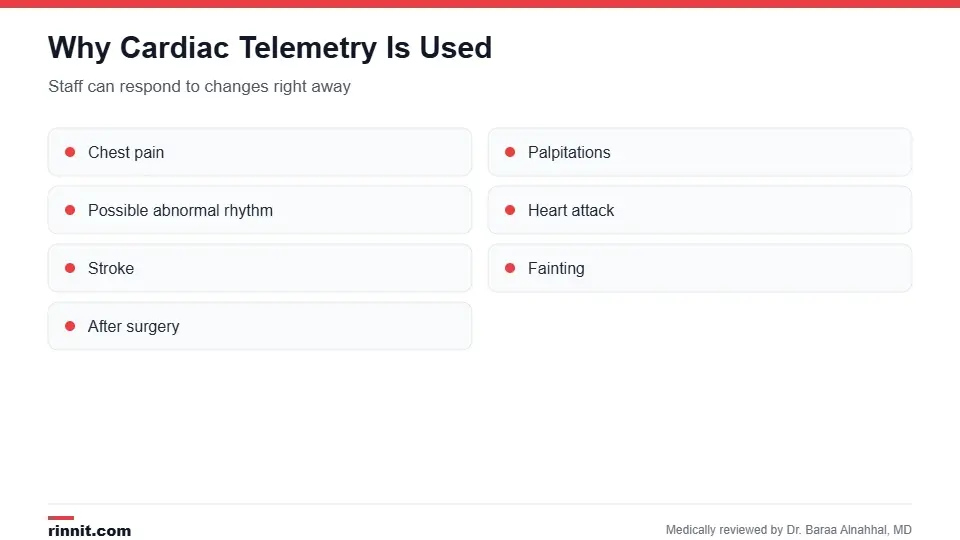
Telemetry lets staff respond to rhythm changes right away.
Chest pain or palpitations.
Possible abnormal heart rhythms, such as atrial fibrillation.
A heart attack or stroke.
Fainting.
Blood clots or a collapsed lung.
After surgery requiring anesthesia, or during a coma. Sources: [1]
Telemetry vs. other heart monitors
Monitor | Where | How long | Watched live? |
Hospital telemetry | Hospital | Up to 30 days | Yes |
Mobile cardiac telemetry | At home | Weeks | Data sent to a monitoring center |
At home | About 1 to 2 days | No; reviewed afterward | |
At home | Weeks | Records when triggered |
Sources: [1, 2]
How it works
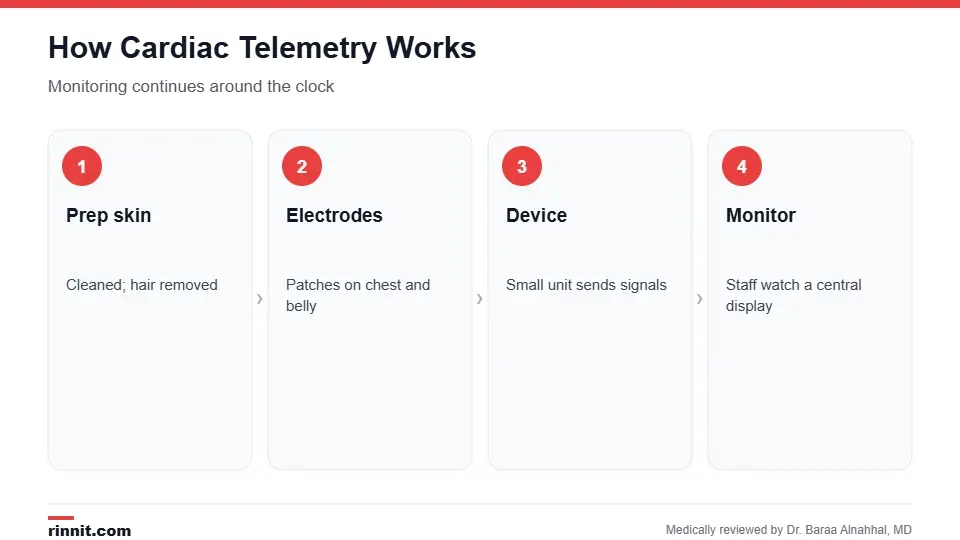
Monitoring continues around the clock.
Staff clean your skin and remove hair where the electrodes will go, usually on your chest and belly.
Electrode patches are attached and connected by wires to a small device that may fit in a gown pocket.
The device sends your heart signals to a display watched by staff.
Alarms alert staff to rhythm changes so they can respond quickly.
When monitoring ends, staff disconnect the wires and remove the patches. Sources: [1]
Risks
Telemetry is very safe. Electrodes need to be replaced daily and can irritate the skin. Sometimes patches are placed incorrectly or signals are misread, for example from movement. Sticky residue left on the skin can be washed off at home. Sources: [1]
Results
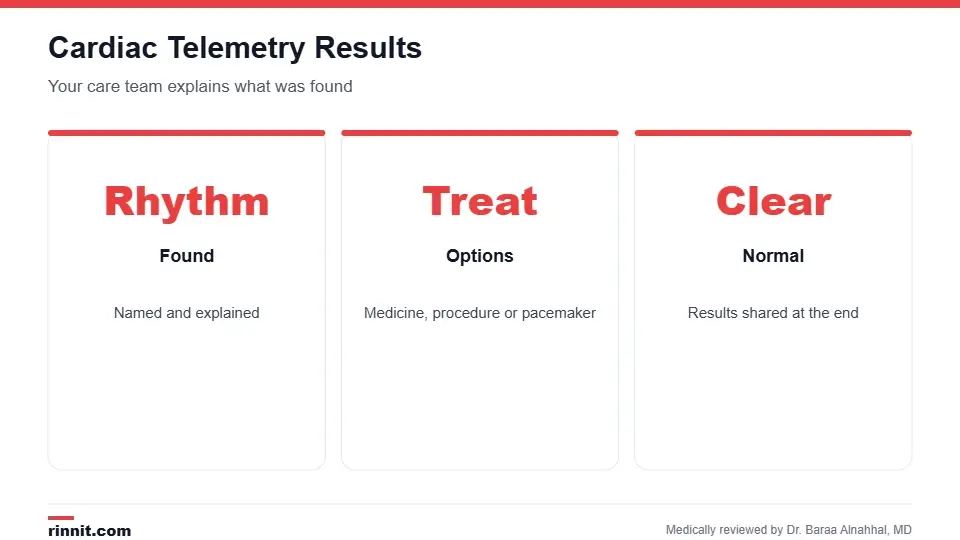
Your care team explains what the monitor showed.
If an abnormal rhythm is found, your care team names it, explains it and starts treatment, which may include medicine, lifestyle changes, procedures, a pacemaker or surgery. If nothing abnormal is found, results are usually shared at the end of monitoring. Sources: [1, 3]
Conclusion
Cardiac telemetry keeps a constant watch on your heart while you're in the hospital or, with mobile versions, at home. It lets your care team catch and treat rhythm problems quickly, often before they cause serious harm.
Keep learning: read about ambulatory heart monitors and the Holter monitor.
Frequently asked questions
What is cardiac telemetry?
Continuous, real-time monitoring of your heart rhythm.
Who watches the monitor?
Trained nurses and technicians, often from a central station.
Why would I need telemetry?
For chest pain, palpitations, a heart attack, stroke or fainting.
How long does telemetry last?
In the hospital, up to 30 days.
Can telemetry be done at home?
Yes. Mobile cardiac telemetry can be used at home.
Is telemetry the same as a Holter monitor?
No. A Holter records for 1 to 2 days and is reviewed later.
Does telemetry hurt?
No, though the patches can irritate your skin.
Can I walk around?
Often yes; the device is small and portable.
Why are the patches changed?
Electrodes usually need daily replacement for good signals.
What happens if a problem is found?
Your care team explains it and starts treatment.
Related Reading
Ambulatory Heart Monitors: Holter, Event, Patch and Loop Recorders heart monitors worn at home.
Holter Monitor: What It Detects, How It Works and Results a 1- to 2-day heart rhythm recorder.
Cardiac Event Monitor: Types, How to Wear It and How It Differs From a Holter a monitor that records when symptoms occur.
Electrocardiogram (EKG or ECG): Why It's Done, How to Prepare, What Happens and Results the standard heart rhythm test.
Atrial Fibrillation (AFib): Symptoms, Causes & Treatment Guide a common rhythm found on telemetry.
References
Cleveland Clinic. What Is Cardiac Telemetry Monitoring? Cleveland Clinic. Last updated March 14, 2024. https://my.clevelandclinic.org/health/diagnostics/cardiac-telemetry-monitoring
Rothman SA, Laughlin JC, Seltzer J, et al. The diagnosis of cardiac arrhythmias: a prospective multi-center randomized study comparing mobile cardiac outpatient telemetry versus standard loop event monitoring. J Cardiovasc Electrophysiol. 2007;18(3):241-247. PMID 17318994. https://doi.org/10.1111/j.1540-8167.2006.00729.x
Sandau KE, Funk M, Auerbach A, et al. Update to practice standards for electrocardiographic monitoring in hospital settings: a scientific statement from the American Heart Association. Circulation. 2017;136(19):e273-e344. PMID 28974521. https://doi.org/10.1161/CIR.0000000000000527
Medical disclaimer
This article is for general education only and does not replace advice from a qualified healthcare professional. Talk to your doctor about your own diagnosis and treatment, and seek emergency care right away for severe or sudden symptoms.



Comments