Ambulatory Heart Monitors: Holter, Event, Patch and Loop Recorders

Updated: 3 days ago
Written and medically reviewed by Dr. Baraa Alnahhal, MD · Last reviewed: November 2026 · How we review
Quick Answer
Ambulatory heart monitors are wearable devices that record the heart's electrical activity at home for days, weeks or years. They help find irregular heart rhythms that come and go and may not show up on a standard EKG. Types include the Holter monitor, event monitors, patch recorders and implantable loop recorders. The main side effect is skin irritation.
What the research says
Longer monitoring finds hidden atrial fibrillation: in 441 people with a stroke of unknown cause, an implantable heart monitor detected atrial fibrillation in 12.4% by 12 months, compared with 2.0% with standard follow-up (Sanna T et al., New England Journal of Medicine, 2014) [2]
A 14-day patch catches more than a 24-hour Holter: in 146 people who wore both at the same time, the 14-day adhesive patch detected 96 arrhythmia events compared with 61 for the 24-hour Holter monitor (Barrett PM et al., American Journal of Medicine, 2014) [3]
Key takeaways
Ambulatory monitors record your heart rhythm while you go about daily life.
They catch arrhythmias that are brief or unpredictable.
Wear time ranges from 1 day to 2 years, depending on the device.
Clean, lotion-free skin helps electrodes stick.
A provider reviews the recording and explains the results.
Types of ambulatory heart monitors
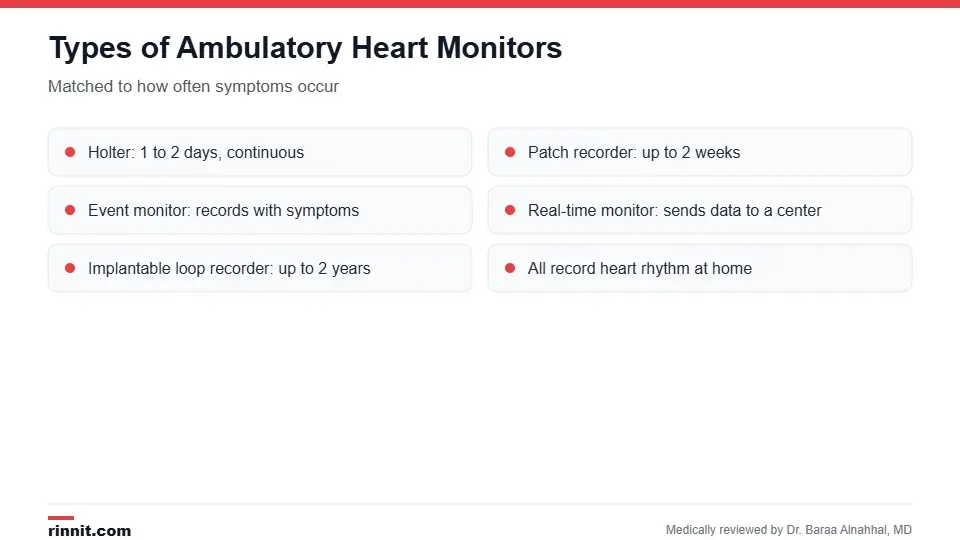
The right monitor depends on how often your symptoms happen.
Monitor | How it works | Typical wear time |
Holter monitor | Records every heartbeat continuously | 1 to 2 days (some up to 1 to 2 weeks) |
Patch recorder | Adhesive patch with all parts built in | Up to 2 weeks |
Event monitor | Records when you press a button or an abnormal rhythm is detected; looping types save the minutes before and after | Weeks |
Real-time monitor | Sends data to a monitoring center for quick review | Weeks |
Implantable loop recorder | Small device placed under the skin of the chest | Up to 2 years |
Sources: [1]
Why they're used
To find arrhythmias that happen unpredictably or last only a short time.
To capture rhythm problems you don't feel.
To explain symptoms such as palpitations, a racing heart, dizziness or fainting.
To look for hidden atrial fibrillation, for example after an unexplained stroke.
To check how well treatment for an arrhythmia is working. Sources: [1]
How to prepare
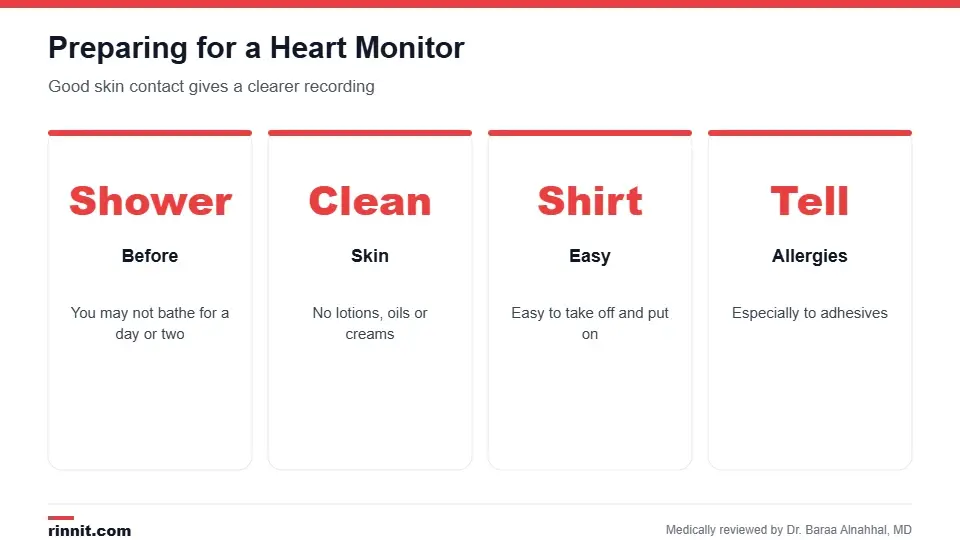
Good skin contact gives a clearer recording.
Shower or bathe beforehand if you like; you may not be able to bathe for a day or two with some monitors.
Keep your chest skin clean and free of oils, lotions and creams.
Wear a shirt that's easy to take off and put on.
A technician cleans the skin with alcohol and may shave small areas of chest hair.
Tell staff about any allergy to adhesives. Sources: [1]
Wearing the monitor
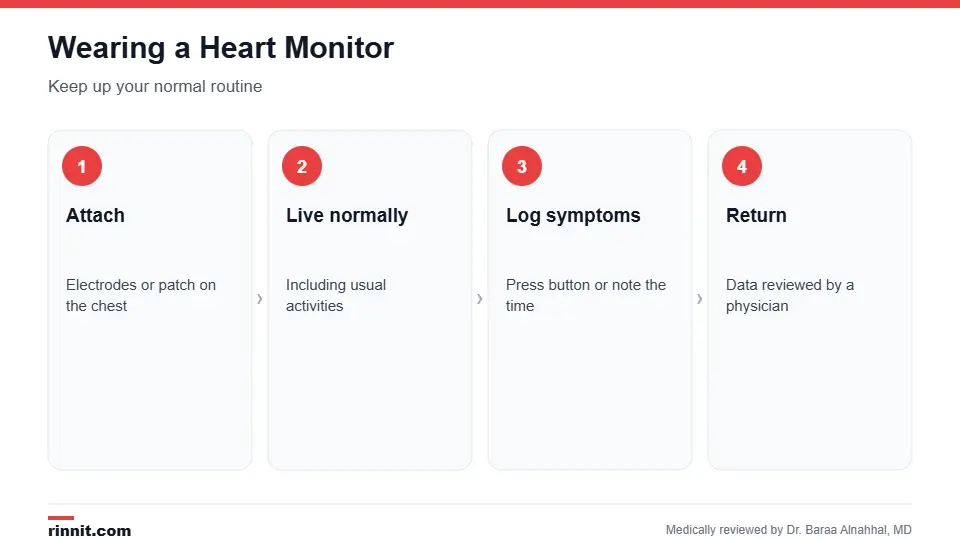
Keep up your normal routine so the monitor captures your typical day.
The technician attaches electrodes or a patch to your chest and shows you how the device works.
You go about your normal routine, including activities that usually trigger symptoms, unless told otherwise.
When you have symptoms, you press the button or note the time and what you were doing.
Some devices let you remove and reattach electrodes after bathing; follow your technician's instructions.
Avoid certain electronics and devices with magnets; ask for a list.
You return the monitor, or data is sent wirelessly for review. Sources: [1]
An implantable loop recorder is placed under the skin through a small incision in a quick outpatient procedure, and its data is downloaded wirelessly. Sources: [1]
Risks
External monitors are very safe. The main side effect is skin irritation from the adhesive, which usually clears up within a few days. With an implantable recorder, there may be pain or irritation at the site and, rarely, infection or an allergic reaction. Call your provider for fever, chills, warmth, swelling, redness or drainage at the incision. Sources: [1]
Results
Technicians download the recording and a physician reviews it. Your provider then explains what was found and the next steps, which may include medicine, an echocardiogram, or treatment for a specific arrhythmia. The wait for results varies, so ask your clinic when to expect them. Sources: [1]
Conclusion
Ambulatory heart monitors let your care team see what your heart does during everyday life, not just during a short office visit. They're a safe, simple way to catch rhythm problems that come and go and to guide the right treatment.
Keep learning: read about the Holter monitor and the cardiac event monitor.
Frequently asked questions
What is an ambulatory heart monitor?
A wearable device that records your heart rhythm at home.
Why would I need one?
To find irregular heart rhythms that come and go.
How long do I wear a Holter monitor?
Usually 1 to 2 days.
How long can a patch monitor be worn?
Up to 2 weeks.
What is an implantable loop recorder?
A small device under the skin that can record for up to 2 years.
Can I shower with a heart monitor?
It depends on the device; follow your technician's instructions.
What should I do when I have symptoms?
Press the button or note the time and what you were doing.
Are there side effects?
Mainly skin irritation from the adhesive.
Can I exercise while wearing it?
Usually yes; normal activity helps capture symptoms.
Who reads the results?
A physician, usually a cardiologist, reviews the recording.
Related Reading
Cardiac Telemetry Monitoring: Real-Time Heart Rhythm Monitoring explains continuous heart rhythm monitoring in the hospital and at home.
Holter Monitor: What It Detects, How It Works and Results the most common continuous heart monitor.
Cardiac Event Monitor: Types, How to Wear It and How It Differs From a Holter a monitor that records when symptoms occur.
Electrocardiogram (EKG or ECG): Why It's Done, How to Prepare, What Happens and Results the standard in-office heart rhythm test.
Atrial Fibrillation (AFib): Symptoms, Causes & Treatment Guide a common rhythm problem these monitors find.
24-Hour Ambulatory Blood Pressure Monitoring: How It Works and Normal Values a wearable test for blood pressure.
References
Cleveland Clinic. Heart and Ambulatory Monitors. Cleveland Clinic. Last updated August 25, 2021. https://my.clevelandclinic.org/health/diagnostics/16732-ambulatory-monitors
Sanna T, Diener HC, Passman RS, et al. Cryptogenic stroke and underlying atrial fibrillation. New England Journal of Medicine. 2014;370(26):2478-2486. PMID 24963567. https://doi.org/10.1056/NEJMoa1313600
Barrett PM, Komatireddy R, Haaser S, et al. Comparison of 24-hour Holter monitoring with 14-day novel adhesive patch electrocardiographic monitoring. American Journal of Medicine. 2014;127(1):95.e11-95.e17. PMID 24384108. https://doi.org/10.1016/j.amjmed.2013.10.003
Medical disclaimer
This article is for general education only and does not replace advice from a qualified healthcare professional. Talk to your doctor about your own diagnosis and treatment, and seek emergency care right away for severe or sudden symptoms.



Comments