24-Hour Ambulatory Blood Pressure Monitoring: How It Works and Normal Values

Updated: 2 days ago
Written and medically reviewed by Dr. Baraa Alnahhal, MD · Last reviewed: November 2026 · How we review
Quick Answer
24-hour ambulatory blood pressure monitoring (ABPM) uses a small, portable monitor and an arm cuff to check blood pressure automatically over a full day and night. It gives a truer picture than a single office reading, helping confirm high blood pressure and spot white coat hypertension. A normal 24-hour average is about 125/75 mm Hg or lower.
What the research says
Ambulatory readings predict risk better than clinic readings: in the Dublin Outcome Study, ambulatory blood pressure was superior to clinic blood pressure in predicting cardiovascular death, and nighttime blood pressure was the strongest predictor of outcome (Dolan E et al., Hypertension, 2005) [2]
ABPM is the reference standard for confirming high readings: a systematic review for the U.S. Preventive Services Task Force concluded that ambulatory monitoring is the reference standard for confirming an elevated office blood pressure, helping avoid misdiagnosis and overtreatment of people with high readings only in the clinic (Piper MA et al., Ann Intern Med, 2015) [3]
Key takeaways
ABPM checks your blood pressure automatically for 24 hours.
It confirms high blood pressure and finds white coat and masked hypertension.
It also shows whether your blood pressure dips normally at night.
A normal 24-hour average is about 125/75 mm Hg or lower.
Keep a diary of activities, sleep and symptoms during the test.
What is ambulatory blood pressure monitoring?
Blood pressure changes throughout the day with activity, stress and sleep. A single reading at the doctor's office may not reflect your usual numbers. ABPM collects dozens of readings in your everyday setting, including while you sleep, so your provider can see your true average and daily pattern. Sources: [1, 3]
Why it's done
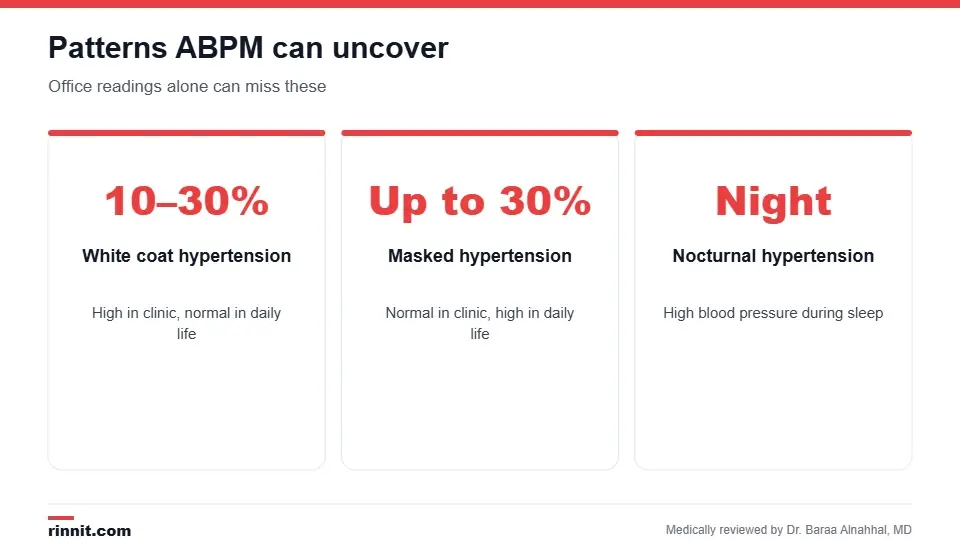
ABPM finds patterns that office readings miss.
Pattern | What it means | How common |
White coat hypertension | High in the clinic, normal at home | About 10–30% of people with high office readings |
Masked hypertension | Normal in the clinic, high in daily life | Up to about 30% |
Nocturnal hypertension | High blood pressure during sleep | About 2 in 10 White and 4 in 10 Black people |
ABPM can also check how well blood pressure medicines are working, look into resistant hypertension and investigate dizziness or fainting from low blood pressure. Sources: [1]
How the test works

You wear the monitor during a normal day and night.
A provider fits a cuff on your upper arm, connected to a small monitor worn on a belt or strap.
The cuff inflates automatically every 15 to 30 minutes during the day and about every 60 minutes at night.
You keep a diary of activities, medicines, sleep times and symptoms.
After 24 hours, you return the monitor and the readings are downloaded. Sources: [1]
Keep your arm still and relaxed at your side when the cuff inflates.
Avoid strenuous exercise, and don't shower or bathe while wearing the monitor.
Some people have mild arm soreness or trouble sleeping. Sources: [1]
Normal values
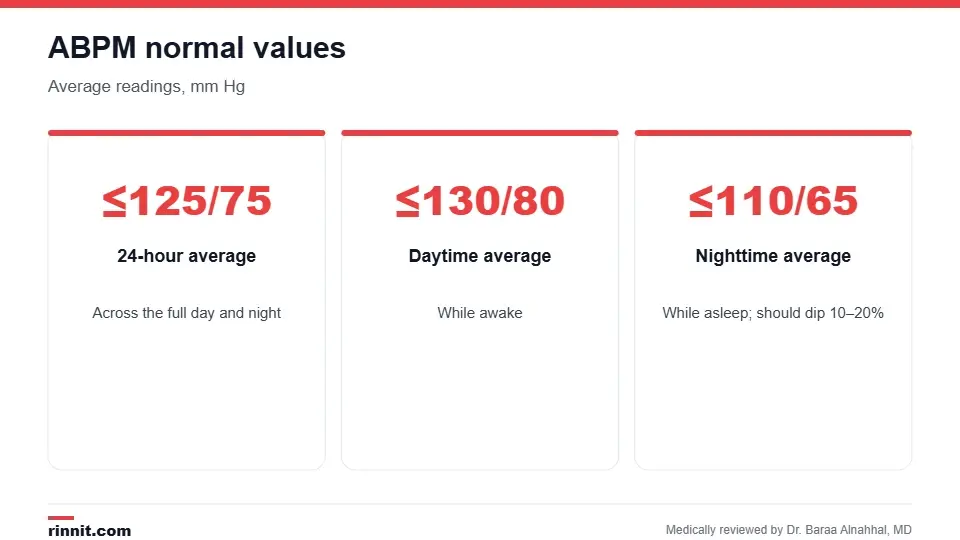
Your provider compares your averages with these thresholds.
Measure | Normal value |
24-hour average | 125/75 mm Hg or lower |
Daytime average | 130/80 mm Hg or lower |
Nighttime average | 110/65 mm Hg or lower |
Night-time dip | Blood pressure falls about 10–20% during sleep |
People whose blood pressure doesn't dip at night have a higher risk of heart and blood vessel problems. Sources: [1, 2]
Conclusion
24-hour ambulatory monitoring is the most accurate way to know your real blood pressure. It helps your provider avoid both missed and unnecessary diagnoses, and it guides treatment decisions.
Keep learning: read about blood pressure measurement and white coat syndrome.
Frequently asked questions
What is ABPM used for?
To confirm high blood pressure and find white coat, masked or nighttime hypertension.
How often does the cuff inflate?
Every 15 to 30 minutes by day and about every 60 minutes at night.
Can I shower with the monitor?
No. Remove it only as instructed and keep it dry.
Can I exercise during the test?
Avoid strenuous exercise; normal daily activity is fine.
What should I write in my diary?
Activities, medicines, sleep and wake times, and any symptoms.
What is a normal 24-hour average?
About 125/75 mm Hg or lower.
What is white coat hypertension?
High readings in the clinic but normal readings in daily life.
What is masked hypertension?
Normal readings in the clinic but high readings in daily life.
Why does nighttime blood pressure matter?
It strongly predicts heart and blood vessel risk.
Does the test hurt?
The cuff squeezes your arm; some people have mild soreness or poor sleep.
Related Reading
Ambulatory Heart Monitors: Holter, Event, Patch and Loop Recorders compares the wearable and implantable monitors that record heart rhythm at home.
High Blood Pressure: Silent Symptoms, Serious Risks, and Proven Ways to Lower It the condition ABPM helps confirm.
White Coat Syndrome: Understanding Clinical Hypertension vs. Home Readings why clinic readings can be misleading.
Blood Pressure Measurement: How to Take an Accurate Reading and What It Means how blood pressure is measured at home and in the clinic.
Resistant Hypertension: Symptoms, Causes, and Management high blood pressure that's hard to control.
Understanding Labile Hypertension: Symptoms, Triggers, and Management blood pressure that swings up and down.
References
Cleveland Clinic. 24-Hour Ambulatory Blood Pressure Monitoring. Cleveland Clinic. Last updated March 6, 2023. https://my.clevelandclinic.org/health/diagnostics/16330-24-hour-ambulatory-blood-pressure-monitoring
Dolan E, Stanton A, Thijs L, et al. Superiority of ambulatory over clinic blood pressure measurement in predicting mortality: the Dublin outcome study. Hypertension. 2005;46(1):156-161. PMID 15939805. https://doi.org/10.1161/01.HYP.0000170138.56903.7a
Piper MA, Evans CV, Burda BU, et al. Diagnostic and predictive accuracy of blood pressure screening methods with consideration of rescreening intervals: a systematic review for the U.S. Preventive Services Task Force. Ann Intern Med. 2015;162(3):192-204. PMID 25531400. https://doi.org/10.7326/M14-1539
Medical disclaimer
This article is for general education only and does not replace advice from a qualified healthcare professional. Talk to your doctor about your own diagnosis and treatment, and seek emergency care right away for severe or sudden symptoms.



Comments