Blood Pressure Measurement: How to Take an Accurate Reading and What It Means

Updated: 2 days ago
Written and medically reviewed by Dr. Baraa Alnahhal, MD · Last reviewed: November 2026 · How we review
Quick Answer
Blood pressure measurement checks the force of blood against the artery walls, reported as two numbers: systolic over diastolic. For an accurate reading, avoid caffeine, food, tobacco and exercise for 30 minutes. For adults, normal is below 120/80 mmHg; high blood pressure is diagnosed only after high readings on two or more separate occasions.
What the research says
Cuff size changes the number: in a randomized crossover trial of 195 adults, using a regular cuff on people who needed a large cuff overestimated systolic pressure by 4.8 mmHg, and on people who needed an extra-large cuff by 19.5 mmHg; in people who needed a small cuff it underestimated by 3.6 mmHg (Ishigami J et al., JAMA Internal Medicine, 2023) [2]
Use a validated device: a review of 628 validation studies found that of 51 studies that included children, 41 reported a pass, but only 22 studies (covering 20 devices) met independent standards; validated devices read within about 1 mmHg of the reference method (Stergiou GS et al., Hypertension, 2026) [3]
Key takeaways
Avoid caffeine, food, tobacco and exercise for 30 minutes and empty your bladder first.
Sit with your back supported, feet flat, legs uncrossed and arm resting at heart level; don't talk.
Put the cuff on a bare upper arm; many adults need a large cuff.
Take 2–3 readings about 1 minute apart and record them.
Normal is below 120/80 mmHg; a diagnosis of high blood pressure needs high readings on separate occasions.
What do the numbers mean?
The top number (systolic) is the pressure in your arteries when your heart contracts. The bottom number (diastolic) is the pressure when the heart relaxes between beats. A reading of 118/76 mmHg is said "118 over 76." Both numbers matter: either one being high raises the risk of heart attack, stroke and kidney disease over time. Sources: [1]
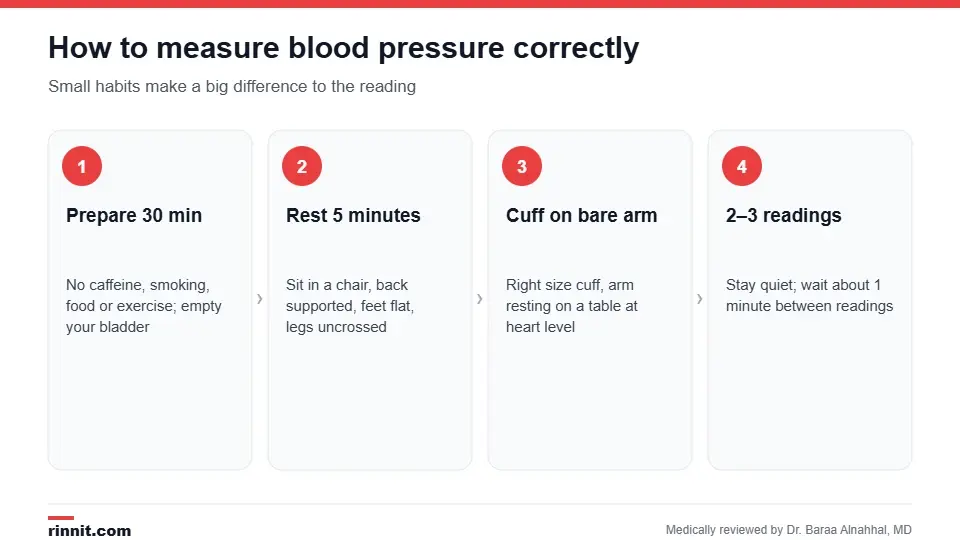
Small details change a blood pressure reading by several points.
Why measure blood pressure?
High blood pressure usually causes no symptoms, so measuring it is the only way to know you have it. Readings are taken at routine checkups, and providers often ask people with high or borderline readings to monitor at home. Home readings also help detect white coat syndrome, where readings are higher in the clinic than at home, and track whether a new medicine is working, usually about two weeks after starting it. Sources: [1]
How do I prepare?
For 30 minutes before: no tobacco, caffeine, food or exercise.
Empty your bladder.
Sit in a chair with back support and rest quietly for 5 minutes.
Keep both feet flat on the floor and legs uncrossed.
Rest your arm on a table so the cuff is at heart level.
Don't talk or look at your phone during the reading. Sources: [1]
How to take a reading
Choose the right cuff: the bladder should wrap most of the way around your upper arm. Most adults need a regular or large cuff.
Wrap the cuff snugly on bare skin, about an inch above the bend of the elbow, not over a sleeve.
Start the automatic monitor and stay still and quiet.
Wait about 1 minute and take one or two more readings.
Write down all readings with the date and time, or use the monitor's memory. Sources: [1]
In the clinic, a provider may measure manually by listening over the brachial artery with a stethoscope while slowly releasing the cuff pressure. Sources: [1]
Common mistakes that skew readings
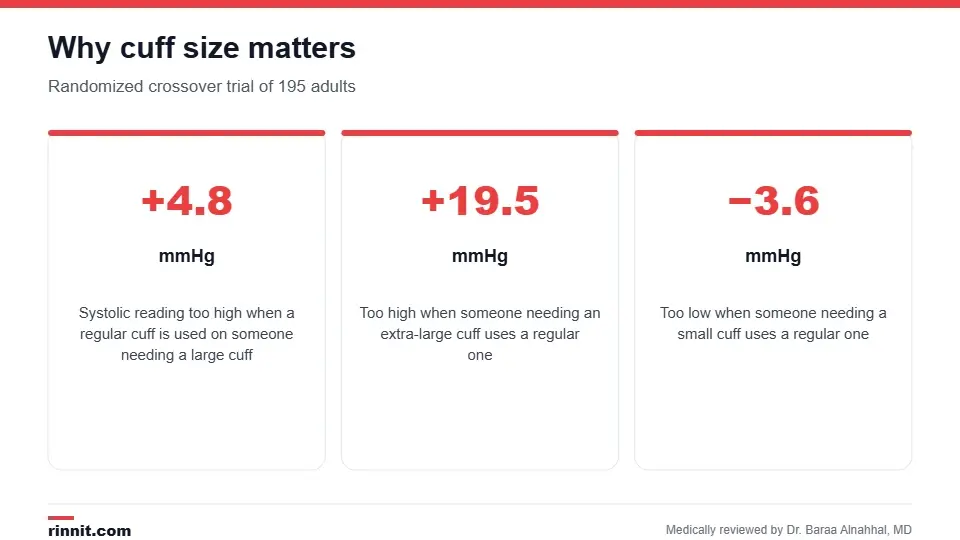
Each error can push the reading off by several mmHg.
Mistake | Effect on the reading |
Cuff too small | Falsely high (up to about 19 mmHg in people who need an extra-large cuff) |
Cuff too large | Falsely low |
Cuff over clothing | Inaccurate |
Arm below heart level or unsupported | Falsely high |
Back unsupported, legs crossed | Falsely high |
Talking, full bladder, recent caffeine or exercise | Falsely high |
Sources: [1, 2]
Understanding your results
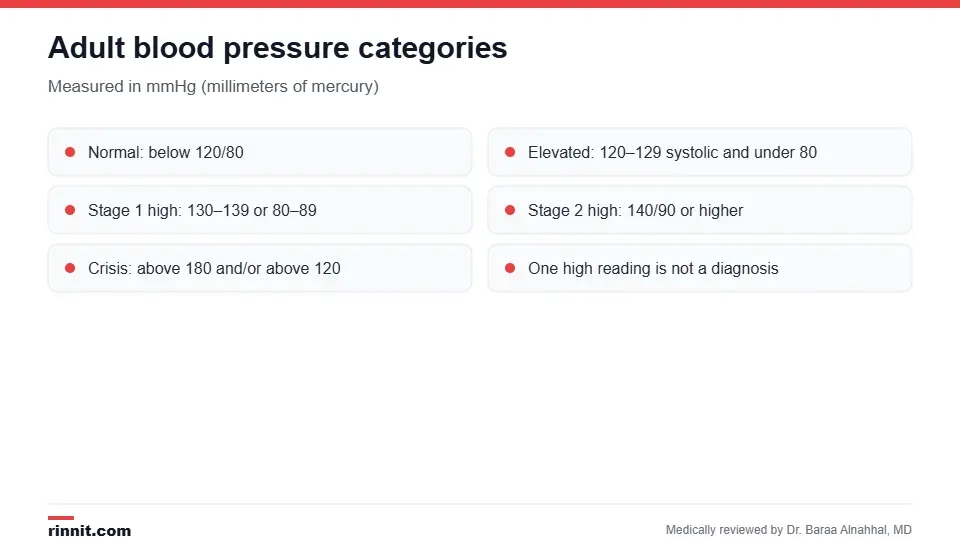
Adult blood pressure categories in mmHg.
Category | Systolic (top) | Diastolic (bottom) |
Normal | Below 120 | and below 80 |
Elevated | 120–129 | and below 80 |
Stage 1 high blood pressure | 130–139 | or 80–89 |
Stage 2 high blood pressure | 140 or higher | or 90 or higher |
Hypertensive crisis | Higher than 180 | and/or higher than 120 |
One high reading doesn't mean you have high blood pressure. Your provider bases a diagnosis on two or more high readings taken on separate occasions, often with home readings for a week before a visit. Very low readings with dizziness or fainting may point to low blood pressure. Sources: [1]
If your reading is above 180/120 mmHg, wait a few minutes and measure again. If it stays that high, contact your provider right away; with chest pain, shortness of breath, back pain, numbness, weakness, vision changes or trouble speaking, call emergency services. Sources: [1]
Choosing a home monitor
Choose an upper-arm cuff monitor rather than a wrist or finger device.
Pick one validated for accuracy; validation lists are available from professional societies.
Make sure the cuff fits your arm; buy a large cuff if needed.
Bring it to your next appointment so your provider can check it against the clinic device. Sources: [1, 3]
Lifestyle steps that lower blood pressure
If your readings are above normal, lifestyle changes help: about 150 minutes of moderate exercise a week, limiting sodium (ideally under 1,500 mg a day), limiting alcohol to one or two drinks a day at most, keeping a healthy weight, not smoking and managing stress. Your provider may add medicine depending on your readings and overall risk. Sources: [1]
Conclusion
An accurate blood pressure reading comes down to preparation, posture and the right cuff. Measure the same way each time, record several readings, and share them with your provider. Read our guide to normal blood pressure by age to see how ranges compare.
Keep learning: read about elevated blood pressure and high blood pressure.
Frequently asked questions
What is a normal blood pressure?
Below 120/80 mmHg for adults.
Which arm should I use?
At the first visit, both arms are often checked; then use the arm with the higher reading consistently.
How many readings should I take?
Two or three, about 1 minute apart, and record them all.
What time of day is best?
Take readings at the same times each day, often morning and evening, before medicines and meals.
Does cuff size really matter?
Yes. A cuff too small can raise the reading by several points, or by about 19 mmHg in people who need an extra-large cuff.
Are wrist monitors accurate?
Upper-arm cuff monitors are preferred; wrist devices are more sensitive to arm position.
Why is my reading higher at the doctor's office?
Anxiety can raise blood pressure in the clinic, called white coat syndrome. Home readings help clarify this.
Can one high reading mean I have hypertension?
No. A diagnosis needs two or more high readings on separate occasions.
When is a reading an emergency?
Above 180/120 mmHg with symptoms like chest pain, shortness of breath, weakness or vision changes. Call emergency services.
How often should I check at home?
As your provider recommends; often daily for a week before a visit or for about two weeks after a medicine change.
Related Reading
24-Hour Ambulatory Blood Pressure Monitoring: How It Works and Normal Values explains the 24-hour monitor that shows your true blood pressure day and night.
High Blood Pressure: Silent Symptoms, Serious Risks, and Proven Ways to Lower It the condition accurate readings help diagnose.
Low Blood Pressure (Hypotension): Numbers, Symptoms, Causes, and When It Needs Treatment when readings are too low and cause symptoms.
Normal Blood Pressure by Age: What Your Numbers Mean reference ranges across age groups.
White Coat Syndrome: Understanding Clinical Hypertension vs. Home Readings why clinic and home readings differ.
Elevated Blood Pressure: Symptoms, Causes, and Treatment the stage before high blood pressure.
References
Cleveland Clinic. How To Take Blood Pressure Measurements. Cleveland Clinic. Last updated June 13, 2023. https://my.clevelandclinic.org/health/diagnostics/25068-blood-pressure-measurement
Ishigami J, Charleston J, Miller ER, et al. Effects of cuff size on the accuracy of blood pressure readings: the Cuff(SZ) randomized crossover trial. JAMA Internal Medicine. 2023;183(10):1061-1068. PMID 37548984. https://doi.org/10.1001/jamainternmed.2023.3264
Stergiou GS, Menti A, Palatini P, et al. Validated automated cuff blood pressure devices for children: STRIDE BP report and call to action. Hypertension. 2026;83(9):e26206. PMID 42454415. https://doi.org/10.1161/HYPERTENSIONAHA.125.26206
Medical disclaimer
This article is for general education only and does not replace advice from a qualified healthcare professional. Talk to your doctor about your own diagnosis and treatment, and seek emergency care right away for severe or sudden symptoms.



Comments