
White Coat Syndrome: Understanding Clinical Hypertension vs. Home Readings

Updated: 3 days ago
Medically reviewed by Dr. Baraa Alnahhal, MD · Last reviewed: October 2026
Quick Answer: What is white coat syndrome?
White coat syndrome, or white coat hypertension, is when blood pressure is high at a provider's office but normal at home, often because of anxiety around doctors. Office readings are 140/90 mmHg or higher, while home readings are below 135/85 mmHg. Most people don't need medicine if home readings are normal, but lifestyle changes and ongoing monitoring are important. [1]
What the research says
Untreated white coat hypertension carries some extra risk. A systematic review and meta-analysis of 27 observational studies compared people with untreated white coat hypertension with people with normal blood pressure and found higher risks of cardiovascular events (hazard ratio 1.36, 95% CI 1.03–2.00), all-cause mortality (HR 1.33, 95% CI 1.07–1.67), and cardiovascular mortality (HR 2.09, 95% CI 1.23–4.48); no significant association was found for treated white coat effect (Cohen et al., Annals of Internal Medicine, 2019) [2].
It can progress to sustained hypertension. A meta-analysis of 11 studies found that people with white coat hypertension had a higher risk of cardiovascular outcomes (relative risk 1.33, 95% CI 1.10–1.62) and a nearly three-times higher risk of progressing to sustained hypertension (RR 2.85, 95% CI 2.32–3.49; 3 studies, 1,722 participants) than people with normal blood pressure (Fujiwara et al., Hypertension Research, 2019) [3].
But the risk is well below that of sustained hypertension. A meta-analysis of 14 cohort studies (29,100 participants, including 4,806 with white coat hypertension, followed for about 8 years) found that cardiovascular morbidity and mortality with white coat hypertension may be slightly higher than with normal blood pressure but well below the risks of sustained hypertension (Briasoulis et al., Journal of Hypertension, 2016) [4].
What Is White Coat Syndrome?
White coat syndrome is a condition in which your blood pressure is high at your healthcare provider's office, but you get a normal reading at home. A normal blood pressure reading is less than 120 mmHg (top number) and less than 80 mmHg (bottom number) [1].
The condition is real — researchers have documented it in multiple studies. It matters because an accurate reading tells you whether you need treatment: if your reading isn't correct, you could be getting medicine you don't need, or a dose that's too high, and your provider may think your medicine isn't working if your office reading is artificially high [1].
Reading type | Systolic (top) | Diastolic (bottom) | What it means |
|---|---|---|---|
Normal blood pressure | Less than 120 mmHg | Less than 80 mmHg | Healthy range |
In-office (white coat) | 140 mmHg or higher | 90 mmHg or higher | Higher than normal in the office |
Home or 24-hour ambulatory | Less than 135 mmHg | Less than 85 mmHg | Normal outside the office |
Why It Happens
Your body may have a reflex when you're concerned about the results of having your blood pressure checked. Arriving at the office, entering the exam room, and getting the reading can all trigger it — like the "fight or flight" response people have when they sense danger. You may feel nervous, and that feeling can get worse in the exam room [1].
It's also normal for blood pressure to vary with the time of day, whether you've rested beforehand, the amount of noise around you, and how you're feeling emotionally [1].

Who gets white coat syndrome, and what does it mean for your health?
White coat hypertension affects 15% to 30% of people with high blood pressure, and people without high blood pressure can have it too. You are more likely to have it if you [1]:
Are older than 50
Are female
Were recently diagnosed with high blood pressure
Have obesity
Don't use tobacco products
White coat syndrome is linked to stiffness in your arteries, worse blood vessel function, higher cardiovascular mortality, and a higher risk of left ventricular hypertrophy, diabetes, or high blood pressure. Every year, 5% of people with white coat syndrome get a hypertension diagnosis. Studies show people with it have a higher cardiovascular risk than people with normal blood pressure, but people with white coat syndrome who take blood pressure medicine don't have a higher risk of heart problems than people with normal readings [1].
How is white coat syndrome confirmed with home or ambulatory readings?
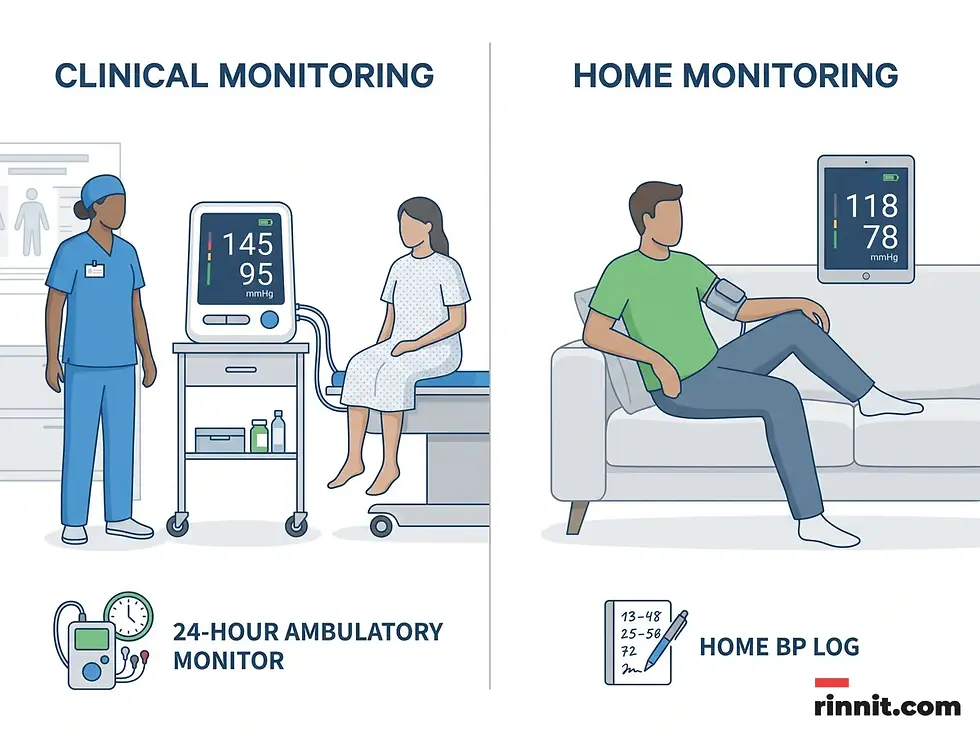
Your provider can diagnose white coat syndrome when you have at least three in-office readings that are higher than normal (140/90 mmHg or higher), but the diagnosis requires either 24-hour ambulatory blood pressure monitoring or home monitoring, with readings below 135/85 mmHg [1].
You can buy an automatic blood pressure monitor to use at home, and many pharmacies have machines that take your blood pressure for you. It's worth asking whether you can bring your home monitor to an appointment so your provider can check its accuracy [1].
How is white coat syndrome managed, and how can you reduce anxiety?
White coat syndrome is usually treated only if you have other cardiovascular risks, and otherwise managed with frequent blood pressure checks and lifestyle changes. Your provider may ask you to check your blood pressure often to make sure you don't develop high blood pressure, and to make lifestyle changes [1]:
Exercising more often
Losing weight
Reducing how much salt you eat
Avoiding tobacco products
If you have other cardiovascular risk factors, such as obesity or tobacco use, your provider may recommend blood pressure medicine. Side effects of these medicines can include dizziness, headache, and upset stomach [1].
How to Feel More Relaxed at Your Appointment
Develop a good relationship with your provider so you can talk easily — and find a different provider if you don't feel comfortable with yours.
Bring a list of questions so you're not anxious about forgetting to ask them.
Allow extra time to get to your appointment and park so you don't feel stressed.
Don't smoke, drink coffee, or exercise for half an hour before your appointment.
These tips come from Cleveland Clinic [1].

How can people live well with white coat syndrome?
Keep checking your blood pressure at home to make sure it stays normal, and contact your healthcare provider if you get several high readings. If your home or pharmacy numbers are normal, let your provider know so they can update their records — and tell them if your readings are high too, because that could mean you actually have high blood pressure. The only way to know is to keep checking [1].
Conclusion
It can be upsetting to hear high numbers in your provider's office, but you may just be nervous. White coat syndrome is real, tends to continue for years, and is linked to a somewhat higher cardiovascular risk, so accurate out-of-office monitoring matters. With home or ambulatory readings, healthy lifestyle habits, and a good relationship with your provider, you can make sure you get the right care — without medicine you don't need [1].
Frequently Asked Questions
Is white coat syndrome dangerous?
White coat syndrome can be. People with white coat syndrome may have blood pressure a little higher than those without it, and studies show a higher risk of cardiovascular issues than people with normal blood pressure. High-risk people older than 60 may have twice the risk of heart issues compared with low-risk people with the syndrome, although those other risk factors, rather than white coat hypertension itself, may explain that increase [1].
Can I overcome white coat syndrome?
White coat syndrome tends to continue for years, even if you see the same provider every year and are comfortable with them. Feeling more relaxed — through a good relationship with your provider, extra time to arrive, and a list of questions — may bring your office readings closer to your home readings [1].
How common is this condition?
White coat hypertension affects 15% to 30% of people who have high blood pressure. People without high blood pressure can have it as well [1].
Should I take medication for white coat hypertension?
Providers usually treat white coat syndrome only if you have other cardiovascular risks, such as obesity or tobacco use. For many people, lifestyle changes like losing a few pounds or eating less salt are the treatment [1].
What is a normal blood pressure reading?
A normal reading is less than 120 mmHg (top number) and less than 80 mmHg (bottom number) [1].
How is it diagnosed?
Providers can diagnose it when you have at least three in-office readings that are higher than normal (140/90 mmHg or higher), but it requires confirmation with 24-hour ambulatory blood pressure monitoring or home monitoring showing readings below 135/85 mmHg [1].
Does it only happen to nervous people?
You may feel nervous in your provider's office, but the response is a reflex similar to "fight or flight," and it can continue for years even if you are comfortable with your provider. Blood pressure also normally varies with the time of day, rest, noise, and how you're feeling emotionally [1].
Can someone without high blood pressure have white coat syndrome?
Yes. White coat hypertension affects people who have high blood pressure and can occur in people who don't have high blood pressure as well [1].
What should I do if my home readings are also high?
If your home readings are consistently high, you may actually have high blood pressure. Contact your healthcare provider if you get several high readings, so you can talk about a treatment plan [1].
Can caffeine affect my reading?
Yes. Avoid smoking, coffee, and exercise for half an hour before your appointment so your reading is more accurate [1].
Related Reading
24-Hour Ambulatory Blood Pressure Monitoring: How It Works and Normal Values explains the 24-hour monitor that shows your true blood pressure day and night.
Blood Pressure Measurement: How to Take an Accurate Reading and What It Means explains how to take an accurate blood pressure reading at home or in the clinic.
References
Source currency note: The Cleveland Clinic page was last updated on August 3, 2022, and the three studies were checked against PubMed. This article reflects the most current information available from those sources.
Cleveland Clinic. What is white coat syndrome? Cleveland Clinic. August 3, 2022. https://my.clevelandclinic.org/health/diseases/23989-white-coat-syndrome
Cohen JB, Lotito MJ, Trivedi UK, et al. Cardiovascular events and mortality in white coat hypertension: a systematic review and meta-analysis. Annals of Internal Medicine. 2019;170(12):853-862. PMID 31181575. https://doi.org/10.7326/M19-0223
Fujiwara T, Matsumoto C, Asayama K, et al. Are the cardiovascular outcomes of participants with white-coat hypertension poor compared to those of participants with normotension? A systemic review and meta-analysis. Hypertension Research. 2019;42(6):825-833. PMID 30971805. https://doi.org/10.1038/s41440-019-0254-2
Briasoulis A, Androulakis E, Palla M, et al. White-coat hypertension and cardiovascular events: a meta-analysis. Journal of Hypertension. 2016;34(4):593-599. PMID 26734955. https://doi.org/10.1097/HJH.0000000000000832
Medical disclaimer
Health information, not medical advice. This article is for general education and is not a substitute for professional diagnosis or treatment. Always consult a qualified healthcare provider about your own health, and seek emergency care for urgent symptoms.



Comments