Cardiac Event Monitor: Types, How to Wear It and How It Differs From a Holter

Updated: 2 days ago
Written and medically reviewed by Dr. Baraa Alnahhal, MD · Last reviewed: November 2026 · How we review
Quick Answer
A cardiac event monitor is a battery-powered device that records the heart's rhythm for weeks to catch symptoms that don't happen every day, such as palpitations, dizziness or fainting. Unlike a Holter monitor, which records for 24 to 48 hours, it covers a longer period. It's painless, and recordings are sent to your care team.
What the research says
Longer monitoring finds more hidden atrial fibrillation: in the EMBRACE trial of 572 people aged 55 or older with an unexplained stroke or mini-stroke, a 30-day event monitor detected atrial fibrillation in 16.1%, compared with 3.2% using a standard 24-hour monitor, and nearly doubled the number started on blood thinners (Gladstone DJ et al., New England Journal of Medicine, 2014) [2]
Implanted recorders extend detection further: in the CRYSTAL AF trial of 441 people with unexplained stroke, an implantable cardiac monitor found atrial fibrillation in 8.9% by 6 months and 12.4% by 12 months, compared with 1.4% and 2.0% with standard follow-up (Sanna T et al., New England Journal of Medicine, 2014) [3]
Key takeaways
Records heart rhythm for weeks to catch symptoms that come and go.
Types: patch, symptom event, loop and implantable loop recorder.
Used for palpitations, dizziness, fainting, unexplained stroke and checking treatment.
Keep magnets, phones and some electronics away from the sensors, and log your symptoms.
Not a real-time alarm: call 911 for serious symptoms.
What is a cardiac event monitor?
An event monitor records the same electrical signals as an electrocardiogram (EKG), but over a much longer time. Some types record all the time, while others save only when you press a button or when the device detects an abnormal rhythm. Recordings are sent to your provider for review. Sources: [1]
Types of event monitors

The type depends on how often your symptoms happen.
Type | How it works | How long |
Patch recorder | A single adhesive patch on the chest records continuously | About 2 weeks |
Symptom event monitor | You place or switch it on when symptoms start | Up to about a month |
Loop memory monitor | Records continuously but saves a minute or two before and after you press the button | Up to about a month |
A small device placed under the chest skin | Up to several years |
Sources: [1]
Why is it done?
To find the cause of occasional heart palpitations, dizziness, chest pain or fainting, such as vasovagal syncope.
To detect atrial fibrillation and other arrhythmias, including after an unexplained stroke.
To check how well a pacemaker, ICD or heart medicine is working.
To assess rhythm problems after a heart attack. Sources: [1, 2, 3]
Event monitor vs Holter monitor
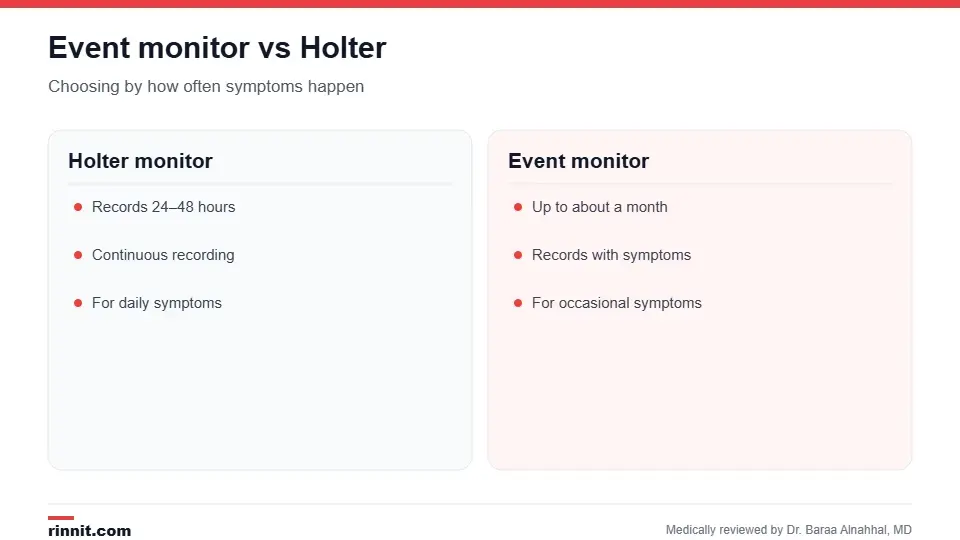
Which one you get depends on how often symptoms happen.
A Holter monitor records every heartbeat for 24–48 hours and works well when symptoms happen daily. If a Holter doesn't capture your symptoms, an event monitor is used because it can stay on for weeks. Sources: [1]
How to wear an event monitor

Clear recordings depend on good skin contact.
A technician cleans, and if needed shaves, small areas of your chest so the sensors stick well.
Sensors or a patch are attached; you'll be shown how to replace electrodes if needed.
Press the record button, if your device has one, when you feel symptoms.
Write down your symptoms, the time, what you were doing and when you took heart medicines.
Send recordings by phone or computer as instructed. Sources: [1]
Keep electric blankets, electric toothbrushes and razors, magnets, cell phones, music players, microwaves, metal detectors and high-voltage areas away from the device, as they can interfere.
Follow your provider's instructions about bathing and showering.
Go about your normal activities, including exercise if your provider asks. Sources: [1]
Risks
The test is painless. The adhesive can irritate your skin, which usually clears up after removal. Implanted recorders carry a small risk of pain or infection from the minor procedure. Sources: [1]
Understanding your results
Your provider reviews the recordings, which can take a few days to a few weeks. Normal results show no significant rhythm problems. Abnormal results may show atrial fibrillation or flutter, a fast heart rate (tachycardia), a slow heart rate (bradycardia) or heart block, and your provider will discuss treatment such as medicines, a pacemaker or ablation. Sources: [1]
An event monitor isn't watched in real time. Seek emergency care for serious symptoms, and call 911 if you think you're having a heart attack. Sources: [1]
Conclusion
A cardiac event monitor is the best way to catch heart rhythm problems that come and go. Wearing it as directed and keeping a careful symptom diary give your provider the information needed to find the cause and choose the right treatment.
Keep learning: read about the Holter monitor and atrial fibrillation.
Frequently asked questions
What is a cardiac event monitor?
A portable device that records your heart rhythm for weeks to catch occasional symptoms.
How long do I wear an event monitor?
Usually up to about a month; patches about two weeks; implanted recorders for years.
How is it different from a Holter monitor?
A Holter records for 24–48 hours; an event monitor records much longer.
Can I shower with an event monitor?
Follow your provider's instructions; some devices must come off for bathing.
Do I need to press a button?
Some types require you to press record when you feel symptoms.
What should I write in my symptom diary?
Your symptoms, the time, what you were doing and when you took heart medicines.
What can interfere with the monitor?
Magnets, cell phones, electric blankets, razors and metal detectors.
Does an event monitor hurt?
No, though the adhesive may irritate your skin.
Will someone watch my heart in real time?
No. Seek emergency care for serious symptoms.
What can an event monitor find?
Atrial fibrillation, fast or slow heart rhythms and heart block.
Related Reading
Cardiac Telemetry Monitoring: Real-Time Heart Rhythm Monitoring explains continuous heart rhythm monitoring in the hospital and at home.
Ambulatory Heart Monitors: Holter, Event, Patch and Loop Recorders compares the wearable and implantable monitors that record heart rhythm at home.
Holter Monitor: What It Detects, How It Works and Results the shorter 24–48-hour heart monitor.
Implantable Loop Recorder (ILR): What It Is, How It's Placed and What It Shows the long-term monitor placed under the skin.
Heart Palpitations: Causes, Symptoms & Treatment Guide symptoms that often lead to monitoring.
Atrial Fibrillation (AFib): Symptoms, Causes & Treatment Guide the most common rhythm problem found.
Heart Arrhythmia: Symptoms, Types, Causes, Diagnosis & Treatment — Complete Guide an overview of abnormal heart rhythms.
References
Cleveland Clinic. Cardiac (Heart) Event Monitor. Cleveland Clinic. Last updated May 8, 2024. https://my.clevelandclinic.org/health/diagnostics/23272-cardiac-event-monitor
Gladstone DJ, Spring M, Dorian P, et al. Atrial fibrillation in patients with cryptogenic stroke. N Engl J Med. 2014;370(26):2467-2477. PMID 24963566. https://doi.org/10.1056/NEJMoa1311376
Sanna T, Diener HC, Passman RS, et al. Cryptogenic stroke and underlying atrial fibrillation. N Engl J Med. 2014;370(26):2478-2486. PMID 24963567. https://doi.org/10.1056/NEJMoa1313600
Medical disclaimer
This article is for general education only and does not replace advice from a qualified healthcare professional. Talk to your doctor about your own diagnosis and treatment, and seek emergency care right away for severe or sudden symptoms.



Comments