Angioplasty: Procedure, Types, Risks and Recovery

Updated: 2 days ago
Written and medically reviewed by Dr. Baraa Alnahhal, MD · Last reviewed: November 2026 · How we review
Quick Answer
Angioplasty is a minimally invasive procedure that opens narrowed or blocked arteries so blood can flow more easily. A catheter is guided to the blockage, and a tiny balloon is inflated to press plaque against the artery wall, usually with a stent left in place. Most people go home the same day or the next.
What the research says
For stable heart disease, medicine alone works about as well: in the ISCHEMIA trial of 5,179 people with stable coronary disease, starting with angiography and opening arteries didn't lower major heart events over about 3 years compared with medicines alone (16.4% vs 18.2% at 5 years) (Maron DJ et al., N Engl J Med, 2020) [2]
Adding PCI to medicine didn't prevent heart attacks in stable disease: in the COURAGE trial of 2,287 people with stable coronary disease, adding angioplasty to optimal medicines didn't reduce death or heart attack over about 4.6 years (19.0% vs 18.5%) (Boden WE et al., N Engl J Med, 2007) [3]
Key takeaways
Angioplasty uses a balloon to open narrowed arteries.
A stent is usually placed to keep the artery open.
It's an emergency treatment for heart attacks and a planned treatment for some blockages.
The procedure takes 30 minutes to two hours.
Take your blood thinners exactly as prescribed afterward.
What is angioplasty?
Angioplasty opens arteries narrowed by plaque, a fatty buildup called atherosclerosis. When it's done on the heart's arteries, it's called coronary angioplasty or percutaneous coronary intervention (PCI). Providers use X-ray imaging with contrast dye (an angiogram) to guide the procedure. Sources: [1]
Why it's done
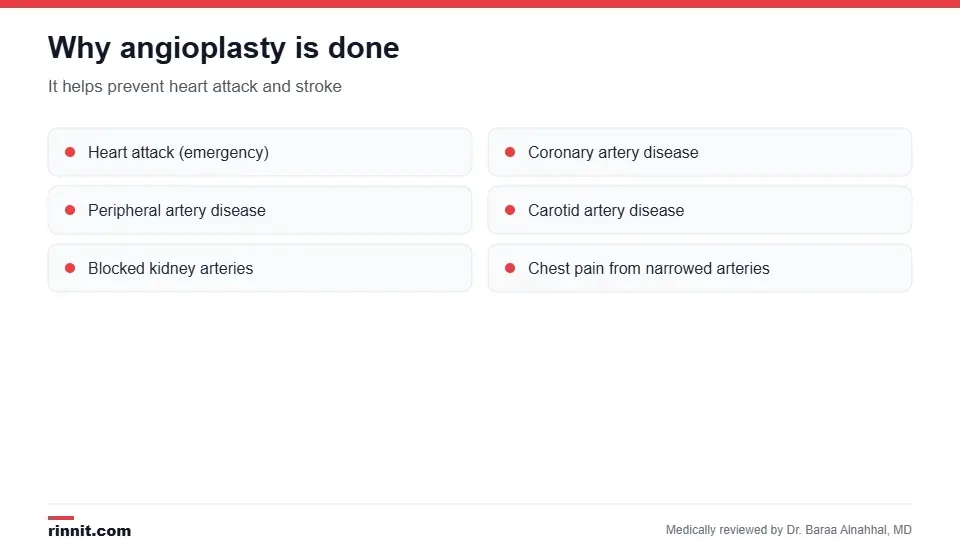
Angioplasty helps prevent heart attack and stroke.
Heart attack, as emergency treatment to restore blood flow.
Coronary artery disease.
Peripheral artery disease, which narrows arteries in the legs.
Carotid artery disease, which narrows arteries in the neck.
Blocked kidney arteries in chronic kidney disease. Sources: [1]
For stable coronary disease without a heart attack, large trials show that medicines alone often work about as well, so angioplasty is mainly used to relieve symptoms or in emergencies. Your cardiologist will help you decide. Sources: [2, 3]
Types of angioplasty
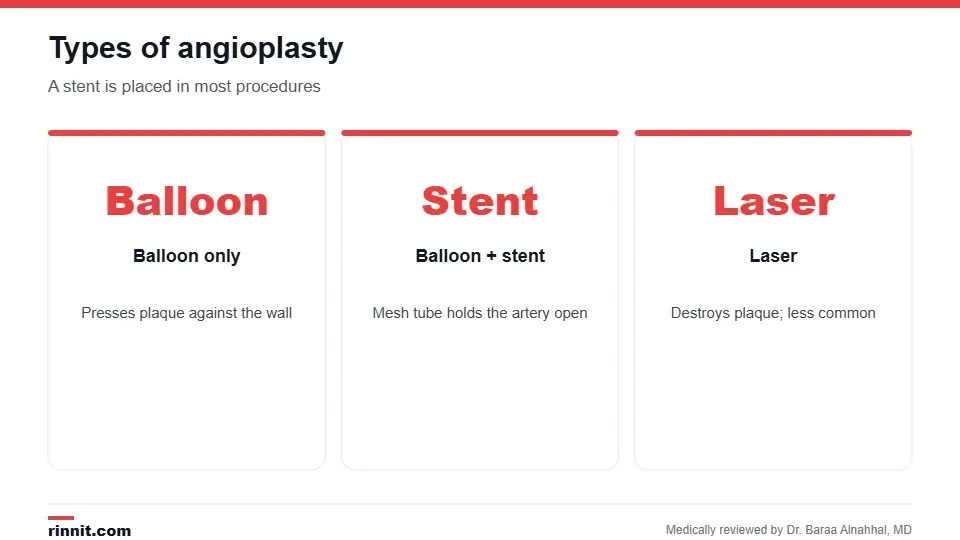
A stent is placed in most procedures.
Type | How it works |
Balloon angioplasty | A tiny balloon presses plaque against the artery wall |
Balloon angioplasty with a stent | A permanent mesh tube holds the artery open |
Excimer laser angioplasty | A laser destroys plaque; less common |
Angioplasty can be done on the heart's arteries (coronary) or on arteries elsewhere in the body (peripheral). Sources: [1]
How to prepare
Don't eat for eight hours before; water may be allowed.
Ask how to adjust your medicines, especially blood thinners.
Tell your provider about allergies to contrast dye or anesthesia and if you might be pregnant.
Arrange a ride home; you may stay overnight. Sources: [1]
What happens during angioplasty
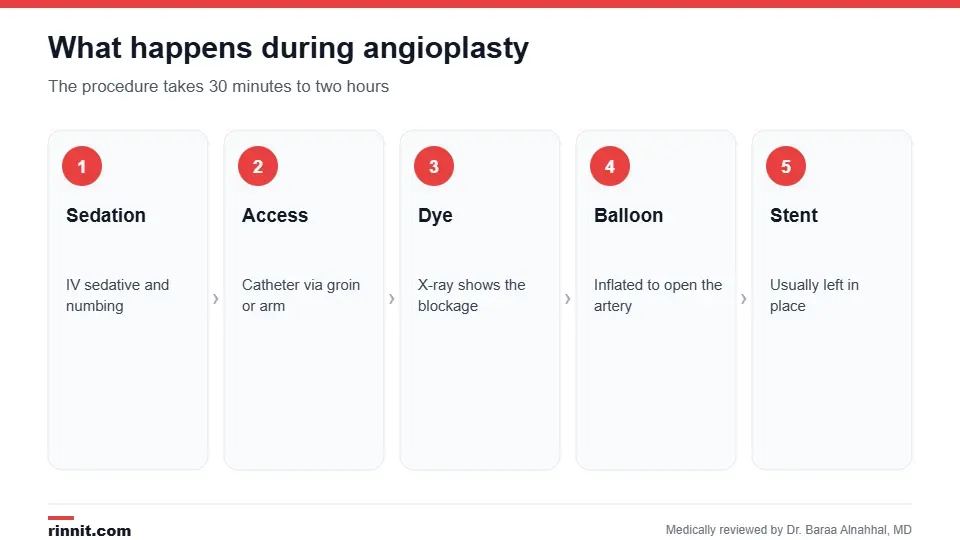
The procedure takes 30 minutes to two hours.
You get a sedative through an IV and numbing medicine at the groin or arm. You stay awake enough to follow instructions.
Your provider places a thin tube (sheath) in the artery and guides a catheter to the blocked artery.
Contrast dye shows the blockage on X-ray, and a guide wire crosses it.
A small balloon is inflated, sometimes more than once, to open the artery.
A stent is usually placed. The catheter is removed and pressure is applied to stop bleeding. Sources: [1]
Tell your care team right away if you feel intense pain during the procedure. Sources: [1]
Risks
Risk | Notes |
Bleeding, pain or infection at the catheter site | Most common |
Artery narrowing again | More likely without a stent |
Blood clots, abnormal heart rhythm | Uncommon |
Allergic reaction to dye | Uncommon |
Kidney or blood vessel damage | Rare |
Heart attack or stroke | Rare |
Serious complications are rare. Risk is higher if you're over 65, have kidney disease or have several blocked arteries. Having it done at an experienced, high-volume center helps. Sources: [1]
Recovery
You may stay a few hours or overnight, and someone else must drive you home.
After a groin procedure, you may need to lie flat for a few hours.
Expect to feel tired; rest and drink fluids.
The catheter site may be sore or bruised for a week or more.
Take aspirin or other blood thinners exactly as prescribed; never skip or stop them on your own.
Most people drive and return to work in about a week. Sources: [1]
When to call your provider
Bleeding or signs of infection at the catheter site.
Pain or warmth at the catheter site.
A change in the color of your leg.
Call 911 for chest pain or stroke symptoms. Sources: [1]
Conclusion
Angioplasty quickly restores blood flow through narrowed arteries and can be lifesaving during a heart attack. Taking your medicines and making heart-healthy changes afterward help keep your arteries open.
Keep learning: read about cardiac catheterization and STEMI heart attacks.
Frequently asked questions
What is angioplasty?
A procedure that uses a balloon to open narrowed or blocked arteries.
Is angioplasty the same as a stent?
Not exactly. A stent is often placed during angioplasty to keep the artery open.
Is angioplasty surgery?
It's minimally invasive; it uses a catheter instead of a large cut.
Am I awake during angioplasty?
Yes, but you're sedated and the access site is numbed.
How long does it take?
30 minutes to two hours.
Does angioplasty hurt?
You may feel brief, mild discomfort; tell your team about strong pain.
How long is recovery?
Most people drive and go back to work in about a week.
What are the risks?
Bleeding at the catheter site, artery renarrowing and, rarely, heart attack or stroke.
Will I need blood thinners?
Yes. Take them exactly as prescribed.
Does angioplasty prevent heart attacks?
It's lifesaving during a heart attack; in stable disease, medicines alone often work as well.
Related Reading
Coronary Brachytherapy: Procedure, Benefits and Risks explains coronary brachytherapy.
Coronary Artery Bypass Graft (CABG) Surgery: Procedure and Recovery explains heart bypass surgery and recovery.
Cardiac Catheterization (Heart Cath): Why It's Done, Procedure, Risks and Recovery a related catheter procedure for the heart.
Heart Attack Symptoms and Treatment: A Complete Guide an emergency treated with angioplasty.
Understanding STEMI: The Severe Heart Attack a severe heart attack that needs fast angioplasty.
NSTEMI Heart Attack: Essential Guide to Symptoms, Risks, and Recovery another type of heart attack.
Acute Coronary Syndrome: What It Is, How It Differs From a Heart Attack, and How It Is Treated sudden reduced blood flow to the heart.
References
Cleveland Clinic. Angioplasty: Procedure, Types & Recovery. Cleveland Clinic. Last updated March 4, 2025. https://my.clevelandclinic.org/health/treatments/22060-angioplasty
Maron DJ, Hochman JS, Reynolds HR, et al. Initial invasive or conservative strategy for stable coronary disease. N Engl J Med. 2020;382(15):1395-1407. PMID 32227755. https://doi.org/10.1056/NEJMoa1915922
Boden WE, O'Rourke RA, Teo KK, et al. Optimal medical therapy with or without PCI for stable coronary disease. N Engl J Med. 2007;356(15):1503-1516. PMID 17387127. https://doi.org/10.1056/NEJMoa070829
Medical disclaimer
This article is for general education only and does not replace advice from a qualified healthcare professional. Talk to your doctor about your own diagnosis and treatment, and seek emergency care right away for severe or sudden symptoms.



Comments