Coronary Brachytherapy: Procedure, Benefits and Risks

Updated: 2 days ago
Written and medically reviewed by Dr. Baraa Alnahhal, MD · Last reviewed: November 2026 · How we review
Quick Answer
Coronary brachytherapy is a minimally invasive treatment that uses a small, controlled dose of radiation inside a heart artery to stop scar tissue from regrowing around a stent. It's used for in-stent restenosis, when a stented artery narrows again. The radiation step takes about 10 minutes, and most people go home the same day.
What the research says
Brachytherapy worked for recurring restenosis: in 6 studies of brachytherapy for recurring restenosis in drug-coated stents, procedural success was 99.8%; repeat procedures were needed in 14.1% at 1 year and 22.7% at 2 years (Ilyas I et al., World Journal of Cardiology, 2021) [2]
Drug-coated stents needed fewer repeat procedures: in 5 studies with 1,375 people with in-stent restenosis, heart attack, stent clots and death were similar at 2 to 5 years, but repeat procedures were more likely after brachytherapy than with drug-eluting stents (Benjo A et al., Catheterization and Cardiovascular Interventions, 2016) [3]
Key takeaways
Coronary brachytherapy uses radiation to stop scar tissue around stents.
It treats in-stent restenosis.
The radiation step takes about 10 minutes.
Most people go home the same day.
It's less common now thanks to drug-eluting stents.
What is coronary brachytherapy?
It's a form of brachytherapy used inside the heart's arteries. It treats in-stent restenosis after percutaneous coronary intervention. Sources: [1]
Who it's for

It usually isn't used for a first restenosis.
Recurring in-stent restenosis.
Multiple or long stents.
Small blood vessels.
Diabetes or other conditions that raise risks of other treatments. Sources: [1]
It's usually not used for a single restenosis, after past chest radiation or when restenosis comes from a balloon problem rather than scar tissue. Sources: [1]
Other treatments for restenosis
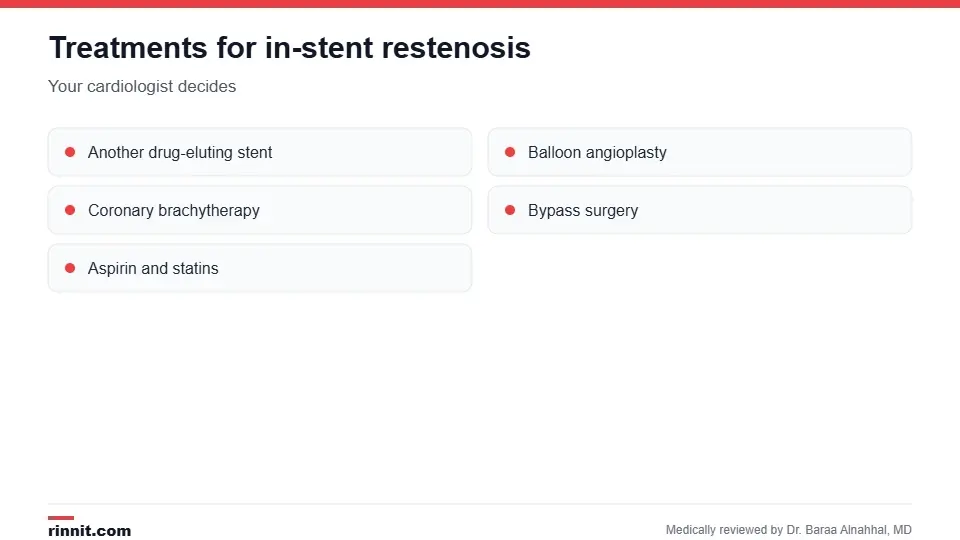
Your cardiologist chooses based on your arteries.
Another stent, often drug-eluting.
Balloon angioplasty, including a cutting balloon.
Medicines such as aspirin and statins. Sources: [1, 3]
What happens during the procedure

The radiation step takes about 10 minutes.
You get sedation; some people get general anesthesia.
An intravascular ultrasound may map your arteries first.
A catheter is guided by X-ray to the narrowed artery.
A small balloon widens the artery.
A controlled radiation dose stays in place for a few minutes.
The radiation and catheter are removed. Sources: [1]
Risks
Abnormal heart rhythms.
Blood clots.
Blood vessel damage.
Infection.
Pain or bleeding at the insertion site. Sources: [1]
The radiation is carefully controlled and doesn't reach other tissues. Sources: [1]
Recovery
Most people go home the same day; some stay overnight.
Rest and avoid strenuous activity for a few days.
Take medicine to prevent blood clots.
Most return to normal activities in a few days. Sources: [1]
Outlook
Studies suggest good long-term results for complex restenosis, but narrowing can come back. A low-fat diet, limited alcohol, no smoking and regular exercise help. Sources: [1, 2, 3]
When to call your provider
Fever.
Severe pain in your chest, jaw, arms or shoulders.
Shortness of breath.
Pus or foul-smelling drainage at the incision. Sources: [1]
Conclusion
Coronary brachytherapy can keep a stubborn stented artery open when restenosis keeps coming back. Heart-healthy habits help protect your results.
Keep learning: read about in-stent restenosis and coronary artery disease.
Frequently asked questions
What is coronary brachytherapy?
Radiation inside a heart artery to stop scar tissue around a stent.
What does it treat?
In-stent restenosis.
What is in-stent restenosis?
When an artery narrows again inside a stent.
Is the radiation safe?
Yes. It's carefully controlled and stays in the artery.
How long does it take?
The radiation step takes about 10 minutes.
Will I stay overnight?
Most people go home the same day.
Who performs it?
An interventional cardiologist and a radiation oncologist.
Why is it less common now?
Drug-eluting stents have lowered restenosis rates.
Can restenosis come back?
Yes, it can recur.
When can I return to normal activities?
Usually in a few days.
Related Reading
In-Stent Restenosis: Causes, Symptoms, and Advanced Treatment Options the condition it treats.
Brachytherapy: What Internal Radiation Is, How It Works and What to Expect internal radiation therapy.
Angioplasty: Procedure, Types, Risks and Recovery opening arteries with a balloon.
Coronary Artery Disease: Symptoms, Causes, Diagnosis, Treatment and Prevention — What You Need to Know an overview of coronary artery disease.
References
Cleveland Clinic. Coronary Brachytherapy: Procedure, Benefits & Risks. Cleveland Clinic. Last updated May 9, 2022. https://my.clevelandclinic.org/health/treatments/17693-coronary-brachytherapy
Ilyas I, Kumar A, Adalja D, et al. Intracoronary brachytherapy for the treatment of recurrent drug-eluting stent in-stent restenosis: a systematic review and meta-analysis. World Journal of Cardiology. 2021;13(4):95-102. PMID 33968308. https://doi.org/10.4330/wjc.v13.i4.95
Benjo A, Cardoso RN, Collins T, et al. Vascular brachytherapy versus drug-eluting stents in the treatment of in-stent restenosis: a meta-analysis of long-term outcomes. Catheterization and Cardiovascular Interventions. 2016;87(2):200-208. PMID 25963829. https://doi.org/10.1002/ccd.25998
Medical disclaimer
This article is for general education only and does not replace advice from a qualified healthcare professional. Talk to your doctor about your own diagnosis and treatment, and seek emergency care right away for severe or sudden symptoms.



Comments