Coronary Artery Calcification: What Calcium in Heart Arteries Means for Your Risk

Updated: 3 days ago
Medically reviewed by Dr. Baraa Alnahhal, MD · Last reviewed: October 2026
Quick Answer
Coronary artery calcification is a buildup of calcium in the coronary arteries, signaling existing coronary artery disease [1]. Most people have no early symptoms [1]. A cardiac CT scan gives a calcium score that estimates heart attack or stroke risk [1]. Care focuses on managing risk factors, often with statin medicine, and on procedures to improve blood flow in severe cases [1].
What the research says
A very low calcium score identifies low-risk people, even with diabetes. A systematic review and meta-analysis of 8 studies (6,521 people with type 2 diabetes, 802 events, mean follow-up 5.18 years) found that a calcium score of 10 or more carried a relative risk of 5.47 (95% CI 2.59–11.53) for death or cardiovascular events compared with a score below 10. A score below 10 meant a post-test probability of about 1.8%. The score was sensitive (94%) but not specific (34%) (PubMed: Kramer et al., BMJ, 2013) [2].
Intravascular lithotripsy worked in nearly all treated calcified lesions in early studies. A meta-analysis of 8 single-arm observational studies (980 patients, 1,011 lesions; severe calcification in 97%) reported clinical success in 95.4% (95% CI 92.9%–97.9%) and angiographic success in 97% (95%–99%). The authors noted that adequately powered randomized trials were still needed (PubMed: Mhanna et al., Cardiovasc Revasc Med, 2021) [3].
Lithotripsy and rotational atherectomy gave similar lumen gain. A 2025 meta-analysis of 11 mostly non-randomized studies (2,120 patients) found that lithotripsy used less contrast (mean difference −17.45 mL) and shorter procedure time (−27.90 min), with no difference in luminal gain. The mortality difference was not statistically significant (OR 0.70; 95% CI 0.35–1.42), and the authors called for further trials (PubMed: Suruagy-Motta et al., Catheter Cardiovasc Interv, 2025) [4].
What Is Coronary Artery Calcification?
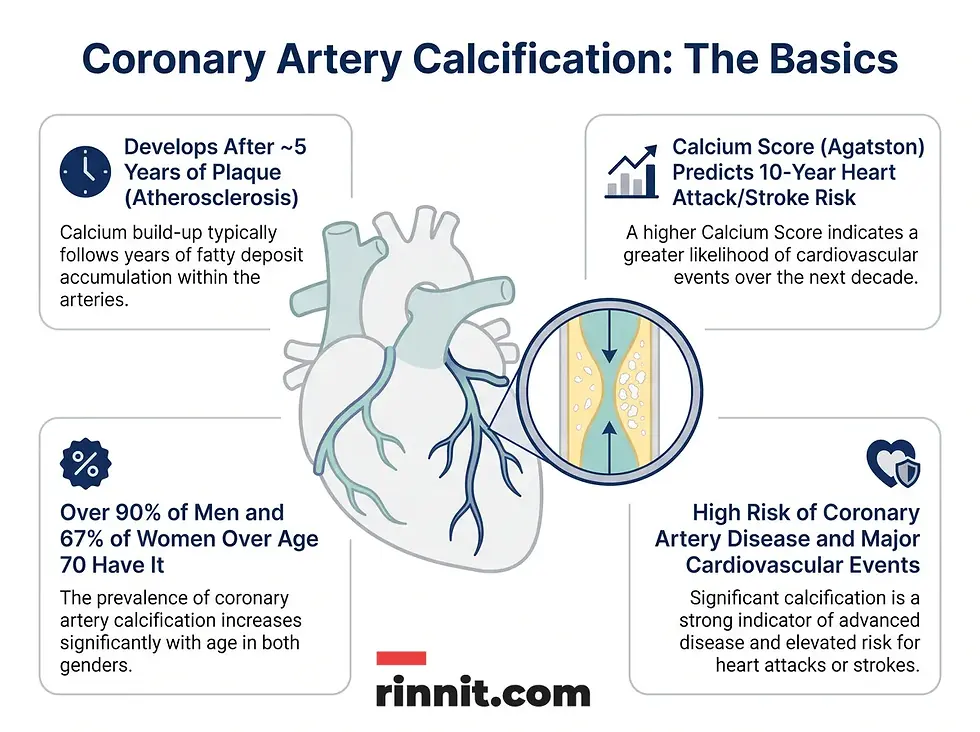
Coronary artery calcification is a collection of calcium in your heart's two main arteries, the coronary arteries. This happens after plaque — made of fat and cholesterol — has been forming in your arteries, a condition called atherosclerosis, for about five years [1].
The coronary arteries supply oxygen-rich blood to your heart muscle. When plaque accumulates in these arteries, it makes it harder for blood to get through. Good blood flow through them is crucial. If blood cannot get through your coronary arteries, the result can be chest pain and/or a heart attack [1]. Coronary artery calcification is an indicator of coronary artery disease. It gives your healthcare provider useful information for assessing your cardiovascular risk [1].
The Two Types
Calcium can collect in different layers of the artery wall. The table below compares the two types [1].
Type | Where It Forms | How Common in Coronary Arteries |
Intimal calcification | In the intimal (inner) artery layer | More common in coronary arteries |
Medial calcification | In the medial (middle) artery layer | Less common |
How It Relates to Atherosclerosis
Coronary artery calcification and atherosclerosis are closely connected, but they are not the same thing. Atherosclerosis is the result of plaque collecting in your arteries, which makes them narrow and makes it difficult for blood to get through. The amount of calcification you have is an indicator of how bad your atherosclerosis may be [1].
Condition | What It Is | Relationship |
Atherosclerosis | Plaque (fat and cholesterol) collecting in and narrowing arteries | The underlying process that precedes calcification |
Coronary artery calcification | Calcium settling into plaque-filled coronary arteries | An indicator of how advanced the atherosclerosis is |
What are the symptoms of coronary artery calcification?
People with coronary artery calcification often do not have any symptoms at first [1]. This is why the condition is frequently discovered only when imaging is done for another reason. Over time, as blood flow becomes more restricted, people may develop symptoms [1].
Symptom | What It Means |
Stable angina | Chest pain that occurs with exertion when the heart needs more oxygen than narrowed arteries can supply |
Shortness of breath | The heart cannot get enough oxygen-rich blood to meet the body's demand |
Heart attack | Blood flow to the heart muscle is severely reduced or blocked |
Because symptoms often do not appear until the buildup has been developing for years, the calcium score from a cardiac CT scan matters even in people who feel fine.
Who Does Coronary Artery Calcification Affect?
The condition is very common with age. People who have coronary heart disease usually have coronary artery calcification. In people older than 70, more than 90 percent of men and 67 percent of women have it [1]. Before menopause, estrogen protects women from developing atherosclerosis. This is why women tend to develop atherosclerosis 10 to 15 years later than men [1]. People who are white are also more likely than other races to have coronary artery calcification, and men have a higher overall risk [1].
Group | Prevalence or Risk |
Men over age 70 | More than 90% have coronary artery calcification |
Women over age 70 | 67% have it |
Women before menopause | Estrogen protects against atherosclerosis, so development is 10 to 15 years later than men |
White adults | More likely than other races to have it |
Men generally | Higher risk than women |
What causes coronary artery calcification, and how does it develop?
After age 40, calcium from your bloodstream can settle in parts of your body. Damaged, inflamed, or repaired arteries are more likely to attract calcium deposits [1]. This process can start in your 20s, but your healthcare provider may not see it until there is an amount large enough to show up on imaging — and most people in their 20s and 30s would not have a reason to get imaging.
Calcium deposits start very small, at about 0.5 micrometers (microns), and grow to be larger than 3 millimeters, with plaque continuing to accumulate at the same time [1]. Researchers believe that microcalcification in the intimal layer starts when smooth muscle cells die [1].
How Coronary Artery Calcification Affects Your Body
Effect on the Body | Consequence |
Makes arteries stiff | Arteries become less able to expand and contract, raising the risk of cardiovascular issues |
Reduces blood flow | Less blood reaches the heart muscle |
Complicates treatment | Makes percutaneous coronary intervention (PCI) and angioplasty harder; harder to expand a stent to keep the artery open |
What are the risk factors for coronary artery calcification?
You are more likely to develop coronary artery calcification if you have certain health conditions and habits [1]. Most of them are the same conditions that drive atherosclerosis in general.
Risk Factor | Category |
Chronic kidney disease | Medical condition |
Diabetes mellitus and other glucose issues | Medical condition |
High LDL ("bad") cholesterol and low HDL ("good") cholesterol | Blood lipids |
High BMI (body mass index) | Weight |
Family history of coronary artery calcification | Genetics |
High blood pressure | Medical condition |
History of cigarette smoking or other tobacco products | Lifestyle |
Older age | Non-modifiable |
Parathyroid hormone irregularities | Hormonal/metabolic |
High phosphate levels | Metabolic |
High calcium level (hypercalcemia) | Metabolic |
How Is Coronary Artery Calcification Diagnosed?
Diagnosis centers on imaging, because the calcification sits inside the artery wall and cannot be seen from the outside. A type of imaging called computed tomography (CT) or multidetector computed tomography (MDCT) can find coronary atherosclerosis before it becomes advanced [1].
The Coronary Artery Calcium (CAC) Test
A cardiac CT scan shows calcified plaque deposits in your coronary arteries. This is called a coronary artery calcium (CAC) test. It looks at three things: how many deposits you have, how dense the deposits are, and how large they are [1].
Your healthcare provider multiplies your calcification area by its density to get an Agatston score. You get a score of 0 to 400 or more, with higher scores indicating a larger risk of a heart attack or stroke in 10 years [1]. Providers have found that the CAC test predicts future cardiovascular risk [1]. Note that you may have to pay for this test out of your own pocket.
Agatston Score | What It Indicates |
0 | No disease |
1 to 99 | Mild disease |
100 to 399 | Moderate disease |
400 or more | Severe disease |
More Invasive Diagnostic Methods
When treatment is being planned, providers may use more invasive imaging to see the calcification from inside the artery.
Test | How It Works | What It Shows |
Cardiac intravascular ultrasound (IVUS) | An ultrasound wand at the end of a catheter (tube) sees the inside of your coronary arteries | A result from Class I to Class IV, with Class IV describing the most severe calcification |
Intravascular optical coherence tomography (IVOCT) | A probe on a catheter sends out near-infrared light and detects it | How much calcification you have and how thick it is |

How Is Coronary Artery Calcification Treated?
Healthcare providers do not have a standard treatment for coronary artery calcification itself [1]. The goal is to improve blood flow through the narrowed, stiffened arteries and to manage the underlying risk factors. For most people, especially those without symptoms, this means lifestyle changes and medicines such as statins, which guidelines generally recommend when the calcium score is 100 or higher; procedures are mainly for severe, symptom-causing blockages.
Intravascular Lithotripsy
For severe cases, some providers use intravascular lithotripsy. This newer procedure uses a catheter (tube) with a device at the end that sends pressure waves out to make the calcification come apart [1] [3]. After the procedure, your provider can put in a stent (small metal tube) to keep your artery open [1].
Other Procedures to Improve Blood Flow
Procedure | How It Works |
Rotational atherectomy | Cuts plaque and calcium out of your artery |
Orbital atherectomy | Cuts plaque and calcium out of your artery using a different motion |
Laser atherectomy | Uses laser energy to cut plaque and calcium out of your artery |
Cutting balloon angioplasty | Uses a balloon with blades to push plaque with calcium against your artery walls |
Scoring balloon angioplasty | Uses a balloon with scoring elements to push plaque against your artery walls |
High-pressure balloon angioplasty | Uses a high-pressure balloon to push plaque against your artery walls |
Complications of Treatment
Each of these procedures carries real risks. Your care team weighs these against the risk of leaving the artery narrowed.
Procedure | Possible Complications |
Intravascular lithotripsy | Arrhythmia (abnormal heart rhythm), aneurysm (a blood vessel that is stretched out), bleeding complications, stroke, death |
Rotational atherectomy | Artery dissection, heart attack, death, emergency coronary artery bypass graft (CABG) |
Coronary angioplasty | Heart attack, stroke, arrhythmia, bleeding, blood clots |

What is the outlook for coronary artery calcification?
If you have coronary artery calcification, you are at a high risk of developing coronary artery disease and major adverse cardiovascular events (MACE) [1]. The condition also has a practical effect on treatment: coronary artery calcification increases the chances that a balloon angioplasty will fail [1]. It also makes it more difficult to put a stent in a position where it would work best [1]. The procedural success rates, however, are encouraging.
Procedure | Reported Success Rate |
Intravascular lithotripsy | Successful in more than 92% of cases |
Rotational atherectomy | 90% success rate |
How can coronary artery calcification be prevented?
You cannot prevent calcium from entering the bloodstream, but you can reduce your risk of coronary artery calcification by treating the problems that put you at risk for it [1].
Underlying Problem | Why Treating It Matters |
Diabetes mellitus | High blood glucose accelerates plaque formation |
Abnormal cholesterol levels | Excess LDL drives plaque buildup in artery walls |
High blood pressure | Elevated pressure damages artery walls, attracting calcium |
Kidney disease | Chronic kidney disease is a direct risk factor for calcification |
How can people live well with coronary artery calcification?
Taking care of yourself with this condition means following the recommendations for a heart-healthy lifestyle [1].
Self-Care Step | Practical Guidance |
Diet | Eat foods low in fat |
Tobacco | Avoid tobacco products entirely |
Exercise | Exercise regularly |
Blood pressure and cholesterol | Keep both at a normal level |
When to see your healthcare provider. If you have high blood pressure and/or high cholesterol, you should see your healthcare provider regularly to make sure you are controlling those issues [1]. See your provider if you need a plan for how to improve your cardiovascular health.
When to go to the ER. Call 911 if you are having chest pain, nausea and vomiting, shortness of breath, or other signs of a heart attack [1].
Conclusion
Coronary artery calcification is a warning sign that shows up inside your heart's arteries long before symptoms do. It reflects about five years of plaque buildup, and its presence raises your risk of coronary artery disease and major cardiovascular events. The good news is that it is measurable with a single cardiac CT scan, treatable with procedures that succeed in more than 90 percent of cases, and preventable in practice through the same habits that protect the whole cardiovascular system: controlling blood pressure and cholesterol, managing blood sugar, staying active, and avoiding tobacco.
If you have high blood pressure, high cholesterol, diabetes, or kidney disease, ask your healthcare provider whether a coronary artery calcium (CAC) test is right for you — and take the first step today by scheduling a heart-health checkup.
Related guides: What Is Coronary Artery Disease? Complete Guide and Heart Attack Symptoms and Treatment: A Complete Guide.
Frequently Asked Questions
1. What is coronary artery calcification?
Coronary artery calcification is a collection of calcium in the heart's two main arteries, the coronary arteries. It develops after plaque (fat and cholesterol) has been forming in the arteries — a process called atherosclerosis — for about five years. It signals existing coronary artery disease and helps providers assess cardiovascular risk.
2. What causes calcium to build up in coronary arteries?
After age 40, calcium from the bloodstream can settle in parts of the body. Damaged, inflamed, or repaired arteries attract calcium deposits more readily. The process can start in your 20s, but deposits are not usually seen until they are large enough to show up on imaging. Researchers believe intimal microcalcification starts when smooth muscle cells die.
3. What are the symptoms of coronary artery calcification?
Most people have no symptoms at first. Over time, symptoms can include stable angina (chest pain with exertion), shortness of breath, and heart attack. Because symptoms arrive late, the condition is often found on imaging done for other reasons.
4. How is coronary artery calcification measured?
A cardiac CT scan performs a coronary artery calcium (CAC) test that counts your deposits, measures their density, and sizes them. Your provider multiplies calcification area by density to calculate an Agatston score from 0 to 400 or more. Higher scores mean a larger ten-year risk of heart attack or stroke.
5. What do coronary artery calcium score results mean?
A score of 0 shows no disease. Scores from 1 to 99 indicate mild disease, 100 to 399 show moderate disease, and 400 or more shows severe disease. The CAC test has been found to predict future cardiovascular risk, though you may need to pay out of pocket for it.
6. Who is most likely to get coronary artery calcification?
In people older than 70, more than 90% of men and 67% of women have it. Before menopause, estrogen protects women, so women typically develop atherosclerosis 10 to 15 years later than men. White adults are more likely than other races to have it. Risk rises with kidney disease, diabetes, abnormal cholesterol, high blood pressure, high BMI, tobacco use, older age, and family history.
7. Can coronary artery calcification be treated?
There is no standard treatment for the calcification itself, but providers can open severely narrowed arteries. Intravascular lithotripsy uses pressure waves to break calcium apart before placing a stent (successful in over 92% of cases). Atherectomy cuts plaque and calcium out of the artery (about 90% success), and cutting, scoring, or high-pressure balloon angioplasty pushes calcified plaque against the artery walls.
8. Does coronary artery calcification make treatment harder?
Yes. Calcification makes arteries stiff and less able to expand and contract. It makes percutaneous coronary intervention and angioplasty more difficult, increases the chance that balloon angioplasty will fail, and makes it harder to position a stent where it would work best.
9. How can I lower my risk of coronary artery calcification?
You can lower your risk by treating the problems that put you at risk for it: diabetes mellitus, abnormal cholesterol levels, high blood pressure, and kidney disease. Eating low-fat foods, avoiding tobacco, exercising regularly, and keeping blood pressure and cholesterol normal are the recommended day-to-day steps.
10. When should I go to the emergency room for heart symptoms?
Call 911 if you are having chest pain, nausea and vomiting, shortness of breath, or other signs of a heart attack. Do not wait to see whether symptoms pass.
11. What questions should I ask my doctor about coronary artery calcification?
Ask whether you need to have your coronary artery calcification checked, how severe your calcification is, and what treatment your provider recommends for your specific situation. These three questions form a practical starting point for a heart-health conversation.
References
Cleveland Clinic. Coronary Artery Calcification. Cleveland Clinic. May 9, 2022. https://my.clevelandclinic.org/health/diseases/22953-coronary-artery-calcification
Kramer CK, Zinman B, Gross JL, et al. Coronary artery calcium score prediction of all cause mortality and cardiovascular events in people with type 2 diabetes: systematic review and meta-analysis. BMJ. 2013;346:f1654. doi:10.1136/bmj.f1654. PMID: 23529983.
Mhanna M, Beran A, Nazir S, et al. Efficacy and safety of intravascular lithotripsy in calcified coronary lesions: a systematic review and meta-analysis. Cardiovasc Revasc Med. 2021;36:73-82. doi:10.1016/j.carrev.2021.05.009. PMID: 34024748.
Suruagy-Motta RFO, Cabeça LS, Da Silva AMP, et al. Intravascular lithotripsy versus rotational atherectomy for calcified coronary lesions: a systematic review and an updated meta-analysis of clinical outcomes. Catheter Cardiovasc Interv. 2025;106(1):563-572. doi:10.1002/ccd.31591. PMID: 40356295.
Medical Disclaimer
This article is for informational purposes only and does not constitute medical advice. Always seek the advice of your physician or other qualified health provider with any questions you may have regarding a medical condition. Never disregard professional medical advice or delay in seeking it because of something you have read here.



Comments