Coronary Flow Reserve (CFR): What It Measures and Normal Values

Updated: 3 days ago
Written and medically reviewed by Dr. Baraa Alnahhal, MD · Last reviewed: November 2026 · How we review
Quick Answer
Coronary flow reserve (CFR) is a measure of how much blood flow to the heart can increase when it needs to work harder. A normal CFR is above about 2 to 2.5. A CFR below 2 suggests the heart's arteries can't deliver enough extra blood and is linked to a higher risk of heart attack and death.
What the research says
Low CFR predicts cardiac death: in 2,783 people who had PET heart scans, a low coronary flow reserve was linked to a 3.2-fold higher rate of cardiac death in people with diabetes and 4.9-fold higher in people without diabetes (Murthy VL et al., Circulation, 2012) [2]
CFR adds information beyond an angiogram: in 329 people followed for a median of 3.1 years, each 1-unit drop in coronary flow reserve doubled the risk of major heart events, regardless of how blocked the arteries looked on an angiogram (Taqueti VR et al., Circulation, 2015) [3]
Key takeaways
CFR compares maximum heart blood flow with resting flow.
Normal CFR is above about 2 to 2.5.
CFR below 2 is linked to higher heart risk.
It can reveal problems in tiny heart vessels that an angiogram can't see.
It's measured by PET, MRI or catheterization with adenosine.
What is coronary flow reserve?
When you exercise, your heart's arteries widen so blood flow can rise several times above resting levels. CFR shows how well this "reserve" works. Blockages in the large coronary arteries lower it, but so does disease of the small vessels (coronary microvascular disease), which a standard coronary angiogram can't see. CFR naturally declines with age. It's also called myocardial blood flow reserve. Sources: [1]
Why it's done
Detect coronary artery disease and judge how severe it is.
Look for microvascular disease in people with chest pain but open arteries.
Identify people at higher risk of future heart attacks or other events.
Help guide treatment decisions. Sources: [1, 2, 3]
How CFR is measured
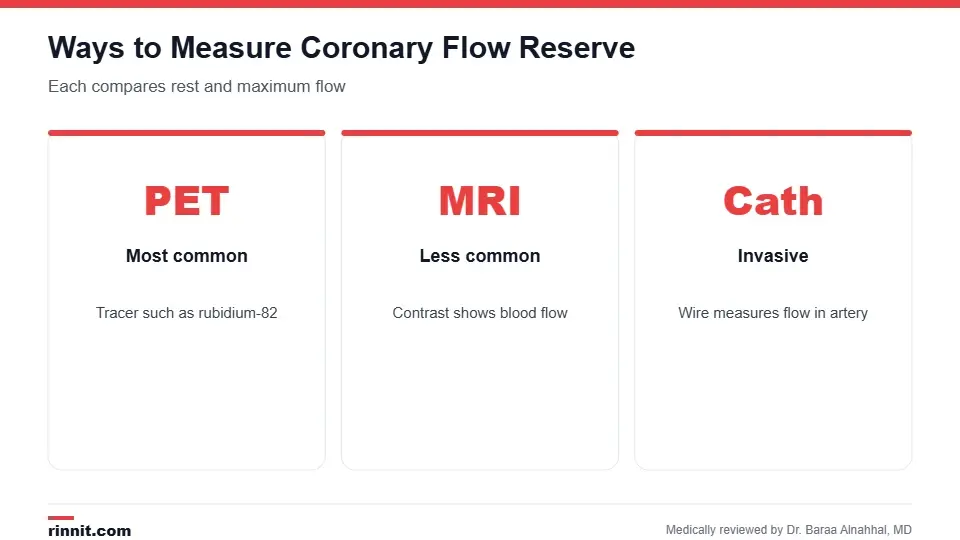
Each method compares blood flow at rest and after a vasodilator.
Method | How it works | Notes |
A tracer such as rubidium-82 shows blood flow | Noninvasive; most common | |
Cardiac MRI | Contrast shows blood flow | Noninvasive; less often used |
Catheterization | A wire or catheter measures flow inside the artery | Invasive; done with an angiogram |
Sources: [1]
How to prepare

Your care team will give you exact instructions.
Tell your provider about all medicines and any allergies to medicines, dyes or latex.
For PET or catheterization, stop eating and drinking, typically 6 to 8 hours before.
For MRI, remove metal, and tell your provider about implanted devices.
If you'll be sedated, arrange for someone to drive you home.
Ask whether to avoid caffeine before the test. Sources: [1]
What happens during the test
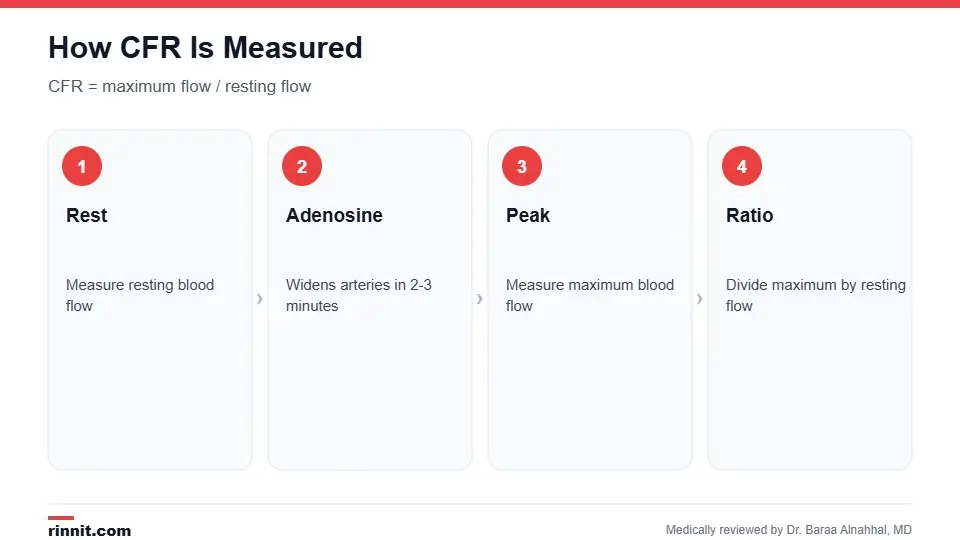
CFR is the ratio of the two measurements.
Blood flow to your heart is measured at rest.
A medicine such as adenosine is given through an IV or catheter to widen the arteries; it takes about 2 to 3 minutes to work.
Blood flow is measured again at its peak.
The maximum flow is divided by the resting flow to calculate your CFR. Sources: [1]
Risks
CFR testing is considered safe. With catheterization, risks include bleeding, blood clots, artery spasm and, rarely, vessel injury. Adenosine can cause brief chest discomfort, shortness of breath, low blood pressure or an irregular heartbeat, and people with asthma should usually avoid it. After catheterization, you'll keep the access-site limb straight for an hour or more. Sources: [1]
Results
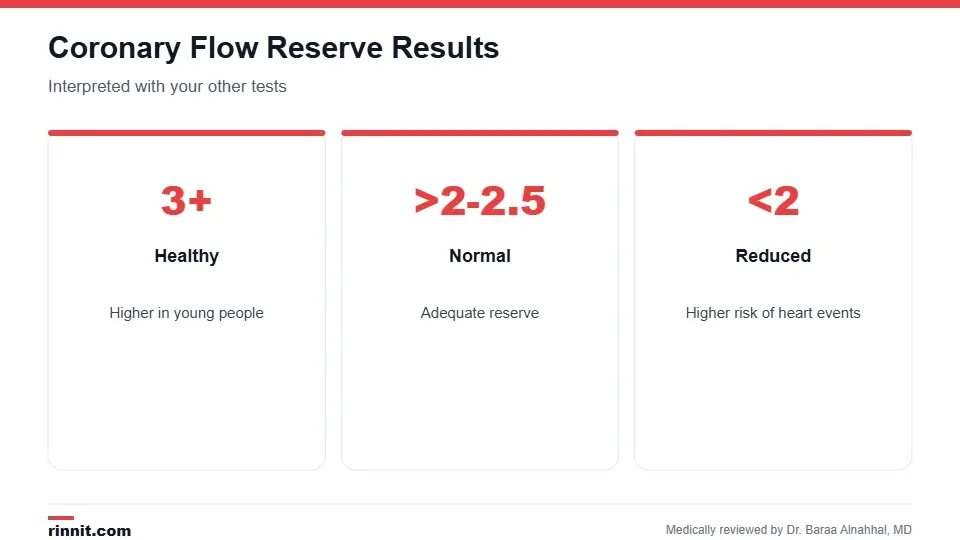
Your provider interprets CFR with your other test results.
CFR value | What it suggests |
About 3 or more | Healthy reserve; higher values in young people |
Above 2 to 2.5 | Normal |
Below 2 | Reduced reserve and higher risk of heart events |
Results may take a few days. A low CFR may lead to treatment for coronary artery or microvascular disease. Sources: [1, 2, 3]
Conclusion
Coronary flow reserve shows how well your heart's blood supply can rise to meet demand. It adds information an angiogram can't give, especially about small-vessel disease, and helps predict and lower your risk of future heart problems.
Keep learning: read about the cardiac PET scan and coronary artery disease.
Frequently asked questions
What is coronary flow reserve?
How much heart blood flow can increase from rest to maximum.
How is CFR calculated?
Maximum blood flow divided by resting blood flow.
What is a normal CFR?
Above about 2 to 2.5.
What does a low CFR mean?
Reduced reserve and a higher risk of heart events.
Can CFR find small-vessel disease?
Yes. It can show microvascular disease an angiogram misses.
How is CFR measured?
With a cardiac PET scan, cardiac MRI or catheterization.
What medicine is used?
Usually adenosine, which widens the arteries.
Does CFR change with age?
Yes. It naturally declines as you get older.
Is the test safe?
Yes, though catheterization carries small risks.
When will I get results?
Usually within a few days.
Related Reading
Fractional Flow Reserve (FFR): Deciding Whether You Need a Stent explains the pressure wire test that shows whether a blockage needs a stent.
Cardiac PET Scan: Heart Blood Flow Imaging, Prep and Results the most common way to measure CFR.
Coronary Artery Disease: Symptoms, Causes, Diagnosis, Treatment and Prevention — What You Need to Know a main cause of reduced CFR.
Coronary Angiogram: Why It's Done, What to Expect and Recovery the X-ray test of the heart arteries.
Cardiac Catheterization (Heart Cath): Why It's Done, Procedure, Risks and Recovery the invasive way to measure CFR.
Nuclear Stress Test: How It Works, How to Prepare and What Results Mean another test of heart blood flow.
References
Cleveland Clinic. Coronary Flow Reserve (CFR). Cleveland Clinic. Last updated August 11, 2022. https://my.clevelandclinic.org/health/diagnostics/24028-coronary-flow-reserve
Murthy VL, Naya M, Foster CR, et al. Association between coronary vascular dysfunction and cardiac mortality in patients with and without diabetes mellitus. Circulation. 2012;126(15):1858-1868. PMID 22919001. https://doi.org/10.1161/CIRCULATIONAHA.112.120402
Taqueti VR, Hachamovitch R, Murthy VL, et al. Global coronary flow reserve is associated with adverse cardiovascular events independently of luminal angiographic severity and modifies the effect of early revascularization. Circulation. 2015;131(1):19-27. PMID 25400060. https://doi.org/10.1161/CIRCULATIONAHA.114.011939
Medical disclaimer
This article is for general education only and does not replace advice from a qualified healthcare professional. Talk to your doctor about your own diagnosis and treatment, and seek emergency care right away for severe or sudden symptoms.



Comments