Coronary Angiogram: Why It's Done, What to Expect and Recovery

Updated: 2 days ago
Written and medically reviewed by Dr. Baraa Alnahhal, MD · Last reviewed: November 2026 · How we review
Quick Answer: What is a coronary angiogram?
A coronary angiogram is an X-ray test that uses contrast dye to show blood flow through the arteries that supply the heart. A cardiologist passes a thin catheter from an artery in the arm or groin to the heart and looks for narrowing or blockages. A blockage can sometimes be opened right away with a balloon or stent. [1]
What the research says
Not everyone with stable heart disease needs an early angiogram. In 5,179 people with stable coronary disease and moderate or severe ischemia, starting with angiography and opening arteries did not lower the five-year rate of major heart events compared with medicines first (16.4% vs 18.2%, not significant). (Maron et al., The New England Journal of Medicine, 2020) [2]
Going through the wrist can be safer in heart attacks. In 8,404 people with acute coronary syndrome, wrist (radial) access reduced major bleeding (1.6% vs 2.3%) and death from any cause (1.6% vs 2.2%) compared with groin (femoral) access. (Valgimigli et al., The Lancet, 2015) [3]
Key takeaways
What is a coronary angiogram?
A coronary angiogram, also called coronary angiography, is an X-ray imaging test that uses contrast dye to show blood flow in your coronary (heart) arteries. [1]
It finds blockages or narrowing in these arteries, which are usually caused by atherosclerosis (plaque buildup). A blocked coronary artery can lead to a heart attack. The images help your cardiologist decide whether you need medicine, a stent or surgery. [1]
Who needs a coronary angiogram?
Your provider may recommend one if you have: [1]
An abnormal stress test or electrocardiogram (EKG)
Heart valve disease, heart failure or a past heart attack
Planned heart surgery, when coronary artery disease is suspected
New or changing chest pain (angina)
Unusual chest discomfort or shortness of breath when other tests are normal
How do you prepare?
Plan on spending a few hours at the hospital. [1]
Fast (have only water) for eight hours before the test.
Ask whether to adjust blood thinners, diabetes medicines, diuretics or sildenafil.
Tell your provider about any past allergic reaction to contrast dye or anesthesia, and whether you might be pregnant.
Arrange a ride home. You can't drive yourself on the day of the procedure.
What happens during a coronary angiogram?

You change into a gown and lie on your back.
You receive an IV sedative that relaxes you but keeps you awake enough to follow instructions, such as coughing or holding your breath.
An EKG monitors your heart rhythm throughout.
Local anesthetic numbs the access site, usually in your groin or arm. You may feel pressure but should not feel pain.
Your cardiologist places a sheath (thin tube) into a large artery and passes wires and catheters through it to your coronary arteries.
A rotating X-ray machine lets your cardiologist see the catheter from all angles.
Dye is injected through the catheter, and X-rays track its path. You may feel flushed or feel the need to urinate for a few seconds.
Sources: [1]
Your cardiologist looks for plaque that limits blood flow. If they find a blockage, they may open it right away with a balloon (angioplasty) and place a stent to keep the artery open. If that isn't possible, or another procedure would be better later, the angiogram ends. [1]
The procedure typically takes 30 to 50 minutes. [1]
Does a coronary angiogram hurt?
Pain is minimal. You may feel a brief pinch when the IV goes in and when the numbing medicine is injected. The catheter itself should not hurt, but the sites may be sore for about a week. Tell your provider right away if you feel intense pain. [1]
What is recovery like?
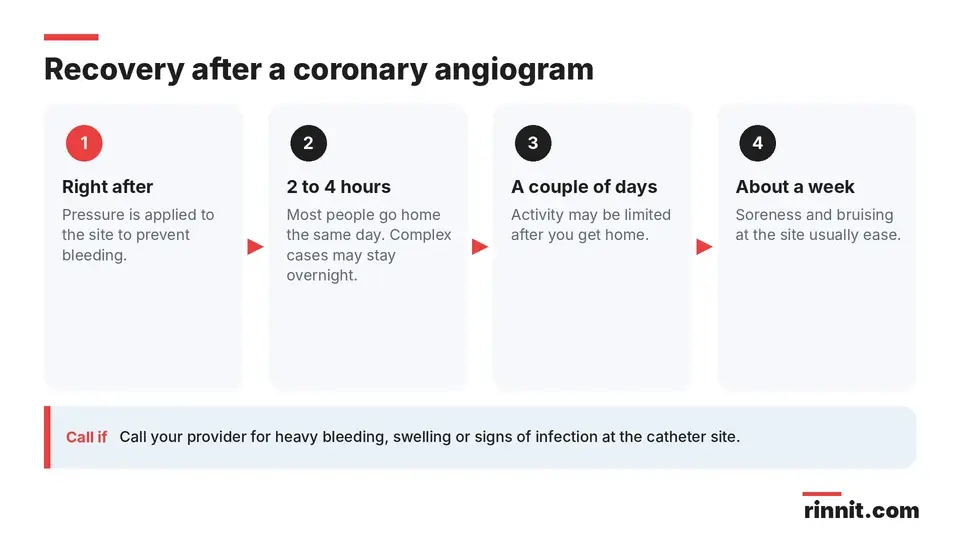
Time after the procedure | What to expect |
Right after | A provider presses on the site to prevent bleeding |
2 to 4 hours | Most people go home the same day |
A couple of days | Your activity may be limited |
About a week | Soreness and bruising at the site ease |
Sources: [1]
Be ready to stay overnight if your procedure was complex or done in the afternoon. You may feel tired afterward. [1]
What are the risks?
A coronary angiogram is generally safe, but it is more invasive than imaging tests such as ultrasound. Serious complications are rare. Choosing a center that does many of these procedures is recommended. Possible risks include: [1]
Abnormal heart rhythms
Allergic reaction to the dye or anesthetic
Injury to a blood vessel or blood clots
Pain, bleeding or infection at the catheter site
Cardiac tamponade (fluid pressing on the heart)
Heart attack or stroke
Kidney damage, rarely needing dialysis
Low blood pressure
Your risk is higher if you are over 65 or have diabetes or kidney disease. [1]
What do the results mean?
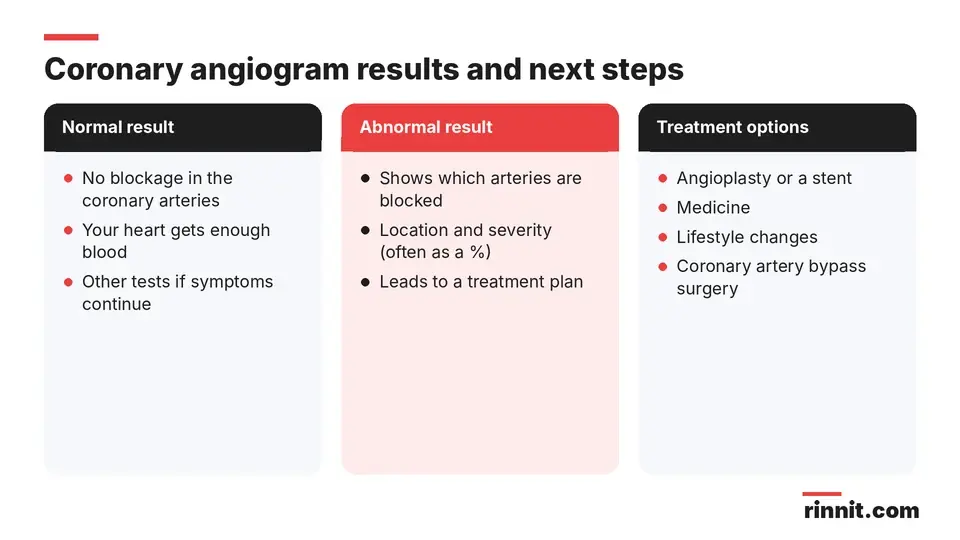
You may be able to watch your X-rays during the procedure, and your provider explains the results afterward. [1]
Normal result: nothing blocks your coronary arteries, and your heart gets enough blood. If symptoms continue, you may need other tests.
Abnormal result: your provider identifies which arteries are blocked, where and how severely, often as a percentage.
Treatment for blockages may include angioplasty or stenting, medicine, lifestyle changes such as more activity and diet changes, or coronary artery bypass surgery. [1]
When should you call your doctor?
Contact your provider if you have: [1]
Heavy bleeding, swelling or signs of infection at the catheter site, such as skin discoloration or pus
Circulation problems in your arms or legs
Conclusion
A coronary angiogram is the most direct way to see inside the arteries that feed your heart. It shows exactly where blood flow is limited, and in many cases a blockage can be treated during the same procedure.
Follow your fasting and medicine instructions, arrange a ride home and plan for a few quiet days afterward. Call 911 if you have chest pain, trouble breathing, signs of a stroke, or bleeding at the catheter site that does not stop with firm pressure.
Keep learning: Read our coronary artery disease guide or our guide to cardiac catheterization. For more background, see the MedlinePlus page on coronary angiography.
FAQ
What is a coronary angiogram?
It is an X-ray test that uses contrast dye to show blood flow and blockages in the arteries supplying your heart. [1]
Why is a coronary angiogram done?
To find narrowed or blocked coronary arteries, often after an abnormal stress test, chest pain or a heart attack. [1]
How long does a coronary angiogram take?
Typically 30 to 50 minutes. [1]
Are you awake during a coronary angiogram?
Yes. You get an IV sedative that relaxes you but keeps you awake enough to follow instructions. [1]
Where is the catheter inserted?
Usually through an artery in the groin or arm. [1]
Do I need to fast before a coronary angiogram?
Yes. Have only water for eight hours beforehand. [1]
Can a blockage be treated during the angiogram?
Often, yes, with a balloon (angioplasty) and a stent. [1]
How soon can I go home?
Most people go home two to four hours after the procedure. [1]
What are the risks of a coronary angiogram?
Serious complications are rare but include bleeding, arrhythmia, allergic reaction, kidney damage, heart attack and stroke. [1]
When should I call my doctor after an angiogram?
Call for heavy bleeding, swelling or infection signs at the site, or circulation problems in an arm or leg. [1]
Related Reading
Fractional Flow Reserve (FFR): Deciding Whether You Need a Stent explains the pressure wire test that shows whether a blockage needs a stent.
Coronary Flow Reserve (CFR): What It Measures and Normal Values explains how coronary flow reserve shows the heart's ability to boost blood flow.
Cardiac MRI Adenosine Stress Test: Prep, Side Effects and Results explains the stress heart MRI that uses adenosine instead of exercise.
Intravascular Ultrasound (IVUS): Seeing Inside Arteries to Guide Stents explains the catheter ultrasound that images arteries from the inside.
Cardiac Imaging: Types of Heart Scans and What Each One Shows compares the main heart imaging tests and what each one shows.
Dobutamine Stress Echocardiogram: How It Works, Preparation and Results explains the medicine-based stress test for people who can't exercise.
Coronary Artery Disease: Symptoms, Causes, Diagnosis, Treatment and Prevention — What You Need to Know explains the condition a coronary angiogram is used to diagnose.
Angina: Symptoms, Causes, Treatment & Complete Guide covers the chest pain that often leads to this test.
Heart Attack Symptoms and Treatment: A Complete Guide describes the emergency in which an angiogram guides treatment.
Unstable Angina: Understanding the Emergency Warning Signs of a Heart Attack explains a warning sign that often calls for urgent angiography.
Arteriosclerosis & Atherosclerosis: Symptoms, Causes, Diagnosis & Treatment — Complete Guide covers the plaque buildup an angiogram reveals.
Exercise Stress Echocardiogram: Why It's Done, How to Prepare and What Results Mean explains the heart ultrasound done at rest and after exercise.
References
Cleveland Clinic. Coronary Angiogram: Procedure & What To Expect. Cleveland Clinic. Last updated February 17, 2025. https://my.clevelandclinic.org/health/diagnostics/22164-coronary-angiogram
Maron DJ, Hochman JS, Reynolds HR, et al. Initial Invasive or Conservative Strategy for Stable Coronary Disease. N Engl J Med. 2020;382(15):1395-1407. PMID 32227755. https://doi.org/10.1056/NEJMoa1915922
Valgimigli M, Gagnor A, Calabró P, et al. Radial versus femoral access in patients with acute coronary syndromes undergoing invasive management: a randomised multicentre trial. Lancet. 2015;385(9986):2465-2476. PMID 25791214. https://doi.org/10.1016/S0140-6736(15)60292-6
Medical disclaimer
This article is for general education only and does not replace advice from a qualified healthcare professional. Talk to your doctor about your own diagnosis and treatment, and seek emergency care right away for severe or sudden symptoms.



Comments