Intravascular Ultrasound (IVUS): Seeing Inside Arteries to Guide Stents

Updated: 3 days ago
Written and medically reviewed by Dr. Baraa Alnahhal, MD · Last reviewed: November 2026 · How we review
Quick Answer
Intravascular ultrasound (IVUS) is a minimally invasive test that uses a tiny ultrasound probe on the tip of a thin catheter to see blood vessels from the inside. It shows how much plaque has built up and how narrow the artery is. It's most often done during cardiac catheterization to plan and check stent placement.
What the research says
IVUS-guided stenting improves outcomes: in 1,400 people with long coronary blockages, using IVUS to guide stent placement lowered major heart events at 1 year to 2.9%, compared with 5.8% when stents were guided by angiography alone (Hong SJ et al., JAMA, 2015) [2]
The benefit holds for all patients: in 1,448 all-comer patients getting drug-eluting stents, target-vessel failure at 12 months was 2.9% with IVUS guidance vs. 5.4% with angiography guidance, and lowest (1.6%) when IVUS-defined optimal results were reached (Zhang J et al., Journal of the American College of Cardiology, 2018) [3]
Key takeaways
IVUS uses sound waves to image blood vessels from inside.
It shows plaque, narrowing and how well a stent is expanded.
It's usually done during cardiac catheterization.
It uses no radiation by itself.
IVUS-guided stenting reduces heart problems compared with angiography alone.
What is IVUS?
IVUS is also called coronary intravascular ultrasound, endovascular ultrasound or intravascular echocardiography. The catheter's probe sends out sound waves, and the echoes from the vessel walls are turned into real-time images on a screen. An interventional cardiologist or vascular surgeon performs it. Sources: [1]
IVUS vs. angiogram

IVUS adds a view from inside the artery.
Feature | Angiogram | IVUS |
Technology | X-rays and contrast dye | Sound waves |
Image | 2D outline of the inside of the vessel | Cross-section of the vessel wall |
Shows plaque in the wall | Limited | Yes |
Guides stent size and expansion | Estimates | Measures directly |
The two are often used together. Sources: [1, 2]
Why it's done

IVUS helps your team choose the best treatment.
Assess plaque buildup (atherosclerosis) and how severe it is.
Decide whether you need a stent or bypass surgery.
Plan stent size and check that a stent is fully expanded, including in in-stent restenosis.
Evaluate peripheral artery disease, carotid artery disease, deep vein thrombosis, aortic aneurysm and pulmonary artery stenosis. Sources: [1]
What happens during the procedure
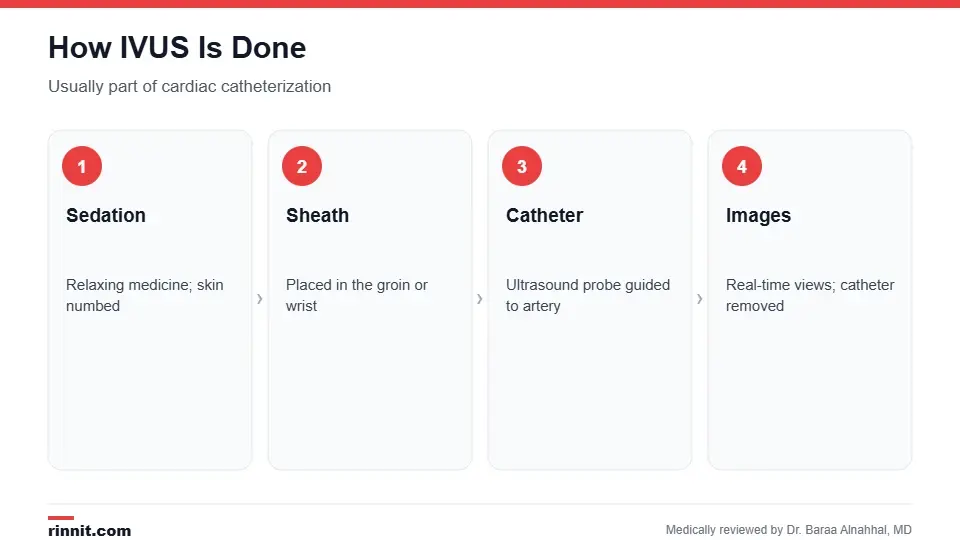
You're usually awake but comfortable.
You receive a sedative to help you relax.
The skin over the access site, often the groin or wrist, is cleaned and numbed.
A thin plastic sheath is placed in the blood vessel.
The IVUS catheter is guided to the area of interest and images are captured.
The catheter and sheath are removed and a dressing is applied; stitches usually aren't needed. Sources: [1]
Risks
IVUS is generally safe. Possible risks include an irregular heartbeat during coronary IVUS, blood clots, infection at the incision site, and damage or a tear (dissection) in the blood vessel. Sources: [1]
Recovery and results
If IVUS is done on its own, you can usually go home the same day. If it's part of coronary catheterization or stenting, you may stay overnight. Images are seen in real time, so your provider can act on them during the procedure, and they usually discuss the results once the sedation wears off. Sources: [1]
Conclusion
IVUS gives your heart team a detailed view from inside your arteries, helping them choose the right treatment and place stents more precisely. Research shows this precision translates into fewer major heart problems, mainly fewer repeat procedures.
Keep learning: read about the coronary angiogram and cardiac catheterization.
Frequently asked questions
What is intravascular ultrasound?
A test that uses a tiny ultrasound probe on a catheter to see inside blood vessels.
Why is IVUS done?
To measure plaque and narrowing and to guide stent placement.
Is IVUS the same as an angiogram?
No. An angiogram uses X-rays; IVUS uses sound waves from inside the vessel.
Does IVUS use radiation?
IVUS itself doesn't, though the catheterization it's part of usually does.
Will I be awake?
Usually yes, with sedation and local numbing.
Does IVUS hurt?
You shouldn't feel discomfort during the procedure.
What are the risks?
Irregular heartbeat, blood clots, infection and vessel damage.
Can I go home the same day?
Often yes, though coronary procedures may need an overnight stay.
Does IVUS improve stent results?
Yes. Studies show fewer heart events with IVUS-guided stenting.
When will I get results?
Usually right after the procedure, once sedation wears off.
Related Reading
Fractional Flow Reserve (FFR): Deciding Whether You Need a Stent explains the pressure wire test that shows whether a blockage needs a stent.
Coronary Angiogram: Why It's Done, What to Expect and Recovery the X-ray test often done with IVUS.
Cardiac Catheterization (Heart Cath): Why It's Done, Procedure, Risks and Recovery the procedure during which IVUS is usually done.
Coronary Artery Disease: Symptoms, Causes, Diagnosis, Treatment and Prevention — What You Need to Know the main condition IVUS evaluates.
In-Stent Restenosis: Causes, Symptoms, and Advanced Treatment Options a stent problem IVUS helps assess.
Peripheral Artery Disease (PAD): Symptoms, Causes, Diagnosis & Treatment Options another condition IVUS can evaluate.
References
Cleveland Clinic. Intravascular Ultrasound (IVUS). Cleveland Clinic. Last updated July 12, 2022. https://my.clevelandclinic.org/health/diagnostics/17143-intravascular-ultrasound
Hong SJ, Kim BK, Shin DH, et al. Effect of intravascular ultrasound-guided vs angiography-guided everolimus-eluting stent implantation: the IVUS-XPL randomized clinical trial. JAMA. 2015;314(20):2155-2163. PMID 26556051. https://doi.org/10.1001/jama.2015.15454
Zhang J, Gao X, Kan J, et al. Intravascular ultrasound versus angiography-guided drug-eluting stent implantation: the ULTIMATE trial. Journal of the American College of Cardiology. 2018;72(24):3126-3137. PMID 30261237. https://doi.org/10.1016/j.jacc.2018.09.013
Medical disclaimer
This article is for general education only and does not replace advice from a qualified healthcare professional. Talk to your doctor about your own diagnosis and treatment, and seek emergency care right away for severe or sudden symptoms.



Comments