Pharmacological Nuclear Stress Test: Heart Imaging Without Exercise

Updated: 3 days ago
Written and medically reviewed by Dr. Baraa Alnahhal, MD · Last reviewed: November 2026 · How we review
Quick Answer
A pharmacological nuclear stress test shows blood flow to the heart muscle at rest and under stress when you can't exercise enough on a treadmill. A medicine given through an IV makes the heart act as if it's working hard. Avoid caffeine, including decaf, for 24 hours before. The test takes about 3 to 4 hours.
What the research says
Regadenoson works as well as adenosine: in 784 patients at 54 sites, a regadenoson stress test detected heart blood flow problems as reliably as adenosine, with fewer bothersome side effects (Iskandrian AE et al., Journal of Nuclear Cardiology, 2007) [2]
Results hold across patient groups: in a combined analysis of 2,015 patients, regadenoson matched adenosine for detecting reduced blood flow regardless of age, sex, obesity or diabetes, with good or excellent image quality in 92% (Cerqueira MD et al., JACC: Cardiovascular Imaging, 2008) [3]
Key takeaways
Medicine replaces exercise to stress the heart.
A radioactive tracer shows blood flow at rest and under stress.
Avoid all caffeine, including decaf, for 24 hours before.
The test takes about 3 to 4 hours.
Side effects such as flushing or headache usually pass quickly.
What is a pharmacological nuclear stress test?
Narrowed heart arteries may supply enough blood at rest but not during stress. A regular nuclear stress test uses a treadmill to raise demand. When exercise isn't possible, because of arthritis, lung disease, weakness or other reasons, medicine widens the heart's blood vessels or speeds up the heart to create the same effect. It's also called a chemically induced stress test. Sources: [1]
Why it's done
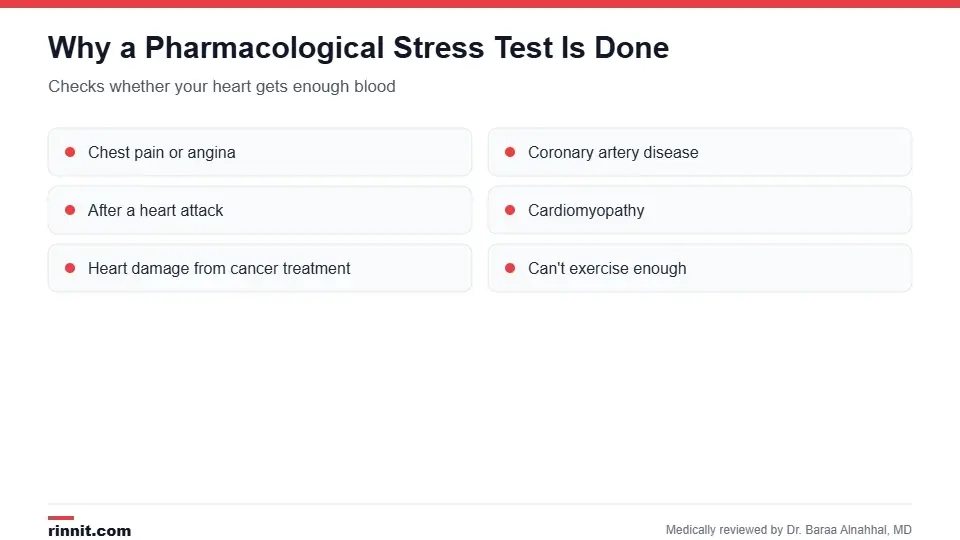
The test checks whether your heart gets enough blood.
Check for angina or coronary artery disease.
Look for heart damage after a recent heart attack.
Evaluate cardiomyopathy or heart damage from chemotherapy or radiation.
Plan treatment, such as a stent or bypass surgery. Sources: [1]
Stress medicines used
Medicine | How it works | Common side effects |
Regadenoson or adenosine | Widens heart arteries | Flushing, chest pressure, shortness of breath, headache |
Dobutamine | Makes the heart beat faster and harder | Fast heartbeat, palpitations |
Sources: [1]
How to prepare
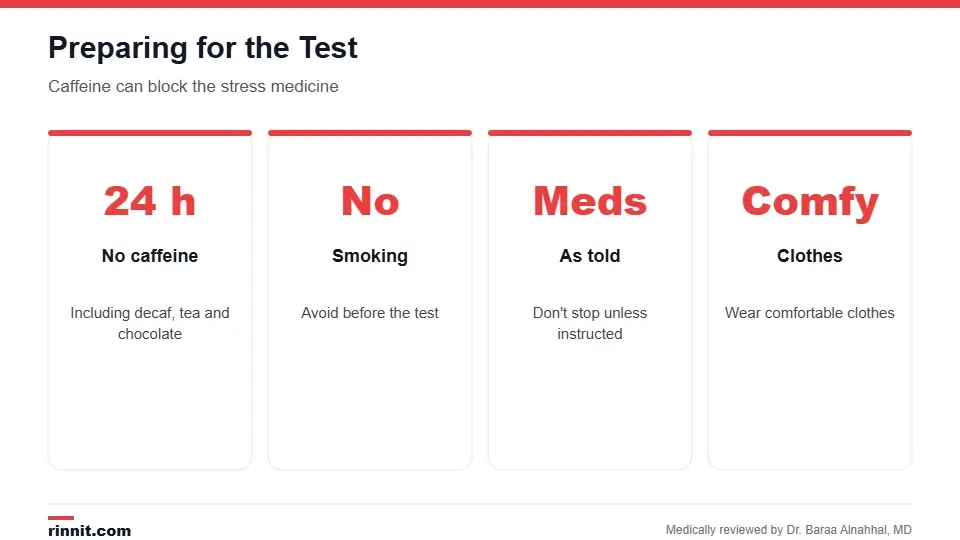
Caffeine can block the stress medicine.
Avoid caffeine for 24 hours, including coffee, tea, soda, chocolate and decaf products.
Don't smoke before the test.
Follow your provider's instructions about medicines; don't stop any unless told. Tell your provider if you have asthma, COPD or a heart rhythm problem such as heart block, because adenosine or regadenoson may not be safe for you and another medicine may be used instead.
Wear comfortable clothes and shoes. Sources: [1]
What happens during the test
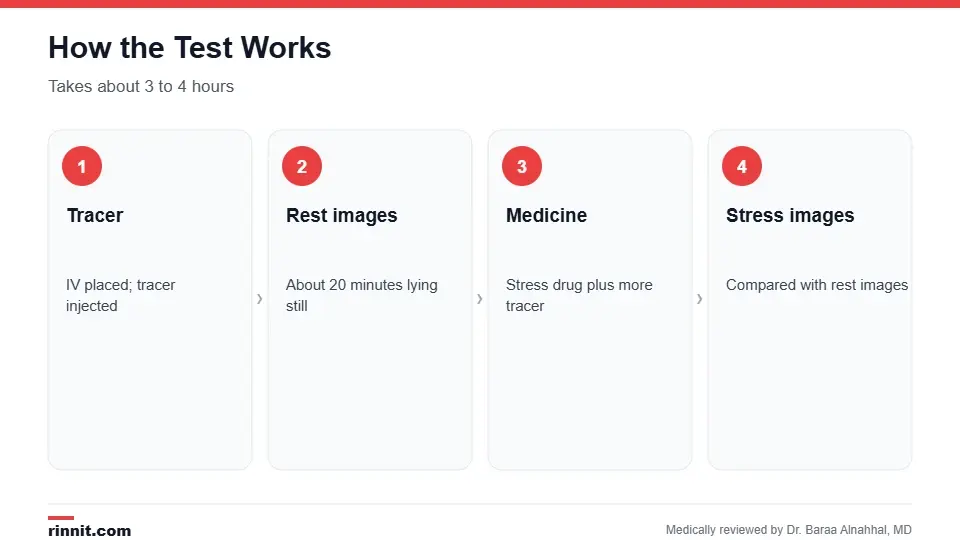
The test takes about 3 to 4 hours.
An IV is placed and a small amount of tracer is injected.
About 30 minutes later, you lie still for about 20 minutes while resting pictures are taken.
The stress medicine is given through the IV while your heart rhythm and blood pressure are monitored, and more tracer is injected.
About 30 minutes later, stress pictures are taken.
You stay until your heart rate returns to normal. Sources: [1]
Side effects and safety
The medicines can cause headache, flushing, a fast heartbeat, chest pain, dizziness, low blood pressure, nausea or shortness of breath; these usually fade quickly. The tracer leaves your body over time, so drink extra water and avoid holding babies or small children for the rest of the day. Tell your care team about any heart rhythm changes. Sources: [1]
Results
The images show whether blood flow is normal at rest and under stress. A normal test means low risk. Reduced flow only under stress suggests a narrowed artery, while reduced flow at both times may mean scar tissue from a past heart attack. Results guide next steps, such as medicine, a coronary angiogram or a procedure to restore blood flow. Sources: [1, 2, 3]
Conclusion
A pharmacological nuclear stress test lets people who can't exercise still get a reliable check of their heart's blood flow. With simple preparation, especially avoiding caffeine, it gives clear information to guide care.
Keep learning: read about the nuclear stress test and the exercise stress test.
Frequently asked questions
What is a pharmacological nuclear stress test?
A heart blood flow test that uses medicine instead of exercise.
Why can't I have caffeine?
Caffeine can block the stress medicine and affect the results.
How long before should I avoid caffeine?
24 hours, including decaf.
How long does the test take?
About 3 to 4 hours, sometimes over 2 days.
Which medicines are used?
Regadenoson, adenosine or dobutamine.
What does the medicine feel like?
You may feel flushing, chest pressure or a fast heartbeat briefly.
Is the radiation safe?
Yes. The dose is low and leaves your body over time.
Should I avoid children afterward?
Avoid holding babies and small children for the rest of the day.
Can I take my regular medicines?
Follow your provider's instructions; don't stop any unless told.
What happens if results are abnormal?
You may need an angiogram or treatment to restore blood flow.
Related Reading
Nuclear Stress Test: How It Works, How to Prepare and What Results Mean the exercise version of this test.
Exercise Stress Test: Why It's Done, How to Prepare, What Happens and Results a treadmill test without a tracer.
Cardiac MRI Adenosine Stress Test: Prep, Side Effects and Results a stress test that uses MRI.
Coronary Artery Disease: Symptoms, Causes, Diagnosis, Treatment and Prevention — What You Need to Know the main condition this test looks for.
SPECT Scan: How It Works, What It Shows and What to Expect the imaging used in many nuclear stress tests.
References
Cleveland Clinic. Pharmacological Nuclear Stress Test. Cleveland Clinic. Last updated September 28, 2022. https://my.clevelandclinic.org/health/diagnostics/17364-pharmacological-nuclear-stress-test
Iskandrian AE, Bateman TM, Belardinelli L, et al. Adenosine versus regadenoson comparative evaluation in myocardial perfusion imaging: results of the ADVANCE phase 3 multicenter international trial. Journal of Nuclear Cardiology. 2007;14(5):645-658. PMID 17826318. https://doi.org/10.1016/j.nuclcard.2007.06.114
Cerqueira MD, Nguyen P, Staehr P, et al. Effects of age, gender, obesity, and diabetes on the efficacy and safety of the selective A2A agonist regadenoson versus adenosine in myocardial perfusion imaging integrated ADVANCE-MPI trial results. JACC: Cardiovascular Imaging. 2008;1(3):307-316. PMID 19356442. https://doi.org/10.1016/j.jcmg.2008.02.003
Medical disclaimer
This article is for general education only and does not replace advice from a qualified healthcare professional. Talk to your doctor about your own diagnosis and treatment, and seek emergency care right away for severe or sudden symptoms.



Comments