SPECT Scan: How It Works, What It Shows and What to Expect

Updated: 2 days ago
Written and medically reviewed by Dr. Baraa Alnahhal, MD · Last reviewed: November 2026 · How we review
Quick Answer
A SPECT scan (single-photon emission computed tomography) is a nuclear medicine test that creates 3D images showing how organs work, not just how they look. A small amount of radiotracer is injected into a vein, and a gamma camera rotates around you. It's most often used for the heart, brain and bones. A scan takes about 30 minutes.
What the research says
Heart SPECT is specific but can miss disease in some patients: a meta-analysis of 18 studies with 3,265 people who already had coronary artery disease found SPECT detected significant blockages with 63% sensitivity and 66% specificity, while CT angiography and cardiac MRI were more sensitive (91–95%) (Jukema RA et al., Heart, 2024) [2]
Brain SPECT often changes care in movement disorders: a meta-analysis of DaTscan, a brain SPECT test of dopamine nerve cells, in people with suspected parkinsonism found the scan changed management in 54% of patients and changed the diagnosis in 31% (Bega D et al., NPJ Parkinson's Disease, 2021) [3]
Key takeaways
Shows organ function and blood flow in 3D using a radiotracer and gamma camera.
Most common for the heart, brain and bones, but can image almost any area.
The tracer is usually injected; the radiation dose is low, though higher than a regular X-ray, and the tracer leaves the body within 24 hours.
A scan takes about 30 minutes; normal activities resume right away.
Not recommended during pregnancy or breastfeeding; results take about a week.
What is a SPECT scan?
SPECT is a type of nuclear medicine imaging. A radiotracer, a substance that gives off small amounts of radiation, collects in tissues according to how active they are or how much blood reaches them. The gamma camera detects this signal from many angles, and a computer builds 3D images. Unlike a CT scan or MRI, which mainly show structure, SPECT shows physiology: how organs are working. Many scanners combine SPECT and CT for both types of information at once. Sources: [1]
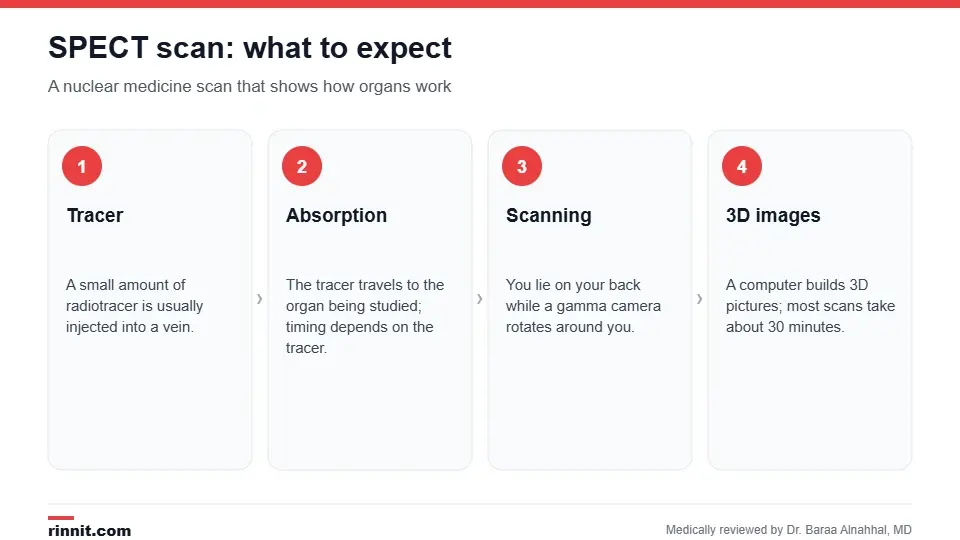
A SPECT scan usually takes about 30 minutes.
Why is it done?
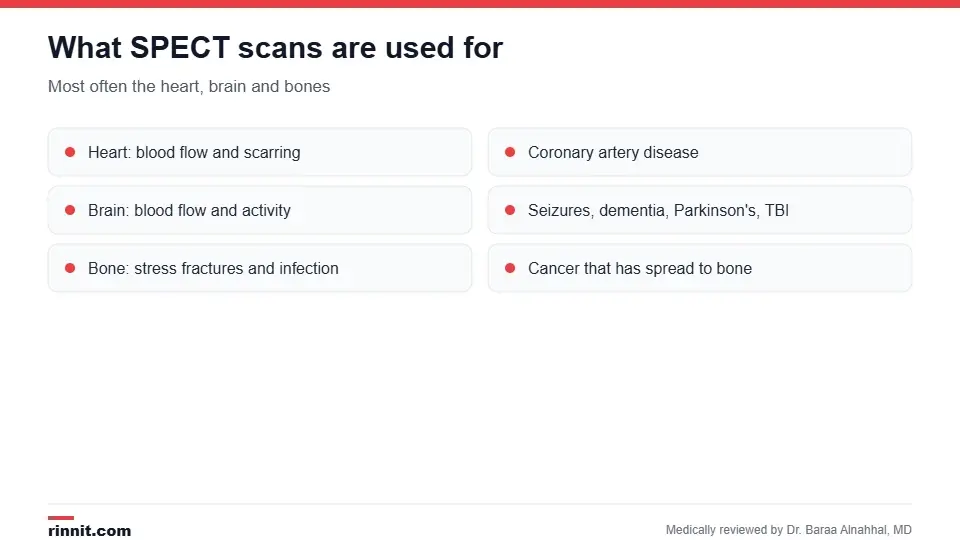
SPECT is most often used for the heart, brain and bones.
Heart: to show blood flow to the heart muscle, find scar tissue from a heart attack, diagnose coronary artery disease and check recovery after bypass surgery or other procedures. It's the imaging used in many nuclear stress tests.
Brain: to show changes in blood flow and activity in epilepsy and seizures, Alzheimer's disease and other dementias, Parkinson's disease, stroke and traumatic brain injury.
Bones: to detect stress fractures, bone infections and cancer that started in or spread to bone, which other imaging may miss. Sources: [1]
How do I prepare?
Wear comfortable clothing and leave jewelry and other metal at home.
Follow specific instructions, which depend on the tracer and the organ being studied; heart scans may involve avoiding caffeine or certain medicines.
Tell your provider if you are or might be pregnant, are breastfeeding or have had a reaction to a tracer. Sources: [1]
The tracer is usually injected at your appointment, but sometimes hours or days before the scan. Sources: [1]
What happens during the scan?
You receive the radiotracer, usually through an IV; occasionally it's swallowed or inhaled.
You wait while the tracer is absorbed by the target organ.
You lie on your back on a table while the gamma camera rotates around you; stay as still as possible.
A computer turns the data into 3D images. Sources: [1]
The scan itself usually takes about 30 minutes, longer if several areas are imaged. You can return to your normal activities right away. Sources: [1]
SPECT vs other imaging
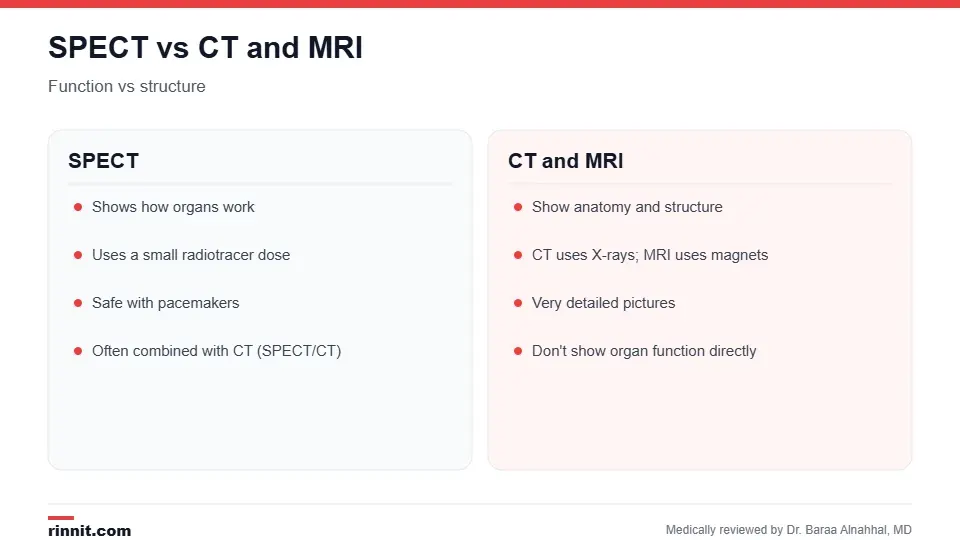
SPECT and CT are often combined.
CT and MRI show the size and shape of structures in fine detail; SPECT shows how they function. A PET scan is another nuclear medicine test that also shows function, using different tracers. SPECT is safe for people with pacemakers and other implanted heart devices. Sources: [1, 2]
Risks
The radiation exposure is low, though higher than a regular X-ray and varying with the tracer used, and the tracer leaves the body within 24 hours. SPECT isn't recommended if you're pregnant or breastfeeding. Allergic reactions to radiotracers are rare. Sources: [1]
Understanding your results
A radiologist or nuclear medicine specialist interprets the images and sends a report to your provider, usually within about a week. Areas with less tracer may mean reduced blood flow or activity; areas with more tracer may mean increased activity, such as healing bone or a seizure focus. Your provider explains what this means and any next steps. Sources: [1, 3]
Conclusion
A SPECT scan adds something other imaging can't: a picture of how your organs are working. It's safe, takes about half an hour and helps guide care for heart disease, brain conditions and bone problems. Follow the preparation instructions for your specific tracer, especially for heart scans.
Keep learning: read about the nuclear stress test and the bone scan.
Frequently asked questions
What does SPECT stand for?
Single-photon emission computed tomography.
What is a SPECT scan used for?
Mainly to check blood flow and function in the heart, brain and bones.
How long does a SPECT scan take?
About 30 minutes, longer if more areas are scanned.
Is a SPECT scan safe?
Yes. The radiation dose is low, though higher than a regular X-ray.
How long does the tracer stay in the body?
It leaves within about 24 hours.
Is SPECT the same as PET?
No. Both show function, but they use different tracers and cameras.
Can I have a SPECT scan with a pacemaker?
Yes. SPECT is safe with pacemakers and other implanted heart devices.
Can I have SPECT while pregnant?
It's generally not recommended during pregnancy or breastfeeding.
Does a SPECT scan hurt?
No. You may feel a small pinch when the IV is placed.
When will I get results?
Usually within about a week.
Related Reading
Cardiac PYP Scan: Testing for ATTR Cardiac Amyloidosis explains the nuclear scan used to diagnose ATTR cardiac amyloidosis.
Liver-Spleen Scan: Nuclear Imaging of Liver and Spleen Function explains the nuclear scan that shows liver and spleen function.
Pharmacological Nuclear Stress Test: Heart Imaging Without Exercise explains the medicine-based nuclear stress test for people who can't exercise.
Parathyroid Scan (Sestamibi): Finding Overactive Glands Before Surgery explains the scan that finds overactive parathyroid glands before surgery.
Nuclear Medicine Imaging: How Tracer Scans Work, Safety and Results explains how tracer-based scans show how organs work.
Nuclear Stress Test: How It Works, How to Prepare and What Results Mean a heart test that commonly uses SPECT imaging.
PET Scan: Uses, Preparation, What to Expect and Results another nuclear medicine scan that shows organ function.
Epilepsy: Seizures, Symptoms, Causes, and Treatment seizures that brain SPECT can help locate.
Alzheimer's Disease: Symptoms, Causes, Treatment & Complete Guide a dementia where SPECT can show blood flow changes.
Bone Scan: What It Shows, How It's Done, Results and Risks a nuclear medicine scan of the skeleton.
Cardiac PET Scan: Heart Blood Flow Imaging, Prep and Results explains the nuclear scan that shows blood flow to the heart muscle.
References
Cleveland Clinic. SPECT Scan: What It Is, Purpose, Procedure, Results & Risks. Cleveland Clinic. Last updated September 21, 2023. https://my.clevelandclinic.org/health/diagnostics/spect-scan
Jukema RA, Dahdal J, Kooijman EM, et al. Diagnostic accuracy of non-invasive cardiac imaging modalities in patients with a history of coronary artery disease: a meta-analysis. Heart. 2024;111(1):4-10. PMID 39179368. https://doi.org/10.1136/heartjnl-2024-324248
Bega D, Kuo PH, Chalkidou A, et al. Clinical utility of DaTscan in patients with suspected Parkinsonian syndrome: a systematic review and meta-analysis. NPJ Parkinsons Dis. 2021;7(1):43. PMID 34031400. https://doi.org/10.1038/s41531-021-00185-8
Medical disclaimer
This article is for general education only and does not replace advice from a qualified healthcare professional. Talk to your doctor about your own diagnosis and treatment, and seek emergency care right away for severe or sudden symptoms.



Comments