Bone Scan: What It Shows, How It's Done, Results and Risks

Updated: 2 days ago
Written and medically reviewed by Dr. Baraa Alnahhal, MD · Last reviewed: November 2026 · How we review
Quick Answer: What is a bone scan?
A bone scan is a nuclear medicine test that checks the bones for damage or unusual activity. A small amount of radioactive tracer is injected into a vein, collects in areas of changing bone and shows up as bright hot spots on images. It's used most often to check whether cancer has spread to the bones.
What the research says
A bone scan finds most bone metastases, but PET/CT is more accurate. In a meta-analysis of 13 studies with 892 breast cancer patients, bone scintigraphy had a sensitivity of 82% and a specificity of 81% for bone metastases, compared with 91% and 98% for FDG PET/CT. (Wang et al., Current Medicinal Chemistry, 2026) [2]
In prostate cancer, newer PSMA PET scans outperform bone scans. Across 67 studies with 7,637 patients whose prostate cancer had come back after treatment, PSMA PET detected bone metastases with an accuracy of 0.95, compared with 0.80 for a bone scan, 0.81 for CT and 0.85 for MRI. (Zhang et al., Academic Radiology, 2025) [3]
Key takeaways
A bone scan uses an injected radiotracer and a gamma camera to find areas of unusual bone activity. [1]
It is mainly ordered to check whether cancer has spread to the bones, and it can also help find fractures, infection and other bone diseases. [1]
You wait one to four hours after the injection, then the scan takes 30 to 60 minutes. [1]
The radiation dose is very small, and most people have no side effects. [1]
Hot spots show where something is happening, but not why, so abnormal results often lead to more tests. [1]
What is a bone scan?
A whole-body bone scan is a nuclear medicine imaging test. A technologist injects a radiotracer, a substance with a small amount of radioactive material, into a vein. The tracer gathers in bone that is breaking down or rebuilding faster than normal, and a gamma camera turns that activity into images. [1]
A bone scan is not the same as a DEXA scan, which is an X-ray that measures bone density, and it differs from an MRI, which uses magnets and radio waves to make 3D pictures. A bone scan produces 2D images of bone activity. [1]
Why is a bone scan done?

What a bone scan can help detect.
Providers usually order a bone scan to check whether cancer has spread to the bones (bone metastasis), and sometimes to help stage a cancer. Along with other tests, it can also help diagnose: [1]
Bone cancer [1]
Bone fractures, including ones that are hard to see on X-ray [1]
Bone infection (osteomyelitis) [1]
Paget's disease of bone and fibrous dysplasia [1]
Osteoarthritis and unexplained bone pain [1]
How do you prepare for a bone scan?
Most people can eat, drink and take their usual medicines unless told otherwise. [1]
Remove metal objects such as jewelry and belts with metal buckles. [1]
Tell your provider about any joint implant, dental implant or pacemaker. [1]
Tell your provider if you are pregnant, might be pregnant or are breastfeeding; the scan is not considered safe in those situations. [1]
What happens during a bone scan?

The bone scan process from injection to results.
A technologist injects the radiotracer into a vein in your arm. You will not feel it travel through your body. [1]
You wait one to four hours while the tracer reaches your bones. You may be asked to drink several glasses of water and urinate often to flush out tracer your bones do not absorb. [1]
You lie on your back on an exam table while a large gamma camera moves over your body and takes images. [1]
You may be asked to hold your breath for a few seconds or change position so the camera can capture several angles. [1]
Bone scan at a glance
Item | Typical detail |
Tracer wait | One to four hours |
Scan time | 30 to 60 minutes |
Total visit | Several hours |
Pain | Only a small sting from the injection |
Results | Usually within one to two weeks |
Sources: [1]
What are the risks of a bone scan?
The tracer dose is very small, and the scan is considered safe for most people. Most have no side effects beyond a minor sting at the injection site; some get mild bruising or swelling that clears within a few days. For about 24 hours, stay an arm's length away from babies, children and pregnant people. [1]
What happens after a bone scan?
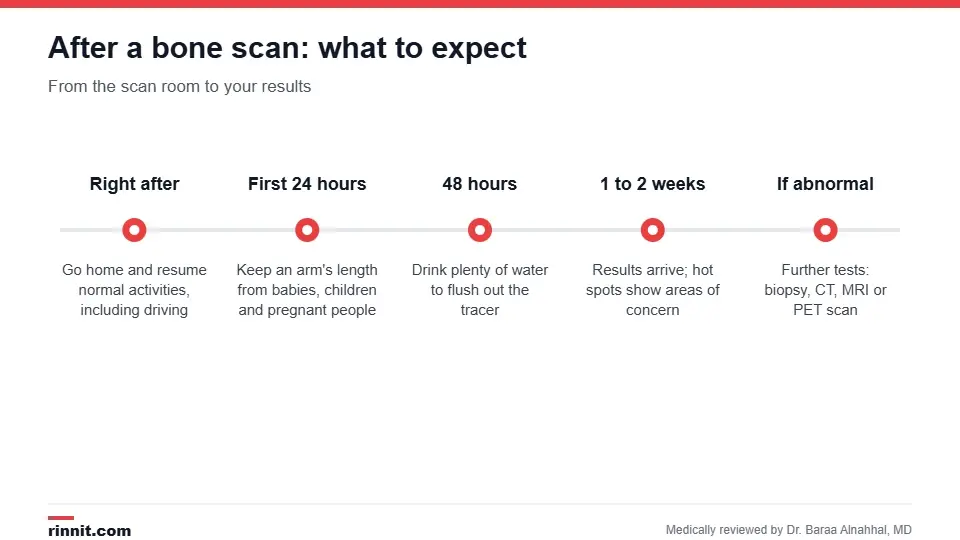
What to expect after the scan.
You can go home and return to normal activities right away, including driving. Your provider may suggest drinking plenty of water for 48 hours to flush out the tracer. [1]
What do bone scan results mean?
Results show "hot spots," areas where the tracer has collected because bone activity is higher than normal. These point to areas of concern but do not reveal the cause. Results usually take one to two weeks. If the scan is abnormal, you may need a biopsy, CT scan, MRI or PET scan. [1]
Research helps explain why: a bone scan picks up about 8 in 10 bone metastases in breast cancer, while PET/CT finds more and gives fewer false alarms, [2] and in prostate cancer PSMA PET is more accurate than a bone scan. [3] Your care team chooses the test that fits your situation.
When should you call a doctor?
Contact your provider if swelling or bruising at the injection site gets worse instead of better, or if you have not received your results within two weeks.
Conclusion
A bone scan is a safe, painless way to spot areas of unusual bone activity across your whole skeleton. It is most often used to check for cancer spread, but it also helps find fractures, infections and other bone diseases. [1]
Plan for several hours at the imaging center, drink water afterward and remember that a hot spot shows where a problem is, not what it is. Your provider will explain what further tests, if any, come next. [1]
Keep learning: Read our guide to bone metastasis to understand the condition bone scans are most often used to detect.
Frequently asked questions
What is a bone scan?
A nuclear medicine test that uses an injected radiotracer and a gamma camera to find areas of unusual bone activity.
What does a bone scan show?
It shows hot spots of increased bone activity, such as cancer spread, fractures, infection or arthritis, but not the cause.
How long does a bone scan take?
The scan takes 30 to 60 minutes, but you wait one to four hours first for the tracer to reach your bones.
Does a bone scan hurt?
No. The only discomfort is a small sting when the tracer is injected.
Is a bone scan safe?
Yes for most people. The radiation dose is very small, but it is not considered safe during pregnancy or breastfeeding.
How do I prepare for a bone scan?
Eat and take medicines as usual unless told otherwise, remove metal objects and tell your provider about implants or a pacemaker.
What is the difference between a bone scan and a DEXA scan?
A DEXA scan is an X-ray that measures bone density. A bone scan uses a radiotracer to show bone activity.
What happens after a bone scan?
You can resume normal activities right away and should drink plenty of water for 48 hours.
When will I get bone scan results?
Usually within one to two weeks.
What if my bone scan is abnormal?
Your provider may order a biopsy, CT scan, MRI or PET scan to find the cause of the hot spots.
Related Reading
Nuclear Medicine Imaging: How Tracer Scans Work, Safety and Results explains how tracer-based scans show how organs work.
Gallium Scan: What It Shows, How It Works and What to Expect explains the nuclear scan that can find hidden infection, inflammation and some cancers.
Bone Metastasis: Symptoms, Causes, and Treatment explains cancer that has spread to the bones, the main reason bone scans are ordered.
Bone Cancer: Symptoms, Causes, and Treatment covers cancers that start in bone.
Osteomyelitis: Symptoms, Causes, and Treatment describes bone infection, which a bone scan can help find.
Paget's Disease of Bone: Symptoms, Causes, and Treatment — A Guide for Adults Over 50 explains a bone disease that shows up on bone scans.
DEXA Scan (DXA Bone Density Test): Uses, Prep, Results and T-Scores covers the bone density X-ray that is often confused with a bone scan.
SPECT Scan: How It Works, What It Shows and What to Expect explains the nuclear medicine scan that shows how the heart, brain and bones work.
References
Cleveland Clinic. Bone Scan: What It Can Show. Cleveland Clinic. Last updated October 19, 2023. https://my.clevelandclinic.org/health/diagnostics/17642-whole-body-bone-scan
Wang X, Xu Y, Jing J, et al. [18F]FDG PET/CT vs Bone Scintigraphy for the Diagnosis of Bone Metastasis in Breast Cancer: A Systematic Review and Meta-Analysis. Curr Med Chem. 2026;33(26):5433-5451. PMID 40947711. https://doi.org/10.2174/0109298673374240250812022451
Zhang H, Xie C, Huang C, et al. Comparison of Prostate-Specific Membrane Antigen Positron Emission Tomography and Conventional Imaging Modalities in the Detection of Biochemical Recurrence of Prostate Cancer and Assessment of the Role of Artificial Intelligence: A Systematic Review and Meta-analysis. Acad Radiol. 2025;32(12):7260-7280. PMID 40976756. https://doi.org/10.1016/j.acra.2025.09.004
Medical disclaimer
This article is for general education only and does not replace advice from a qualified healthcare professional. Talk to your doctor about your own diagnosis and treatment, and seek emergency care right away for severe or sudden symptoms.



Comments