DEXA Scan (DXA Bone Density Test): Uses, Prep, Results and T-Scores

Updated: 6 days ago
Written and medically reviewed by Dr. Baraa Alnahhal, MD · Last reviewed: November 2026 · How we review
Quick Answer: What is a DEXA (DXA) scan?
A DXA scan, often still called a DEXA scan, is a quick, painless imaging test that uses two low-level X-ray beams to measure how dense your bones are. It usually checks the hips and spine, and it helps diagnose osteoporosis and osteopenia, estimate fracture risk and track whether bone treatment is working [1].
What the research says
Low bone density on DXA strongly predicts hip fracture. A meta-analysis of 307,205 men and women from 53 cohorts found that each standard-deviation drop in femoral neck bone density raised hip fracture risk about 2.6-fold in women and 2.7-fold in men at age 65, and 92% of hip fractures in women occurred in those with low bone mass or osteoporosis at the start. (Kanis et al., Osteoporosis International, 2026) [3]
Screening older, higher-risk women lowers hip fractures. A systematic review for the US Preventive Services Task Force pooled 3 trials with 42,009 participants and found screening programs that used fracture-risk tools plus bone density testing cut hip fractures by 17% (relative risk 0.83), or 5 to 6 fewer fractures per 1,000 people screened. (Kahwati et al., JAMA, 2025) [4]
Treating a low T-score can prevent fractures. A Cochrane review of postmenopausal women at higher risk, including those with a T-score of -2.5 or lower, found alendronate probably reduced clinical spine fractures by about 55% (relative risk 0.45) and may have roughly halved hip fractures (relative risk 0.49) compared with placebo. (Wells et al., Cochrane Database of Systematic Reviews, 2025) [5]
Key takeaways
A DXA scan measures bone mineral density, most often at the hips and spine, using two low-dose X-ray beams [1].
It is the main test used to diagnose osteoporosis and osteopenia and to judge your risk of breaking a bone [1].
Preparation is simple: eat and take your usual medicines, but skip calcium and over-the-counter vitamin supplements for 24 hours beforehand [1].
The scan is painless, needle-free and takes about 30 minutes [1].
Results come as a T-score: 0 to -1 is healthy, -1 to -2.5 is osteopenia, and -2.5 or lower is osteoporosis [1].
Pregnant people should not have the test because of the radiation, even though the dose is very low [1].
What is a DXA scan and how does it work?
DXA stands for dual-energy X-ray absorptiometry. It is an imaging test that uses X-rays to measure the density, or mineral content, of your bones [1].
You may also hear it called a bone density scan or bone density test. The older abbreviation, DEXA, is no longer used by many providers, although people still often search for the test by that name [1].
The results help your provider decide whether your bones are healthy, thinner than usual or weak enough to raise your fracture risk [1].
The scanner uses two types of low-level radiation, which is where the "dual-energy" part of the name comes from. As the scanning arm passes over you, the machine uses these beams to measure your bone mineral density [1].
The hips and spine are the usual sites, and the forearm or other bones are sometimes scanned as well [1]. The hip and spine are chosen because they are the bones most likely to break when bone is weak [2].
What is a DXA scan used for?
Healthcare providers order a bone density test for several reasons [1]:
To diagnose osteoporosis (weakened bones) and osteopenia (bone density lower than usual)
To estimate your risk of a future fracture
To track bone loss over time
To check your bones before you start a medication that can weaken them
To see whether osteoporosis treatment is working
Repeat scans let your provider compare results over time and see whether your bone density is holding steady or dropping [1, 2].
What is the difference between a DXA scan and a whole-body bone scan?
They are different tests. A whole-body bone scan looks for problems such as infections, bone lesions or cancer that has spread to the bones, while a DXA scan only measures bone density [1].
Who should get a bone density test?
Your provider may recommend a DXA scan based on your age, sex and personal risk factors. The table below lists the groups most commonly advised to have one [1].
Group | Reason for testing |
Females 65 and older | Age-based screening |
Males 70 and older | Age-based screening |
Adults over 50 | A previous broken bone |
Family history | Biological parents or grandparents had osteoporosis |
Height loss | Lost 1.5 inches or more of height |
Sources: [1]
Younger people can need testing too if they have a higher chance of bone loss [1]. Risk factors include:
Autoimmune diseases
Smoking or other tobacco use
Heavy alcohol use
Vitamin D deficiency
Long-term use of corticosteroids, immunosuppressants, hormone suppressants, certain cancer drugs, some seizure medicines, proton pump inhibitors or heparin

These groups are the ones a provider is most likely to refer for a first scan.
How do you prepare for a DXA scan?
Most people do not need to change their daily routine before the test [1].
Eat and drink normally. You can also take your regular prescription medicines unless your provider says otherwise.
Pause supplements. Stop calcium and other over-the-counter vitamin supplements for 24 hours before the scan, and tell your provider which supplements you use.
Check your imaging schedule. Do not book the scan within 24 hours of certain other imaging tests; ask the scheduling team if you have another scan planned.
Dress simply. Wear loose, comfortable clothes without metal zippers, buttons or buckles, or plan to change into a gown.
Leave jewelry at home. You will be asked to remove metal items before the scan.
Mention pregnancy. Tell your provider if you are or might be pregnant.
These steps help the machine read your bones clearly [1].
What happens during a DXA scan?
A bone density test is done as an outpatient visit, so you go home the same day [1].
You lie on an X-ray table.
A technician positions your body, sometimes using foam blocks to hold your legs or hips in the right place.
A scanning arm passes over the part of your body being measured.
The technician may reposition you to scan another site, such as your forearm.
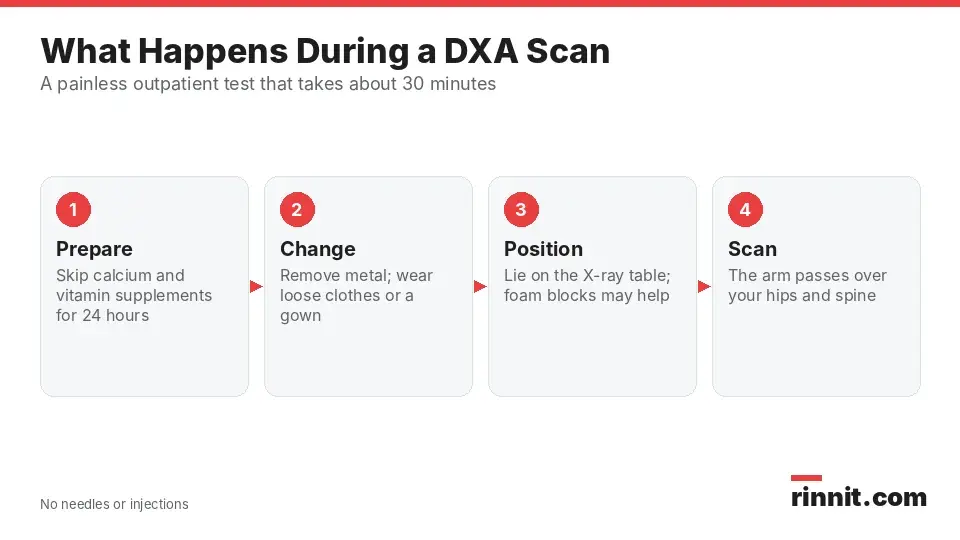
The number of positions depends on how many bones your provider wants measured.
Does a DXA scan hurt?
No. The test uses no needles or injections, and you should not feel any pain [1].
How long does a DXA scan take?
The appointment takes about 30 minutes. The exact time depends on how many bones are scanned [1].
What do DXA scan results mean?
Your results are usually reported as a T-score. This number compares your bone density with that of a healthy young adult in their 20s or 30s [1]. The lower the T-score, the higher your risk of a fracture [2].
T-score | What it means |
0 to -1 | Healthy bone density |
-1 to -2.5 | Osteopenia: lower than usual, with a higher risk of osteoporosis |
-2.5 or lower | Osteoporosis: weakened bones with a higher fracture risk |
Sources: [1]
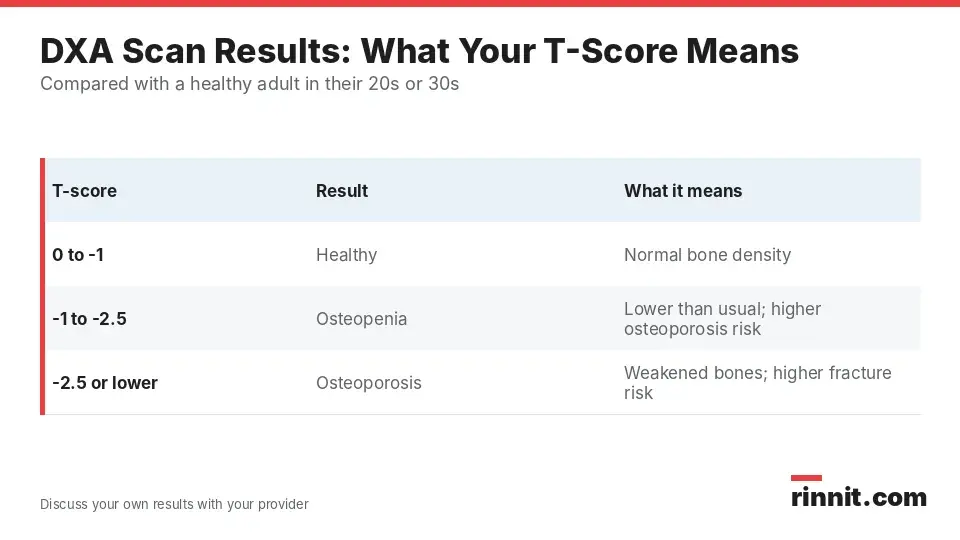
A T-score is read as a range, so ask your provider where your number falls and what it means for you.
What is a Z-score?
Some reports also include a Z-score. It compares your bone density with the average for healthy people of your own age, ethnicity and sex rather than with a young adult [2].
Score | Compared with | Commonly used for |
T-score | A healthy young adult | Women after menopause and men 50 or older |
Z-score | Healthy people your age, ethnicity and sex | Premenopausal women, men under 50 and children |
Sources: [2]
Your provider will explain what your Z-score means alongside your age and health history [2].
What happens if my bone density is low?
If your bones are less dense than expected, your provider may suggest [1]:
More exercise, such as walking, yoga or strength training
Vitamin D or calcium supplements
Changes to your diet
Medication to slow bone loss or strengthen bone
How accurate is a DXA scan?
A DXA scan is the standard tool for measuring bone density, and low results are closely linked to future fractures, especially of the hip [3]. Results can differ slightly between scanners made by different manufacturers, but this usually is not a concern [1].
What are the risks of a DXA scan?
The test has very few drawbacks. You should not have pain or side effects [1].
The scan does use radiation, but the dose is very low. Because radiation should be avoided during pregnancy, pregnant people should not have a DXA scan [1].
When should you call your doctor?
Talk to your provider about a DXA scan if you are in one of the groups above, have broken a bone after age 50, or have lost 1.5 inches or more of height [1]. Ask for a follow-up visit to review your T-score and plan next steps, including when to repeat the test [2].
How often should you have a bone density test?
There is no single schedule for everyone. How often you need a scan depends on your age, family history and other risk factors [1].
People with a family history of osteoporosis may need screening more often. Everyone should have their bone health checked as they get older [1].
Conclusion
A DXA scan is a fast, painless way to measure how strong your bones are. It is the main test for finding osteoporosis and osteopenia before a fracture happens and for checking whether treatment is helping [1].
Most people need little preparation beyond pausing calcium and vitamin supplements for a day. Your T-score shows whether your bone density is healthy, low or in the osteoporosis range, and your provider can use it to guide exercise, diet, supplements or medication [1].
Keep learning: Read our guide to Osteoporosis: Causes, Symptoms, Diagnosis and Treatment Explained and learn how weak bones lead to a Hip Fracture: Symptoms, Causes, and Treatment.
FAQ
What is a DEXA scan?
A DEXA or DXA scan is an imaging test that uses two low-level X-ray beams to measure your bone mineral density. It is the standard test for diagnosing osteoporosis and osteopenia [1].
Why would a doctor order a bone density test?
A provider may order it to diagnose osteoporosis or osteopenia, estimate your fracture risk, track bone loss, check your bones before certain medicines or see if treatment is working [1].
Who should have a DXA scan?
Females 65 and older, males 70 and older, adults over 50 who have broken a bone, people with a family history of osteoporosis and anyone who has lost 1.5 inches or more of height are common candidates [1].
How do I prepare for a DXA scan?
You can eat, drink and take your usual medicines. Skip calcium and over-the-counter vitamin supplements for 24 hours, and wear clothes without metal [1].
Does a bone density scan hurt?
No. There are no needles or injections, and you simply lie still on a table while the scanner passes over you [1].
How long does a DXA scan take?
It takes about 30 minutes, depending on how many bones are scanned [1].
What is a normal T-score?
A T-score between 0 and -1 means healthy bone density. A score from -1 to -2.5 points to osteopenia, and -2.5 or lower means osteoporosis [1].
What is the difference between a T-score and a Z-score?
A T-score compares your bones with a healthy young adult's, while a Z-score compares them with people your own age, ethnicity and sex. Z-scores are often used for children, premenopausal women and men under 50 [2].
Is a DXA scan safe?
Yes, for most people. It uses a very low dose of radiation and causes no side effects, but it is not done during pregnancy [1].
How often should I get a bone density test?
It depends on your age, family history and other risk factors. Your provider will suggest a schedule, and people with a family history of osteoporosis may need testing more often [1].
Related Reading
Bisphosphonates: Uses, Types and Side Effects explains bisphosphonate medicines for osteoporosis.
Osteoporosis: Causes, Symptoms, Diagnosis and Treatment Explained explains the bone-thinning disease that a DXA scan is most often used to diagnose and monitor.
Hip Fracture: Symptoms, Causes, and Treatment covers the type of break that low bone density on a DXA scan most strongly predicts.
What Is a Compression Fracture? Symptoms, Causes, Treatment & Outlook Explained explains spinal bone collapse, a common reason for height loss that can prompt bone density testing.
Rheumatoid Arthritis — Symptoms, Causes, Diagnosis, Treatment & Complete Guide covers an autoimmune disease that, along with steroid treatment, can raise the risk of bone loss.
Bone Scan: What It Shows, How It's Done, Results and Risks explains the nuclear medicine scan that finds cancer spread, fractures and infection in bone.
References
Cleveland Clinic. DXA Scan (Bone Density Test): What Is It & How It's Done. Cleveland Clinic. Last updated May 28, 2024. https://my.clevelandclinic.org/health/diagnostics/10683-dexa-dxa-scan-bone-density-test
National Institute of Arthritis and Musculoskeletal and Skin Diseases. Bone Mineral Density Tests: What the Numbers Mean. NIAMS. Accessed November 6, 2026. https://www.niams.nih.gov/health-topics/bone-mineral-density-tests-what-numbers-mean
Kanis JA, McCloskey EV, Johansson H, et al. Predictive value of BMD for hip and other fractures: a meta-analysis to update FRAX. Osteoporos Int. 2026;37(5):1067-1085. PMID 41820630. https://doi.org/10.1007/s00198-026-07925-7
Kahwati LC, Kistler CE, Booth G, et al. Screening for Osteoporosis to Prevent Fractures: A Systematic Evidence Review for the US Preventive Services Task Force. JAMA. 2025;333(6):509-531. PMID 39808441. https://doi.org/10.1001/jama.2024.21653
Wells GA, Hsieh SC, Peterson J, et al. Alendronate for the primary and secondary prevention of osteoporotic fractures in postmenopausal women. Cochrane Database Syst Rev. 2025;1(1):CD001155. PMID 39868546. https://doi.org/10.1002/14651858.CD001155.pub3
Medical disclaimer
This article is for general education only and does not replace advice from a qualified healthcare professional. Talk to your doctor about your own diagnosis and treatment, and seek emergency care right away for severe or sudden symptoms.



Comments